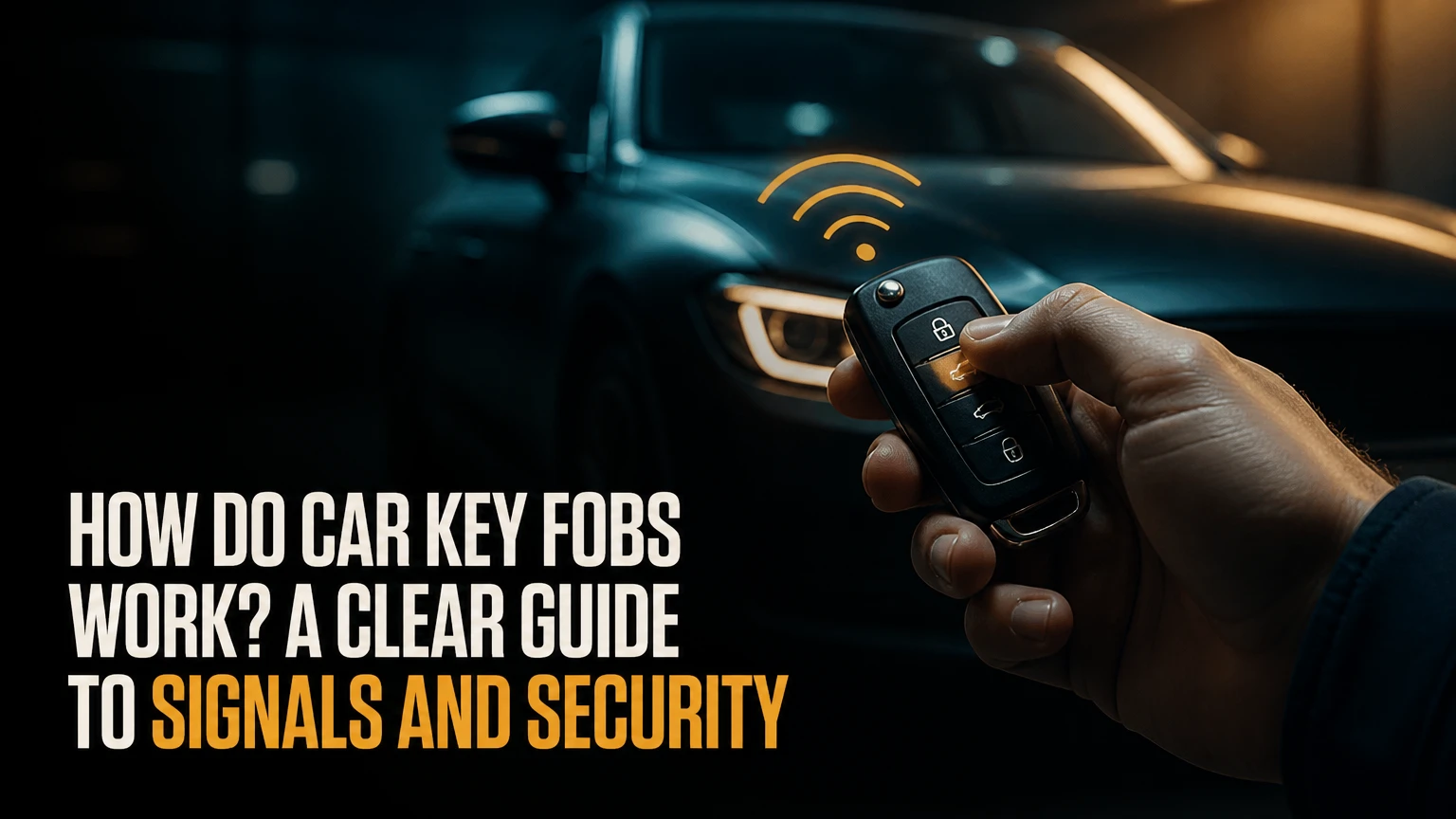
A car key fob is a battery-powered radio transmitter and security credential that communicates with a vehicle’s access and immobilizer systems. When you press a button or approach with a proximity fob, the vehicle validates an encrypted credential, then the Body Control Module commands the locks, alarm, trunk, or start authorization.
Key Facts at a Glance
- A remote key fob usually transmits a short-range coded radio message after a button press.
- A rolling-code system changes the accepted credential so a recorded unlock message cannot normally be reused.
- Door unlocking and engine immobilizer authorization are separate functions, although one physical key may contain both.
- A proximity key normally uses low-frequency vehicle antennas to detect presence and a higher-frequency response from the fob.
- A dead fob battery may still allow starting through a passive transponder or an emergency detection position specified by the vehicle manufacturer.
- A replacement fob must match the vehicle’s model, year, market, radio system, immobilizer system, and programming requirements.
What Is a Car Key Fob?
A car key fob is a small electronic device that identifies an authorized user to a vehicle over a short-range wireless link. Depending on its design, the fob may lock doors, unlock doors, open the trunk, activate a panic alarm, permit keyless starting, or provide an emergency mechanical key.
The word “fob” covers several different systems. A button-operated remote sends a message only when the driver presses a control. A passive transponder may contain no battery at all. A smart key combines passive proximity detection, active radio communication, and an immobilizer credential in one housing.
A fob does not usually operate the lock motor directly. The fob sends data to the vehicle’s radio receiver; the Body Control Module, or BCM, checks that data and sends commands over the vehicle network to door-lock actuators, the alarm module, and sometimes the engine control or immobilizer module.
What a key fob contains
| Component | Typical function | Failure symptom |
|---|---|---|
| Coin-cell battery | Powers active transmission | Short range or no button response |
| Microcontroller | Stores identity and generates messages | No authentication after physical damage |
| RF transmitter | Sends coded radio data | Vehicle never receives command |
| Antenna or antenna trace | Couples energy into the radio field | Range becomes unusually short |
| Tactile button | Selects lock, unlock, trunk, or panic | One command fails while others work |
| Immobilizer transponder | Provides passive start authorization | Engine starts, then immediately stops |
The fob’s circuit board may also contain an LED, battery contacts, capacitors, an accelerometer, or a near-field antenna. The exact layout is manufacturer-specific, so two visually identical fobs can be electronically incompatible.
How Do Car Key Fobs Work in Practice?
Car key fobs work through a five-stage exchange: user input, radio transmission, vehicle reception, credential validation, and physical action. A button remote begins the exchange, while a proximity system begins with the vehicle polling for a nearby credential before the fob replies.
Step 1: The driver creates a request
Pressing the lock button tells the fob’s microcontroller which command to prepare. A smart key may respond automatically when a door-handle sensor detects touch, but the vehicle still needs a valid credential before unlocking.
The fob does not broadcast continuously in ordinary button-operated use. That design conserves battery power and reduces unnecessary radio exposure.
Step 2: The fob prepares a credential
The microcontroller combines a vehicle-specific identity, a command such as unlock, and a changing authentication value. Older systems may use a synchronized rolling counter; newer systems can use stronger challenge-response or cryptographic protocols.
The message is usually encrypted or otherwise authenticated. Encryption hides content, while authentication helps the car determine whether the message came from an authorized device and was not altered.
Step 3: The radio transmitter sends the message
The fob’s antenna converts an electrical signal into a radio-frequency transmission. Many older North American systems use approximately 315 MHz, while many European systems use approximately 433.92 MHz, but frequency is only one compatibility attribute.
The vehicle may also send low-frequency signals around 125 kHz for proximity detection. This distinction matters: a smart key can use one frequency band to wake or locate the fob and another band for the fob’s response.
Step 4: The vehicle validates the message
A receiver passes the message to the BCM or a dedicated keyless-entry module. The vehicle checks the credential, command, counter or challenge value, and sometimes whether the fob is inside or outside the cabin.
A valid door command can unlock the car without authorizing engine operation. Start authorization normally requires a separate immobilizer exchange, because allowing access and allowing propulsion have different security consequences.
Step 5: The vehicle performs the command
After validation, the BCM communicates with door modules and lock actuators through the vehicle’s internal network, often a Controller Area Network connection. The actuator moves the latch, the hazard lamps may flash, and the alarm state changes.
A remote-start command adds more checks. The vehicle may verify that the hood is closed, the transmission is in Park, the brake is not pressed, and an immobilizer condition remains satisfied.
How Does the Car Know the Code Is Valid?
A vehicle recognizes a valid key through synchronized counters, cryptographic authentication, or a passive transponder exchange. The common “rolling code” explanation is broadly accurate for many remote-entry systems, but modern vehicles do not all use the same algorithm, and a code is not literally selected from a fixed pool of billions each time.
A rolling-code system assigns the fob and vehicle related counter states. Each accepted transmission advances the expected state, which prevents an attacker from replaying an old captured unlock message. Some systems permit a tolerance window because a driver can press the button outside radio range several times.
If the fob and car become desynchronized, the vehicle may reject the remote even though the battery is healthy. A manufacturer-specific resynchronization routine can sometimes restore operation, but immobilizer programming generally requires more formal security access.
Bruce Schneier, a widely cited security technologist, summarizes the relevant principle as, “Security is a process, not a product.” A rolling code blocks a basic replay attack, but it does not eliminate relay attacks, stolen keys, weak cryptography, damaged equipment, or unauthorized programming.
Radio technology comparison
| Technology | Typical role | Approximate range or condition | Main limitation |
|---|---|---|---|
| 315 MHz RF | Button remote in many North American vehicles | Commonly 10-50 meters outdoors | Regional and vehicle-specific compatibility |
| 433.92 MHz RF | Button remote in many European vehicles | Commonly 10-50 meters outdoors | Frequency alone does not guarantee pairing |
| 125 kHz LF | Proximity wake-up and cabin localization | Usually roughly 1-2 meters | Short range and antenna placement dependent |
| NFC | Tap-to-start or backup phone credential | A few centimeters | Requires deliberate close contact |
| Bluetooth Low Energy | Phone key and some smart-key links | Commonly several meters | Software, pairing, and battery dependencies |
| Ultra-Wideband | Precise phone or fob ranging | Vehicle and device dependent | Hardware support is required on both ends |
These figures are typical engineering ranges, not universal specifications. Body panels, nearby transmitters, building materials, the fob’s antenna orientation, and local regulations can change performance substantially.
What Types of Car Keys Use Fobs?
Car keys fall into four practical groups: transponder keys, remote-head or switchblade keys, proximity smart keys, and digital keys. The groups overlap because a single molded housing can contain a metal blade, a remote transmitter, and an immobilizer transponder.
Transponder keys
A transponder key has a coded chip in the plastic head or blade assembly. The ignition-area antenna generates an electromagnetic field that powers many passive chips, allowing the immobilizer system to verify the key without a coin-cell battery.
The transponder usually does not unlock the doors by itself. A vehicle can therefore have a working remote battery but a failed start authorization, or a working transponder with a dead remote battery.
Remote-head and switchblade keys
A remote-head key combines a metal ignition blade with lock, unlock, and trunk buttons. A switchblade model folds the blade into a spring-loaded housing, reducing pocket bulk but adding a hinge, release button, and spring that can wear.
This design remains common on vehicles that use a physical ignition cylinder. It is generally less expensive than a proximity smart key because the system does not need continuous presence detection or a push-button start module.
Proximity smart keys
A proximity fob permits passive entry and push-button starting when the car detects an authorized credential nearby. The vehicle’s low-frequency antennas locate the fob around the doors and cabin, then the fob responds with a radio message or participates in a challenge-response exchange.
The car must distinguish “fob outside” from “fob inside.” That distinction prevents a vehicle from starting when the key is outside the cabin, although antenna faults or sophisticated attacks can defeat intended behavior.
Digital keys
A digital key uses a smartphone, smartwatch, NFC card, BLE connection, UWB ranging, or a combination of these technologies. The owner normally pairs the device through the vehicle manufacturer’s application and can sometimes issue time-limited or feature-limited access to another person.
A phone key is convenient, but it is not automatically a complete replacement. Compatibility depends on the vehicle, phone hardware, operating system, account status, network-independent credential storage, and the manufacturer’s fallback procedure.
Which Key Type Fits Each Use Case?
A physical transponder key is usually the lowest-cost option, a remote-head key balances convenience and price, and a proximity or digital key provides the easiest hands-free access. The best choice depends on whether the priority is replacement cost, theft resistance, mechanical simplicity, or phone-based access.
| Key type | Typical replacement cost | Start method | Main security exposure | Best fit |
|---|---|---|---|---|
| Basic metal key | $10-$30 | Mechanical ignition | Physical duplication | Older vehicles without immobilizers |
| Transponder key | $80-$250 | Blade plus chip authentication | Lost-key compromise | Budget replacement with immobilizer security |
| Remote-head key | $150-$300 | Blade ignition | Remote capture and lost key | Vehicles with physical ignition |
| Proximity smart key | $250-$600 or more | Push button with presence check | Relay attack and lost fob | Hands-free entry and newer vehicles |
| Digital phone key | $0-$300 in hardware, vehicle dependent | App, NFC, BLE, or UWB | Account and device compromise | Owners who need shareable access |
Typical prices vary by make, model, market, security level, and whether all keys are lost. Dealer pricing can exceed these ranges, while a qualified automotive locksmith may reduce labor and hardware costs for supported vehicles.
Can Thieves Copy or Relay a Key Fob?
Thieves can sometimes relay a proximity fob’s radio exchange, but simply recording a rolling-code button press normally does not provide a reusable unlock message. Relay theft extends the apparent distance between the vehicle and the fob, allowing a passive-entry car to believe the authorized key is nearby.
A Faraday pouch can reduce relay risk at home by blocking radio signals, but the pouch must remain closed and should be checked periodically. Storing the fob in a metal container with gaps, or leaving it beside the front door, may not provide reliable shielding.
Relay protection does not solve every threat. A thief with the physical fob, a valid digital account, a stolen spare key, or access to vehicle programming equipment may use a different attack path.
Security habits that matter
- Keep proximity fobs away from exterior walls, doors, and windows when parked overnight.
- Use a tested Faraday pouch if the vehicle is a high-theft model with passive entry.
- Disable passive entry or motion-based wake features when the manufacturer permits it.
- Remove missing keys from the vehicle’s authorized-key list promptly.
- Keep software, phone accounts, and vehicle telematics credentials protected with strong authentication.
- Do not leave the emergency blade and registration details together in an unsecured location.
What Happens During Programming?
A replacement fob must be cut, electronically paired, or both. A locksmith or dealer first verifies the vehicle identification number, checks the exact part number and radio market, cuts an emergency blade if present, and uses an approved scan tool or manufacturer system to add the credential.
Programming may take 15-45 minutes when one working key remains and the correct fob is available. An all-keys-lost case can take several hours or, where security credentials or parts are delayed, one to two business days.
The vehicle may erase previously stored keys during an all-keys-lost procedure, but not every model behaves the same way. Ask the technician whether every key you still own will be present during programming.
Compatibility checklist
| Item to match | Why it matters | Typical verification source |
|---|---|---|
| Vehicle make, model, and year | Different immobilizer generations exist | Registration and VIN |
| Market or region | Radio allocation and certification differ | OEM catalog or diagnostic tool |
| FCC ID or part number | Housing appearance is not enough | Existing fob label |
| Frequency | Receiver must hear the transmission | OEM specification |
| Button layout | Commands must map correctly | Vehicle equipment list |
| Transponder type | Start authorization depends on chip family | Locksmith database |
| Programming status | Used fobs may remain locked to another car | Diagnostic scan or seller policy |
An aftermarket fob can work when its electronic part number, frequency, immobilizer support, and software compatibility match the vehicle. A cheap shell with the wrong transponder cannot become compatible through button programming alone.
How Much Does Replacement Cost?
A typical replacement costs $80-$250 for a transponder key, $150-$300 for a remote-head key, and $250-$600 or more for a proximity smart key. The final invoice combines hardware, cutting, programming, emergency service, taxes, and sometimes a security-code or subscription charge.
| Situation | Typical price range | Typical time | Main cost driver |
|---|---|---|---|
| Duplicate metal key | $10-$30 | 5-15 minutes | Cutting |
| One working transponder key | $80-$250 | 15-45 minutes | Chip and programming |
| One working smart fob | $250-$600+ | 30-90 minutes | OEM fob and security access |
| All keys lost | $300-$1,000+ | Several hours to 1-2 days | Vehicle entry and credential recovery |
| Broken shell, working electronics | $15-$60 | 10-30 minutes | Housing transfer |
| Dead battery replacement | $5-$20 | 2-10 minutes | Battery and housing design |
Consumer Reports notes that key replacement prices differ widely by vehicle and recommends comparing a dealership with an automotive locksmith. A locksmith may be less expensive, but the provider must have the correct equipment and authorization for the specific immobilizer system.
What Should You Do When the Fob Battery Dies?
When a fob battery dies, use the hidden mechanical blade to unlock the door and follow the vehicle manual’s emergency-start procedure. Many push-button vehicles detect the passive transponder when the fob is held against the start button or placed in a marked backup pocket, but the exact location differs by model.
A dead coin cell does not always mean the fob is useless. Passive immobilizer chips can operate from the electromagnetic field generated by the vehicle, while an active remote transmitter cannot send normal lock or unlock commands without power.
Replace the battery with the specified type, often CR2032 or CR2025, while matching polarity and avoiding excessive pressure on the circuit board. After replacement, test every button from several distances and confirm that the car recognizes the fob for starting.
Emergency recovery sequence
- Find the release latch on the fob housing.
- Remove the concealed emergency blade.
- Unlock the driver’s door manually.
- Enter the vehicle and look for the backup fob pocket.
- Hold the fob against the designated start-button area.
- Press the brake and start button as the manual specifies.
- Replace the coin cell before relying on the fob again.
The emergency blade may trigger the alarm because mechanical entry is not the same as electronic disarming. Starting the vehicle with a recognized credential normally stops the alarm.
Why Has the Operating Range Dropped?
A sudden reduction in range usually indicates a weak coin-cell battery, damaged antenna, button contact failure, radio interference, or a failing vehicle battery. If the fob works only beside the driver’s window, replace the battery first, then compare the spare fob before replacing expensive components.
| Symptom | Likely cause | Safe first test | Next action |
|---|---|---|---|
| Range declines gradually | Weak coin cell | Install specified new battery | Retest outdoors |
| One button fails | Worn tactile switch | Test remaining buttons | Repair board or replace fob |
| Both fobs fail | Vehicle battery or receiver issue | Check vehicle battery voltage | Inspect fuses and scan modules |
| Works near one door only | Antenna or body-module fault | Test each vehicle side | Diagnostic inspection |
| Works after moving location | RF interference | Try a different parking area | Identify nearby transmitter |
| No response after immersion | Corrosion or short circuit | Remove battery, inspect board | Professional repair or replacement |
Expert locksmith practice treats the spare fob as a diagnostic control. If both fobs show the same failure simultaneously, replacing both batteries is reasonable, but a vehicle-side problem becomes more likely than two independent fob failures.
What Other Problems Affect Key Fob Operation?
Water intrusion, crushed housings, poor battery contacts, valet mode, and vehicle low voltage can stop a fob from working even when its battery measures correctly. A newly programmed fob can also appear defective when the vehicle’s receiver, antenna, or body module has a stored fault.
Check whether the physical key starts the vehicle, whether the interior lock switch works, and whether the instrument cluster reports “key not detected.” These observations separate remote-entry failure from immobilizer failure.
Do not repeatedly press buttons near the vehicle while troubleshooting a suspected synchronization problem. Some systems advance a counter for each transmitted message, and repeated out-of-range presses can enlarge the resynchronization gap.
Three practitioner rules
- Test the spare before buying parts. One failed fob points toward the fob; two failed fobs point toward the car, interference, or a shared programming problem.
- Separate access from authorization. A car can unlock normally while refusing to start because the immobilizer credential is independent.
- Verify the part number, not the shell. Identical plastic cases can contain different antennas, frequencies, transponders, or regional firmware.
Is a Phone Key Better Than a Physical Fob?
A phone key is better for owners who need remote sharing and already use a supported device, while a physical fob is better for predictable access during dead-battery, account, or software failures. NFC backup cards and a second physical key reduce the practical weaknesses of phone-only entry.
BLE provides convenient hands-free communication, while UWB can improve distance measurement and reduce some ambiguity about whether a device is inside or outside the car. Neither technology guarantees theft prevention because overall security depends on the vehicle implementation, account controls, and credential management.
Phone keys are poor emergency-only solutions when the owner has not enabled offline access. Pairing the phone, testing the backup method, and carrying a wallet card where supported are more important than choosing the newest radio standard.
FAQ
Can a key fob work without a battery?
A button-operated remote generally cannot transmit normally without its coin-cell battery. A passive transponder can still authorize starting because the vehicle’s antenna supplies energy, and many smart-key vehicles include a backup detection location that reads the fob directly.
Can someone start my car with only a copied key fob signal?
A copied recording normally cannot start a properly implemented modern vehicle because rolling counters, challenge-response exchanges, or immobilizer checks reject replayed data. Relay equipment is a different threat because it forwards a live exchange between the vehicle and an authorized proximity fob.
How long do car key fob batteries last?
A coin-cell battery commonly lasts one to three years, depending on button use, passive proximity wake-ups, temperature, and the fob’s design. A gradual range reduction is an earlier warning than total failure, so replacing the battery at that stage avoids emergency entry.
Does locking the car with the fob drain the battery?
Normal button presses use little energy and should not drain a healthy coin cell quickly. A stuck button, water contamination, damaged circuit board, or proximity fob repeatedly waking near the car can accelerate battery consumption.
Can a locksmith program any replacement key fob?
A locksmith can program only vehicles and fobs supported by the locksmith’s equipment, security access, and database. The replacement must also match the vehicle’s part number, market, frequency, transponder, and software requirements; appearance alone proves nothing.
Why does my car unlock but not start?
Unlocking uses the remote-entry system, while starting requires immobilizer authorization. The vehicle may accept the fob’s door command but reject its transponder because of a damaged chip, unprogrammed replacement, weak vehicle battery, antenna fault, or incorrect emergency-start position.
The Bottom Line
How do car key fobs work? A car key fob sends an authorized radio or near-field credential, the vehicle’s receiver passes it to the BCM or immobilizer system, and the car performs the requested action only after validation. Rolling codes reduce replay risk, but proximity systems remain exposed to relay attacks, and replacement compatibility depends on the exact vehicle and fob specifications.
For reliable ownership, keep a tested spare, learn the emergency-blade and backup-start procedure, replace weak coin cells promptly, and verify the part number before buying a replacement. A fob is both a convenience control and a security credential, so access, starting authorization, programming, and theft resistance must be evaluated separately.