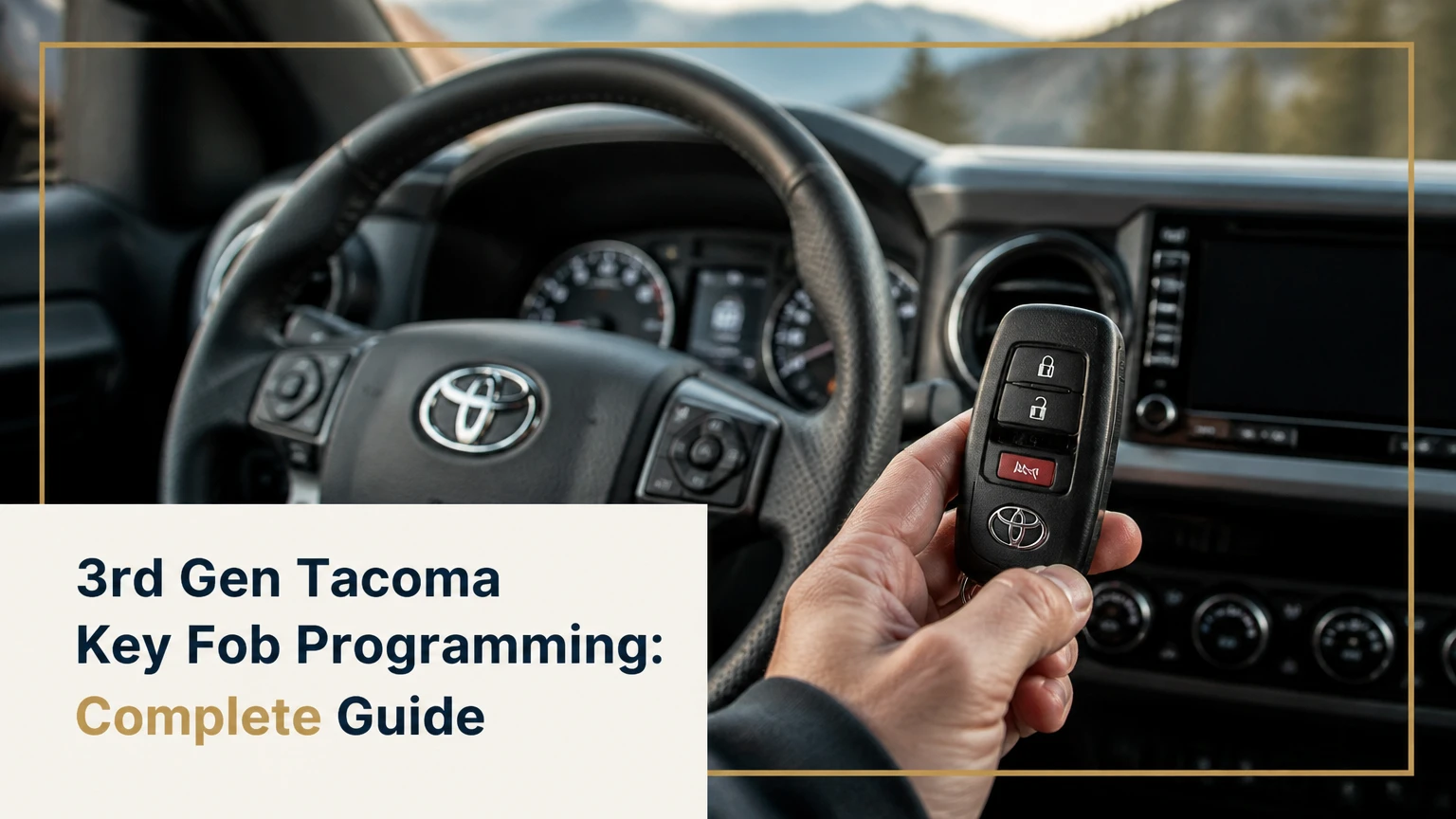
3rd gen Tacoma key fob programming normally requires immobilizer-capable diagnostic equipment, because 2016-2023 Toyota Tacoma trucks do not reliably support the older manual door-cycling routine. The exact procedure depends on whether the truck has push-button Smart Key or a conventional turn-key ignition, and the replacement fob must match the vehicle’s transmitter and transponder system.
Key Facts at a Glance
- A Toyota Tacoma key fob contains separate remote-locking and engine-immobilizer functions.
- Push-button Tacomas use a proximity Smart Key; turn-key Tacomas use a remote-head key with a transponder.
- Techstream, an immobilizer-capable locksmith tool, or a compatible consumer kit is normally required.
- A replacement fob’s FCC ID, Toyota part number, frequency, and chip type must match the truck.
- Adding a key is safer than selecting an erase-all or reset-keys utility.
- Typical programming costs range from about $120 for a mobile locksmith service to $450 at a dealer.
What Does Tacoma Key Fob Programming Actually Do?
Tacoma key programming stores an electronic identifier in the truck’s body or immobilizer control system. The vehicle then recognizes that identifier during remote-locking commands and, where applicable, during the engine-start authorization sequence.
The key fob has two functional layers. The remote keyless entry transmitter sends lock, unlock, panic, and sometimes remote-start commands. The transponder or Smart Key system authorizes starting through a separate immobilizer exchange, so a fob can operate the door locks while the engine still refuses to start.
Toyota’s 2016-2023 Tacoma range includes multiple ignition configurations and regional variations. A procedure that works for a 2018 push-button TRD Off-Road may not apply to a 2017 SR with a keyed ignition.
Why the Door-Cycling Routine Usually Fails
The familiar “chicken dance” sequence belongs to certain older Toyota remote systems and does not replace immobilizer registration on a third-generation Tacoma. Door cycling may enter a remote-learning mode on some vehicles, but it cannot securely enroll a new transponder into the engine immobilizer.
That distinction explains many failed DIY attempts. The door locks may flash or cycle, yet the truck still cannot authenticate the key for starting. Diagnostic equipment is required when the immobilizer memory must change.
How Do You Identify the Correct Tacoma Fob?
Identify the ignition system first, then verify the FCC ID and Toyota part number printed on the original fob or its circuit board. Push-button trucks require a Smart Key assembly, while turn-key trucks require a remote-head key and a correctly cut blade.
Push-Button Smart Key
A Smart Key Tacoma has a Start/Stop button and typically detects the fob when the driver touches the door handle or enters the cab. Common third-generation Tacoma Smart Key references include FCC IDs such as HYQ14FBB and HYQ14FBX, but those identifiers are not universal across every market or production configuration.
Common characteristics include:
- Three or four exterior buttons, depending on equipment
- A removable mechanical emergency blade
- Passive entry through capacitive door-handle sensors
- A Toyota transponder integrated into the Smart Key electronics
- A commonly listed battery size of CR2032 or CR2450, depending on the fob design
Do not choose a battery or part solely from a seller’s product title. Open the original fob and read the battery marking.
Turn-Key Remote-Head Key
A turn-key Tacoma has a mechanical ignition cylinder. The remote buttons may be integrated into the plastic key head, while a transponder chip inside the head authorizes engine operation.
Common references include FCC ID GQ4-52T and Toyota H-chip applications, but compatibility still depends on the truck’s year, market, and equipment. A remote-head key normally requires two separate services:
- Cutting the metal blade to match the ignition and door locks.
- Registering the electronic transponder and remote functions.
A key that turns the ignition but does not start the engine is not fully programmed. A key that starts the engine but does not lock the doors may have a remote-transmitter mismatch.
Common Fob References
| Tacoma configuration | Typical identifier | Physical feature | Required verification |
|---|---|---|---|
| Push-button Smart Key | HYQ14FBB | Proximity fob with emergency blade | FCC ID, Toyota number, market |
| Push-button Smart Key | HYQ14FBX | Proximity fob with passive entry | FCC ID, board frequency, vehicle year |
| Turn-key remote head | GQ4-52T | Integrated metal key blade | FCC ID, blade profile, transponder type |
| Aftermarket replacement | Seller-specific | New shell or electronics | Board compatibility, return policy, FCC marking |
These are reference examples, not a universal fitment list. Toyota parts catalogs and the original fob remain more reliable than a photograph of a similar-looking key.
What Should You Do Before Programming?
Before programming a Tacoma key fob, confirm the truck’s battery is charged, keep every working key available, and verify the replacement’s electronics. Most failures originate from wrong hardware, insufficient vehicle voltage, or an incorrect programming mode.
Before-You-Start Checklist
| Requirement | Typical specification | Why it matters |
|---|---|---|
| Vehicle battery | At least 12.2 V at rest | Prevents module communication interruptions |
| New fob battery | Fresh CR2032 or CR2450 as marked | Supports the registration handshake |
| Diagnostic connection | J2534 interface or immobilizer tool | Provides access to key-registration utilities |
| Working key | One recognized master key when available | Many add-key procedures require authorization |
| Ownership proof | Registration, title, or photo ID | Dealers and locksmiths require security verification |
| Time | 15-60 minutes after setup | Software installation can take longer |
Switch off aftermarket electronics that could interfere with programming, including remote-start modules, battery chargers with unstable output, and some high-power radio accessories. Keep unregistered fobs several feet away unless the tool’s instructions specifically require them inside the vehicle.
Which Programming Method Should You Use?
Use an automotive locksmith for the best balance of cost, speed, and risk; use Toyota Techstream only if you understand Windows diagnostic software and have a compatible interface; use a consumer kit only after confirming exact vehicle compatibility. A dealer is the safest escalation point for all-keys-lost cases or uncertain hardware.
| Method | Typical cost | Typical time | Best fit | Main limitation |
|---|---|---|---|---|
| Automotive locksmith | $120-$250 | 20-45 minutes | One working key, mobile service | Tool coverage varies by year and market |
| Toyota dealer | $300-$500 | 1-3 hours | OEM parts and factory support | Highest labor and programming cost |
| Consumer OBD kit | $150-$250 | 30-90 minutes | Supported add-key situation | Compatibility and support vary |
| Toyota Techstream DIY | $40-$150 in equipment | 1-3 hours | Experienced diagnostic user | Setup, licensing, and interface issues |
| All-keys-lost specialist | $250-$700 | 1-4 hours | No recognized key remains | May require EEPROM or advanced security access |
Toyota Techstream is Toyota’s factory diagnostic platform, normally used with Toyota service information and an approved communication interface. Low-cost cloned cables and unauthorized software packages can communicate inconsistently, damage vehicle modules through interruption, or expose the owner to malware and licensing problems.
How Do You Program a Push-Button Smart Key?
A push-button Tacoma Smart Key is registered through a Smart Key or immobilizer utility in Techstream or a compatible locksmith programmer. The usual workflow takes about 10-30 minutes once the correct fob and diagnostic connection are ready.
Step 1: Connect the Diagnostic Tool
Connect the tool to the Tacoma’s OBD-II port beneath the dashboard. Set the ignition to ON without starting the engine, then identify the vehicle by year, model, engine, and market rather than accepting an automatic guess.
Success checkpoint: The tool displays the correct Tacoma identification and communicates with body and immobilizer modules.
Common mistake: Selecting a similar Toyota model, such as a 4Runner, because the tool’s automatic vehicle detection is wrong.
Step 2: Open the Smart Key Utility
In Techstream, menu names vary by model and software version, but the path generally leads through Body Electrical, Smart Access, Immobilizer, or Utility. Select an add-key or Smart Code Registration function.
Read the prompts completely. Do not select Erase All Keys, Reset Keys, or a similar function unless you intend to remove existing registrations and have the required security access.
Success checkpoint: The tool identifies an available registration function and reports the key capacity or current key status.
Common mistake: Assuming “key registration” means remote-button pairing only. The correct utility must address the Smart Key or immobilizer system.
Step 3: Authenticate With a Working Key
Hold the recognized key in the location specified by the tool, usually against the Start/Stop button or another designated detection area. Toyota Smart Key systems can use close-range immobilizer communication when the fob battery is weak.
Success checkpoint: The truck produces the specified beep or the tool advances to new-key registration.
Common mistake: Holding the fob beside the button instead of placing the Toyota emblem or specified side directly against it.
Step 4: Register the New Smart Key
Move the old key away from the vehicle when the prompt requires it. Place the new Smart Key against the Start/Stop button within the displayed time window, which is often approximately 30 seconds.
Success checkpoint: The vehicle or programmer gives a confirmation beep, status message, or successful-registration result.
Common mistake: Leaving multiple registered keys beside the button, allowing the vehicle to detect the wrong fob.
Step 5: Test Every Function
Exit the utility, switch the vehicle off, and test passive unlocking, locking, push-button starting, emergency-blade operation, and every remote button. Test the new fob outside the truck, because a fob can appear functional at the button while passive entry remains unregistered or disabled.
Success checkpoint: The Tacoma starts with the new fob and responds consistently from several feet away.
Common mistake: Returning the vehicle before confirming that the mechanical blade fits both the driver-door cylinder and ignition or that the emergency blade was cut.
How Do You Program a Turn-Key Tacoma Key?
A turn-key Tacoma requires a correctly cut mechanical blade plus electronic registration for the transponder and remote transmitter. Programming must use an immobilizer-capable tool, although remote-button pairing and transponder enrollment may appear as separate functions.
The locksmith or technician normally cuts the blade from the vehicle code, an existing key, or an approved key-code source. The programmer then communicates through the OBD-II port and places the immobilizer system into a key-registration mode.
The exact prompts differ by tool. Some systems require a recognized key for an add-key procedure, while all-keys-lost programming may need advanced security access. After registration, the technician tests engine start separately from lock, unlock, and panic-button operation.
The most important checkpoint is engine authorization. Remote control alone does not prove that the transponder is registered.
What Are the Costs and Timeframes?
Typical third-generation Tacoma key programming costs range from $120-$250 with an automotive locksmith and $300-$500 through a Toyota dealer. The final price depends on whether the fob is OEM, whether a blade must be cut, whether a working key exists, and whether the vehicle needs all-keys-lost service.
| Service situation | Typical parts cost | Typical labor and programming | Typical total |
|---|---|---|---|
| Add Smart Key, aftermarket fob | $60-$160 | $60-$150 | $120-$310 |
| Add Smart Key, OEM fob | $150-$300 | $80-$200 | $230-$500 |
| Turn-key remote-head replacement | $50-$180 | $70-$180 | $120-$360 |
| Dealer OEM Smart Key service | $180-$350 | $120-$250 | $300-$600 |
| All-keys-lost programming | $100-$350 | $150-$450 | $250-$800 |
These are typical North American planning ranges, not published Toyota price schedules. Call three providers and ask whether the quote includes the fob, blade cutting, programming, mobile travel, taxes, and disposal of lost-key registrations.
Why Does Programming Fail?
Most Tacoma key-registration failures result from an incompatible fob, weak vehicle voltage, an incorrect diagnostic menu, or a security condition that the selected tool cannot handle. A failed registration does not automatically mean the truck’s immobilizer module is damaged.
Troubleshooting by Symptom
| Symptom | Likely cause | First corrective action |
|---|---|---|
| Locks work, engine will not start | Transponder not registered | Run immobilizer registration, not RKE pairing |
| Engine starts, buttons do nothing | Wrong transmitter or unpaired remote | Verify FCC ID and remote utility |
| No tool communication | Poor cable, low voltage, wrong ignition state | Charge battery and reconnect OBD-II |
| Registration stops at security step | All-keys-lost or unsupported market | Use an automotive locksmith or dealer |
| New fob works only against button | Weak fob battery or proximity issue | Install the specified fresh battery |
| Existing keys stop working | Erase-all function selected | Stop and obtain security-capable service |
Expert Insight: Add-Key Is Not Erase-All
An add-key function preserves existing authorized keys. An erase-all function deletes them before enrolling replacements, and some Toyota security workflows require a seed or passcode afterward. Selecting the wrong utility can turn a simple spare-key job into an immobilizer recovery job.
Expert Insight: A VIN Beginning With 3 Is Not an Automatic Block
The first VIN character identifies the manufacturing country, and a VIN beginning with 3 generally indicates Mexico. That character alone does not prove that a Tacoma cannot be programmed with a consumer tool.
Market, model year, immobilizer generation, software support, and the programmer’s database determine compatibility. Treat claims that every Mexico-built Tacoma is blocked as an oversimplification. A locksmith should verify the VIN and security system before promising an add-key service.
Expert Insight: The Original Board Can Avoid Programming
A replacement shell does not require electronic programming when the original working circuit board and transponder are transferred intact. This solution is useful when the buttons or plastic housing are damaged but the truck still recognizes the original fob.
The shell must hold the board in the correct orientation, preserve the antenna position, and accept the original emergency blade. Moving only the exterior buttons or installing a visually similar board will not preserve authorization.
Can You Reuse a Used Tacoma Key Fob?
A used Tacoma fob may be reusable, but compatibility and reset status determine whether programming succeeds. Matching appearance, button count, or Toyota branding does not prove that the used board can be registered to another truck.
Check the FCC ID, Toyota part number, frequency, circuit-board marking, and ignition configuration. Some used Smart Keys can be reset or reinitialized by an appropriate locksmith tool, while others are locked to their previous vehicle or are economically impractical to recover.
A seller should provide a return policy and exact fitment information. Avoid buying a used fob when the seller cannot show the FCC ID or refuses to identify whether the board is new, unlocked, or previously registered.
What Happens When All Keys Are Lost?
All-keys-lost Tacoma programming is more difficult than adding a spare because the vehicle has no recognized key to authorize a simple enrollment process. The technician may need an immobilizer-capable locksmith tool, Toyota security access, or a dealer procedure tied to ownership verification.
Do not repeatedly try random consumer procedures in an all-keys-lost situation. An unsuccessful attempt can consume time, lock the security system into a temporary wait period, or create a requirement for credentials that the basic kit cannot obtain.
Bring the VIN, registration or title, government-issued identification, and proof of insurance when requesting service. A mobile locksmith can often cut and program the key at the vehicle, but a dealer may be required for unsupported market configurations.
Dealer or Locksmith: Which Is Better?
A locksmith is usually the better choice for a normal spare-key job when the provider explicitly supports the Tacoma’s Smart Key or transponder system. A Toyota dealer is preferable when the vehicle has no working keys, the VIN or market is unusual, or the owner wants factory parts and factory software support.
| Decision factor | Locksmith | Toyota dealer |
|---|---|---|
| Typical total price | $120-$350 | $300-$600 |
| Mobile availability | Common | Rare |
| OEM fob availability | Sometimes | Usually |
| All-keys-lost capability | Depends on tool | Strong factory escalation |
| Blade cutting | Usually included | Usually available |
| Appointment time | Same day often possible | Commonly scheduled |
Ask a locksmith, “Can you program a 2016-2023 Tacoma Smart Key or remote-head transponder for this VIN?” Ask whether the quote includes cutting and whether existing keys remain active. A provider who cannot answer those questions should not be the first choice.
Can You Program a Tacoma Fob Without Diagnostic Equipment?
You generally cannot complete immobilizer programming on a third-generation Tacoma using only the ignition key, pedals, or door locks. Some remote transmitters may have model-specific manual pairing routines, but those routines do not reliably enroll the engine-start transponder and should not be confused with complete key programming.
Diagnostic equipment is unnecessary only in limited situations. For example, transferring the original board into a new shell preserves the existing electronic identity, and replacing a dead fob battery does not erase programming.
A battery replacement also does not require reprogramming. Install the same battery type shown inside the original fob, observe polarity, and test the key before purchasing a replacement board.
FAQ
Does disconnecting the Tacoma battery erase key programming?
No. Disconnecting the vehicle battery normally does not erase registered Smart Keys or transponder identities. It can reset some convenience settings and create low-voltage communication errors, but it is not a key-reset procedure. Use a stable battery voltage during programming rather than disconnecting the battery as a troubleshooting shortcut.
Can a Tacoma fob lock the truck but fail to start it?
Yes. Door locking uses the remote keyless-entry transmitter, while engine authorization uses the immobilizer transponder or Smart Key system. If the buttons work but the engine will not start, verify transponder registration, fob compatibility, vehicle battery voltage, and the emergency detection procedure near the Start/Stop button.
Does remote start change the programming procedure?
An aftermarket remote-start module can add another transmitter or bypass interface, but it does not replace Toyota immobilizer registration. Tell the locksmith or dealer about the module before programming. Some installations interfere with diagnostics, while others require separate remote-start pairing after the factory key is registered.
Can I cut the emergency blade at a hardware store?
A hardware store may cut a compatible emergency blade if it has the correct blank and an existing key to copy. The blade still must match the Tacoma’s door cylinder and, where relevant, ignition cylinder. Blade cutting does not program the remote transmitter or immobilizer transponder.
How many keys can a third-generation Tacoma store?
The available key capacity depends on the Tacoma’s specific Smart Key or immobilizer system and the diagnostic utility. Do not rely on a universal number such as six without checking the tool’s live status screen. A technician should confirm available slots before starting an add-key procedure.
Should I buy an OEM or aftermarket fob?
An OEM fob offers the most predictable fitment and electronics, while a reputable aftermarket fob can reduce the parts cost substantially. Select either type only after matching the FCC ID, Toyota part number, ignition type, and market. A cheap incompatible fob costs more when a second programming appointment is required.
The Bottom Line
3rd gen Tacoma key fob programming is an electronic immobilizer procedure, not a dependable door-cycling task. Identify push-button Smart Key versus turn-key remote head, match the FCC ID and Toyota part number, select Add Key rather than Erase All, and use a qualified locksmith or Toyota dealer when the truck has no working key or an unusual VIN configuration.
A capable DIY owner can use Techstream or a supported OBD kit for a verified add-key job, but the lowest purchase price is not the lowest risk. For most owners, a locksmith who confirms compatibility by VIN provides the fastest practical solution, usually within 20-45 minutes and $120-$350.