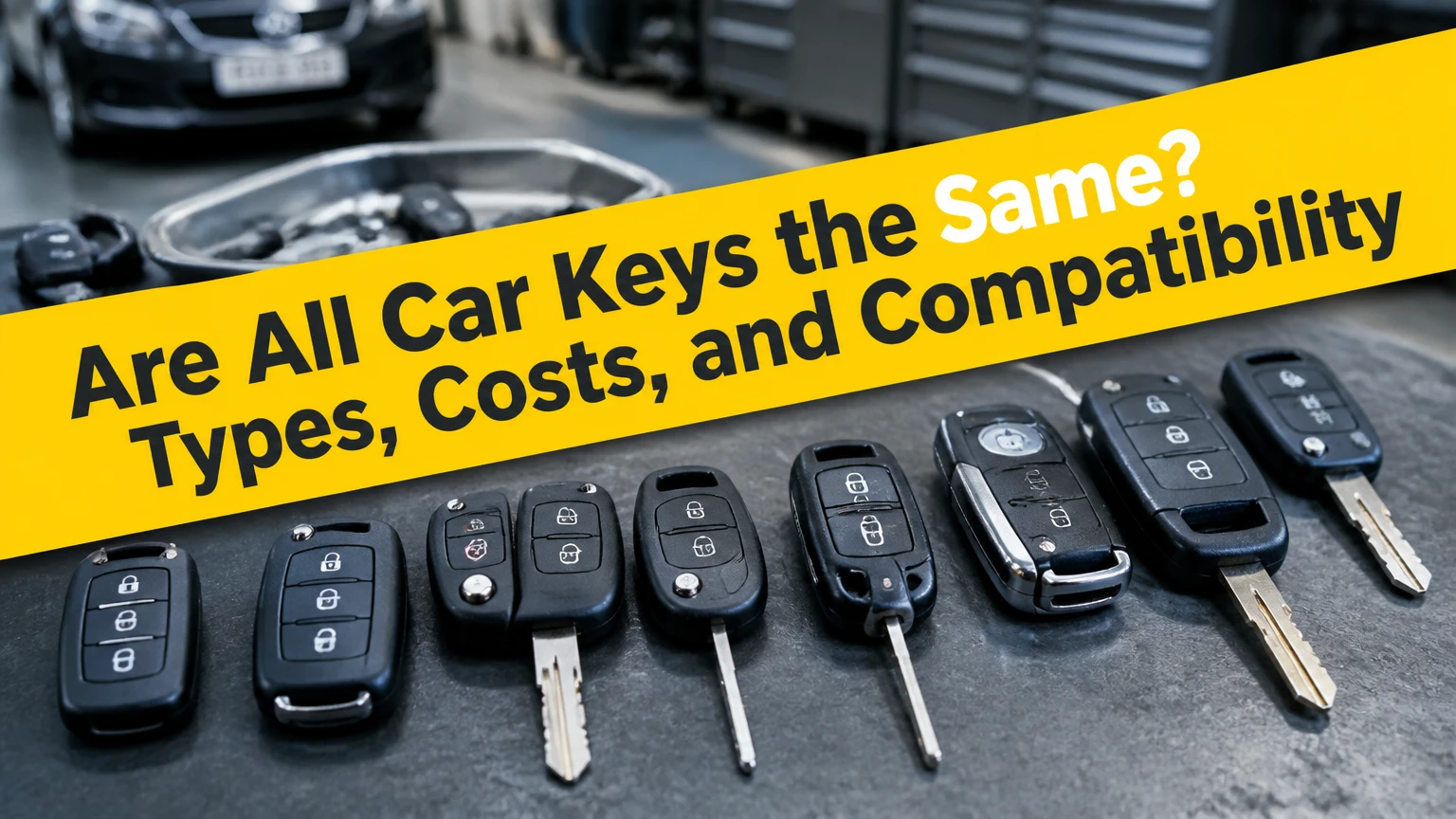
No, all car keys are not the same. A car key may be a cut metal blade, a transponder key, a remote fob, a proximity smart key, or a digital phone credential, and each type uses different hardware and authorization methods. Matching the vehicle requires more than finding a key with the same shape.
Key Facts at a Glance
A mechanical key can open a lock without necessarily authorizing the engine to run.
A transponder chip communicates with the immobilizer, usually without needing its own battery.
Remote-locking buttons and engine-start authorization are separate functions.
A replacement key must match the vehicle’s make, model, year, market, immobilizer system, and sometimes a specific part number.
Typical US replacement prices range from about $5 for a basic duplicate to more than $600 for some smart keys.
A dead smart-key battery may still permit emergency starting, but the backup-reading location differs by vehicle.
Are All Car Keys the Same?
All car keys perform access or starting functions, but their construction, communication method, security level, and replacement process differ. A metal blade relies on physical cuts, while a modern key may combine a blade, remote transmitter, passive transponder, proximity antennas, encrypted credentials, and a vehicle-specific programming procedure.
The most important distinction is between unlocking the vehicle and authorizing the engine. A remote keyless-entry fob can lock and unlock doors, yet its internal immobilizer chip separately determines whether the engine can run. On some older vehicles, a copied blade turns the ignition cylinder but leaves the engine disabled.
Vehicle age provides a useful clue, not a reliable identification method. Many vehicles built after the 1990s use electronic immobilizers, but introduction dates vary by manufacturer, country, trim, and model. A 2005 vehicle may use a simple transponder key, an integrated remote, or a manufacturer-specific system.
Appearance is also unreliable. Two black three-button fobs can use different radio frequencies, chips, circuit boards, or cryptographic systems. Conversely, two keys that look different may use the same electronic platform if the manufacturer changed the shell design.
What Does a Car Key Actually Do?
A car key can perform four separate jobs: unlock a mechanical cylinder, transmit remote commands, prove authorized ownership to the immobilizer, and provide proximity authorization for push-button starting. A particular key may perform one job or all four, depending on the vehicle.
Mechanical access
The blade contains a pattern of grooves or side-milled cuts. When inserted into a door or ignition cylinder, those cuts align wafers or pins so the cylinder can rotate. A blade can be cut accurately and still fail to start the car if the vehicle requires a coded transponder.
Some smart fobs contain an emergency blade. The blade may open the driver’s door during a discharged fob battery, but it usually does not replace the electronic credential needed for normal push-button starting.
Remote keyless entry
Remote keyless entry, often abbreviated RKE, uses buttons to send commands such as lock, unlock, panic, or trunk release. The remote circuit board requires a battery because it actively transmits a radio signal across a useful distance.
Remote frequency is market-specific. Common examples include 315 MHz in North America and 433.92 MHz in many other markets, but 868 MHz and other systems also exist. The correct frequency is only one compatibility requirement.
Immobilizer authorization
The immobilizer decides whether the powertrain may run. A passive transponder near the ignition switch or cabin antenna responds to a vehicle query, and the immobilizer accepts the response only when the stored credential matches.
This process does not always use a “rolling code” in the same way a door-lock remote does. Manufacturers use different fixed-code, cryptographic, challenge-response, and rolling-code designs. The practical result is the same: cutting the blade alone does not create a valid engine-start credential.
How Does a Modern Car Key Work?
A modern car key works through two linked systems: mechanical alignment for locks and electronic authentication for the immobilizer. The vehicle detects a key or button command, exchanges or verifies coded information, and permits the requested function only when the credential and operating conditions are valid.
A typical passive-transponder sequence works like this:
- The key enters the ignition, or a proximity key enters the vehicle’s detection zone.
- An antenna around the ignition cylinder or inside the cabin creates a low-power electromagnetic field.
- The passive transponder chip receives enough energy to respond, so its start authorization does not normally depend on the coin-cell battery.
- The immobilizer module sends a coded query or challenge.
- The chip returns an identification or cryptographic response.
- The vehicle validates the response and permits engine operation.
Push-button systems add other checks. The brake pedal, transmission position, steering lock, cabin antennas, body-control module, and engine-control module may all participate. The exact architecture differs by brand.
A remote unlock command is not necessarily proof that the key can start the engine. A weak battery can reduce button range while leaving the passive transponder functional. The reverse can also occur: the remote buttons may work while the transponder or key programming has failed.
What Are the Main Types of Car Keys?
The main car-key categories are mechanical, transponder, remote-integrated, proximity smart, and digital keys. Categories overlap because manufacturers frequently combine a metal blade with a transponder and remote circuit in one housing.
| Key type | Main hardware | Battery for engine start | Typical US replacement cost | Typical cutting or programming time |
|---|---|---|---|---|
| Mechanical blade | Cut metal blade, lock cylinder | No | $5-$25 | 2-10 minutes |
| Transponder key | Blade plus passive immobilizer chip | Usually no | $50-$175 | 15-45 minutes |
| Remote-head key | Blade, transponder, remote circuit board | Usually yes for buttons | $100-$250 | 20-60 minutes |
| Proximity smart fob | LF/UHF antennas, transponder, remote electronics | Usually yes, with passive backup | $200-$600+ | 30-120 minutes |
| Digital key | Smartphone secure element, NFC, Bluetooth, or UWB | Phone battery required | $0-$150 for supported options | 5-30 minutes |
Mechanical car keys
Mechanical keys are the simplest and least expensive. They are suitable for vehicles with no electronic immobilizer and for door or trunk access when a separate electronic credential controls starting.
A locksmith can usually duplicate a mechanical key from an existing key or decode the lock. A hardware store may cut one if it has the correct blank, but a poorly cut blade can bind the cylinder or wear its internal components.
Mechanical keys offer no remote convenience and limited protection against unauthorized duplication. Their main advantages are low cost, long storage life, and independence from batteries or software.
Transponder keys
A transponder key contains a small chip embedded in the plastic head or blade assembly. The chip is generally passive, which means the ignition antenna powers its response during authentication.
The vehicle must be programmed to recognize the chip. Cutting a matching blade does not complete the replacement. Some vehicles allow onboard procedures when a specific number of working keys already exist, while others require a diagnostic tool or manufacturer authorization.
Remote-head keys
A remote-head key combines a folding or fixed blade, a transponder, and buttons in one housing. The coin-cell battery normally powers locking and unlocking, while the immobilizer chip may operate passively.
Remote-head keys are common on vehicles that use a conventional ignition cylinder but provide remote door access. Shell replacement can solve broken buttons or cracked plastic when the original circuit board and chip remain functional.
Proximity smart keys
A proximity fob allows passive entry and push-button starting. Low-frequency antennas locate the fob near the vehicle, while a higher-frequency radio link commonly handles communication over longer distances.
Smart keys cost more because they contain multiple antennas, a circuit board, security credentials, and sometimes motion or capacitive sensors. Some vehicles also use an emergency mechanical blade hidden inside the fob.
Digital and smartphone keys
A digital key stores vehicle access credentials in a supported smartphone, NFC card, smartwatch, or secure hardware environment. Depending on the vehicle, the system may use NFC for close-range entry, Bluetooth for passive functions, or Ultra-Wideband for precise location detection.
Digital keys are convenient for sharing and revoking access, but compatibility depends on the vehicle platform, phone model, operating-system version, account permissions, and battery state. A phone app cannot add digital-key capability to a vehicle that lacks the required hardware and software.
Which Key Types Need Batteries?
Mechanical and passive transponder keys generally do not need batteries to authorize engine starting. Remote fobs and smart keys usually need coin-cell batteries for buttons, proximity functions, and longer-range communication, although many include a passive emergency-start method.
Common battery designations include CR2032 and CR2025, but the correct part number and orientation come from the owner’s manual or the marking inside the fob. A battery with the wrong thickness can damage contacts or prevent the case from closing correctly.
Battery symptoms include shorter remote range, intermittent locking, a “key battery low” message, or failure of passive unlocking. A dead battery does not automatically mean the key is unusable. Manufacturers place backup readers in different locations, including the steering-column area, a marked center-console pocket, or directly beside the start button.
How Much Does a Replacement Car Key Cost?
A typical US replacement car key costs about $5-$25 for a basic blade, $50-$175 for a transponder key, $100-$250 for an integrated remote key, and $200-$600 or more for a smart fob. Prices rise when all keys are lost, dealer programming is required, or the vehicle uses a restricted security system.
| Replacement situation | Typical parts cost | Typical labor or programming | Typical total |
|---|---|---|---|
| Duplicate mechanical blade | $3-$15 | $2-$20 | $5-$25 |
| Transponder spare with one working key | $25-$100 | $25-$100 | $50-$175 |
| Remote-head replacement | $60-$160 | $40-$100 | $100-$250 |
| Smart-fob replacement | $120-$450 | $80-$250 | $200-$700+ |
| All keys lost, mobile locksmith visit | $100-$500 | $100-$350 | $200-$850+ |
| Dealer replacement for restricted system | $150-$600 | $100-$400 | $250-$1,000+ |
These are typical planning ranges, not quotes. Labor may include vehicle recovery, key cutting, security-code access, module initialization, and deletion of missing keys from the vehicle’s memory.
A locksmith may charge less than a dealer for common vehicles because mobile automotive locksmiths often carry key programmers and blanks for multiple manufacturers. A dealer may be the practical choice when a brand uses online authorization, proprietary credentials, or a replacement procedure unavailable to independent technicians.
Can Any Key Be Copied?
A mechanical blade can often be copied, but a modern electronic key must also be electronically compatible and programmed. Key appearance, button count, and seller claims do not establish compatibility.
Before buying a blank or replacement fob, verify:
- Exact make, model, and model year
- Country or market where the vehicle was sold
- VIN, when a professional needs it for identification
- Original key part number
- FCC ID in the United States, when applicable
- Frequency and transponder type
- Blade profile and cut pattern
- Whether the vehicle uses push-button or keyed ignition
- Whether the replacement is new, refurbished, or previously paired
FCC ID matching is useful for US remote transmitters, but it is not sufficient by itself. The immobilizer chip, frequency, circuit board, firmware, and vehicle module must also agree.
A hardware store may duplicate the blade but usually cannot program a proprietary immobilizer credential. Some automotive retailers and locksmiths can cut and program certain systems, while a dealer may be required for restricted models.
Can a Used Key Fob Be Reprogrammed?
A used key fob can sometimes be reused, but many immobilizer systems permanently bind the fob or transponder to its original vehicle. Remote-button programming and engine-start programming are separate, so a reused fob may lock doors yet remain unable to start another vehicle.
A replacement specialist should identify whether the fob is reusable, resettable, or permanently locked before purchase. “Unlocked” and “refurbished” listings require careful verification because a refurbished shell may contain an incompatible or still-paired circuit board.
The least risky purchase is a new, vehicle-compatible key from a dealer or reputable automotive locksmith. A used unit can reduce parts cost, but unsuccessful programming may eliminate the expected savings.
Which Car Key Is Most Secure and Convenient?
A smart key generally provides the most convenience, while a modern transponder system supplies strong protection against a simple copied blade. No key type eliminates theft risk, because vehicle security also depends on software, relay-attack resistance, alarm design, immobilizer implementation, and owner behavior.
| Key system | Convenience | Replacement complexity | Typical weakness | Best fit |
|---|---|---|---|---|
| Mechanical blade | Manual lock and ignition operation | Low | Easy physical duplication | Older vehicles |
| Transponder key | Insert-and-turn starting | Moderate | Lost credential requires programming | Basic daily driving |
| Remote-head key | Remote locking plus blade | Moderate | Battery and button wear | Keyed ignition vehicles |
| Proximity fob | Passive entry and push start | High | Cost, battery failure, relay attacks | Newer daily-use vehicles |
| Digital key | Sharing through an app or wallet | Moderate to high | Phone, account, and software dependency | Supported fleets and families |
Proximity systems should not be treated as automatically safer than all other keys. The Insurance Institute for Highway Safety has documented that keyless systems can create theft concerns when criminals amplify signals from a fob inside a home. Owners should use the manufacturer’s security guidance, keep software updated, and consider a signal-blocking storage method when the vehicle is vulnerable to relay attacks.
Digital keys are not ideal as the only access method for every driver. A dead phone, disabled account, incompatible replacement phone, or failed enrollment can prevent convenient access, so a physical backup remains sensible where the manufacturer permits one.
What Should You Check When a Key Fails?
When a car fails to recognize a key, check the simplest causes first: fob battery, key position, spare-key operation, visible damage, and vehicle battery condition. Do not assume that a remote-control failure proves immobilizer failure.
Use this diagnostic order:
- Test the spare key. If the spare starts the vehicle, the primary key, its battery, or its programming is the likely problem.
- Replace the coin cell. Install the specified CR2032, CR2025, or other listed battery with the correct polarity.
- Use the emergency-start location. Hold the fob against the marked reader, steering-column area, or start button while pressing the brake, following the owner’s manual.
- Remove possible interference. Separate the fob from other electronic devices, metal containers, and additional keys during testing.
- Check the vehicle battery. Low vehicle voltage can disrupt body-control modules and antenna operation.
- Look for immobilizer warnings. A flashing key or padlock symbol indicates a security-system issue, but the exact meaning varies by manufacturer.
- Arrange professional diagnosis. A locksmith or dealer can test the transponder, antenna coils, stored key count, and module communication.
A broken shell does not necessarily mean a failed key. If the circuit board and transponder remain intact, transferring them into a compatible replacement shell may restore function at a much lower cost than purchasing a complete programmed key.
Who Can Cut and Program a Replacement?
An automotive locksmith is often the most efficient option for common vehicles, while a dealer is more appropriate for restricted systems, some luxury models, and cases requiring manufacturer-server authorization. The correct provider depends on the vehicle’s security architecture, not simply on whether the key has buttons.
Ask the provider these questions before authorizing work:
- Can you identify the key by VIN and existing part number?
- Does the quote include cutting, programming, tax, and travel?
- Will missing keys be erased from the vehicle’s authorized-key list?
- Is the replacement new, refurbished, or previously used?
- What happens if the key does not program?
- Will you provide a second working key test before payment?
Bring the vehicle registration and government-issued identification if requested. Security professionals may need proof of ownership before generating or programming a key. Avoid providers who offer programming without ownership verification.
What Information Is Needed to Order a Key?
The minimum useful identification usually includes the vehicle identification number, exact model year, trim, ignition type, and the market where the vehicle was sold. A photograph of the old key can help identify the shell, but it cannot prove that the internal electronics match.
A dealer or locksmith may also ask for:
- Existing key count
- Whether any key currently starts the vehicle
- Key blade code or code tag
- FCC ID or manufacturer part number
- Remote-button layout
- VIN security access details
- Vehicle location and whether it can be driven
- Proof of ownership
A key-code tag can simplify blade cutting, but losing the tag does not make replacement impossible. The code may be recoverable through manufacturer records, a locksmith’s decoding process, or the vehicle lock itself, subject to ownership checks.
Expert Rules That Prevent Expensive Mistakes
A working key changes the price. Adding one programmed spare is usually less expensive than replacing every key after a total loss because the vehicle can often remain in its existing security state.
A shell is not a key. Online listings may show a complete-looking housing, but the vehicle needs the correct chip and circuit board, followed by successful pairing.
Remote range is not a reliable security test. A fob can unlock doors from a short distance while its transponder remains fully functional, or its buttons can work while the immobilizer chip has failed.
Program the spare before losing the original. All-keys-lost service may require towing, emergency access, security-code retrieval, and deletion of old credentials.
Frequently Asked Questions
Can a key from the same car model start my vehicle?
Usually not without matching programming. A key from the same model may have the correct blade profile or shell, yet its transponder and remote credentials can remain paired to another vehicle. Compatibility must be confirmed by model year, market, part number, frequency, chip type, and immobilizer system.
Do car keys have unique codes?
Electronic car keys contain identifiers or cryptographic credentials recognized by the vehicle’s security modules. Mechanical blades also have unique cut patterns, while remote transmitters use vehicle-specific pairing information. The exact code structure varies, and a visible serial number does not necessarily reveal the engine-start credential.
Can I start my car with only the metal blade?
A metal blade starts a vehicle only when the vehicle does not require an electronic immobilizer credential, or when the blade is part of a properly programmed transponder key. On many modern cars, the blade can turn a lock or open a door but cannot authorize fuel injection or ignition operation.
How many spare keys should a car owner keep?
Most owners should maintain at least one tested spare key separate from the primary key. Families, fleets, and vehicles used in remote locations may justify two spares. Test each spare periodically because a key that unlocks the doors may still lack valid engine-start programming.
Is a key fob the same as a car key?
A key fob is not always the entire car key. “Fob” commonly describes the remote or proximity transmitter, while the complete key may also include a blade and immobilizer transponder. On push-button vehicles, the fob may be the primary key, but the terms remain technically different.
The Bottom Line
Are all car keys the same? No. Car keys range from inexpensive mechanical blades to programmed transponder keys, remote-head designs, proximity smart fobs, and smartphone credentials, and each category has different compatibility, battery, security, cost, and programming requirements.
Identify the vehicle by VIN, model year, market, part number, and immobilizer system before buying a replacement. A locksmith can often provide the best value for common systems, while a dealer may be necessary for restricted credentials. Test the spare key before an emergency, because a correctly cut blade alone may not start the car.