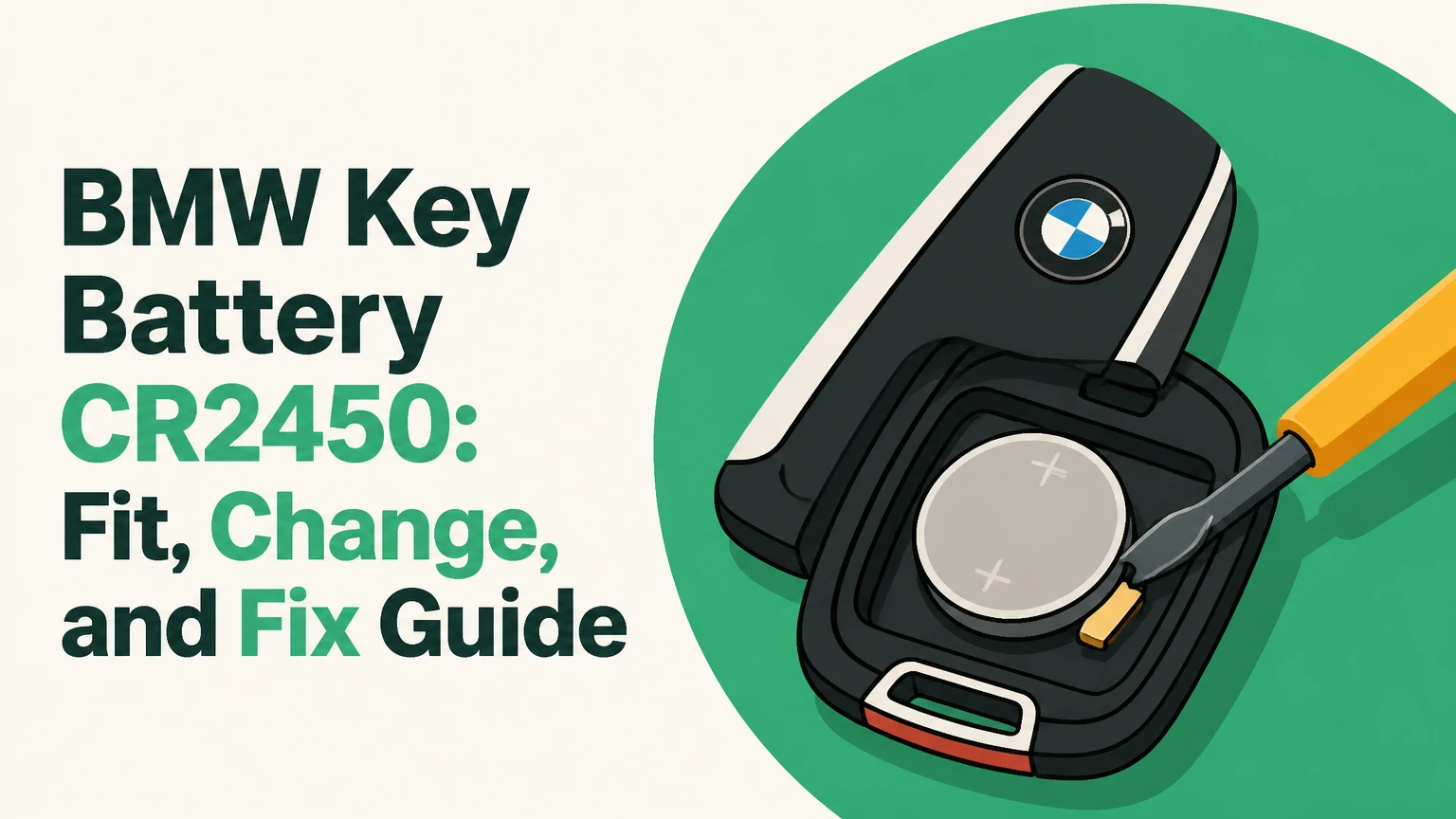
A BMW key battery CR2450 is a 3-volt, non-rechargeable lithium coin cell used in many rectangular BMW Comfort Access keys, especially F-Series fobs. Verify the code printed on the existing battery before purchasing, because BMW keys also use CR2032 cells and rechargeable VL2020 batteries. Replacement typically takes 5 minutes.
Key Facts
A CR2450 measures 24.5 mm across, is 5.0 mm thick, and supplies 3 volts.
Many BMW F-Series Comfort Access keys use a standard flat CR2450.
A CR2032 is 1.8 mm thinner and should not replace a CR2450 where contacts require full height.
Older diamond-shaped BMW keys commonly contain a rechargeable VL2020 cell soldered inside the case.
A battery replacement does not normally erase key programming or immobilizer authorization.
Typical replacement cost is $3-$8 for one branded cell, with local prices varying by country and retailer.
What Does BMW Key Battery CR2450 Mean?
The BMW key battery CR2450 designation identifies a standardized lithium manganese dioxide coin cell. “CR” indicates lithium chemistry with manganese dioxide, while “2450” describes an approximate 24 mm diameter and 5.0 mm thickness; the actual IEC diameter is 24.5 mm.
A CR2450 delivers a nominal 3.0 volts and commonly has a datasheet capacity near 600-620 mAh under light-load test conditions. Remote fobs rarely consume power continuously at the maximum rate, so practical service life depends on button use, Comfort Access proximity detection, temperature, battery age, and the fob’s electronic condition.
BMW uses the cell to power radio-frequency locking, unlocking, trunk release, panic functions, and proximity communication. The passive immobilizer transponder is a separate matter. A dead coin cell can disable remote buttons while the vehicle may still recognize the key when the fob is held at the designated emergency-reading position.
CR2450 specifications
| Attribute | Typical CR2450 value | Practical BMW meaning |
|---|---|---|
| Nominal voltage | 3.0 V | Correct voltage for many Comfort Access circuits |
| Diameter | 24.5 mm | Determines whether the cell fits the circular holder |
| Thickness | 5.0 mm | Maintains spring-contact pressure |
| Chemistry | LiMnO2 | Primary, non-rechargeable lithium cell |
| Typical capacity | 600-620 mAh | More reserve than a CR2032 |
| Typical shelf life | Up to 10 years unopened | Buy sealed, recently manufactured stock |
Capacity figures require context. Energizer’s CR2450 datasheet, for example, specifies capacity under defined discharge conditions rather than promising a fixed lifespan in every device. A BMW key that repeatedly wakes for Comfort Access can exhaust a cell sooner than a spare key kept far from the vehicle.
Which BMW Keys Accept a CR2450?
Many rectangular or shield-shaped BMW Comfort Access fobs from F-Series vehicles use a CR2450, but chassis and model year are only screening clues. The battery holder and the number printed on the old cell provide the reliable confirmation.
Examples frequently associated with CR2450-equipped keys include the F30 3 Series, F32 4 Series, F10 5 Series, F01 and F02 7 Series, F25 X3, and F26 X4. The same vehicle can have different key designs because of market equipment, replacement-key history, Comfort Access configuration, or an earlier key-generation transition.
Common F-Series associations
| BMW vehicle or chassis | Approximate production period | Likely key situation |
|---|---|---|
| F30 3 Series | 2012-2019 | Rectangular Comfort Access fob often uses CR2450 |
| F10 5 Series | 2010-2017 | Many smart keys use CR2450 |
| F25 X3 | 2011-2017 | Comfort Access versions commonly use CR2450 |
| F01/F02 7 Series | 2009-2015 | Key design and battery holder must be checked |
| F32 4 Series | 2014-2020 | Transitional years require physical verification |
The word “often” matters. BMW did not assign one universal battery to every key sold during a model generation. A replacement key supplied later may have a different housing, and aftermarket shells can omit or alter the original holder.
How can you identify the battery without guessing?
Remove the mechanical key and inspect the battery compartment. A stamped “CR2450,” “CR2032,” or “VL2020” is more authoritative than a model-year chart. Photograph the orientation before removal, because some housings place the positive face upward while others use a different contact arrangement.
A removable rear cover usually indicates a replaceable primary cell. That clue is useful, but it is not conclusive. Some BMW keys with replaceable covers use CR2032 cells, and older rechargeable keys may require case opening rather than a simple cover removal.
How to Replace the Battery
Replacing the cell takes about 5 minutes, requires no programming, and is normally a low-risk procedure when the cover notch and gold contacts are handled gently. The main success factor is installing the exact printed battery type with the correct polarity, not forcing a thinner or rechargeable substitute into the holder.
Before you start
| Requirement | Typical value | Notes |
|---|---|---|
| Work time | 3-8 minutes | Longer if the cover is tight |
| Difficulty | Low | No coding equipment is normally required |
| Battery | 1 CR2450, 3 V | Use the printed code from the old cell |
| Tools | 0-1 small flat screwdriver | The internal key blade may open the notch |
| Cleaning material | 1 lint-free cloth | Useful for fingerprints or residue |
Step 1: Remove the metal key
Press the small release button on the side of the fob and pull out the internal metal emergency key. Put the blade on a clean surface so it does not scratch the housing.
The exposed slot usually reveals the cover-release notch. Do not insert a screwdriver deep into the electronics or twist against the side buttons, because those parts can break before the case separates.
Success checkpoint: the metal blade is fully removed and the release notch is visible.
Common mistake: pulling on the blade without pressing the release button, which can damage the retaining mechanism.
Step 2: Open the rear cover
Insert the tip of the metal blade or a small flat screwdriver into the molded notch. Apply light upward leverage and work around the seam only if the first lift does not release the cover.
Use controlled pressure rather than bending the plastic. A plastic pry tool is safer than a large screwdriver, especially on glossy housings that mark easily.
Success checkpoint: the rear cover separates without cracking and the battery holder remains attached to the circuit board.
Common mistake: prying at the wrong seam, which can lift decorative trim or deform the case.
Step 3: Record polarity and remove the old cell
Before removing the battery, note which face carries the plus sign. In many rectangular BMW Comfort Access keys, the positive face is upward, but the old installation is the best guide for that specific housing.
Lift the cell from its edge with a fingernail, plastic pick, or small insulated tool. Avoid levering directly against the gold-plated spring contacts. Bent contacts can create an intermittent fault that looks like a weak battery.
Success checkpoint: the old cell is out and both contacts remain flat, clean, and spring-loaded.
Common mistake: pushing a metal tool under the contact tab and bending it away from the battery.
Step 4: Install the new CR2450
Remove the new battery from its packaging and check both faces for a plastic shipping film or adhesive label. Place the positive side in the orientation recorded earlier, usually with the printed face visible, then slide the edge under the retaining lip before pressing it flat.
Hold the coin cell by its rim or use a clean cloth. Finger oils rarely destroy a battery, but contamination on the contact surface can increase resistance in a low-power radio circuit.
Success checkpoint: the cell sits flush, cannot rattle, and the contacts press firmly against its surfaces.
Common mistake: installing a CR2032 because it has the same diameter. Its 3.2 mm thickness may leave 1.8 mm of lost contact height.
Step 5: Close and test the fob
Snap the rear cover into place, reinstall the metal key, and test lock, unlock, trunk release, and panic functions near the vehicle. Test the spare key separately if one is available, because a working spare can distinguish a vehicle fault from a fob fault.
Success checkpoint: the vehicle responds consistently from a normal distance, and Comfort Access recognizes the key when the handle is touched.
Common mistake: testing only one button, which can miss a damaged individual switch or a worn rubber membrane.
CR2450 Versus CR2032 and Other Batteries
CR2450, CR2032, and VL2020 are not interchangeable merely because they are round coin cells. CR2450 and CR2032 both provide nominally 3 volts, but their different thickness changes the holder’s mechanical contact pressure; VL2020 is rechargeable and belongs to a different charging system.
| Battery type | Voltage | Thickness | Typical capacity | BMW key relevance |
|---|---|---|---|---|
| CR2450 | 3.0 V | 5.0 mm | 600-620 mAh | Many F-Series Comfort Access keys |
| CR2032 | 3.0 V | 3.2 mm | 200-240 mAh | Some newer or non-Comfort keys |
| CR2025 | 3.0 V | 2.5 mm | 150-170 mAh | Usually too thin for CR2450 holders |
| LIR2450 | 3.6 V nominal | 5.0 mm | About 100-150 mAh | Not suitable for a CR2450 primary-cell circuit |
| VL2020 | 3.0 V nominal | About 2.0 mm | Model-dependent | Older rechargeable diamond keys |
Is CR2450 the same as CR2032?
CR2450 is not the same as CR2032: both are 3-volt lithium cells with a 20 or 24 mm diameter difference, but CR2450 is 5.0 mm thick and CR2032 is 3.2 mm thick. A CR2032 may fit loosely, fail intermittently, or make no contact in a holder designed for CR2450.
A temporary test with a thinner cell can mislead diagnosis. The key may work when squeezed or moved, then fail in a pocket or vehicle because vibration breaks contact. Do not add foil, coins, cardboard, or other improvised spacers. Those materials can short the cell or distort the spring.
CR2025 is also too thin for a CR2450 holder in most cases. Diameter and voltage alone do not establish compatibility.
Can you use a rechargeable LIR2450?
Do not use an LIR2450 as a drop-in replacement for a CR2450. LIR2450 cells use lithium-ion chemistry, charge to approximately 4.2 volts, and can expose a circuit designed for a 3.0-volt primary cell to excessive voltage.
The similar size is irrelevant. A rechargeable replacement is appropriate only where the key’s charging circuit and battery specification are designed for it. Older BMW diamond keys commonly use a rechargeable VL2020 arrangement, but that does not make VL2020 or LIR2450 suitable for a removable CR2450 holder.
Which Brand and Battery Version Should You Buy?
A fresh, standard-profile CR2450 from Panasonic, Energizer, Duracell, Varta, Sony, Murata, or Renata is generally suitable when the holder is undamaged. Brand is less important than correct chemistry, recent stock, intact packaging, and a flat profile that fits the BMW contacts.
| Buying factor | Recommended choice | Avoid |
|---|---|---|
| Battery code | CR2450 | CR2032, CR2025, or LIR2450 without verification |
| Chemistry | Lithium manganese dioxide | Lithium-ion rechargeable |
| Condition | Sealed, recent retail package | Loose cells with unknown storage age |
| Profile | Standard flat-top CR2450 | Raised terminal versions that obstruct contact |
| Quantity | One cell plus one spare | Large packs with unclear expiration dates |
The CR2450N designation deserves attention. The “N” version can have a formed or raised terminal profile that differs from a flat CR2450. It may work in one holder and fail in another because BMW fob contacts have limited travel.
This is a mechanical-fit issue, not evidence that one brand has inferior electrical performance. If the old battery has a flat top, select a matching standard-profile replacement and retain the receipt until the fob passes testing.
Cost, Lifespan, and Storage
A single branded CR2450 typically costs $3-$8 in the United States, while a two-pack commonly costs $5-$12; local prices in the United Kingdom, European Union, Canada, and Australia vary with tax, shipping, and retailer markup.
| Situation | Typical life or cost | Main variable |
|---|---|---|
| Frequently used primary fob | 2-3 years | Button activity and Comfort Access wakeups |
| Lightly used primary fob | 3-5 years | Distance from vehicle and ambient temperature |
| Unused spare in storage | 5-10 years before use | Manufacturing date and storage conditions |
| Dealer-installed replacement | About $10-$30 | Labor and regional service pricing |
| Retail self-replacement | About $3-$8 | Brand and purchase location |
A battery warning may appear before the remote stops working, but the warning behavior differs by BMW generation and instrument cluster. Cold weather reduces available output temporarily, so a marginal cell can appear dead outdoors and recover slightly indoors without being healthy.
Store spare coin cells in their sealed packaging at room temperature. Keep them away from keys, coins, and tools that could bridge the positive and negative surfaces.
Why Does the BMW Key Still Not Work?
A new CR2450 does not solve every BMW key problem. The remaining causes include reversed polarity, shipping film, poor contact pressure, a defective cell, water damage, failed switches, a damaged antenna, or a vehicle-side receiver fault.
Use this diagnostic order:
- Confirm the code. Compare the new cell with the old marking. A CR2032 in a CR2450 holder is a fit failure, not a synchronization problem.
- Confirm polarity. Check the plus and minus faces against the housing marks and the original orientation.
- Remove all film. Inspect both faces for a clear protective disc or label.
- Inspect the contacts. Look for flattened springs, corrosion, dirt, or a contact tab lifted away from the cell.
- Try the spare key. If the spare works normally, focus on the original fob.
- Try the emergency start position. Hold the back of the key against the steering-column key symbol or the Start/Stop area, depending on the vehicle, and press the start control.
- Test remote range. A very short range suggests a weak cell or antenna issue; no immobilizer recognition suggests a separate fault.
The emergency-reading procedure does not “resync” every BMW key in the same way. It gives the vehicle a short-range method to read the transponder when the remote battery is depleted. BMW owner documentation should take priority because the exact location differs by model and market.
Does a battery change require programming?
A normal coin-cell replacement does not require programming or immobilizer reauthorization. The key’s coding and security data remain stored in the fob’s electronics, so replacing the power source should not erase them.
Remote-button synchronization procedures vary by generation and should not be performed randomly. If the vehicle starts with the emergency position but the buttons remain dead, inspect the remote circuit and follow the model-specific BMW procedure rather than assuming the key needs coding.
Older Rechargeable BMW Keys
Older diamond-shaped BMW keys often contain a rechargeable VL2020 or similar cell that charges while the key is used in the ignition. Those keys are different from removable-cover Comfort Access fobs and should not be treated as ordinary CR2450 replacements.
| Key appearance or system | Battery arrangement | Typical service approach |
|---|---|---|
| Diamond-shaped older key | Rechargeable VL2020-type cell | Specialist repair or key replacement |
| Rectangular Comfort Access key | Removable primary coin cell | User replacement when holder opens |
| Newer slim smart key | Often CR2032 or model-specific cell | Verify printed code and case design |
| Display Key | Rechargeable internal battery | Charge or specialist service, not CR2450 |
A rechargeable key may have a permanently sealed case, soldered battery tabs, or a circuit that expects charging current. Opening the housing can damage the transponder, coil, or case clips. A locksmith experienced with BMW electronics can replace a soldered cell while preserving the original board, but cost and success depend on the key’s condition.
Newer G-Series and Non-Comfort Keys
Many newer BMW G-Series or non-Comfort Access keys use CR2032 cells, although the model, market, and key revision determine the actual specification. The 2019 cutoff is a useful search shortcut, not a universal rule.
Check three identifiers before buying:
- The battery code printed on the installed cell.
- The molded designation inside the holder.
- The physical thickness required for firm contact.
A newer key may also use a rechargeable design, a sealed assembly, or a different remote module. Vehicle year alone cannot override the evidence inside the fob.
Common Mistakes and Repairs
| Failure mode | Observable symptom | Corrective action |
|---|---|---|
| CR2032 installed in CR2450 holder | Rattle, short range, intermittent buttons | Fit a standard 5.0 mm CR2450 |
| Battery installed upside down | No buttons work after replacement | Reinstall according to polarity marks |
| Protective film left on cell | No electrical contact | Remove film and clean lightly |
| Spring contact bent | Works when pressed, fails in pocket | Restore contact carefully or seek repair |
| Old battery stored in heat | New cell dies quickly | Replace with fresh stock from a reliable seller |
| Water-damaged fob | Corrosion or multiple dead buttons | Stop repeated testing and obtain board repair |
One practitioner rule prevents many failures: never diagnose synchronization until battery code, polarity, film, and contact pressure have been verified. Those four checks take less time than a programming appointment.
Another useful rule concerns range. A key that works only when held against the vehicle is not demonstrating normal remote performance, even if the engine starts. Emergency transponder recognition and radio remote operation use different paths.
Dispose of used lithium coin cells through a battery-recycling program. Cover both sides with non-conductive tape before transport, and keep loose cells away from children and pets because coin-cell ingestion is a medical emergency.
When Should You Use a Dealer or Locksmith?
Use a dealer or qualified automotive locksmith when the key case is sealed, the rechargeable cell is soldered, the contacts have torn from the circuit board, the fob has water damage, or the vehicle rejects multiple known-good keys. A simple CR2450 replacement is a suitable home task, but board-level faults require different equipment.
A dealer can supply a vehicle-specific replacement key and perform required authorization procedures, usually at higher cost. An automotive locksmith may repair a rechargeable key or replace a damaged shell, but verify that the locksmith supports your BMW generation, immobilizer system, and market-specific frequency.
Do not discard a partially working key before diagnosis. The original transponder and circuit board may retain value even when the coin cell holder or case is damaged.
FAQ
How long should a BMW key battery last?
A CR2450 in a BMW Comfort Access fob commonly lasts 2-5 years. Frequent proximity detection, heavy button use, cold temperatures, a weak battery batch, or a fob stored close to the vehicle can shorten that range. A spare key stored away from the car may retain useful charge for several years.
Can a dead BMW key battery prevent the car from starting?
A dead coin cell can prevent remote locking and keyless entry, but many BMW models can still start when the key is held at the vehicle’s emergency-reading location. The exact position varies, so consult the owner’s manual. If emergency recognition also fails, the problem may involve the transponder, antenna, or vehicle receiver.
Should the positive side face up?
The positive side commonly faces upward in rectangular BMW Comfort Access fobs, but the correct orientation is determined by the holder markings and the old battery position. Photograph the cell before removal, then verify the plus symbol and contact arrangement before closing the case.
Can I buy a BMW key battery at a supermarket?
You can buy a suitable CR2450 at many supermarkets, pharmacies, electronics retailers, automotive stores, and online sellers. Select a sealed branded cell with the correct code and a recent date or reputable stock rotation. Avoid loose batteries and confirm that the cell has a standard flat profile.
Why does Comfort Access drain the battery faster?
Comfort Access periodically detects the key’s presence near the vehicle, while ordinary remote keys may remain mostly inactive until a button is pressed. Keeping the fob beside the car, repeatedly touching the door handle, or using the vehicle many times daily increases wake activity and can reduce practical battery life.
Can I test a CR2450 with a multimeter?
A multimeter can confirm open-circuit voltage, but voltage alone cannot prove that the cell will deliver reliable current under load. A fresh CR2450 may show close to 3 volts while a weak cell collapses during transmission. Test the fob’s range and button consistency after installation, not voltage alone.
The Bottom Line
The correct BMW key battery CR2450 is a 3-volt, 5.0 mm-thick lithium coin cell for many rectangular F-Series Comfort Access fobs. Confirm the printed code inside the key before buying, avoid substituting CR2032 or LIR2450, install the positive face correctly, and inspect the contacts before blaming synchronization. A normal replacement takes about 5 minutes and does not erase key programming.