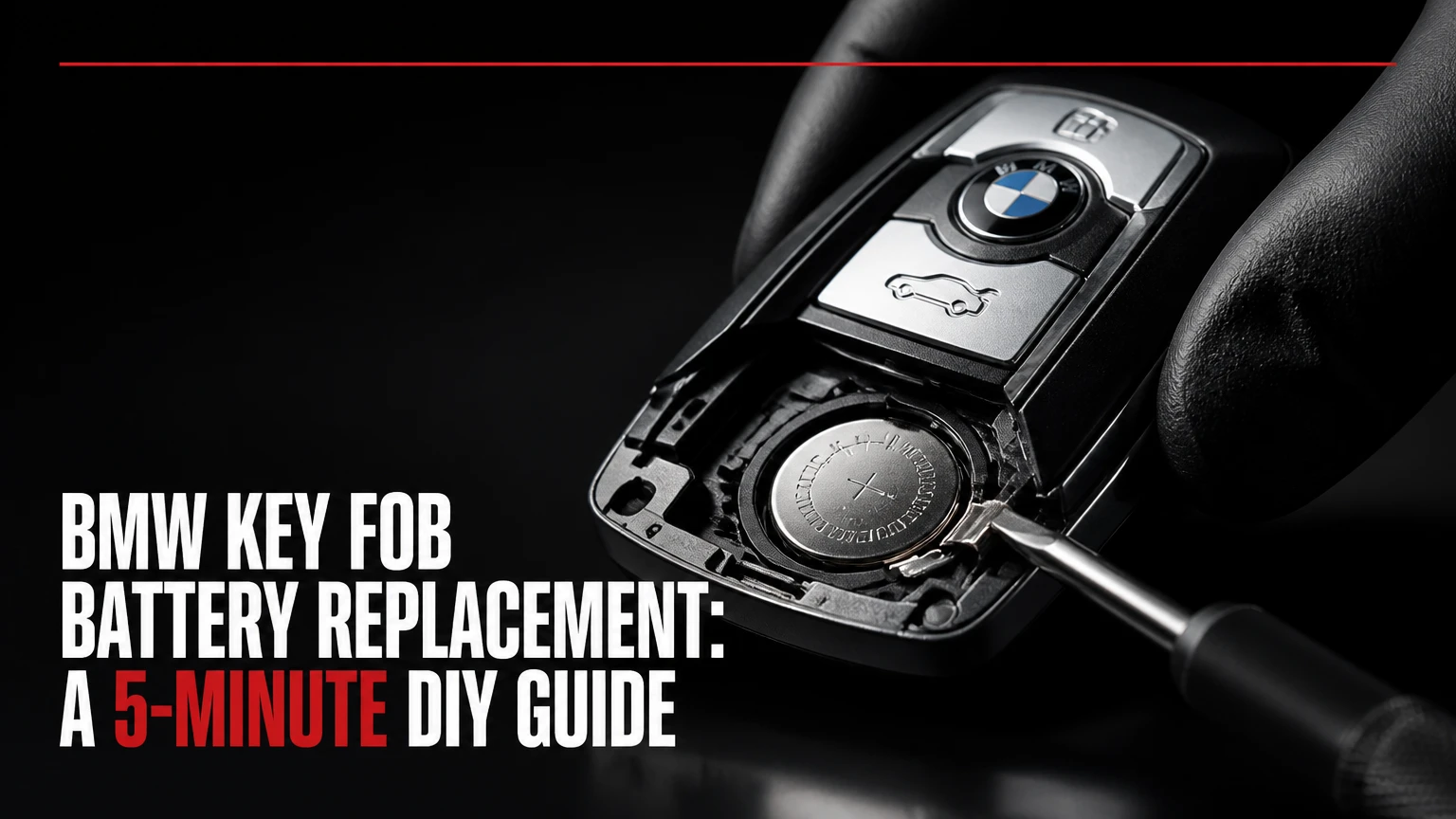
BMW key fob battery replacement usually takes 2-5 minutes and costs $4-$10 when the fob uses a replaceable CR2032 or CR2450 coin cell. Remove the valet key, open the designated cover or tray, match the old battery number and polarity, install the new cell, and test the buttons. Most replaceable BMW fobs retain their programming after battery replacement.
Key Facts at a Glance
- A BMW key fob battery should be identified from the installed battery marking, not from vehicle year alone.
- Newer BMW blade-style fobs commonly use a CR2032, while many rectangular Comfort Access fobs use a CR2450.
- Older diamond-shaped BMW keys usually contain a rechargeable VL2020 cell soldered to the circuit board.
- BMW Display Keys are charged through USB or a vehicle charging tray; their internal battery is generally not designed for home replacement.
- Replacing a normal coin cell does not usually erase the key’s immobilizer authorization or remote pairing.
- A dead remote battery does not necessarily prevent the vehicle from starting because BMW passive-start systems use a separate close-range transponder function.
Before You Start
BMW key fob battery replacement is simple only after the fob type and cell specification are confirmed. Prepare the replacement battery, a clean work surface, and a nonmetallic pry tool; most newer replaceable-cell keys need no programming equipment and no vehicle disassembly.
| Requirement | Typical specification | Why it matters |
|---|---|---|
| Replacement battery | CR2032, CR2450, or VL2020 | Diameter alone does not confirm fit |
| Work time | 2-5 minutes | Longer time usually indicates a stuck cover or wrong procedure |
| Battery cost | $2-$8 per pack | Panasonic, Energizer, Sony, and Duracell are common choices |
| Tools | Valet key plus plastic pick | Reduces scratches and accidental shorting |
| Difficulty | Low for replaceable cells | High for soldered rechargeable cells |
| Test condition | Vehicle nearby, doors unlocked | Confirms lock, unlock, trunk, and comfort functions |
Use the exact number printed on the old cell whenever possible. A CR2032 and CR2025 share a 20-millimeter diameter, but a CR2032 is 3.2 millimeters thick and a CR2025 is 2.5 millimeters thick; the thinner cell can create unreliable electrical contact in a holder designed for CR2032.
Keep coin cells away from children and pets. The U.S. Consumer Product Safety Commission classifies button and coin batteries as an ingestion hazard, so tape the old cell and take it to a battery recycling collection point rather than placing it loose in household waste.
Which Battery Does Your BMW Key Use?
The installed battery marking is the most reliable identification method because BMW used overlapping key designs across model generations, markets, equipment packages, and replacement-key revisions. Model year can narrow the possibilities, but it cannot safely replace direct inspection.
| Fob appearance | Common BMW application | Typical cell or power source | User replacement |
|---|---|---|---|
| Slim blade-style body | Many G-Series 3 Series, 5 Series, X5, and X7 models | CR2032 | Yes, if fitted with a removable tray |
| Rounded rectangular Comfort Access body | Many F-Series 3, 4, 5, and X models | CR2450, some CR2032 versions | Yes |
| Diamond-shaped integrated buttons | Many E-Series vehicles, including E46 and E39 | Rechargeable VL2020 | Usually requires soldering |
| Touchscreen Display Key | Selected 5 Series, 7 Series, i8, X5, and X7 vehicles | Internal lithium-polymer cell | No ordinary user replacement |
| Older rectangular non-Comfort Access key | Certain E-Series and early F-Series applications | Rechargeable internal cell or model-specific cell | Varies by exact part |
Inspect the back before inserting a tool. A removable battery door, slide-out tray, or molded pry notch indicates a serviceable design. A smooth, permanently bonded shell suggests a rechargeable or sealed key, where cutting the case can damage the transponder, circuit board, or waterproofing.
BMW part numbers printed inside the shell can also help. If the key has already been replaced, the fob part number and battery marking are more useful than the vehicle’s original build year.
BMW Key Fob Battery Replacement Steps
The replacement process depends on the shell, but replaceable BMW fobs follow the same sequence: remove the mechanical key, open only the battery access point, replace the cell with matching polarity, and test every function before discarding the old battery.
Step 1: Remove the Mechanical Key
Press the release button and pull out the emergency or valet key blade. The blade is normally used to unlock the driver’s door manually and may also provide leverage at the battery cover notch.
Do not insert the blade into an arbitrary seam. BMW shells have retaining clips, decorative joints, and circuit-board edges that can be damaged by force.
Success checkpoint: The metal blade comes free without bending, and the fob remains closed.
Common mistake: Pulling on the key ring or forcing the shell before removing the blade.
Step 2: Open the Battery Cover or Tray
Locate the small slot near the blade opening, lower edge, or rear cover. Insert the blade tip or a plastic pick, then twist gently rather than levering upward aggressively.
Some blade-style BMW keys use a sliding battery tray instead of a hinged cover. Pull the tray straight out after releasing its latch. Do not pull on the green circuit board, because the board is not the battery holder.
Success checkpoint: The cover separates at its designed seam, or the tray slides out with moderate resistance.
Common mistake: Working at the decorative shell seam instead of the marked access notch.
Step 3: Record Battery Orientation
Before removing the old cell, note the side facing upward and photograph the holder if necessary. In many BMW replaceable fobs, the positive side marked “+” faces outward or upward, but the holder’s stamped polarity symbol is the final authority.
Touch the battery edges rather than both flat faces. Finger oils rarely prevent operation, but clean handling reduces contamination on small contacts.
Success checkpoint: You can identify both the battery number and the positive terminal position.
Common mistake: Assuming every BMW key places the positive side in the same direction.
Step 4: Install the Matching Cell
Lift the old battery with a plastic pick or fingernail and install the same specification. Use a CR2032 only where the fob calls for CR2032, and use a CR2450 where the holder is designed for the thicker 24.5-millimeter cell.
Do not stack two thinner batteries. The combined voltage and mechanical fit are unsafe, and the extra height can deform contacts or crack the case.
Success checkpoint: The cell sits flat, the retaining clip contacts its edge, and the polarity mark matches the holder.
Common mistake: Substituting a CR2025 for a CR2032 because both cells are 20 millimeters wide.
Step 5: Close the Fob and Test It
Snap the cover fully into place, reinstall the mechanical blade, and press lock, unlock, trunk, and panic functions beside the vehicle. Test Comfort Access by touching the door handle only after the normal buttons work.
A brief delay can occur while the vehicle recognizes the first command, but repeated button presses are unnecessary. Test the spare key separately because a weak spare may have a separate battery problem.
Success checkpoint: The locks respond consistently from a normal distance, and the key blade remains securely retained.
Common mistake: Testing only one button, which can hide a damaged trunk switch or worn unlock contact.
How Do Blade-Style BMW Keys Open?
Blade-style BMW keys commonly open through a removable tray or a small rear access cover, and many use a CR2032. The metal emergency blade releases first, after which the battery tray can be slid out or the cover can be lifted at its molded notch.
The exact design differs between G-Series and other newer keys. Some fobs expose the tray near the blade slot; others require a plastic tool at a narrow rear indentation. A rigid cover that does not move with light pressure is a signal to stop and inspect the shell again.
A blade-style key is not automatically rechargeable merely because it has no visible battery door. Check for a removable tray, a replacement part number, or the existing battery marking before cutting or heating the housing.
How Do Rectangular Comfort Access Keys Open?
Rectangular BMW Comfort Access keys usually open after the valet blade is removed and the blade tip is inserted into a notch along the lower rear edge. Many use a CR2450, although some versions use a CR2032, so the cell number must be verified before purchase.
Comfort Access keys often have a deeper battery seat than standard remote keys. A plastic pick can lift the old cell from its edge, while a metal screwdriver can bridge the positive and negative terminals and discharge the cell.
| Observed feature | Likely interpretation | Correct action | Risk if misread |
|---|---|---|---|
| Removable rear cover | Replaceable-cell Comfort Access fob | Open at molded notch | Broken retaining tabs |
| Solid rear shell | Sealed or rechargeable design | Confirm part number first | Cracked housing |
| Printed CR2450 | Thick 24.5-millimeter coin cell | Install CR2450 | Poor fit with thinner cell |
| Printed CR2032 | 20-millimeter, 3.2-millimeter cell | Install CR2032 | Cover pressure if oversized |
| Deep battery recess | Protected internal holder | Lift edge carefully | Bent contact spring |
Replace the cover before testing the vehicle. The shell supplies mechanical pressure that keeps the battery against its contact, so a key can appear functional while open but fail after careless assembly.
What About Older Diamond Keys?
Older diamond-shaped BMW keys generally use a rechargeable VL2020 battery that charges while the key is in the ignition and the vehicle is running. The cell is commonly soldered or welded to the circuit board, so it is not equivalent to a removable CR2032 replacement.
First, place the key in the ignition and drive for at least 30 minutes, provided the vehicle and key are otherwise safe to use. A key that works after charging may have a depleted rechargeable cell rather than a failed remote circuit.
A failed VL2020 usually leaves three options:
| Repair route | Typical cost | Technical demand | Main limitation |
|---|---|---|---|
| BMW dealer key | $200-$500 or more | Low for owner | VIN verification and ordering time |
| Automotive locksmith repair | $50-$150 | Low for owner | Availability varies by region |
| Electronics repair | $30-$100 | Moderate to high | Requires correct solder-tab VL2020 |
| DIY shell and cell repair | $15-$40 in parts | High | Cutting can damage board and immobilizer |
A soldered-cell repair requires a battery with the correct tabs, polarity, chemistry, and charging characteristics. Installing a non-rechargeable CR2032 into the charging circuit can create leakage, overheating, or circuit damage.
BMW owner-handbook battery warnings often use the message, “Remote control battery is discharged.” The wording varies by model, but the message identifies low remote power, not necessarily a failed vehicle immobilizer system.
Can a BMW Display Key Battery Be Replaced?
A BMW Display Key normally should be charged through its USB port or the vehicle’s compatible wireless charging area rather than opened at home. The internal lithium-polymer battery is not designed as a routine user-replaceable coin cell, and case damage can compromise the touchscreen, antenna, or security electronics.
Charge the Display Key with the specified cable and a stable power source, then allow enough time for the screen to respond. If the key loses charge rapidly after a full cycle, an electronics specialist may replace the internal cell, but repair quality depends on the technician and replacement battery.
A dealer replacement is the safer choice when the key is under warranty, physically swollen, water-damaged, or needed as the only available key. Do not puncture, crush, or heat a lithium-polymer pouch cell.
Does Replacing the Battery Erase BMW Key Programming?
Replacing a normal BMW coin cell does not usually erase the key’s remote pairing or immobilizer authorization because those functions are stored in nonvolatile electronics, not in the battery. A key that remains unresponsive after a new cell usually has a polarity, contact, synchronization, button, or vehicle-side fault.
Use this order of diagnosis:
- Confirm the battery number and positive-side orientation.
- Inspect the holder for a flattened or bent contact.
- Test the new cell with a multimeter or install a second known-good cell.
- Lock and unlock the vehicle with the spare key.
- Follow the exact synchronization procedure for the vehicle generation if remote buttons remain inactive.
Some older BMW remote systems use a lock-unlock synchronization sequence after battery replacement or prolonged disuse. The sequence commonly involves entering the vehicle, switching the ignition off, holding unlock, and pressing lock several times, but procedures vary by model and market. A generic sequence should not be treated as universal programming.
Synchronization affects remote button commands. It does not create a new immobilizer key. Adding a replacement key to the vehicle’s anti-theft system requires security access, a compatible key, and often a BMW dealer or qualified automotive locksmith.
Why Does Comfort Access Drain Batteries Faster?
BMW Comfort Access fobs can use more battery power than standard remotes because the key participates in proximity detection and may respond while carried near the vehicle. A replaceable Comfort Access battery commonly lasts 1-2 years, while a standard remote may last 3 years or longer, although temperature, button use, and signal exposure change the result.
Store a spare key several feet away from the vehicle when possible. Keeping a Comfort Access key beside the car, especially in a garage, can increase communication activity and shorten battery life.
A sudden range reduction is an early warning. Replace the cell when the vehicle reports a low remote battery, the lock range becomes inconsistent, or Comfort Access works only when the fob is very close.
What If the New Battery Does Not Work?
A new BMW key battery that fails immediately is most often installed backward, seated loosely, damaged during prying, or incorrectly identified. If the battery and contacts are correct, test the spare key and the vehicle battery before buying a replacement fob.
| Symptom after replacement | Likely cause | Recovery action |
|---|---|---|
| No buttons work | Reversed cell or dead new battery | Confirm polarity and test another cell |
| Works only when pressed hard | Loose contact spring | Inspect holder, avoid bending excessively |
| Lock works, trunk fails | Worn or damaged trunk switch | Arrange fob button repair |
| Short range on both keys | Vehicle receiver or interference | Test outdoors, then diagnose vehicle |
| Comfort Access fails, buttons work | Passive-entry antenna or settings issue | Test spare and inspect vehicle system |
| Car says key not detected | Low fob power or vehicle battery | Use emergency start position and test both batteries |
| Shell will not close | Wrong thickness or mis-seated cell | Match specification and reseat cover |
A multimeter reading near the nominal 3 volts does not prove a coin cell can deliver current under load. The most practical test is a fresh, reputable cell installed in the correct holder, followed by comparison with the spare key.
Do not scrape circuit-board components or flood the fob with contact cleaner. Moisture, solvent, and static damage can turn a simple battery job into a key replacement.
Can You Start a BMW With a Dead Key Battery?
A BMW can often start with a dead remote battery because the passive transponder or emergency recognition system operates at close range. Hold the fob against the marked steering-column area or place it in the designated key receptacle, then press the Start/Stop button while pressing the brake.
The exact recognition location differs by chassis. Consult the vehicle handbook for the key symbol or insert slot, and use the mechanical blade to unlock the driver’s door if the remote buttons fail.
| Vehicle access situation | Immediate action | Expected result |
|---|---|---|
| Remote unlock fails | Remove valet blade | Manual driver-door entry |
| Key not detected | Hold fob at marked recognition point | Engine authorization may occur |
| Older BMW with key slot | Insert fob or key as designed | Close-range recognition |
| Vehicle battery also weak | Use a jump-start procedure | Fob repair alone will not restore power |
| No recognized key available | Contact dealer or automotive locksmith | Security programming may be required |
Emergency starting is a temporary workaround. It does not restore remote locking, trunk release, alarm control, or Comfort Access.
How Much Does Replacement Cost?
DIY replacement typically costs $4-$10 and takes 2-5 minutes for a replaceable CR2032 or CR2450. Dealer or locksmith pricing rises when the key is sealed, rechargeable, damaged, lost, or requires immobilizer authorization rather than a simple battery.
| Service or part | Typical price range | Typical time | Best use case |
|---|---|---|---|
| CR2032 or CR2450 multipack | $4-$10 | 2-5 minutes | Replaceable modern fob |
| Dealer battery service | $15-$50 | 15-45 minutes | Owner wants low-risk handling |
| Locksmith rechargeable-key repair | $50-$150 | 30-90 minutes | Diamond key battery failure |
| New dealer key | $250-$800 or more | Several days to weeks | Lost, damaged, or unrepairable key |
| Display Key replacement | $300-$800 or more | Several days to weeks | Failed screen or internal battery |
Prices vary with region, vehicle security requirements, key availability, and whether the provider must verify ownership. A battery service should not be priced like a full key replacement unless the fob requires internal soldering or security programming.
Dealer, Locksmith, or DIY: Which Is Best?
DIY is the best choice for a clearly replaceable CR2032 or CR2450 fob with an intact shell and accessible battery tray. A locksmith is usually the practical middle option for soldered diamond keys, while a dealer is preferable for Display Keys, lost keys, warranty claims, and immobilizer programming.
Choose DIY when the battery marking is visible and the cover opens at a defined notch. Choose a locksmith when preserving the original immobilizer electronics matters but the rechargeable cell is no longer holding charge. Choose a BMW dealer when ownership verification, key ordering, or factory-specific programming is required.
The limitation is significant: online battery guides cannot reliably identify every regional key revision. The fob in your hand controls the correct procedure.
Common Mistakes and How to Fix Them
- Buying by BMW model alone: Check the old cell, fob part number, or holder marking before ordering.
- Using CR2025 in a CR2032 holder: Replace it with the specified 3.2-millimeter cell to restore contact pressure.
- Prying the shell at the wrong seam: Stop, reinstall the valet blade, and locate the molded battery notch.
- Shorting the coin cell with metal tools: Remove the battery with a plastic pick and avoid bridging both terminals.
- Cutting open a sealed key casually: Use a locksmith or electronics technician when the cell is soldered.
- Assuming a new battery fixes every fault: Compare the spare key, inspect vehicle battery voltage, and test range outdoors.
One practitioner rule prevents many failures: never discard the old battery until the replacement key passes every function test. The original cell confirms the specification and provides a useful comparison if the new one behaves unexpectedly.
Frequently Asked Questions
How long should a BMW key fob battery last?
A standard BMW remote battery often lasts about 3 years or longer, while a Comfort Access battery commonly lasts 1-2 years because proximity communication increases usage. Cold temperatures, frequent button presses, storage beside the vehicle, and poor-quality cells can shorten those typical periods.
Can I use any brand of CR2032 in a BMW key?
A reputable CR2032 from Panasonic, Energizer, Sony, or Duracell is generally suitable when the fob specifies CR2032. Brand matters less than correct thickness, fresh stock, intact packaging, and proper polarity. Avoid unmarked cells because inconsistent voltage or capacity can cause intermittent remote operation.
Why does my BMW key work only near the car?
Short range usually indicates a weak battery, poor battery contact, radio interference, damaged fob electronics, or a vehicle receiver fault. Install a known-good cell, test the spare key, and compare operation outdoors. If both keys have short range, investigate the vehicle rather than replacing both fobs.
Will a BMW key charge while driving?
A diamond-shaped BMW key with a rechargeable VL2020 cell can charge while inserted in the ignition and the vehicle is running. A CR2032 or CR2450 key does not recharge. A Display Key charges through its USB connection or compatible wireless charging tray.
What should I do if I lost my only BMW key?
Contact a BMW dealer or qualified automotive locksmith with proof of ownership, vehicle identification, and registration documents. A new key requires security authorization and may take days to obtain. A replacement coin-cell battery cannot solve a lost-key problem.
Is a BMW key fob waterproof after battery replacement?
A BMW key may tolerate limited incidental moisture, but opening the shell can weaken its original sealing. Keep the fob dry, ensure every clip and gasket is correctly seated, and replace a cracked shell. Water damage can affect buttons, the antenna, and immobilizer electronics even after a successful battery change.
The Bottom Line
BMW key fob battery replacement is usually a short, low-cost repair when the fob uses a removable CR2032 or CR2450 cell. Identify the battery from the key itself, preserve polarity, avoid forcing the case, and test every function before closing the job. Older diamond keys and Display Keys require different treatment because their rechargeable batteries are sealed or soldered. For the ordinary modern remote, a correct cell restores operation without reprogramming.