BMW key fob cover replacement usually means either fitting a protective cover over a working remote or transferring the original electronics into an empty replacement shell. A shell swap normally takes 15-30 minutes and does not require programming, but compatibility, battery orientation, and safe PCB transfer determine whether the repaired key works.
Key Facts
An empty BMW replacement shell normally retains the original PCB, buttons, transponder, and vehicle pairing.
A silicone cover installs in about one minute without opening the key.
BMW F-series and G-series keys commonly use clipped housings, while many E-series keys use glued seams.
A replacement shell does not repair a failed circuit board, dead transponder, damaged antenna, or worn-out battery contacts.
Match the key’s shape, button count, blade arrangement, FCC ID, and internal layout before ordering.
Typical aftermarket shell prices range from $5-$25, while locksmith or dealer solutions can cost substantially more.
What Does BMW Key Fob Cover Replacement Mean?
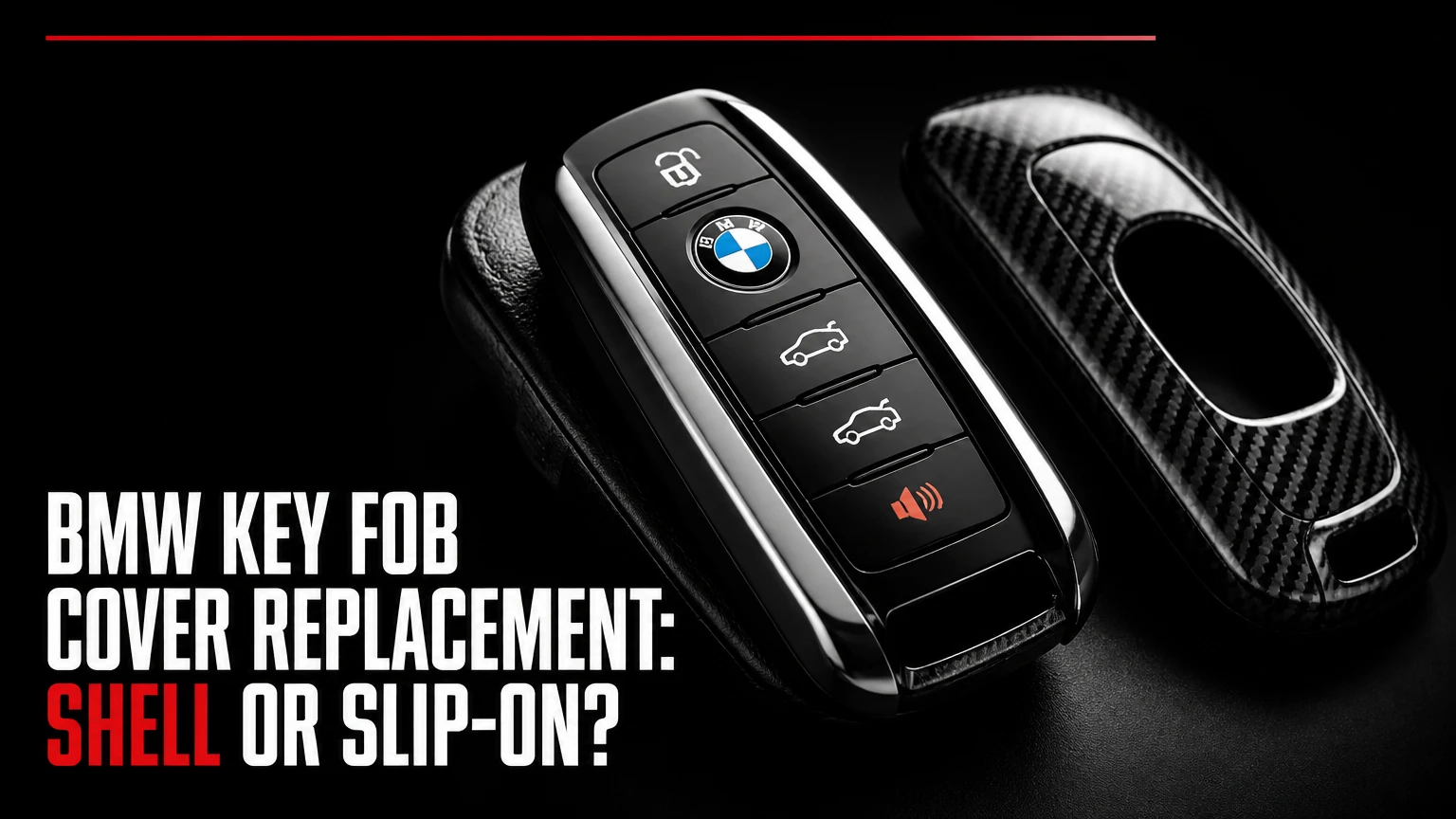
BMW key fob cover replacement has two distinct meanings. A slip-on cover protects the original remote externally, while a replacement shell removes the old housing and reuses the original electronic assembly inside a new case.
The distinction matters because the two repairs solve different problems. A silicone or TPU skin hides scratches and absorbs impact, but it cannot restore broken button mounts or a cracked battery hatch. An empty shell can restore those physical parts, but the transfer process exposes the circuit board to static, pry damage, and incorrect assembly.
A BMW remote contains more than a plastic enclosure. Depending on the generation, the assembly may include a PCB, rubber or plastic button interface, coin-cell battery compartment, emergency blade, inductive charging coil, radio antenna, and immobilizer transponder. Some older keys use a separate transponder capsule, so the original key must not be discarded until every internal component has been identified.
Which repair matches the damage?
| Key condition | Recommended solution | Typical time | Main limitation |
|---|---|---|---|
| Surface scratches only | TPU or silicone cover | 1-2 minutes | Adds 2-5 mm bulk |
| Cracked battery door | Empty replacement shell | 15-30 minutes | Requires PCB transfer |
| Sticky or collapsed buttons | Replacement shell with new button pad | 20-35 minutes | Wrong pad causes poor travel |
| Dead remote electronics | Locksmith diagnosis or new programmed key | 30 minutes to several days | Shell alone will not fix PCB |
| Broken emergency blade | Shell with compatible blank blade | 20-45 minutes | Blade requires cutting |
| Water-damaged PCB | Professional electronic inspection | 1-3 business days | New plastic cannot restore electronics |
Does a Shell Replacement Require Programming?
An empty BMW key shell generally does not require programming because the original PCB and immobilizer components remain paired with the vehicle. Programming becomes relevant when the PCB, transponder, or complete remote is replaced, not when only the exterior housing changes.
The original electronics carry the remote’s identity and, on many BMW systems, the immobilizer information. Moving that assembly into a mechanically compatible shell preserves the relationship with the car. The new plastic has no electronic identity to program.
The exception is a shell that includes a replacement PCB, battery board, or complete uncut remote. Those products are not empty housings even when the listing uses the word “shell.” A new remote may require vehicle-specific coding, key-learning equipment, or a specialist locksmith.
A key that fails immediately after a shell swap usually has a mechanical or electrical assembly problem. Common causes include a reversed coin cell, a PCB sitting above its locating posts, a missing button membrane, a dislodged transponder, or an antenna obstructed by metal.
How Do You Choose the Correct BMW Key Shell?
Choose a BMW shell by matching the original key’s physical architecture rather than relying on a broad vehicle fitment list. Confirm generation, button count, emergency-blade position, Comfort Access design, FCC ID where present, and the interior PCB layout.
Vehicle model alone is insufficient. A BMW 3 Series can use different remotes across E90, F30, and G20 production periods, and a three-button standard key is not automatically interchangeable with a four-button Comfort Access key. Compare photographs of the front, rear, side release, blade channel, and open interior.
| Identification check | What to compare | Example mismatch | Likely result |
|---|---|---|---|
| Vehicle generation | E90, F30, G20, F15, G05 | F30 shell for E90 key | PCB will not seat |
| Button count | 3, 4, or 5 buttons | 3-button pad for 4-button PCB | Missing function or poor fit |
| Key profile | Blade, trapezoid, rectangular, display style | Standard key for Comfort Access | Incorrect cavity dimensions |
| Side release | Release button position and travel | Opposite-side release | Emergency blade cannot release |
| FCC ID | Printed identifier where available | KR55WK49127 versus NBGIDGNG1 | Different electronic architecture |
| Rear cover | Battery hatch shape and latch | Rechargeable key versus coin cell | Cover will not close |
| Interior layout | Posts, ribs, clips, antenna area | Different PCB registration points | Buttons may remain pressed |
FCC ID matching is useful, but it is not a universal guarantee. Some replacement shells omit or imitate identifiers, and regional BMW keys may use different markings. Interior photographs and direct measurement remain the final checks.
Which BMW Key Cover Type Should You Buy?
The best option depends on whether the original housing still functions. TPU is the safest choice for cosmetic wear, an empty hard shell is the practical choice for broken plastic, and metal or carbon-fiber cases suit appearance-focused owners who accept extra weight and possible antenna interference.
| Cover type | Typical price | Installation time | Protection and fit | Best application |
|---|---|---|---|---|
| TPU or silicone skin | $3-$12 | 1-2 minutes | Flexible, adds bulk, no PCB exposure | Scratches and drop protection |
| Empty hard shell | $5-$25 | 15-30 minutes | Factory-like shape, requires transfer | Broken housing or sticky buttons |
| Hard shell with blade | $8-$30 | 20-45 minutes | Includes cuttable blank blade | Lost or damaged emergency blade |
| Metal alloy case | $20-$60 | 5-10 minutes | Heavy, screw-secured, rigid | Cosmetic customization |
| Carbon-fiber frame | $20-$60 | 5-10 minutes | Light relative to metal, variable antenna clearance | Premium appearance |
| Complete replacement remote | $150-$500+ typical | Locksmith-dependent | New electronics and programming | Lost, dead, or irreparable key |
Prices vary by country, seller, generation, and whether the product includes a blank blade. BDT 300-1,200 is a typical local range for silicone covers, BDT 500-2,500 for empty shells, and BDT 2,000-6,000 for premium metal or carbon-fiber cases. Cutting a blade can add approximately $10-$30 through a locksmith.
Are metal BMW key covers safe for Comfort Access?
Metal BMW key covers can reduce Comfort Access reliability when the case surrounds the remote antenna or creates poor clearance around the original housing. A metal case is not automatically incompatible, but the product needs an antenna opening, accurate fit, and a return option.
Comfort Access uses low-frequency vehicle detection and radio communication between the vehicle and key. A poorly designed conductive enclosure can reduce range or create inconsistent touch-to-unlock behavior, particularly when the key is in a pocket or behind the body.
Test every function after installation. Check lock, unlock, trunk release, remote start where equipped, passive door unlocking, passive locking, and vehicle-start recognition. If range falls sharply, remove the metal cover before diagnosing the BMW remote itself.
What Tools and Parts Are Needed?
A shell swap requires the correct empty housing, a plastic pry tool, a clean work surface, and the original battery. A precision flat screwdriver can help, but plastic tools reduce scratches and PCB damage.
Before You Start
Time: 15-30 minutes for a clipped F-series or G-series shell
Difficulty: Moderate, with a higher risk on glued E-series housings
Parts: Correct empty shell, button pad if supplied, compatible coin cell if needed
Tools: Plastic trim pick, small flat tool, clean tray, nitrile gloves, lint-free cloth
Prerequisite: Confirm the original key locks, unlocks, and starts the car before opening it
Safety: Keep the original housing and every internal part until the replacement passes testing
Take a photograph of the open key before moving the PCB. That image records button orientation, battery polarity, spring contacts, and the position of any small transponder capsule.
How Do You Replace a BMW Key Fob Cover?
A modern clipped BMW key shell can usually be replaced in six stages: remove the emergency blade, open the battery hatch, separate the housing, transfer the electronics, reassemble the shell, and test every function. The most important success factor is matching the new housing to the original PCB.
Step 1: Remove the emergency blade
Press the small release button on the side or rear of the BMW key and pull the mechanical blade outward. Place the blade on the work surface because it may later act as the opening tool.
Do not force the blade sideways. The release button should move a short distance, and the blade should slide from its channel without twisting.
Checkpoint: The blade is completely removed and the release button returns to its normal position.
Common mistake: Losing the blade inside the old shell and ordering a housing with an incompatible blank.
Step 2: Remove the battery hatch and battery
Insert the blade tip or a plastic pick into the release notch inside the blade channel. Lift the battery cover gently, then remove the coin cell and record its orientation.
Many BMW remotes use a CR2032 coin cell, while some older or rechargeable designs use a different battery arrangement. Read the marking on the installed battery and compare the positive and negative symbols before replacement.
Checkpoint: The hatch separates without bending its latch, and the battery polarity is documented.
Common mistake: Assuming every BMW key uses a CR2032 or reinstalling the cell upside down.
Step 3: Separate the housing halves
Start at the structural seam inside the key-blade channel, where the shell usually provides a designed opening point. Insert a plastic pry tool only a few millimeters, twist gradually, and work around the clips.
Use controlled pressure rather than repeated deep insertion. On many F-series and G-series keys, the PCB sits close to the shell wall, and a screwdriver driven too far can break a capacitor, antenna trace, or battery contact.
Checkpoint: The halves release progressively without visible PCB contact or cracked locating posts.
Common mistake: Prying near the button face, where the board and button supports are most vulnerable.
Step 4: Transfer the PCB and internal parts
Ground yourself against a suitable unpainted metal surface before touching the board, then lift the PCB by its edges. Transfer the original rubber button membrane, light pipe, battery contacts, charging component, and separate transponder capsule if the design uses them.
Never scrape the board with metal tools. Keep small components in a tray, because a loose immobilizer transponder can be smaller than a fingernail and may not be attached to the PCB.
Checkpoint: The PCB sits flush in every registration channel, with no corner raised and no button held down.
Common mistake: Discarding the original shell before confirming that the transponder and button parts transferred.
Step 5: Assemble the replacement shell
Place the front and rear shell sections together without pressing fully. Confirm that each button moves freely, the battery contacts meet the cell, and the emergency-blade channel remains unobstructed.
Snap the housing together from the center outward, applying pressure only where the shell has clips. A replacement case that needs excessive force is usually the wrong design or contains a misaligned component.
Checkpoint: The seam closes evenly, buttons click independently, and the battery hatch latches without a gap.
Common mistake: Pinching the rubber membrane between the shell halves, which produces a permanently pressed or weak button.
Step 6: Test the key before final disposal
Test the remote beside the car, then test starting authorization and passive entry if the BMW has Comfort Access. Check the emergency blade in the driver’s door before placing the key into regular service.
If the remote does not respond, verify battery polarity, battery voltage, board seating, and button alignment first. Holding the key against the steering-column key symbol may allow an emergency start on some BMW models, but that procedure does not reprogram or “re-link” the key.
Checkpoint: Lock, unlock, trunk, start authorization, and passive functions operate as they did before.
Common mistake: Treating emergency-start recognition as proof that the remote transmitter is working.
What Changes Between E-Series, F-Series, and G-Series Keys?
E-series BMW keys often present the highest shell-replacement risk because many housings are ultrasonically welded or glued, while F-series and G-series designs more commonly use clipped or replaceable sections. Model year alone still cannot identify the correct case.
| BMW key family | Common housing condition | Battery arrangement | Repair implication |
|---|---|---|---|
| E-series diamond-style | Frequently glued or welded | Rechargeable or model-specific | Requires seam cutting or specialist work |
| E-series rectangular | Mixed glued construction | Coin cell or rechargeable | Inspect before ordering |
| F-series standard | Usually clipped shell | Replaceable coin cell on many versions | Suitable for careful DIY transfer |
| F-series Comfort Access | Clipped, model-specific layout | Coin cell or rechargeable design | Match antenna and button layout |
| G-series modern remote | Compact clipped or sealed design | Model-specific battery system | Shell fitment must be exact |
| Display Key | Large specialized housing | Rechargeable internal battery | Ordinary shell listings do not apply |
A glued E-series key should be opened only when the shell’s value and the owner’s repair experience justify the risk. Cutting through the seam can destroy the rechargeable battery, antenna, PCB edge, or transponder. For a single working key, a locksmith may be cheaper than replacing a damaged board and then commissioning another key.
How Much Does BMW Key Housing Repair Cost?
An aftermarket cover or shell usually costs $3-$60, while professional key-housing work commonly costs about $30-$100 and a complete programmed replacement can range from $150 to more than $500. The final price depends on blade cutting, immobilizer programming, battery type, and local labor.
| Repair route | Parts cost, typical | Labor or service cost | Expected completion |
|---|---|---|---|
| Silicone cover | $3-$12 | $0 DIY | 1-2 minutes |
| Empty replacement shell | $5-$25 | $0 DIY | 15-30 minutes |
| Shell plus blank blade | $8-$30 | $10-$30 cutting | 20-45 minutes |
| Locksmith housing transfer | $10-$40 parts | $30-$100 labor | Same day |
| PCB or transponder diagnosis | $0-$50 initial parts | $50-$150 service | Same day to 3 days |
| Dealer-supplied programmed key | $150-$500+ | Included or regional fee | Several days typical |
A dealer may not offer a shell-only service and may quote a complete key. An automotive locksmith can sometimes transfer the housing, cut a blade, test the immobilizer, and diagnose the PCB without ordering a new factory key.
What Problems Occur After a Shell Swap?
Post-repair failures usually come from incorrect fitment or component placement, not from lost vehicle programming. Diagnose the battery, button membrane, PCB seating, antenna clearance, and transponder before assuming that the car needs coding.
| Symptom | Most likely cause | First corrective action |
|---|---|---|
| No buttons respond | Battery reversed or discharged | Reinstall a verified cell correctly |
| One button stays pressed | Membrane misaligned | Reopen and center the rubber pad |
| Key starts car but remote fails | Transmitter battery or antenna issue | Check cell contacts and metal-cover interference |
| Remote works but car will not start | Transponder moved or damaged | Stop using the key and seek locksmith diagnosis |
| Comfort Access range drops | Metal case blocks antenna | Remove case and retest |
| Emergency blade will not release | Wrong shell geometry | Compare release button and blade channel |
| Shell will not close | Wrong PCB layout or trapped part | Do not clamp; compare internal photographs |
| Key works intermittently | Loose contact or cracked board trace | Inspect under magnification |
A shell cannot cure a failed microswitch, cracked solder joint, corroded PCB, or exhausted rechargeable battery. If the original key already had intermittent operation, test the electronics before ordering plastic.
When should you stop the DIY repair?
Stop when the housing is glued, the PCB is cracked, a transponder is loose and unidentified, or the new shell requires force to close. Continuing at that point can convert a low-cost cosmetic repair into a programmed-key replacement.
A professional is also the safer choice when the BMW has only one key, the key is required for daily transport, or the remote contains a rechargeable battery that cannot be safely separated. A locksmith can preserve the original electronics while reducing the risk of immobilizer failure.
Which Option Is Best for Your Situation?
A TPU cover is best for intact keys with surface wear, an empty hard shell is best for damaged plastic and sticky buttons, and a professional transfer is best for glued housings or irreplaceable single keys. Metal cases suit styling needs only when Comfort Access testing confirms acceptable range.
| Owner situation | Best choice | Why | Avoid when |
|---|---|---|---|
| Daily key has scratches | TPU or silicone cover | Lowest risk and fastest installation | The housing is cracked |
| Buttons feel sticky | Hard replacement shell | Replaces worn button supports | PCB switches are electrically failed |
| E-series key is sealed | Locksmith transfer | Limits cutting damage | The key already has severe water damage |
| Comfort Access is essential | Plastic shell or open-frame cover | Preserves antenna clearance | A solid metal case surrounds the antenna |
| Emergency blade is broken | Shell with cuttable blank | Restores mechanical access | Seller cannot confirm blade channel |
| Only one working key remains | Professional inspection | Protects against immobilizer loss | DIY experience is high and shell is clipped |
The most reliable practitioner rule is simple: protect a working key without opening it, but replace the shell only when the damaged housing creates a functional problem. Opening a key increases risk even when the replacement part costs very little.
BMW Key Fob Cover Replacement FAQ
Can I change the BMW key cover without changing the battery?
Yes. A shell transfer can reuse a healthy battery, but replacing a low-cost coin cell while the housing is open is sensible if the old battery is more than two to three years old. Record the original type and polarity, because a fresh but incompatible cell can damage fitment or produce unreliable contact.
Will a replacement BMW shell make my key waterproof?
No. Aftermarket shells rarely reproduce factory sealing tolerances, ultrasonic welds, gaskets, or water-resistant button interfaces precisely. Keep a transferred key away from rain and immersion, particularly around the battery hatch and seam. A silicone over-cover may reduce splash exposure, but it does not make a damaged housing waterproof.
Can I use a three-button shell for a four-button BMW key?
Usually not. The button pad, PCB registration points, and front-shell apertures must match the original four-button layout. A three-button case may physically close while hiding or continuously pressing one switch. Match the number and position of every button before purchase.
Does BMW need the replacement shell’s logo?
No. The logo is cosmetic and does not control the remote, immobilizer, or Comfort Access system. Some aftermarket sellers omit the BMW emblem for trademark reasons. If the emblem matters, verify whether the replacement uses a transferable badge or a recessed insert without assuming that the shell includes one.
Can a locksmith replace only the BMW key housing?
Often, yes. Automotive locksmiths commonly provide shell transfer, blank-blade cutting, battery replacement, and electronic diagnosis, although services vary by country and key generation. Ask whether the quoted service preserves the original PCB and transponder, because a complete new remote follows a different programming and pricing process.
Why does my BMW key start the car but not unlock it remotely?
Starting and remote locking use different parts of the key system. The immobilizer transponder may still work even when the coin-cell battery, transmitter circuit, button membrane, or antenna has a fault. Remove any metal cover, verify battery contacts, and test the original housing before paying for programming.
The Bottom Line
BMW key fob cover replacement is a low-cost repair when the original electronics work and the new shell matches the key precisely. Use a TPU cover for cosmetic protection, an empty hard shell for broken plastic, and a locksmith for glued E-series housings, damaged electronics, loose transponders, or a sole working key. A careful 15-30-minute shell transfer preserves the original programming, but the replacement case itself cannot repair electronic or immobilizer faults.