BMW key fob functions control vehicle access, alarm status, trunk release, comfort features, and, on some models, driver personalization. The exact functions depend on the BMW chassis, production year, equipment package, and market, because a basic remote fob, Comfort Access key, Display Key, and smartphone Digital Key use different hardware and software.
Key Facts at a Glance
- BMW key fob buttons usually control locking, unlocking, trunk access, and an alarm or panic function.
- Comfort Access can unlock or lock a compatible BMW when the key remains in a pocket or bag.
- A dead coin-cell battery may prevent remote buttons from working, but many BMWs still permit emergency starting.
- BMW Digital Key uses a compatible smartphone or wearable, while Digital Key Plus adds proximity detection on supported vehicles.
- Replacement keys require vehicle ownership verification and compatibility with the car’s immobilizer system.
- BMW model year matters more than fob appearance when identifying functions, battery type, and programming requirements.
What Can a BMW Key Fob Do?
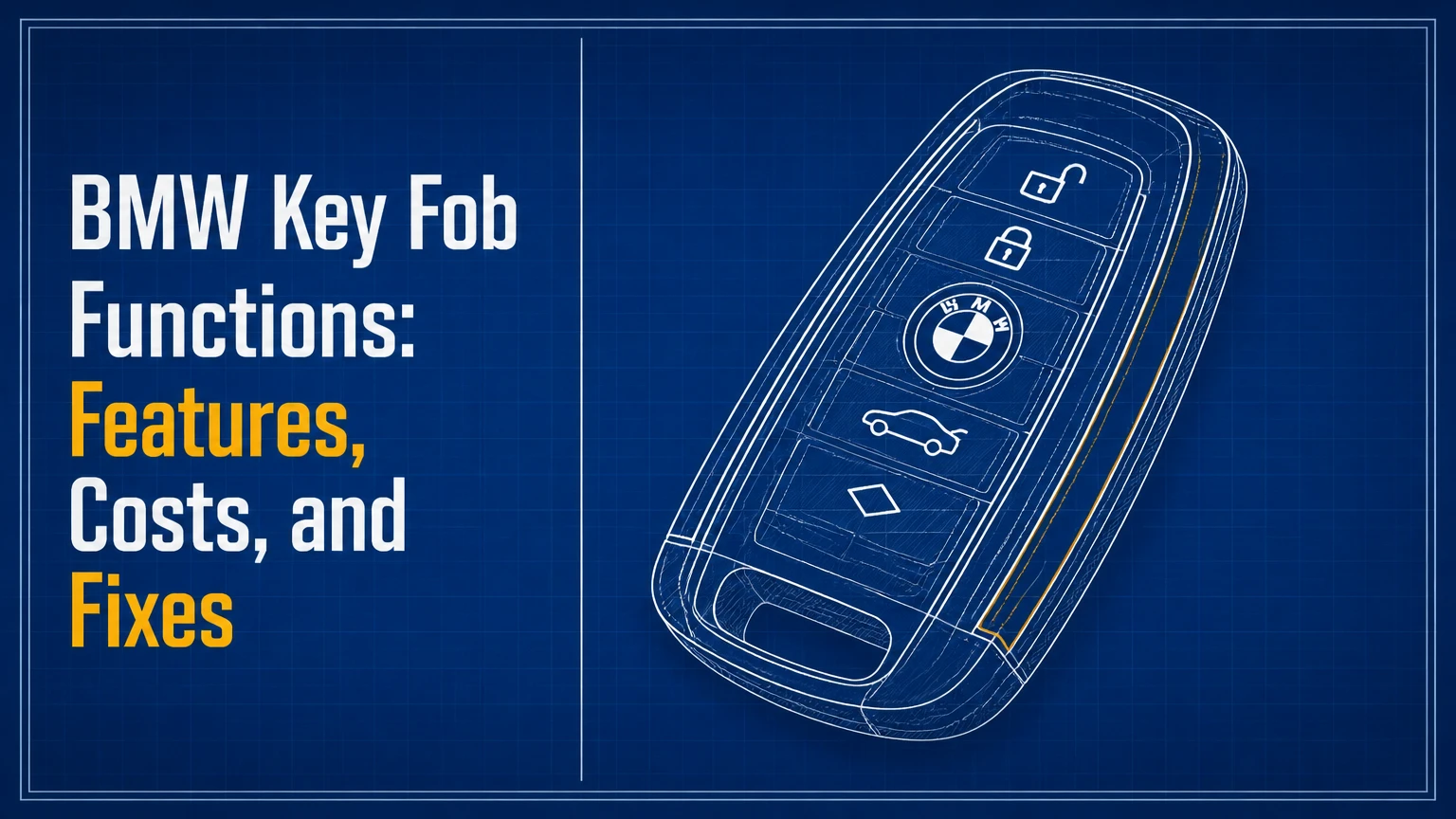
A BMW key fob can lock and unlock the doors, release the luggage compartment, arm or disarm the alarm, and authorize the vehicle to start. Some BMWs add remote window operation, selective unlocking, panic activation, welcome lighting, remote climate control, or remote parking through a Display Key or connected service.
Button layouts differ, but a typical three-button fob has lock, unlock, and trunk buttons. A fourth button may operate a programmable alarm, vehicle locator, or remote function. Holding a button can produce a different command from pressing it briefly, although the available behavior varies by market and vehicle coding.
| Function | Typical input | Vehicle response | Main limitation |
|---|---|---|---|
| Lock doors | Press lock once | Doors lock and alarm may arm | Vehicle must receive the signal |
| Unlock doors | Press unlock once | Driver door or all doors unlock | Selective unlocking may be coded |
| Trunk release | Press or hold trunk button | Luggage compartment opens or unlatches | Power trunk hardware is required |
| Panic or alarm | Hold programmable button | Horn and lamps activate | Not fitted to every market |
| Window opening | Hold unlock | Windows lower on supported cars | Often disabled by coding or regulation |
| Window closing | Hold lock | Windows close on supported cars | Requires anti-pinch and model support |
| Vehicle locating | Press lock or app command | Lamps flash, horn may chirp | Range and connected service vary |
The fob does not independently operate every feature it appears to control. The BMW body domain controller, alarm module, comfort-access antennas, and vehicle software determine whether the command is accepted.
Which Hidden BMW Fob Functions Are Real?
Several commonly reported functions are conditional rather than universal. Holding unlock may lower windows on some older BMWs, while holding lock may close them, but modern safety settings and regional coding can disable either command. Pressing the lock button twice may suppress the interior motion sensor on certain models, which helps when a pet remains inside.
The vehicle handbook is the final authority for a specific VIN. BMW service information also distinguishes factory equipment from coding changes, so an internet button sequence cannot guarantee the same result on an E90, F30, G05, and iX.
How Does the BMW Key Security System Work?
A BMW key communicates with the vehicle through a short-range encrypted radio exchange, while a separate immobilizer authorization process permits engine starting. The remote transmitter, passive transponder, vehicle antennas, and CAS, FEM, or BDC control module cooperate, but they are not one universal system shared across all BMW generations.
When a driver presses a button, the fob transmits an authenticated command. The car checks whether the key is authorized, whether the command is valid, and whether the vehicle state permits the requested action. Newer BMWs use modern cryptographic security and rolling or synchronized counters; exact algorithms and frequencies are not universal public specifications.
Starting authorization is a separate security layer. A passive transponder or key electronics must be recognized by the immobilizer, and a valid door-lock signal alone does not authorize the engine. That separation explains why a fob may still lock doors while a damaged transponder prevents starting.
What Are CAS, FEM, and BDC?
CAS, FEM, and BDC are BMW vehicle access and body-control systems used across different generations. E-Series vehicles commonly use EWS or CAS-related architecture, many F-Series vehicles use FEM or CAS modules, and newer G-Series vehicles increasingly use a BDC.
| BMW system | Common period | Primary role | Diagnostic implication |
|---|---|---|---|
| EWS | Older E-Series | Immobilizer and start authorization | Key and transponder compatibility matter |
| CAS | Late E-Series and F-Series | Access, key validation, starting | Battery and module faults can mimic key failure |
| FEM | Selected F-Series | Front electronic body functions | Programming may require specialist equipment |
| BDC | Many G-Series | Body, access, and key management | VIN-specific replacement is common |
| Digital Key controller | Newer compatible cars | Phone, card, and proximity credentials | Phone compatibility is required |
BMW architecture changes by model and production date. A technician should identify the chassis and build date before recommending a fob, battery, or programming procedure.
Which BMW Key Type Do You Have?
BMW key types range from rechargeable diamond-shaped E-Series keys to modern blade-style fobs, touchscreen Display Keys, NFC cards, and smartphone credentials. The physical design is useful for identification, but the vehicle’s production date and optional equipment determine the actual function set.
| Key type | Typical BMW examples | Power source | Distinguishing functions |
|---|---|---|---|
| Diamond key | E39, E46, E53 | Rechargeable internal cell | Ignition-slot charging and physical ignition |
| Comfort Access fob | E60, E70, E90 | Replaceable coin cell on many versions | Passive entry and keyless start |
| Blade or M Sport fob | F-Series, early G-Series | CR2032 or CR2450, depending on part | Remote buttons and proximity access |
| Display Key | Selected G11, G30, G05 | Rechargeable lithium-ion battery | Range, vehicle status, parking on equipped cars |
| NFC key card | Selected newer BMWs | Passive NFC card | Backup entry and start with supported vehicle |
| Digital Key Plus | Selected newer BMWs | Phone or wearable battery | UWB proximity access and sharing |
A Display Key is not automatically compatible with every G-Series BMW. Remote parking, remote ventilation, charging controls, and other screen functions require both the correct key and matching vehicle equipment.
Which BMW Key Fob Battery Do You Need?
The correct battery is printed in the owner’s manual or identified by opening the specific fob, not by BMW series alone. CR2032 and CR2450 cells are common replaceable batteries, while older diamond keys often contain a soldered rechargeable cell that should not be treated like a normal coin-cell replacement.
| Fob situation | Common battery arrangement | Replacement difficulty | Important caution |
|---|---|---|---|
| E-Series diamond key | Internal rechargeable VL2020-type cell | High | Soldering may be required |
| Replaceable Comfort Access fob | CR2032 in many versions | Low | Match polarity and thickness |
| F-Series blade fob | CR2032 or CR2450 | Low to moderate | Confirm part number first |
| Display Key | Internal rechargeable battery | Moderate to high | Charge before diagnosing failure |
| NFC key card | No user battery | None | Card must remain physically usable |
Battery replacement normally does not erase the key’s authorization. Damage from prying the case, incorrect polarity, or a poor-quality cell can, however, create a second fault that resembles lost programming.
How Does Comfort Access Differ From a Standard Fob?
Comfort Access detects an authorized key near the vehicle and permits touch-based locking or unlocking, followed by push-button starting. A standard remote fob requires a button press for entry, although both key types can also include a hidden mechanical blade for emergency door access.
Comfort Access depends on several low-frequency antennas around the doors and cabin, the fob battery, and the vehicle’s access module. A weak battery can reduce passive-entry reliability before button operation stops completely. Metallic objects, RF interference, or a low vehicle battery can also produce intermittent detection.
A useful practitioner rule is to test three conditions separately: button locking, passive handle unlocking, and interior key detection. If only passive entry fails, replace the fob battery and inspect the vehicle battery before replacing an expensive key.
How Does Digital Key Compare With a BMW Fob?
BMW Digital Key is best as a convenient secondary credential, while a physical fob remains the more predictable primary key for long trips, valet use, and a depleted-phone scenario. Digital Key uses NFC on compatible systems, and Digital Key Plus uses Bluetooth and Ultra-Wideband, or UWB, for proximity-aware access.
| Credential | Entry method | Starting method | Sharing | Dead-device fallback |
|---|---|---|---|---|
| Standard fob | Radio buttons | Wireless key authorization | No digital sharing | Mechanical blade and emergency detection |
| NFC card | Tap at designated area | Place card at reader area | Usually limited | Card has no battery |
| Digital Key | Phone NFC or proximity | Phone authorization | Supported app or wallet sharing | NFC may work with supported reserve power |
| Digital Key Plus | UWB proximity | Phone remains with driver | Supported sharing controls | Physical key or card recommended |
| Display Key | Radio and touchscreen | Vehicle recognizes key | Usually no simple text sharing | Standard key recommended |
Compatibility depends on the BMW model, operating system, phone hardware, ConnectedDrive region, and software version. BMW documentation should be checked before deleting a working physical key or relying on a phone as the only credential.
Digital access also creates management issues. Remove old users after a sale, avoid sharing credentials with unrestricted permissions, and keep an NFC card or physical key available when traveling.
Can You Program a BMW Key Fob Yourself?
Most BMW replacement keys cannot be fully programmed by a simple button sequence at home. Some existing fobs can be resynchronized to the remote-locking system, but immobilizer enrollment, VIN assignment, and newer FEM or BDC procedures generally require a dealer or qualified automotive locksmith with security-capable equipment.
A commonly published sequence for some push-button BMWs is to enter the car, close the doors, hold the fob against the marked steering-column location, press the brake, and press Start/Stop. That procedure is an emergency recognition or synchronization method for particular vehicles, not a universal replacement-key programming process.
Before ordering a key, provide the supplier with:
- VIN and exact production date.
- Registration or title and government identification.
- Current key part number or a photograph.
- Comfort Access, Display Key, or Digital Key equipment status.
- The number of working and missing keys.
Do not repeatedly attempt unsupported coding procedures. A failed session can create module faults, immobilize the car, or require recovery before another programming attempt.
How Much Does BMW Key Replacement Cost?
A typical BMW replacement costs about $180-$450 for a standard compatible key through an independent specialist and approximately $300-$900 or more through a dealer, before unusual towing, coding, or module work. Display Keys and complex newer systems can exceed those ranges, while regional labor rates and model equipment create substantial variation.
| Replacement route | Typical price range | Typical time | Best fit |
|---|---|---|---|
| Dealer standard fob | $300-$900 | 2-10 business days | Newer BMW or maximum OEM certainty |
| Independent BMW locksmith | $180-$500 | Same day to 3 days | Supported E-Series and F-Series |
| Display Key replacement | $500-$1,200+ | 3-14 business days | Equipped G-Series vehicles |
| NFC card | $50-$150 | Same day to 7 days | Compatible Digital Key vehicle |
| All-keys-lost service | $350-$1,500+ | 1-3 days | No working key available |
| Module repair or replacement | $500-$2,000+ | 1-10 days | Damaged CAS, FEM, or BDC |
These are typical market ranges, not BMW’s official global pricing. Ask whether cutting, coding, VAT or sales tax, emergency travel, towing, and deletion of lost keys are included.
A dealer normally verifies ownership and orders a compatible key through BMW’s parts and security systems. A reputable locksmith should also verify ownership and explain whether the proposed key is new, refurbished, or aftermarket.
Do Used BMW Key Fobs Work?
A used BMW fob is not a dependable plug-and-play replacement. Many keys retain vehicle-specific authorization data, and some can be reset only with specialist equipment, while others cannot be reused economically; a seller’s claim that a case or circuit board “fits” does not prove immobilizer compatibility.
Aftermarket shells are different from aftermarket electronics. A replacement shell can transfer the original circuit board and blade, whereas a complete used transmitter may fail because of frequency, encryption, immobilizer, or Comfort Access differences.
How Do You Start a BMW With a Dead Key Fob?
A BMW with a dead fob battery can often start by placing the key at the vehicle’s emergency detection point and pressing Start/Stop, but the exact location varies by model. Common locations include a marked area near the steering column, a center-console recess, or a designated cupholder position.
Use this sequence:
- Enter with the mechanical blade if remote unlocking fails.
- Place the fob on the marked emergency-start symbol or documented tray.
- Press the brake pedal on automatic vehicles.
- Press Start/Stop while the fob remains in position.
- Replace the fob battery after the engine starts.
You will know the procedure worked when the instrument cluster recognizes the key and the engine cranks normally. If the car still reports “key not detected,” test the spare key, inspect the vehicle’s 12-volt battery, and check the owner’s manual for the exact emergency position.
A dead fob battery does not necessarily mean a dead transponder. If neither key works, the fault may involve the vehicle battery, antenna, BDC or CAS, or immobilizer communication.
Why Does a BMW Stop Detecting the Key?
BMW key detection commonly fails because of a weak fob battery, a discharged vehicle battery, antenna failure, radio interference, or a key that is incompatible with the vehicle. Replacing the fob immediately is premature when the same symptom affects both working keys.
Use this diagnostic order:
- Test the spare key within the cabin.
- Replace the primary battery with the specified cell.
- Remove the key from a metal wallet or crowded key ring.
- Try the emergency-start location.
- Measure the vehicle battery, especially after repeated short trips.
- Check whether Comfort Access alone has failed.
- Scan the CAS, FEM, or BDC for stored access faults.
Aftermarket window tint is often blamed, but ordinary tint rarely explains a complete no-start condition. Metallic film can reduce radio performance near antennas, yet a total starting failure more strongly suggests authorization, power, or antenna faults.
What Does a Comfort Access Warning Mean?
A “Comfort Access deactivated” message does not prove the fob is defective. BMW may disable passive entry when the vehicle detects low voltage, a system fault, repeated invalid signals, or an issue in the comfort-access antenna network.
The practical response is to use the buttons or mechanical blade, confirm the car battery’s state of charge, replace the fob battery, and obtain a diagnostic scan if the warning returns. Driving for a fixed period is not a guaranteed repair for a failing battery or module.
How Should You Protect BMW Keys From Theft?
BMW owners should store spare keys away from exterior doors and windows, remove unused Digital Key users, and avoid leaving a Display Key or fob in an exposed vehicle. A Faraday pouch can reduce passive relay risk, but it must be tested because poorly made pouches lose effectiveness.
Security steps include:
- Keep the spare key in a tested signal-blocking container.
- Disable or remove credentials belonging to former drivers.
- Lock the vehicle manually and confirm the mirrors or lamps respond.
- Do not leave the mechanical blade with the fob in an unsecured location.
- Use BMW software and ConnectedDrive updates where applicable.
- Ask a dealer or locksmith whether lost keys can be deleted from vehicle access.
A key fob is an access credential, not a theft-prevention guarantee. Relay attacks target passive keyless systems, while a missing credential can create risk even when the vehicle’s alarm works correctly.
BMW Key Fob Functions FAQ
Will changing the BMW key battery erase my settings?
Changing a normal replaceable coin cell typically does not erase vehicle settings or immobilizer authorization. Driver memory is stored by the vehicle and may be associated with a key profile, seat button, user account, or startup selection. A damaged circuit board or incorrect battery installation can cause apparent loss of function.
Why does my BMW unlock only the driver door?
Selective unlocking is a vehicle setting available on many BMWs. The first unlock command may open only the driver door, while a second press opens the remaining doors. iDrive, the owner’s manual, or vehicle coding can change the behavior, so the same button sequence may differ between two BMW model years.
Can a BMW key fob open the windows remotely?
Some BMWs support comfort opening by holding the unlock button, and selected vehicles support closing by holding lock. The feature depends on model, market, software, and coding, and it may be restricted for safety or security reasons. Test the function outdoors, where accidental operation cannot damage the interior.
How many BMW keys should an owner keep?
Two working keys are the sensible minimum for a daily BMW. Replacing a lost spare is usually less expensive than recovering an all-keys-lost vehicle, which may require specialist access, towing, or module work. Store the second key separately rather than leaving both in the same household drawer.
Does a BMW key fob track mileage and service data?
Some BMW keys can store identification or service-related data that technicians may read with BMW diagnostic equipment, but the contents vary by generation and market. The key is not a live GPS tracker. Vehicle control modules and ConnectedDrive services hold the more complete operating and service records.
Is BMW Digital Key available for every BMW?
BMW Digital Key is available only on compatible vehicles, phones, markets, and software configurations. NFC and Digital Key Plus requirements differ, and a compatible phone model alone does not guarantee support. Check the BMW ConnectedDrive compatibility information for the vehicle’s VIN before depending on phone access.
The Bottom Line
BMW key fob functions range from basic locking and trunk release to Comfort Access, driver profiles, Display Key controls, and Digital Key Plus proximity entry. The correct behavior depends on the BMW’s chassis, build date, equipment, battery, and access module. Confirm the exact key part number, keep two credentials, and use a dealer or qualified locksmith for VIN-specific replacement work.