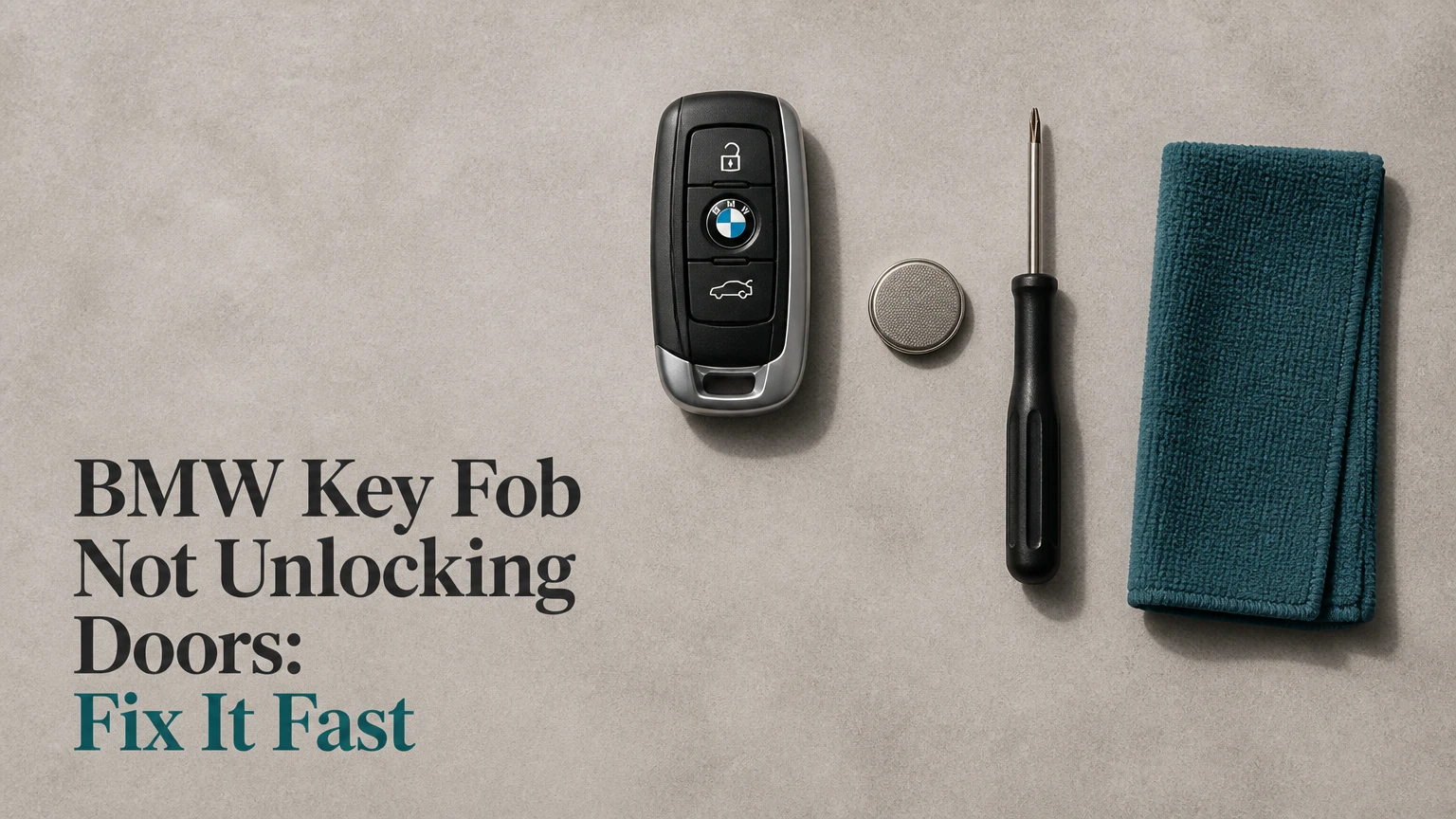
A BMW key fob not unlocking doors usually results from a depleted fob battery, lost synchronization, vehicle battery failure, radio interference, or a fault in the BMW antenna, fuse, GM5 module, CAS, FEM, or BDC. Use the hidden mechanical key first, then compare the behavior of every available fob and the interior central-locking switch before buying a replacement key.
Key Facts at a Glance
- A BMW fob contains an integrated mechanical blade that can unlock the driver’s door when the remote battery is flat.
- A CR2032 and CR2450 battery are not interchangeable in a tight BMW key housing because the CR2450 is thicker.
- If both BMW fobs fail at the same time, the vehicle is more likely to have a fuse, antenna, wiring, module, or low-voltage problem.
- Older rechargeable BMW keys commonly use a soldered VL2020 cell and charge while inserted in the ignition.
- A BMW key that starts the engine but will not unlock remotely has a different fault pattern from a key that the car does not recognize at all.
- Used BMW keys are generally VIN-paired and cannot be freely programmed by the owner.
How Do You Unlock a BMW When the Fob Fails?
You can unlock most BMW vehicles with the integrated mechanical key in approximately 2-5 minutes, although the driver’s-door lock cylinder may sit beneath a removable handle cover. Remove the blade from the fob, expose the lock cylinder without forcing the painted trim, and turn the key manually.
Emergency entry procedure
- Release the mechanical blade. Press the small release tab on the fob spine, then pull the metal blade from its slot.
- Locate the driver’s-door cylinder. Older BMWs may show the keyhole directly. Many F-Series and G-Series handles hide it beneath a plastic cap.
- Remove the handle cap carefully. Insert the blade into the designated slot on the underside or edge of the cap, then lift or slide the cover as the owner’s manual describes. Do not twist against the painted handle.
- Unlock the door manually. Insert the blade fully and turn it in the unlock direction. The alarm may activate because the car detected a mechanical entry rather than a valid remote command.
- Keep the fob with you. Do not leave the key inside the cabin while working around the alarm or ignition.
The mechanical blade unlocks the door but does not operate the remote locking system. It also does not replace the transponder function used by the immobilizer, so an emergency entry and an emergency start are separate events.
Why Does a BMW Fob Stop Unlocking Doors?
A BMW remote unlock command fails when one link in the communication chain cannot transmit, receive, authenticate, or execute the request. The key sends a coded radio-frequency signal, commonly in the 315 MHz or 433 MHz range depending on market, while the car’s antenna system and access module validate the command before activating door-lock actuators.
The likely failure points are the fob battery, damaged button contacts, water intrusion, radio interference, the diversity antenna amplifier, a broken wiring loom, a blown fuse, a weak vehicle battery, or a body-control module fault. BMW terminology changes by generation: E-Series cars may use GM5 and CAS systems, while later cars use FEM or BDC modules.
A practical diagnostic rule is more useful than replacing parts at random: determine whether the vehicle can still lock itself from inside, whether another key works, and whether the remote range changed gradually or disappeared suddenly.
What symptoms identify the failed component?
| Observed symptom | Most likely area | Best next check |
|---|---|---|
| One fob fails, spare fob works | Fob battery, button, or key electronics | Replace the correct battery and test range |
| Both fobs fail simultaneously | Vehicle fuse, antenna, wiring, module, or low voltage | Test interior locking and vehicle battery |
| Remote works only within 1-2 feet | Diversity antenna or weak fob output | Test near rear glass and inspect antenna area |
| AM/FM reception becomes static too | Diversity antenna amplifier or coaxial wiring | Inspect shark fin, rear glass, and antenna connections |
| Interior lock switch also fails | Fuse, GM5, door-lock circuit, or body module | Check the model’s fuse chart and scan modules |
| Engine starts but buttons do not work | Remote battery, contacts, or transmitter circuit | Replace battery and inspect its seating |
| Engine does not recognize the key | Immobilizer recognition, key electronics, vehicle voltage, or antenna | Use the emergency-start procedure and scan the car |
| Unlock works but lock does not | Button membrane, contact, coding, or lock command circuit | Compare buttons and test the spare key |
Is the Problem the Key or the BMW?
The fastest separation test is to try every available key, operate the interior central-locking switch, and test the remote at the rear of the vehicle. One failed key points toward the transmitter; two failed keys plus poor interior locking points toward the car.
Perform these checks in order:
- Test the spare fob. A second working key is strong evidence against a vehicle-wide fault.
- Use the interior lock switch. With the car safely accessible, press the central-locking button. If the locks respond, the actuators and much of the body-control system are functioning.
- Test remote range. Stand beside the driver’s door, then near the rear window. A command that works only beside the glass suggests an antenna or amplifier problem.
- Check radio reception. Poor AM/FM reception alongside remote-range loss is a valuable diversity-antenna clue, especially on E-Series wagons.
- Check vehicle voltage. A weak 12-volt battery can create access and recognition problems. Measure it with the car at rest; approximately 12.6 volts indicates a fully charged conventional battery, while readings near 12.0 volts indicate substantial discharge.
- Inspect for water. Check the key, shark-fin area, rear spoiler, trunk side trim, and tailgate wiring for moisture.
A remote jammer, metal building, underground garage, or nearby radio equipment can temporarily block commands. Move the vehicle and test again before diagnosing a permanent failure.
Which Battery Does a BMW Key Fob Use?
BMW key-battery type depends on the fob generation and Comfort Access equipment, not simply the vehicle’s model name. Modern replaceable-battery fobs commonly use CR2032 or CR2450 cells, while several older sealed keys use rechargeable VL2020 batteries that require opening and soldering the housing.
| BMW key style and period | Common applications | Battery arrangement | Owner action |
|---|---|---|---|
| Diamond-shaped key, approximately 1999-2006 | E46, E39, E53 | Rechargeable VL2020, commonly soldered | Repair or replace the cell professionally |
| Rectangular slot key with battery hatch, approximately 2006-2013 | E90, E60, E70 with Comfort Access | Replaceable CR2032 on many versions | Open hatch and fit a quality CR2032 |
| Rectangular sealed slot key | E90, E60, E70 without the replaceable hatch | Rechargeable VL2020 on many versions | Use a key-repair specialist |
| Shaped F-Series key, approximately 2012 onward | F30, F10, F25 | CR2450 or CR2032 depending on housing | Read the old cell and housing specification |
| G-Series smart or display key | G20, G30, G05 and related models | Model-specific rechargeable or replaceable design | Follow the vehicle manual or dealer procedure |
Never substitute a CR2032 for a specified CR2450 merely because it fits the compartment. A CR2032 is 3.2 mm thick, while a CR2450 is 4.5 mm thick; the thinner cell may lose contact during vibration and cause intermittent operation.
How do you replace the battery safely?
Use a plastic pry tool, the correct cell, and a clean work surface. Photograph the old battery orientation before removal, because the positive and negative faces must match the original installation.
After fitting the cell, confirm that the retaining clip applies pressure and that the cover closes completely. A fob can appear to have a new battery while its internal contact is bent, oxidized, or too loose to maintain voltage.
Avoid coated batteries if the coating prevents firm contact in a tight housing. The brand matters less than the exact chemistry, fresh manufacture date, correct dimensions, and reliable contact pressure.
How Do You Resynchronize an Older BMW Key?
Many older BMW diamond and rectangular keys can be resynchronized through the ignition “key dance,” without dealer programming. The procedure pairs the remote buttons to the car’s central-locking receiver, but it does not create a new immobilizer key or repair a dead transmitter.
Older BMW synchronization sequence
- Enter the vehicle and close all doors.
- Insert the key and turn it to ignition position 1, then return it to off five times quickly. Do not start the engine.
- Remove the key.
- Hold the unlock button.
- While holding unlock, press the lock button, often marked with the BMW logo, three times rapidly.
- Release the unlock button.
- Watch for the locks to cycle, which confirms synchronization.
- Program additional keys during the same session by repeating the button sequence without cycling the ignition again.
The exact ignition-position count and button timing can vary by chassis and market, so the BMW owner’s manual or a model-specific service procedure takes priority. If the locks never cycle, the fob may have a failed rechargeable cell, damaged electronics, or a vehicle-side receiver problem.
Can modern BMW keys be resynchronized the same way?
Modern F-Series and G-Series keys generally do not use the older ignition key dance. If the car reports that a key is not recognized, hold the fob against the marked key symbol on the steering column, press the brake or clutch as appropriate, and press the Start/Stop button.
This emergency recognition position can allow the engine to start when the fob battery is weak. It does not prove that the remote locking transmitter is healthy, and it does not necessarily repair a lost comfort-access or remote-locking function.
How Do You Start the BMW After Manual Entry?
A BMW with a weak key-fob battery may still start when the fob is placed against the vehicle’s emergency recognition antenna, usually identified by a key icon on or near the steering column. Press the brake in an automatic BMW, press the clutch in a manual model, and operate the Start/Stop button while the fob is in that position.
The exact emergency-start location differs by generation. Consult the owner’s manual if the steering-column symbol is absent, because some models use a designated tray or center-console location.
If the car still refuses to start, distinguish key recognition from engine operation. A discharged vehicle battery, immobilizer fault, damaged transponder, or communication failure between CAS, FEM, BDC, and the engine-management system requires diagnostic scanning rather than another battery replacement.
What Does It Mean When Both Fobs Fail?
Simultaneous failure of two previously working BMW fobs usually indicates a vehicle-side problem, although two depleted batteries remain possible if the keys were stored unused for a long period. Start with the interior locking switch and the 12-volt battery before ordering keys.
| Test result | Interpretation | Recommended action |
|---|---|---|
| Both fobs fail, interior switch works | Remote receiver, antenna, interference, or both batteries | Test range, replace batteries, inspect antenna |
| Both fobs fail, interior switch fails | Fuse, GM5, body module, or central-locking power | Check fuse chart and scan the body module |
| Both fobs work near rear glass only | Diversity antenna or amplifier fault | Inspect amplifier and coaxial connections |
| One fob works normally | Failed battery, switch, or electronics in the other fob | Repair the failed fob rather than the car |
| Fobs and interior locks fail after low battery | Vehicle voltage or module power issue | Charge and load-test the vehicle battery |
| Failure follows heavy rain | Water intrusion or corroded antenna wiring | Dry, inspect, and repair the leak source |
Do not rely on generic fuse-number advice. Fuse locations and assignments vary by chassis, production date, and market, so a fuse labeled 56, 57, or 63 on one BMW may serve a different circuit on another.
Why Are BMW Wagons Prone to Remote-Range Faults?
BMW wagons, including E61 and E91 Touring models, commonly develop remote-range problems from water intrusion around the diversity antenna or broken conductors in the tailgate hinge loom. The symptom often appears as a remote that works only beside the rear glass, accompanied by weak or static radio reception.
Inspect the rear spoiler or shark-fin antenna amplifier for corrosion and check the rubber hinge boot for cracked insulation. A broken wire can affect the antenna, rear wiper, license-plate lamps, central locking, or tailgate functions, so related symptoms make the loom more suspicious.
Replacing the fob first is a poor strategy when both keys have identical short-range behavior. A locksmith can test transmitter output, but the vehicle’s antenna circuit may still require BMW-specific electrical diagnosis.
What Is the GM5 Failure Pattern?
The BMW GM5, or General Module 5, controls several body functions on selected E-Series vehicles and can develop worn internal central-locking relays. A failing GM5 may prevent remote unlocking, interior-button operation, or individual door functions, with symptoms that change according to temperature.
GM5 suspicion increases when the fob batteries are known good, the interior locking switch also fails, and the problem affects multiple doors. Heat-related operation is a useful clue because aging relay contacts can behave differently as internal resistance and mechanical tolerances change.
A specialist can remove the module and replace relays or send it to a module-repair service. Typical specialist repair pricing is approximately $80-$150, while a complete diagnostic visit may cost more; coding and replacement-module requirements vary by model.
Do not open a GM5 module unless you can identify the correct relay, protect the circuit board from static discharge, and restore the housing against moisture. A used module may require coding and may not be a plug-and-play solution.
What Should You Check After Replacing the Battery?
After battery replacement, verify that the BMW fob has stable contact, correct polarity, working buttons, and expected range before attempting programming. A new cell cannot correct a cracked solder joint, damaged tactile switch, water-damaged circuit board, or failed vehicle antenna.
Use this checklist:
- Confirm the battery part number and thickness against the removed cell.
- Inspect the positive and negative contacts for flattening or oxidation.
- Press lock and unlock close to the driver’s door, then test from normal parking distance.
- Test the trunk button separately if equipped.
- Try the spare fob to identify a vehicle-side fault.
- Resynchronize an older key only after confirming that the locks can respond.
- Keep the key away from a mobile phone, magnetic wallet, and metal case during testing.
- Check whether Comfort Access works at the handle, because passive-entry failure can coexist with working remote buttons.
A fob that operates only after squeezing the case has a mechanical contact or circuit-board problem. Repeatedly pressing the button will not restore a weak connection.
What Does BMW Key-Fob Repair Cost?
Typical U.S. pricing ranges from $5-$15 for a replaceable battery, $80-$150 for a specialist GM5 repair, $150-$350 for mobile locksmith service, and $300-$600 or more for a new dealer-supplied key. Time ranges from 10 minutes for a battery to several days when a VIN-coded replacement must be ordered.
| Service route | Typical price | Typical time | Suitable situation |
|---|---|---|---|
| Replaceable fob battery | $5-$15 | 10-15 minutes | CR2032 or CR2450 housing |
| Rechargeable-key repair | $50-$150 | 1-3 days | VL2020 cell or damaged housing |
| Mobile automotive locksmith | $150-$350 | 30-90 minutes | Entry, diagnosis, and some key services |
| Dealer replacement key | $300-$600+ | 2-5 days | New VIN-coded key with ownership proof |
| GM5 module repair | $80-$150 typical repair | 3-5 days | Relay failure on supported E-Series |
| Electrical diagnosis | $100-$250 typical | 1-2 hours | Antenna, wiring, fuse, or body module fault |
Prices vary by country, model year, key type, travel distance, coding requirements, and whether the vehicle is already accessible. A dealer key is expensive but appropriate when every key is lost, the immobilizer data is compromised, or a locksmith cannot support the vehicle’s generation.
Can You Program a Used BMW Key?
Most used BMW keys cannot be owner-programmed to another vehicle because the transmitter and immobilizer data are paired to the original vehicle identification number. Some specialist locksmiths can reset or “virginize” certain key types, but compatibility depends on generation, encryption, hardware, and available equipment.
A used key listing is risky when the seller cannot provide the exact part number, frequency, blade configuration, and compatible chassis. A key that locks another BMW may still be unusable for yours, and a display key or Comfort Access key may require additional validation.
When requesting a replacement, prepare proof of ownership, the VIN, registration, identification, and the vehicle’s exact model year. Never post the full VIN or key data publicly.
When Should You Call a Locksmith or Dealer?
Call a locksmith when one fob needs a battery, shell, soldered-cell repair, mechanical blade, or supported programming service. Call a BMW dealer when all keys are lost, the car needs a new factory-coded key, a late G-Series system is involved, or a body module and immobilizer require factory-level programming.
Use a practical escalation sequence:
- Unlock with the mechanical blade.
- Test the interior lock switch and spare key.
- Replace the correct fob battery if only one remote fails.
- Check vehicle voltage and the model-specific fuse chart.
- Test remote range and radio reception.
- Arrange antenna, wiring, GM5, CAS, FEM, or BDC diagnosis.
- Order a key only after vehicle-side faults are excluded.
What is the final-key contingency?
If one key still works, obtain a spare before the working key fails. Losing the final recognized key can turn a routine replacement into a more expensive immobilizer and vehicle-recovery job, particularly on newer BMWs with encrypted key authorization.
Common Mistakes and How to Fix Them
Buying a key before testing the car
If both fobs fail, a new key may reproduce the same symptom because the fault is in the antenna, fuse, module, or vehicle battery. Test the interior switch and a second key first.
Installing the wrong coin cell
A CR2032 may fit a CR2450 compartment but lose contact under vibration. Match the original designation and physical thickness.
Assuming emergency starting repaired the remote
The steering-column recognition procedure can start a BMW with a weak fob battery while leaving the lock buttons nonfunctional. Treat starting and remote unlocking as separate circuits.
Forcing the hidden door-handle cover
Painted handle caps can crack or scratch when pried from the wrong edge. Use the mechanical blade only at the specified release slot and consult the chassis manual.
Replacing a GM5 without diagnosis
A GM5 cannot explain every E-Series lock problem. Water damage, a fuse, actuator failure, broken wiring, or low vehicle voltage can create similar symptoms.
Using generic fuse numbers
Fuse numbering differs across BMW chassis and production dates. Use the fuse card in the vehicle, the official wiring information, or a diagram matched to the VIN.
FAQ
Will a BMW key fob work if the car battery is dead?
No remote command can unlock a BMW if the vehicle has no usable electrical power, although the mechanical blade can still unlock the driver’s door. After entry, connect a suitable charger or jump supply according to the vehicle manual, then test key recognition and central locking.
Why does my BMW key work only when touching the car?
A very short operating range usually indicates a weak transmitter battery, poor battery contact, damaged fob electronics, or a failing diversity antenna amplifier. If the radio also has poor reception, prioritize vehicle-side antenna diagnosis over buying another key.
Can phone charging or radio equipment block BMW keyless entry?
Yes. Radio interference can temporarily prevent a remote command from reaching the vehicle, especially in parking structures, near transmitters, or beside another vehicle using a jammer. Move several parking spaces away and retest both fobs before treating the failure as permanent.
Does Comfort Access failure mean the BMW key is dead?
No. Comfort Access uses passive-entry antennas and handle sensors that can fail while the fob’s conventional lock buttons still work. Test the lock and unlock buttons separately, then compare passive entry at another door if the vehicle supports it.
How long does a BMW key-fob battery last?
A replaceable coin cell commonly lasts roughly 1-3 years, depending on button use, passive-entry polling, temperature, and battery quality. A rechargeable VL2020 key’s service life depends on charging cycles and age, and replacement usually requires opening the sealed housing.
Is a BMW key fob not unlocking doors always a battery problem?
No. A battery is the simplest cause when only one fob fails, but simultaneous failure of both keys, poor radio reception, interior-lock failure, or near-zero range points toward the vehicle’s power, antenna, wiring, or body-control system.
The Bottom Line
A BMW key fob not unlocking doors should be diagnosed from the outside inward: use the mechanical blade, test the spare key, operate the interior locking switch, check range and radio reception, and install only the battery specified for the fob. A single failed remote usually needs battery or key repair; two failed remotes require vehicle-side testing for voltage, fuses, antenna wiring, GM5, CAS, FEM, or BDC faults.