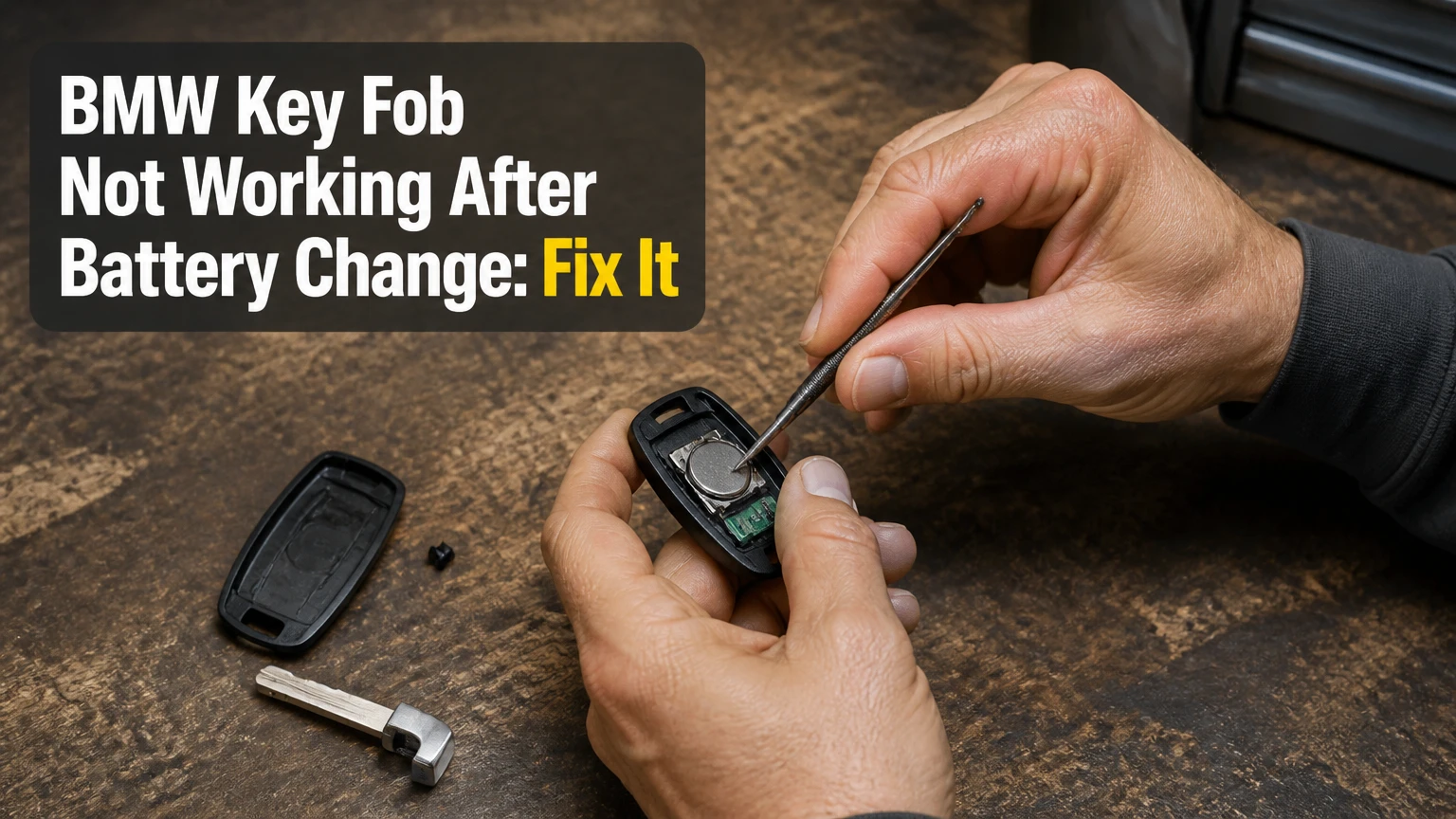
A BMW key fob that stops working after a battery change usually has an incorrect battery, poor battery contact, damaged contacts, or lost remote synchronization. First verify the battery number and polarity, then initialize the remote if the key has an ignition blade. Push-button BMWs generally require emergency-start recognition rather than the older remote-initialization sequence.
Key Facts
A CR2032 and CR2450 have the same nominal voltage, 3 volts, but different thicknesses and are not interchangeable in every BMW key.
Remote-button synchronization does not normally program the BMW immobilizer or create a new authorized key.
A non-Comfort Access rectangular BMW key may contain a soldered rechargeable VL2020 cell that charges in the ignition.
If the key starts the engine but cannot lock or unlock the car, the fault may be in the remote buttons, receiver, or diversity antenna.
If every key fails at the same time, investigate the vehicle-side power supply, central-locking system, or antenna before buying another key.
A correct battery replacement should normally take 5-10 minutes, but a sealed rechargeable key may require board-level repair.
Why Is My BMW Key Fob Not Working After Battery Change?
The fastest diagnosis is to separate battery-contact failure from synchronization failure. If the key LED does not illuminate, inspect the cell and contacts; if the LED works but the car ignores the buttons, try remote initialization where applicable; if the key starts the engine but the buttons remain dead, investigate the transmitter or vehicle receiver.
BMW remote keys contain separate functions. The remote transmitter operates buttons such as lock, unlock, and trunk release, while the immobilizer or electronic vehicle immobilization system uses a transponder and vehicle authorization system. A battery change can affect the transmitter without erasing the immobilizer authorization.
BMW does use changing or rolling remote codes, but repeated button presses outside the vehicle do not automatically mean the key must be “reprogrammed” in the dealer sense. Older BMW remotes can often be initialized to the car with a button sequence. Modern BMW keys may require diagnostic programming for replacement, while emergency recognition only allows an already authorized key to start the car.
What symptom does your BMW have?
| Symptom after battery replacement | Most likely area | First test |
|---|---|---|
| No LED and no button response | Battery, polarity, contact, board | Reopen key and inspect cell fit |
| LED works, buttons do nothing | Remote initialization, transmitter, receiver | Try model-appropriate initialization |
| Key starts engine, buttons fail | Remote circuit or antenna system | Test spare key and vehicle range |
| Buttons work, engine will not start | Immobilizer, key authorization, vehicle battery | Use emergency-start position |
| All keys fail | Vehicle fuse, receiver, antenna, low car battery | Test vehicle-side systems |
| Works only very close to car | Weak transmitter, interference, antenna | Test outdoors with spare key |
Step 1: Identify the BMW Key and Battery
Read the number printed on the old cell before discarding it. BMW key housings vary by production year, market, Comfort Access equipment, and replacement history, so the model year alone cannot guarantee the correct battery.
| BMW key style or system | Common applications | Typical battery | Replacement method |
|---|---|---|---|
| Diamond-shaped key with blade | E39, E46, E53, some E83 | VL2020 rechargeable | Soldered repair or key-service replacement |
| Rectangular Comfort Access key | E90, E60, E70 and related models | CR2032 or CR2450 | User-replaceable housing, model-dependent |
| Rectangular non-Comfort Access key | Many E90 and E60 vehicles | Rechargeable VL2020 | Charges in ignition, sealed board repair |
| Rubber-button blade key | Older E36, E38, E39 variants | CR2016, often two cells | Screw-open housing, verify exact layout |
| F-Series or G-Series smart key | F30, F10, G20, G30 and related models | CR2032 or CR2450 | Replaceable or model-specific housing |
| BMW Display Key | Selected 7 Series, 5 Series, X5 and others | Internal rechargeable battery | USB charging or specialist service |
A CR2032 is 20 millimeters wide and approximately 3.2 millimeters thick. A CR2450 is also 24 millimeters wide and approximately 5.0 millimeters thick. Both are nominally 3-volt lithium cells, but a key designed for the thicker CR2450 may not press a CR2032 firmly against its terminals.
Do not assume every rectangular key has a removable coin cell. BMW documentation and dealer guidance distinguish Comfort Access keys from sealed non-Comfort Access designs. If the housing has no intended battery door, forcing the shell open can break clips, the circuit board, or the transponder antenna.
Step 2: Check Polarity, Sticker, and Contacts
Install the new battery in the same orientation as the old one, usually with the positive side facing the marked contact, but follow the symbols inside the housing rather than relying on a generic diagram. Remove any transparent shipping film from the cell because the film can block electrical contact even when the key’s LED briefly flashes.
Use this inspection sequence:
- Compare the new cell with the old cell by part number, diameter, and thickness.
- Confirm the positive and negative faces match the housing markings.
- Check that the cell lies flat and cannot move under light finger pressure.
- Inspect metal tabs for flattening, corrosion, cracks, or sideways displacement.
- Clean light oxidation with a dry lint-free swab.
- Reassemble the shell without pinching the rubber button membrane.
A multimeter can test an unloaded coin cell, but an unloaded reading does not prove that the battery can supply a transmitter pulse. A reputable new Panasonic, Energizer, Maxell, Sony, or Duracell cell is a safer diagnostic choice than an unbranded bulk battery. Typical retail cost is $3-$8 per quality cell.
Expert insight: A key LED is a poor battery test. The LED needs little current, while the radio transmitter can fail under load. A bright LED therefore does not prove that the transmitter has adequate voltage.
What should you do if the contacts are bent?
Gently move a flattened contact upward with a plastic pick or fine nonmagnetic tool, then reinstall the battery. Do not lever aggressively against the circuit board, because a lifted solder pad can turn a five-minute battery problem into a board repair.
If the contact is broken, the battery holder is loose, or the board has green corrosion, stop repeated battery swaps. Moisture damage and cracked solder joints require electronics repair, not synchronization.
Step 3: Test BMW Emergency Start Recognition
A BMW with Comfort Access or push-button start can often start with a weak or discharged key battery because the vehicle reads the passive transponder at a designated emergency-recognition location. The exact location varies by generation, so the owner’s manual takes precedence over a generic internet procedure.
For many F-Series and G-Series vehicles:
- Enter the BMW with the key and close the doors.
- Press the brake pedal, or the clutch pedal in a manual-transmission car.
- Hold the back of the key against the marked steering-column area or the specified center-console location.
- Press the Start/Stop button while keeping the key in position.
- Remove the key only after the vehicle responds.
BMW owner information commonly describes this action with wording similar to “Hold the remote control against the marked area”, but the marked area differs across vehicles. BMW Australia’s vehicle-access guidance and individual BMW owner manuals provide model-specific emergency-start locations.
The procedure does not repair remote locking. It only tests whether the car still recognizes the key’s authorized transponder. If the engine starts but the buttons remain inactive, return to transmitter and receiver diagnosis.
Success checkpoint: The engine starts or the instrument cluster responds with the key held at the specified location.
Common mistake: Holding the key near the Start/Stop button instead of the documented emergency-recognition mark.
Step 4: Initialize an Older BMW Remote
Older BMW diamond and rubber-button keys with a mechanical ignition switch can often be initialized without diagnostic equipment. This sequence synchronizes the remote buttons; it does not add an unauthorized key to the immobilizer system.
- Sit in the vehicle and close all doors, including the trunk and hood where applicable.
- Insert a working key into the ignition.
- Turn the key to Position 1, where the instrument cluster illuminates, without starting the engine.
- Return the key to Position 0 and remove it within approximately five seconds.
- Press and hold the unlock button.
- While holding unlock, press the lock button three times within approximately 10 seconds.
- Release the unlock button.
- Watch for a lock-unlock cycle as confirmation.
BMW dealer instructions commonly specify completing additional keys immediately, usually within 30 seconds, without switching the ignition on again. Repeat the button sequence for each additional key. Do not press buttons on a key that has already been synchronized unless you are intentionally repeating the procedure.
The exact sequence can differ by chassis, market, and aftermarket remote. If the locks do not cycle, check the owner’s manual for the VIN-specific procedure before assuming the key is defective.
Expert insight: Initializing one key can make another remote appear dead if the second key was not included in the same session. Keep every key that needs synchronization beside you before starting.
Step 5: Diagnose the Key, Receiver, or Antenna
A spare-key comparison is the highest-value test because it separates the key from the vehicle. Test both keys beside the driver’s door, then at 1 meter, 3 meters, and the normal operating distance, away from other transmitters.
| Test result | Probable diagnosis | Recommended action |
|---|---|---|
| New battery fails in one key, spare works | Defective key or contact fault | Repair or replace the affected key |
| Both keys work only beside the door | Receiver, antenna, interference, or weak transmitters | Scan and inspect vehicle-side system |
| One key works after battery swap | Bad cell or poor original battery | Replace with a reputable matching cell |
| Key starts car but buttons never work | Remote circuit or antenna fault | Test initialization and RF function |
| Locks work manually but no remote works | Fuse, receiver, antenna, coding, or car battery | Diagnose vehicle electronics |
| Remote range changed after water exposure | Corrosion or transmitter damage | Open for inspection or send for repair |
The BMW diversity antenna system, used on several E39, E60, E70, E90, and related vehicles, can create a misleading key-fob diagnosis. Depending on the chassis, the antenna amplifier may be located near the rear window, tailgate, roof area, or spoiler. Water intrusion, damaged coaxial wiring, and amplifier failure can prevent remote reception while the key itself remains healthy.
Poor radio reception can support an antenna diagnosis on some BMW models, but it is not conclusive. BMW receivers, antenna amplifiers, wiring, fuses, and body-control modules vary by chassis.
Can radio interference cause the failure?
Yes. Strong local radio-frequency interference can temporarily block remote locking, especially near secured facilities, airports, industrial sites, or large broadcast installations. Move the BMW several hundred meters away and retest before replacing a key.
Interference usually affects operation in one location. A key that fails everywhere after a correct battery installation has a different fault.
BMW Key Battery and Key-Type Comparison
The replacement decision depends on the key construction, not simply the BMW badge or model year. A soldered rechargeable key should not be treated like a user-serviceable CR2032 housing.
| Key condition | DIY suitability | Typical repair cost | Typical time | Main risk |
|---|---|---|---|---|
| Replaceable CR2032 cell | High | $3-$8 | 5-10 minutes | Reversed polarity |
| Replaceable CR2450 cell | High | $4-$10 | 5-10 minutes | Wrong thickness |
| Soldered VL2020 cell | Low | $40-$90 | 2-7 days by mail | Board or transponder damage |
| Damaged remote buttons | Medium | $30-$120 | 1-3 hours | Incompatible shell |
| Failed key transmitter | Low | $100-$300 | Same day to 1 week | Incorrect coding |
| Complete OEM replacement key | None | $300-$600 or more | 2-14 days | VIN and ownership verification |
These are typical US consumer ranges, not fixed BMW pricing. A dealer usually orders a VIN-specific key and may require proof of ownership. An automotive locksmith may cost less, but confirm that the locksmith supports the exact BMW chassis and can handle immobilizer authorization rather than merely cutting a blade.
A mail-in VL2020 repair can preserve the original transponder and housing, but shipping time and workmanship vary. A replacement shell may improve worn buttons while leaving an exhausted circuit board unchanged.
Why Is the Key Still Not Working After Resynchronization?
A failed resynchronization usually means the problem is not synchronization alone. The battery may be wrong, the key may be sealed and damaged, or the vehicle may not be receiving the radio signal.
Use this decision path:
- No LED: reopen the key, verify polarity, remove the sticker, and inspect contacts.
- LED but no lock cycle: confirm that the key type supports the procedure and that the ignition timing was correct.
- Lock cycle occurs but remote remains inconsistent: test the cell under load, button membrane, transmitter, and receiver.
- Engine starts but remote buttons fail: the immobilizer is functioning; focus on the remote circuit or antenna.
- Neither key starts the BMW: use emergency recognition, check the vehicle battery, and scan immobilizer-related faults.
- All remote functions stopped after water exposure: inspect the key and antenna system for corrosion.
- Failure began after installing an aftermarket shell: verify that the circuit board, rubber membrane, and transponder were transferred correctly.
Is a blown fuse possible?
Yes. A blown central-locking or body-electronics fuse can mimic simultaneous key failure, but fuse positions and ratings differ by BMW chassis. Use the fuse card or owner’s manual, replace only with the specified amperage, and do not substitute a larger fuse.
If the replacement fuse fails again, stop testing. A recurring failure indicates a short or module fault that needs electrical diagnosis.
Can You Program a BMW Key at Home?
You can often initialize the remote buttons on an older compatible BMW at home, but you generally cannot create a new immobilizer-authorized key with a simple button sequence. Replacement keys for modern BMW vehicles require vehicle-specific authorization, coding, or preprogramming procedures.
The distinction matters:
| Operation | Typical home procedure | Creates a new authorized key? | Equipment often needed |
|---|---|---|---|
| Battery replacement | Open housing and fit correct cell | No | Plastic pry tool |
| Older remote initialization | Ignition and button sequence | No | No scan tool |
| Emergency start recognition | Hold key at marked location | No | No scan tool |
| Comfort Access diagnosis | Test passive and active functions | No | BMW-capable scan tool |
| Replacement-key authorization | VIN-specific security process | Yes | Dealer or qualified locksmith |
| Module or antenna diagnosis | Fault-code and signal testing | No | BMW diagnostic equipment |
Avoid online sellers offering a generic “programming” service without asking for the BMW VIN, chassis, key frequency, equipment options, and ownership documentation. A housing that fits physically may still have the wrong electronics.
When Should You Repair or Replace the BMW Key?
Repair the original key when the transponder remains recognized, the housing is intact, and the fault is a rechargeable cell, button membrane, or cracked solder joint. Replace the key when the board has severe corrosion, the transmitter is destroyed, or a qualified technician cannot verify its identity and authorization.
| Situation | Best option | Typical total cost | Why |
|---|---|---|---|
| One CR2032 key failed after DIY swap | Correct battery and inspection | $3-$10 | Lowest-cost likely fix |
| Diamond key has exhausted VL2020 | Specialist battery repair | $40-$90 | Preserves original electronics |
| Worn buttons but working board | Compatible shell or button repair | $20-$80 | Avoids unnecessary coding |
| Lost only key | Dealer or BMW-qualified locksmith | $250-$600+ | Security and authorization required |
| Both keys fail with poor radio reception | Vehicle diagnosis first | $100-$250 diagnostic typical | Prevents buying two unnecessary keys |
| Water-damaged board | Replace or specialist electronics repair | $80-$350 | Outcome depends on corrosion |
A dealer is the safest choice for a lost-key situation or a modern BMW with complex key authorization. A BMW-capable locksmith is often faster for a failed remote, but ask whether the quoted service includes testing, coding, and a warranty.
What Should You Do in Common Situations?
The BMW starts, but the key buttons do not work
Treat the immobilizer and remote transmitter as separate systems. Since the engine starts, test battery fit, remote initialization, button operation, receiver range, and the diversity antenna before replacing the key.
The spare key works normally
The vehicle is probably receiving remote signals correctly. Swap only the known-good battery into the failing key; if the failing key still does not work, inspect its contacts, membrane, transmitter board, or rechargeable cell.
Neither key works after one battery change
Do not immediately resynchronize both keys repeatedly. Check the car’s 12-volt battery, central-locking fuses, antenna amplifier, recent water intrusion, and local RF interference.
The key has no battery door
Do not pry the housing open with a knife. A non-Comfort Access or diamond-style BMW key may use a soldered VL2020 rechargeable cell, and careless opening can damage the coil, circuit board, or transponder.
The BMW is locked and the remote is dead
Remove the mechanical blade from the fob and unlock the driver’s door manually. The alarm may sound on some vehicles, but the authorized key can often be placed at the emergency-start location to start the car.
The Bottom Line
BMW key fob not working after battery change problems are usually resolved by correcting the battery type, polarity, or contact pressure before attempting synchronization. A replaceable CR2032 or CR2450 key can often be restored in minutes, while a sealed VL2020 key needs specialist repair.
Use the emergency-start location to test an already authorized push-button key. Use the ignition-and-button initialization sequence only for a compatible older remote. If the key starts the BMW but remote buttons fail, or if every key fails, diagnose the transmitter, diversity antenna, fuse supply, and vehicle receiver instead of repeatedly buying batteries.
Frequently Asked Questions
Does a BMW key need to be reset after every battery change?
No. Many BMW keys work immediately after a correct battery replacement, while older remotes may need initialization if the transmitter lost synchronization. A battery change does not normally erase immobilizer authorization. Follow the procedure for the exact chassis and key style rather than applying a universal reset.
How long should a BMW key battery last?
A replaceable lithium coin cell typically lasts 2-5 years, depending on button use, Comfort Access activity, temperature, and storage. A rechargeable BMW key battery can last several years but eventually loses capacity. Frequent short range, intermittent operation, or failure after cold exposure indicates a battery or circuit problem.
Can I use a CR2032 instead of a CR2450 in a BMW key?
Usually no. Both cells provide approximately 3 volts, but the CR2450 is thicker and may be required to maintain contact in the housing. A CR2032 can fit loosely in a CR2450 compartment and produce an intermittent or completely dead remote. Match the old battery number and housing specification.
Why does my BMW key work only when touching the car?
Very short range points to a weak transmitter, poor battery contact, radio interference, or a failing vehicle antenna amplifier. Test a fresh name-brand cell and the spare key outdoors. If both keys have short range, inspect the BMW receiver and antenna system rather than assuming both transmitters failed.
Will locking and unlocking the BMW manually resynchronize the key?
No. Manual operation of the door lock does not normally synchronize the remote transmitter. Older compatible keys require the ignition-and-button initialization sequence. Modern keys may need only a correct battery, while a replacement key requires a security authorization process that manual locking cannot perform.