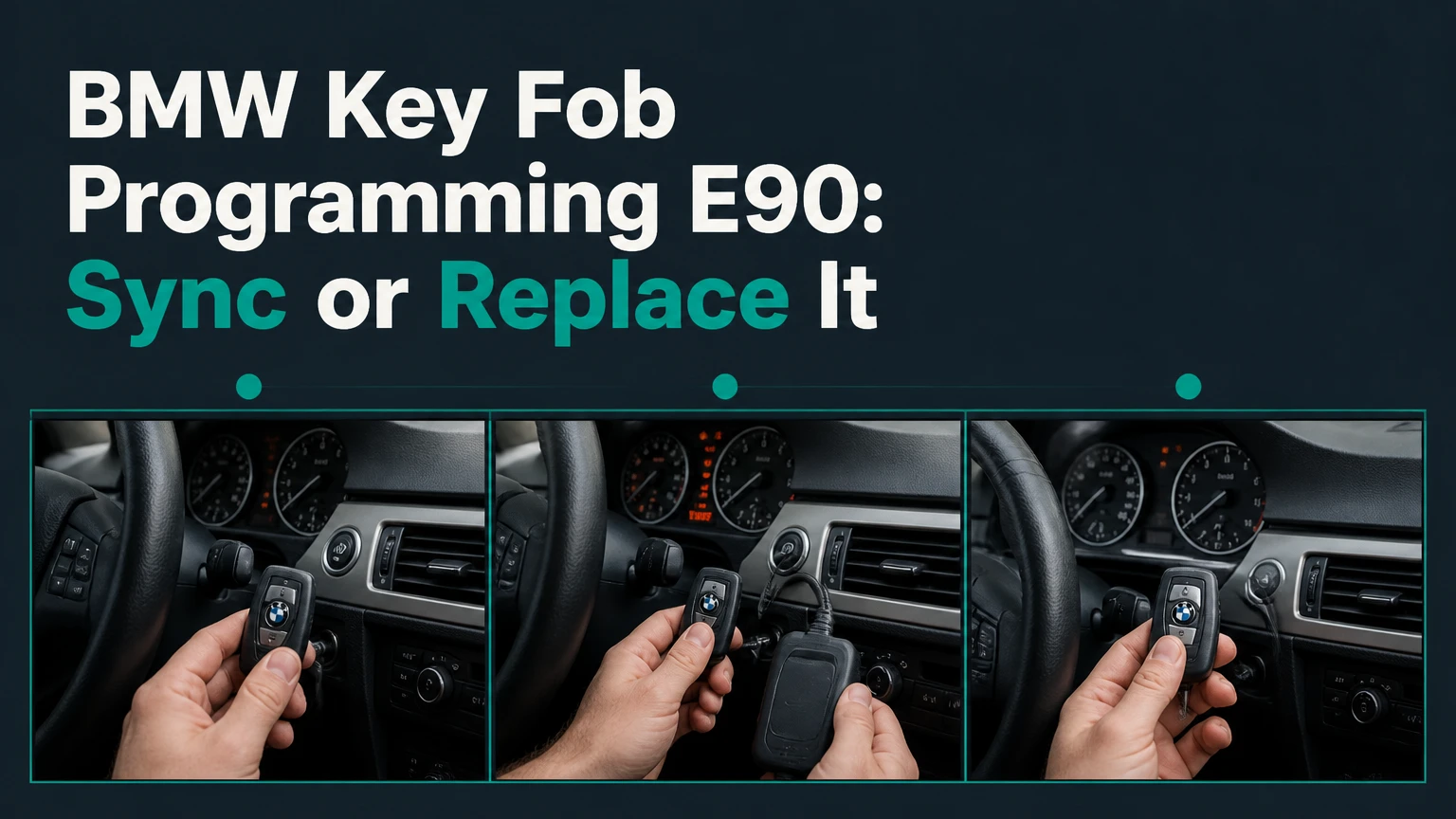
BMW E90 key fob programming usually means initializing the lock and unlock buttons on an existing key, a process that takes about one minute and requires no scan tool. A new key that must start the engine is different: its immobilizer authorization must be registered to the car by BMW or a qualified automotive locksmith.
Key Facts
Remote-button initialization does not create engine-start authorization.
The standard E90 remote commonly uses a rechargeable VL2020 cell, while Comfort Access keys commonly use a replaceable CR2032 battery.
North American E90 remotes generally use 315 MHz; many European-market vehicles use 868 MHz.
Every previously working remote should be initialized during the same session.
A replacement key must match the vehicle’s market, frequency, CAS generation, and Comfort Access configuration.
Typical replacement cost is about $150-$300 through a mobile automotive locksmith and $300-$500 through a BMW dealer, with local variation.
What Does BMW E90 Key Programming Actually Do?
BMW E90 key programming has two separate jobs: remote initialization for door controls and immobilizer registration for engine starting. The distinction matters because an E90 can start normally while its lock buttons stop responding, yet a newly cut or aftermarket remote may unlock doors without being authorized to start the engine.
The E90, sold as the 3 Series sedan, wagon, coupe, and convertible under several related chassis codes, uses a slot-based electronic key system. The Car Access System, or CAS, authenticates the transponder and manages key authorization. The remote receiver and vehicle body electronics process radio commands for locking and unlocking.
BMW’s E90 owner documentation describes the remote control function plainly: “The remote control can be used to lock and unlock the vehicle.” That statement describes the buttons, not the separate immobilizer function inside the same housing.
Remote initialization versus key registration
| Function | User symptom | Usual procedure | Engine-start effect |
|---|---|---|---|
| Remote initialization | Engine starts, buttons do nothing | Ignition cycle and button sequence | None |
| Immobilizer registration | New key cannot start car | BMW or locksmith diagnostic registration | Adds authorized key |
| Key blocking | Lost key remains a security concern | CAS key-slot deactivation | Prevents blocked key from authorizing start |
| Comfort Access repair | Touch entry or passive start fails | Battery, antenna, fault diagnosis | Depends on the fault |
A key that starts the engine but cannot lock the doors normally needs remote initialization, a charged or healthy battery, or receiver diagnosis. A key that does not start the engine requires a different assessment, even if its buttons work.
How Does the E90 Remote System Work?
The E90 remote sends a market-specific radio signal containing a changing, vehicle-matched code. The car receives that signal through the antenna and body electronics, while CAS separately verifies the embedded transponder when the key is inserted or detected for starting.
The exact module arrangement varies by build date and equipment. The AI Overview’s description of FRM as the central-locking module is too broad: the Footwell Module, or FRM, primarily controls lighting, windows, mirrors, and related body functions on equipped E90 vehicles. The remote receiver, CAS, junction-box electronics, and central-locking circuits work together.
Which E90 key type do you have?
| Key configuration | Visual clue | Typical battery | Passive entry | Replacement concern |
|---|---|---|---|---|
| Standard slot key | Sealed molded housing | VL2020 rechargeable cell | No | Battery charges while driving in the slot |
| Comfort Access key | Replaceable rear battery cover | CR2032 coin cell | Yes | Battery polarity and water sealing matter |
| Dealer replacement key | BMW-branded, VIN-associated | Depends on configuration | Matches original equipment | Must match CAS and market |
| Aftermarket replacement | Variable shell and electronics | VL2020, CR2032, or poor substitute | Often inconsistent | Frequency and transponder compatibility vary |
Do not identify the key solely by its shape. Check whether the vehicle unlocks when a hand touches the door handle, whether the engine starts without inserting the key, and whether the battery cover is removable. VIN-based equipment information is more reliable than online photographs.
Why does frequency matter?
Frequency matters because a 315 MHz transmitter generally cannot communicate correctly with an E90 configured for 868 MHz, and the reverse is also true. Market frequency is only one requirement; the key’s circuit board, rolling-code data, Comfort Access hardware, and CAS compatibility must also match.
Typical regional patterns are:
| Market | Common E90 remote frequency | Verification method | Risk of wrong purchase |
|---|---|---|---|
| United States | 315 MHz | Original key label or VIN lookup | Buttons remain unresponsive |
| Canada | 315 MHz | VIN and original part number | Remote may be incompatible |
| United Kingdom | 868 MHz | BMW part number and vehicle market | No reliable synchronization |
| Continental Europe | 868 MHz in many applications | VIN-specific catalog check | Possible frequency mismatch |
Part numbers can differ by production date and body style. Confirm the original key’s part number, vehicle VIN, market, and Comfort Access status before purchasing a blank.
How Do You Initialize an Existing E90 Remote?
To initialize an existing E90 remote, place the car in ignition mode without starting the engine, switch the ignition off, remove the key, then hold unlock while pressing lock three times. The locks should cycle to confirm synchronization, and all other working remotes must be initialized during the same session.
Before you start
| Requirement | Typical value |
|---|---|
| Vehicle time | 2-5 minutes |
| Procedure difficulty | Low |
| Required tools | None |
| Vehicle condition | Doors and trunk closed |
| Key requirement | Existing key with compatible electronics |
| Battery condition | Vehicle battery preferably above 12.2 V at rest |
The sequence applies to remote-button initialization, not the addition of a new immobilizer key. Keep every working remote inside the vehicle because the initialization session can overwrite the vehicle’s active remote synchronization state.
Step 1: Enter the vehicle and close it
Sit in the driver’s seat and close every door, the trunk, and the hood if the vehicle’s alarm system is sensitive to an open panel. Do not press the brake or clutch during the ignition step.
You will know the setup is correct when the instrument cluster can be activated without the engine cranking. An open door or a pressed pedal can alter the ignition state.
Step 2: Turn ignition on and off
Insert the key into the dashboard slot. Press the Start/Stop button once without pressing the brake or clutch, wait approximately one second, then press the button again to switch the ignition off. Remove the key from the slot.
On some E90 builds, the car may enter a different ignition state if the button is held too long. The checkpoint is simple: the key is out, the engine has not started, and the dashboard ignition cycle has completed.
Step 3: Initialize the first remote
Press and hold the unlock button. While continuing to hold unlock, press the lock button, usually marked with the BMW roundel, three times within approximately five seconds. Release unlock after the third lock press.
The vehicle locks should cycle down and up within a few seconds. That cycle confirms that the remote portion of the procedure was accepted.
Step 4: Initialize every other working remote
For each additional working remote, hold unlock and press lock three times within five seconds, without reinserting the key or repeating the ignition cycle. Complete all remotes promptly, commonly within 30 seconds of the first successful initialization.
A common mistake is testing the first remote outside the vehicle before initializing the second. Finish the complete set first, then test lock, unlock, trunk release, and the mechanical blade separately.
What if the locks do not cycle?
First repeat the sequence with stricter timing and a fully charged vehicle battery. If the key starts the engine but no remote responds after two attempts, inspect the key battery, transmitter board, antenna amplifier, and relevant fault codes rather than repeatedly forcing the button sequence.
The diversity antenna amplifier is located in the rear roof area on many E90 body styles. Water intrusion around the rear window, roof spoiler, or antenna wiring can disable remote reception while leaving the key’s immobilizer function unaffected.
Can You Program a Brand-New E90 Key at Home?
A brand-new E90 key cannot normally be made into a complete start-authorized key through the lock-button sequence. The immobilizer transponder and CAS authorization require vehicle-specific security data, so a BMW dealer or properly equipped automotive locksmith should perform the registration.
The remote sequence can synchronize buttons on an already authorized key. It does not read the CAS, create a new authorization slot, cut a mechanical blade, or convert an incompatible used key into a secure replacement.
Dealer and locksmith registration
A dealer typically verifies ownership, orders a VIN-associated key, and supplies a cut blade and compatible electronics. A locksmith may provide a key on site, but the locksmith must verify ownership and use equipment appropriate for the specific CAS version.
Expect approximately 20-45 minutes of on-site locksmith work when the correct key is available. Dealer ordering commonly takes 2-5 business days, although stock, vehicle documentation, and regional distribution can change that period.
Used keys and aftermarket keys
A used BMW key is a poor assumption for an E90 replacement. Many keys contain vehicle-associated immobilizer data that cannot be reset reliably, and a used remote may have the wrong frequency, battery design, Comfort Access configuration, or CAS compatibility.
Some aftermarket keys can be registered by a specialist, but shell appearance does not prove electronic compatibility. Ask the supplier whether the key supports the exact VIN, CAS generation, market frequency, and passive-entry system before paying.
Which Replacement Option Should You Choose?
The best replacement route depends on security assurance, price, urgency, and whether the vehicle has Comfort Access. A dealer is the lowest-risk choice for documentation and OEM compatibility, while a reputable automotive locksmith usually offers the strongest price and convenience balance.
| Option | Typical price | Typical time | Main strength | Main limitation |
|---|---|---|---|---|
| BMW dealer | $300-$500 | 2-5 business days | VIN-matched OEM key | Higher price and appointment requirement |
| Automotive locksmith | $150-$300 | 20-45 minutes on site | Mobile service and lower cost | Quality varies by equipment and key source |
| Used key conversion | $40-$150 before labor | 1-3 hours or longer | Lowest purchase price | CAS, frequency, and data compatibility problems |
| DIY diagnostic work | $100-$500+ in equipment | Several hours | Control for experienced technicians | CAS corruption and immobilizer lockout risk |
Prices are typical North American practitioner ranges, not fixed BMW rates. A locksmith may charge more for Comfort Access, an all-keys-lost situation, emergency travel, or a CAS module requiring bench work.
When is a dealer the better choice?
Choose a dealer when every key is lost, the vehicle has uncertain CAS history, the car is under a service policy, or you need documented OEM provenance. Dealer service also reduces the chance of buying a key that fits the shell but cannot communicate with the car.
The limitation is cost and waiting time. A dealer usually will not make an undocumented request, and ownership verification commonly requires identification, registration, and title or equivalent evidence.
When is a locksmith the better choice?
Choose a locksmith when one working key remains, the vehicle is out of warranty, and you need mobile service at a lower typical cost. Confirm that the technician works with BMW CAS systems rather than general key-cutting equipment.
Ask for the exact key type, programming method, warranty period, and whether lost keys can be blocked. A professional should not request that you disable theft protections or provide undocumented access.
Why is DIY CAS work risky?
CAS data is security-sensitive vehicle information. Incorrect reading, writing, voltage interruption, or incompatible software can leave the car unable to recognize keys or communicate with other modules.
Tools marketed for EEPROM extraction, such as older CAS programmers, are not beginner programming solutions. A backup made incorrectly is not a backup, and a low-cost blank key does not compensate for a bricked CAS module or recovery bill that can exceed $1,000.
What Are the Most Common E90 Programming Failures?
Most E90 programming failures come from confusing remote initialization with immobilizer registration, using the wrong key frequency, or attempting the sequence with weak batteries. Correct diagnosis begins with the symptom: starting, button operation, passive entry, and key insertion are separate functions.
| Symptom | Likely cause | First check | Correct next action |
|---|---|---|---|
| Engine starts, buttons fail | Lost remote synchronization | Repeat initialization | Test another known-good key |
| Buttons work, engine will not start | Immobilizer authorization fault | Key warning symbol and spare key | Dealer or BMW locksmith diagnosis |
| One key works, another does not | Wrong frequency or damaged board | Part number and market | Replace with VIN-compatible key |
| All remotes fail | Vehicle receiver or power fault | Vehicle battery and rear antenna | Scan CAS and inspect antenna |
| Passive entry fails, slot start works | Comfort Access battery or antenna | CR2032 voltage and contacts | Test antennas and Comfort Access faults |
| Key will not eject | Low voltage or slot mechanism issue | Battery voltage and fault memory | Stabilize voltage, then diagnose mechanism |
The key starts the car but will not lock it
Repeat the initialization procedure once, with all doors closed and the key battery in usable condition. If the locks still do not respond, the likely fault is a transmitter board, antenna amplifier, wiring, or body module rather than immobilizer programming.
A standard key with a depleted rechargeable cell may regain function after extended driving in the slot, but a failed VL2020 cell will not recover consistently. Replacing a soldered cell requires board-level work and can damage the key if performed without the correct tools.
The key buttons work but the engine will not start
Button operation does not prove immobilizer authorization. The remote transmitter and transponder can fail independently, and a generic replacement housing may contain no compatible transponder at all.
Test the spare key if available. If both authorized keys fail, check vehicle voltage and CAS fault memory before buying another fob, because a vehicle-side fault can imitate a bad key.
The key symbol is crossed out
A crossed-out key symbol indicates that the vehicle did not complete the expected key authentication. Causes include an unregistered key, damaged transponder, incompatible used key, severe vehicle-voltage instability, or a CAS fault.
Do not repeatedly attempt random coding procedures. Record the warning, test a known-good key, stabilize the vehicle battery with a suitable support charger, and obtain a BMW-capable diagnostic scan.
Comfort Access works intermittently
Comfort Access failures often involve the CR2032 cell, corroded contacts, door-handle antennas, interior antennas, or water intrusion. A key that starts the engine in the slot can still have a failed passive-entry battery or antenna circuit.
Install the correct CR2032 with the polarity shown in the key. Do not assume that replacing the battery programs the key; battery replacement restores power, while key registration and remote initialization remain separate operations.
What Should You Check Before Buying a Key?
Verify the VIN, production date, market, frequency, CAS compatibility, key shape, battery type, and Comfort Access status before purchasing. The least expensive online key becomes expensive when its electronics cannot be initialized or its immobilizer data cannot be registered.
Use this purchase checklist:
- Confirm whether the car has Comfort Access by testing passive door-handle entry.
- Photograph the original key’s markings and compare the BMW part number.
- Confirm 315 MHz or 868 MHz from a reliable VIN-based catalog.
- Ask whether the replacement includes an immobilizer transponder.
- Confirm whether the key is new, unused, refurbished, or previously assigned.
- Verify that the seller accepts the exact E90 production date and chassis configuration.
- Obtain a written programming and return policy before ordering.
A shell that matches the original does not establish radio or CAS compatibility. The circuit board and transponder determine function.
How Can You Prevent Lost-Key Security Problems?
A lost E90 key should be blocked from the CAS authorization list, not merely removed from your key ring or remote memory. Blocking prevents that key from authorizing the vehicle, although it does not repair a damaged key or recover a missing mechanical blade.
Ask the dealer or locksmith to document which key position was blocked and how many authorized keys remain. Do not assume that deleting a remote synchronization code disables the immobilizer transponder; those are different security operations.
Keep the remaining key separate from the vehicle paperwork. Record its part number and store a spare in a secure location, because all-keys-lost service costs more and may require additional vehicle access.
What Is the Safest Programming Workflow?
The safest E90 workflow is to diagnose the existing key first, confirm the vehicle configuration second, and purchase a VIN-compatible replacement only when synchronization cannot solve the problem. Separating those stages prevents unnecessary key purchases and protects the CAS system from unsupported writes.
Use this decision path:
- The engine starts and buttons fail: initialize the remote.
- The engine starts and passive entry fails: check the Comfort Access battery and antennas.
- A new key does not start the car: contact a BMW dealer or qualified locksmith.
- Every key fails: check vehicle voltage, CAS faults, and the antenna system.
- A key is lost: request CAS key blocking and replacement registration.
- An online key has uncertain origin: do not attempt programming until compatibility is confirmed.
BMW electrical systems are sensitive to low voltage during diagnostic work. A practitioner rule is to stabilize the vehicle power supply before module programming, especially when a session may write security data.
FAQ
Does programming a BMW E90 remote erase the old key?
Remote initialization can change the active synchronization state, which is why all working remotes should be initialized during one session. It does not normally erase the immobilizer authorization stored for a correctly registered key. Key blocking is a separate CAS security operation.
Can a dead key-fob battery stop an E90 from starting?
A dead remote battery does not necessarily stop a standard E90 key from starting the engine because the immobilizer transponder is separate from the remote battery circuit. Comfort Access behavior can differ, so insert the key into the slot and test it before replacing the entire fob.
Does replacing a VL2020 battery program the key?
Replacing a VL2020 restores or improves power in a standard rechargeable key, but it does not program the remote or register the immobilizer. The key may still need remote initialization, and board-level soldering can damage the fob if the cell is installed incorrectly.
Can I use any BMW E90 key from the same model year?
No. An E90 key must match the market frequency, electronics, CAS configuration, battery design, and Comfort Access equipment. A key from the same model year may still be incompatible because BMW changed equipment and part numbers by market, production date, and body configuration.
How long does an E90 key replacement take?
Remote-button initialization takes roughly two to five minutes when the key is already authorized. A locksmith replacement commonly takes 20-45 minutes on site if the correct key is available, while dealer ordering often takes two to five business days.
The Bottom Line
BMW key fob programming for an E90 is usually a one-minute remote initialization when the engine already starts and only the buttons have failed. A new start-capable key requires CAS-compatible security registration, so a BMW dealer or qualified automotive locksmith is the appropriate route. Confirm the market frequency, key type, Comfort Access equipment, and VIN before buying any replacement.