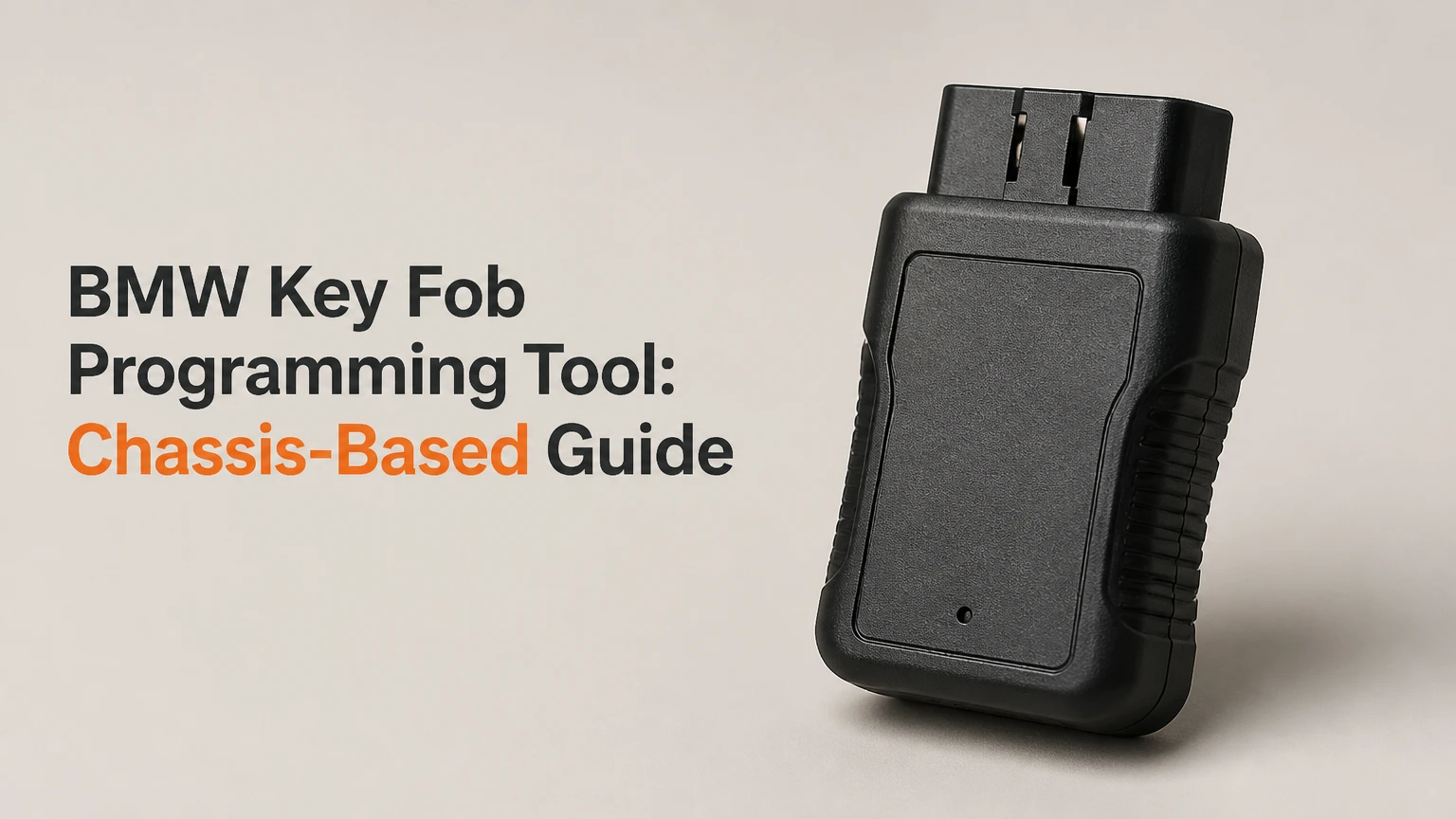
A BMW key fob programming tool is a specialist immobilizer and key-learning device matched to a vehicle’s EWS, CAS, FEM, or BDC system. The correct tool depends on the BMW chassis, key type, region, and whether a working key remains. A basic OBD scanner can diagnose faults, but it usually cannot create a valid immobilizer key.
Key Facts
EWS, CAS, FEM, and BDC are different BMW immobilizer generations, so one programmer does not cover every BMW.
Older E-Series remote buttons may be initialized manually, but that does not necessarily add the engine-start transponder.
AK90-style programmers target older EWS modules and are unsuitable for most FEM, BDC, and G-Series vehicles.
Yanhua ACDP, Autel MaxiIM, and Xhorse systems require model-specific coverage, adapters, tokens, or software licenses.
A stable regulated power supply is required during module communication and coding; a weak battery can interrupt a write operation.
BMW dealers and qualified automotive locksmiths remain the practical route for many modern or all-keys-lost cases.
What Does a BMW Key Fob Programming Tool Do?
A BMW key fob programming tool reads or communicates with the vehicle’s immobilizer system, prepares a compatible key, and registers the key for authorized starting and remote functions. The device may use the OBD-II diagnostic connector, a module bench adapter, a key coil, or a combination of those interfaces.
“Programming a key fob” describes two separate functions. The immobilizer transponder authorizes starting, while the radio remote controls locking, unlocking, trunk release, and sometimes panic functions. A remote can be synchronized while the engine-start authorization remains absent, or a transponder can start the vehicle while the buttons remain unpaired.
BMW systems do not use one universal procedure. EWS-equipped cars generally use an immobilizer module under the dashboard, while later vehicles use CAS, FEM, or BDC modules integrated into broader body electronics. Modern G-Series vehicles can add online authorization, newer cryptography, and Digital Key requirements that exceed the capability of inexpensive programmers.
How Does BMW Immobilizer Programming Work?
BMW immobilizer authorization requires agreement among the key, the immobilizer module, and the engine computer. The key contains electronic identity data, the EWS, CAS, FEM, or BDC module manages authorized key positions, and the DME or DDE verifies vehicle-specific security information before enabling starting.
The exact cryptographic exchange is proprietary and differs by generation. Older EWS systems use fixed module and transponder relationships, while CAS and FEM systems add more complex key data and protected programming operations. The Individual Serial Number, commonly called the ISN, belongs to the engine control unit and is relevant to some advanced learning and replacement workflows, but not every key procedure requires a technician to manually extract it.
A programmer may read module data, identify available key positions, generate or prepare a compatible transponder, and write authorized information. That description does not mean every advertised tool can perform every operation. “BMW coverage” on a product page may mean fault diagnosis, remote generation, bench reading, or complete all-keys-lost support.
Which BMW Key Programming Tool Fits Each Generation?
The BMW chassis and immobilizer module should be identified before buying a tool. Model-year ranges overlap because BMW introduced systems by platform, production date, market, and equipment package rather than by one global calendar year.
| BMW system | Typical examples | Approximate production period | Appropriate tool category |
|---|---|---|---|
| EWS2, EWS3, EWS4 | E36, E38, E39, E46, E53, E85 | 1995-2006 | EWS-specific bench programmer or professional key tool |
| CAS1, CAS2, CAS3, CAS3+ | E60, E61, E70, E87, E90, E91, R56 MINI | 2004-2011 | CAS-capable diagnostic or bench programmer |
| CAS4, CAS4+ | F10, F01, F25, later E-Series and early F-Series | 2010-2015 | CAS4-capable tool with supported adapter and workflow |
| FEM, early BDC | F20, F30, F15, F80, i3 | 2012-2019 | FEM/BDC bench platform or professional locksmith tablet |
| BDC2 and later G-Series systems | G20, G30, G05, G07, G11 | 2017-present | Current professional tool, online authorization, or BMW dealer |
These assignments are guides, not a substitute for reading the vehicle identification number and installed module. A 2015 BMW can require a different workflow from another 2015 BMW, even when the model name is identical.
What Is the Best Budget BMW Programmer?
An AK90 or comparable EWS-specific programmer is the economical choice for an owner or specialist working only on supported EWS vehicles. Typical purchase prices are approximately $30-$60 before a compatible key, computer, shipping, and any replacement module accessories.
The limitation is decisive. An AK90 does not become a CAS, FEM, BDC, or G-Series programmer because the vehicle has an OBD-II socket. EWS work commonly involves removing the module and reading its data with a dedicated adapter, so the operator needs trim-removal ability, correct identification, and a recoverable backup.
Which Professional Tools Cover More BMW Systems?
Autel MaxiIM IM508S or IM608-class platforms, Xhorse VVDI Key Tool Plus, and Yanhua Mini ACDP 2 can cover substantially more BMW generations than an EWS-only device. Typical equipment costs range from roughly $250-$600 for a modular ACDP platform before all licenses, to approximately $1,200-$3,500 for a professional tablet and programmer package.
Coverage is modular. A device may require a BMW software package, annual subscription, token, XP400 Pro-type programmer, FEM adapter, or bench cable. Confirm the exact chassis, immobilizer version, key type, and all-keys-lost status in the manufacturer’s current coverage list before purchase.
| Tool category | Typical equipment cost | Main BMW coverage | Skill and access requirement |
|---|---|---|---|
| AK90-style EWS tool | $30-$60 | EWS2-EWS4 | Windows computer, module removal, adapter handling |
| Yanhua Mini ACDP 2 | $250-$600 plus licenses | CAS, CAS4, FEM, selected BDC | Module adapter, software license, bench discipline |
| Autel IM508S with programmer | $1,200-$2,000 typical package range | EWS, CAS, selected FEM and BDC | Guided tablet workflow, current subscription |
| Autel IM608-class platform | $2,000-$3,500 typical package range | Broad multi-brand and BMW coverage | Professional training and paid updates |
| Xhorse VVDI Key Tool Plus | $1,500-$3,000 typical package range | BMW and multi-brand key systems | Token, adapter, and key-generation knowledge |
Can You Program a BMW Key Without a Specialist Tool?
A working key can sometimes initialize the remote buttons on older BMWs without a programmer, but the procedure does not create immobilizer authorization. Newer BMWs and all-keys-lost situations generally require a supported diagnostic, bench, dealer, or locksmith workflow.
For many E-Series vehicles, the commonly published remote-initialization sequence is:
- Close the doors and sit inside the vehicle.
- Insert a working key and switch ignition to position 1, without starting.
- Return the ignition to position 0 and remove the key promptly.
- Hold the unlock button, press the lock button three times, then release unlock.
- Within the model’s time limit, repeat the button sequence on each additional remote.
- Confirm that the central locking system cycles.
The number of ignition cycles and timing vary by model and market, so the owner’s manual or BMW service information takes priority. The procedure pairs radio functions; it cannot make an unrecognized transponder start the engine.
A useful checkpoint is simple: if the locks respond but the starter remains immobilized, remote initialization succeeded only partially or the key lacks valid immobilizer data.
How Does a Professional BMW Key Workflow Differ?
A professional workflow begins with ownership verification, vehicle identification, battery stabilization, and a scan of the installed immobilizer system. The technician then selects a supported method, creates a complete backup where the tool permits it, and follows the manufacturer’s recovery procedure rather than guessing at a key slot.
The main paths are:
- Spare key with a working key: The technician verifies the original key, identifies the immobilizer, prepares a compatible key, and registers it without deleting valid keys.
- All keys lost: The technician confirms ownership, gains controlled vehicle access, communicates with the immobilizer or replaces the key through an approved process, and tests starting and remote functions.
- Damaged or corrupted module: The technician diagnoses whether the fault is in the key, antenna, wiring, CAS, FEM, BDC, or DME before attempting programming.
- Modern G-Series or Digital Key: The technician determines whether BMW online services, a dealer connection, a supported replacement key, or smartphone authorization is required.
Bench work can involve opening a module and using a board-specific adapter. That is not a beginner operation. Conformal coating, connector damage, static discharge, incorrect pin pressure, or an interrupted write can turn a key job into a module-repair job.
What Should You Check Before Buying a BMW Key Programmer?
Confirm the immobilizer, key frequency, key format, licensing model, and recovery support before buying any BMW key fob programming tool. Product compatibility should be verified by VIN or exact module version, not by BMW series name alone.
Use this checklist:
- Record the VIN, production month, chassis code, and market.
- Identify EWS, CAS, FEM, BDC, or another installed immobilizer module.
- Decide whether the job is a spare key, replacement key, or all-keys-lost case.
- Confirm whether the replacement key is OEM, aftermarket, rechargeable, comfort-access, display, or Digital Key compatible.
- Match the radio frequency and regional part number.
- Check whether the software license is permanent, annual, token-based, or restricted to a number of vehicles.
- Verify that the tool can save original data and recover an interrupted operation.
- Budget for a regulated battery maintainer, adapters, laptop, key shell, and replacement key.
BMW keys are often vehicle-specific. A used key from another BMW may be physically similar but electronically locked, incompatible, or unsuitable for reliable reuse. A universal programmable key can also lack the correct Comfort Access, rechargeable battery, transponder, or frequency characteristics.
How Much Does BMW Key Programming Cost?
Typical BMW key replacement costs range from about $150-$350 through an independent automotive locksmith and $400-$800 or more through a BMW dealer, while a legacy DIY tool project may cost $40-$150 before the owner’s time and risk. Modern keys, remote access, towing, module damage, and all-keys-lost work increase the total.
| Service route | Typical total cost | Typical time | Best-fit situation |
|---|---|---|---|
| EWS DIY project | $40-$150 | 1-3 hours | Supported older BMW and technically capable owner |
| Mobile locksmith, spare key | $150-$350 | 30-90 minutes | Working vehicle, verified replacement key |
| Mobile locksmith, all keys lost | $250-$600 | 1-3 hours | Vehicle access and supported immobilizer |
| BMW dealer key order | $400-$800+ | 1-3 days | OEM key, documentation, modern BMW |
| Module repair after failed programming | $300-$1,500+ | 1-7 days | Corrupted CAS, FEM, BDC, or related electronics |
Prices vary by country, key type, labor rate, and whether the vehicle must be opened or towed. A low-cost programmer is not automatically cheaper when software licenses, adapters, a replacement module, and recovery labor are included.
What Are the Most Common Programming Failures?
The most expensive BMW key-programming mistakes involve incorrect system identification, unstable power, missing backups, and damage to the immobilizer module. A failed remote pairing is usually recoverable; a corrupted FEM or CAS write may require specialist electronics repair.
| Failure symptom | Likely cause | Safe first response | Escalation point |
|---|---|---|---|
| Tool cannot identify module | Wrong vehicle menu, low voltage, poor connection | Verify VIN, ignition state, cables, and power supply | Stop before any write operation |
| Key starts car but buttons fail | Remote not initialized or incorrect frequency | Repeat the model-specific remote procedure | Test antenna and key compatibility |
| “Frequency mismatch” message | Wrong regional key or transmitter | Compare key part number and market frequency | Replace with verified compatible key |
| All keys stop working after attempt | Wrong slot or incomplete write | Disconnect nothing until tool instructions finish | Contact an automotive locksmith or module specialist |
| FEM or BDC communication loss | Interrupted power, adapter error, or module fault | Maintain power and follow recovery instructions | Do not repeatedly retry random functions |
| Comfort Access does not work | Incompatible key hardware or antenna fault | Test standard remote and vehicle antennas | Diagnose Comfort Access separately |
A common practitioner rule is to treat every immobilizer write as a recovery-sensitive operation. Save the original file when the tool supports that function, use a stable power supply specified for programming, and do not select a key position merely because an online guide calls it “safe.” The tool’s readout and the vehicle record determine whether a position is available.
BMW does not publish one universal battery threshold for every programming event. In practice, technicians commonly use a regulated power supply that maintains approximately 13.2-14.5 volts under load, with current capacity selected for the vehicle and procedure. A trickle charger designed only for battery charging may not control voltage adequately during diagnostic programming.
Can BimmerCode, ISTA, or an OBD Scanner Program Keys?
BimmerCode is designed for coding convenience features, not immobilizer key creation. BMW ISTA provides official diagnostic and service functions, but protected key replacement can require dealer authorization, online access, documented ownership, and a genuine replacement key. A generic OBD scanner normally reads and clears faults rather than learning immobilizer keys.
| Device or software | Reads BMW faults | Codes vehicle modules | Creates immobilizer key | Typical user |
|---|---|---|---|---|
| Generic OBD scanner | Yes | No | No | Vehicle owner |
| BimmerCode adapter and app | Limited | Yes, supported modules | No | BMW enthusiast |
| BMW ISTA workshop system | Yes | Yes | Restricted or workflow-dependent | BMW workshop |
| EWS-specific programmer | Module-dependent | No | EWS keys | Specialist or trained owner |
| Professional IMMO tablet | Yes | Yes | Supported systems only | Automotive locksmith |
Do not buy an ordinary coding cable expecting key-programming capability. Coding changes configuration values; immobilizer learning changes protected authorization data.
Which Tool Should You Choose?
Choose an AK90-style tool only for a confirmed EWS vehicle, a modular ACDP or similar platform for supported CAS and FEM work, and a professional locksmith or BMW dealer for modern BDC, G-Series, Digital Key, or high-risk all-keys-lost cases.
Older BMW Owner With One Working Key
A qualified locksmith is usually the lowest-risk option. An EWS specialist may use an AK90-style device for an E46, E39, E38, or E53, but the owner should not attempt module reading without understanding static protection, connector handling, and data recovery.
F-Series Owner With a Specific CAS or FEM Job
A Yanhua ACDP 2 or comparable professional platform may be appropriate when the exact BMW module and adapter are supported. The purchase makes financial sense for repeated work, not usually for one replacement key after licenses and adapters are included.
Independent Repair Shop
An Autel IM508S, IM608-class device, or Xhorse VVDI Key Tool Plus provides broader diagnostics and guided workflows. The shop still needs current coverage, correct adapters, power equipment, training, and a policy for declined high-risk jobs.
G-Series Owner or All-Keys-Lost Customer
Use a BMW dealer or established automotive locksmith with documented BDC and current G-Series capability. Low-cost EWS and generic OBD products are unsuitable for this situation.
When Should You Stop a DIY Attempt?
Stop before writing data when the vehicle module is unidentified, the tool shows unsupported coverage, the battery voltage is unstable, or the procedure requests a bench operation you cannot perform confidently. Stop immediately after an unexpected error if the tool provides a recovery or backup workflow, because repeated attempts can overwrite useful diagnostic evidence.
The following conditions justify professional service:
- No working key remains.
- The vehicle has FEM, BDC, BDC2, or a current G-Series system.
- The replacement key is a Display Key, Comfort Access key, or Digital Key.
- The tool cannot create and verify a backup.
- The immobilizer has water damage, communication faults, or previous repair history.
- The car contains valuable coding or aftermarket equipment that could be lost.
- Ownership documents, VIN, and key provenance cannot be verified.
A professional service also reduces theft risk. Reputable locksmiths and dealers record identification, ownership, key serial information, and deleted-key status rather than treating immobilizer programming as an anonymous electronic transaction.
FAQ
Can a BMW dealer program an aftermarket key?
A BMW dealer commonly supplies and programs an OEM key ordered against the vehicle identification number, but dealer policy differs for aftermarket or previously used keys. An independent locksmith may support a verified aftermarket key when the transponder, frequency, electronics, and part number match the vehicle.
Can I reuse a used BMW key?
A used BMW key may be physically reusable in limited situations, but many keys retain prior immobilizer data or cannot be reset reliably. A compatible new key ordered for the vehicle is generally more predictable, particularly for CAS, FEM, BDC, Comfort Access, and Digital Key systems.
What frequency does a BMW key use?
BMW remote frequencies commonly include 315 MHz in North American applications and 433 MHz in many European and Asian applications, but frequency alone does not prove compatibility. Verify the regional part number, FCC or regulatory marking where applicable, transponder type, and vehicle equipment.
Why does my BMW key work only near the steering column?
A BMW key that starts the vehicle only when held near the steering-column emergency reader may have a weak battery, a damaged rechargeable cell, or a radio-transmitter fault. The immobilizer transponder can function independently from the remote buttons, so remote diagnosis and starting authorization must be tested separately.
Does programming a new key delete the old key?
Programming a new key does not automatically delete every existing key, but some procedures can disable a selected key position or overwrite data if the operator chooses the wrong slot. Ask the technician to verify active positions before programming and confirm that every retained key still starts and locks the vehicle.
Is the cheapest BMW key fob programming tool the best choice?
The cheapest BMW key fob programming tool is suitable only when its coverage exactly matches the installed immobilizer and the operator can safely complete the required workflow. An EWS-only tool is economical for a supported older BMW, while a modern BDC or G-Series vehicle usually needs professional equipment or dealer service.
The Bottom Line
The right BMW key fob programming tool is selected by immobilizer generation, not by the BMW badge or the presence of an OBD-II port. AK90-style devices fit narrow EWS applications, modular programmers cover selected CAS and FEM systems, and professional locksmith or dealer services are safer for BDC, G-Series, Digital Key, and all-keys-lost cases. Verify the chassis, module, key part number, frequency, licensing, power requirements, and recovery procedure before purchasing or writing any data.