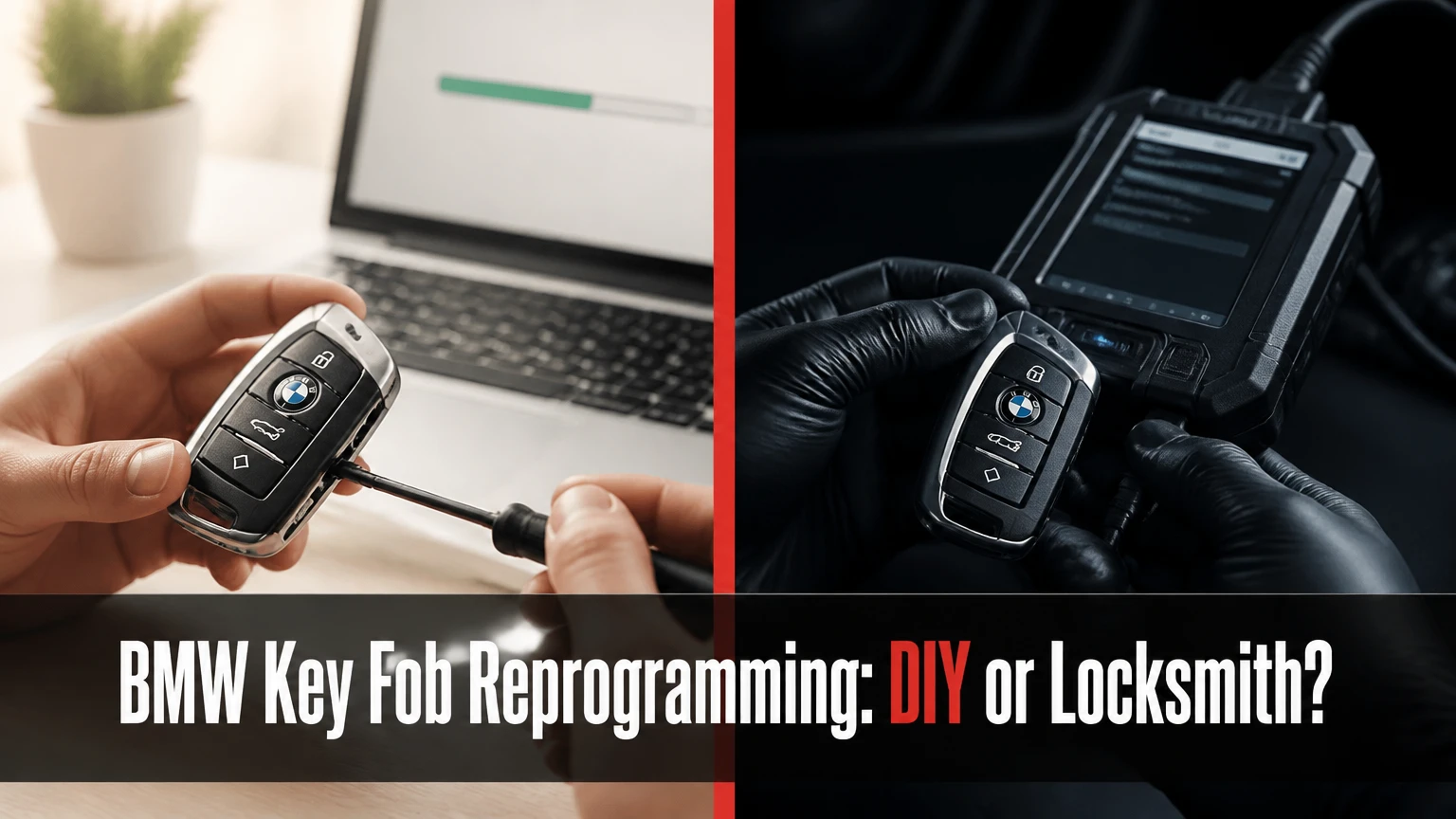
BMW key fob reprogramming usually means restoring the remote buttons, not programming the immobilizer that permits engine starting. Older E-Series BMWs often allow DIY remote initialization in under two minutes, while adding a key that starts an F-Series or G-Series vehicle normally requires BMW-compatible security equipment, vehicle identification, and proof of ownership.
Key Facts at a Glance
- A BMW key can start the engine while its lock and unlock buttons remain unsynchronized.
- E-Series remote initialization commonly uses the ignition Position 1, unlock, and lock-button sequence.
- Immobilizer programming writes key data to EWS, CAS, FEM, or BDC security modules.
- A new BMW key must match the vehicle identification number, region, frequency, and key type.
- Holding a modern key against the steering-column mark is usually an emergency recognition procedure, not full key programming.
- Typical North American costs range from $80-$200 for older remote work and $200-$1,000 or more for modern replacement keys.
What Does BMW Key Fob Reprogramming Actually Mean?
BMW key fob reprogramming describes two different operations: remote initialization and immobilizer programming. Remote initialization pairs the buttons with the vehicle’s locking receiver, whereas immobilizer programming authorizes a transponder or smart key inside the EWS, CAS, FEM, or BDC system to start the engine.
That distinction explains the most common BMW key confusion. If a key starts the car but cannot lock or unlock it, the remote signal needs synchronization. If a replacement key does nothing, the key may need VIN-specific immobilizer programming, may have the wrong frequency, or may not be a compatible BMW key at all.
BMW security systems are intentionally divided. The radio-frequency remote controls convenience functions, while the immobilizer validates an encrypted key identity before allowing engine operation. A button sequence cannot normally create that immobilizer authorization.
Which BMW function has failed?
| Symptom | Likely system | First action | Typical service level |
|---|---|---|---|
| Engine starts, buttons do not work | Remote transmitter | Initialize the remote | DIY on many E-Series |
| Buttons work, engine will not start | Immobilizer or transponder | Diagnose key and security module | Locksmith or dealer |
| New key is completely inactive | Compatibility or programming | Verify VIN, frequency, and key type | Professional diagnosis |
| Unlock works, lock fails | Button, shell, or receiver | Test button and central locking | Battery or repair service |
| Comfort Access fails, buttons work | Passive-entry antenna or key battery | Replace battery and test antennas | Diagnostic service |
| All keys are lost | Immobilizer security data | Arrange mobile locksmith or dealer | Professional-only in practice |
Can You Program an Older BMW Remote Yourself?
Many E-Series BMWs from approximately 1999-2011 permit DIY remote initialization when the key already belongs to the vehicle and the immobilizer still recognizes it. The procedure takes roughly one to two minutes, costs nothing, and requires every working remote to be initialized during the same session.
The method applies frequently to E46, E39, E53, E60, E83, E87, and E90 vehicles, but production-year overlap and regional equipment create exceptions. A BMW owner’s manual and the vehicle’s actual ignition design take priority over a generic internet sequence.
Before you start
| Requirement | Typical value | Why it matters |
|---|---|---|
| Vehicle condition | All doors closed | Prevents the car leaving initialization mode |
| Working key | At least 1 recognized key | Starts the synchronization sequence |
| Additional remotes | All available keys | Uninitialized remotes may stop operating |
| Ignition timing | Position 1, then Position 0 within 5 seconds | Opens the initialization window |
| Button timing | Lock button pressed 3 times rapidly | Sends the pairing command |
| Completion window | Usually under 30 seconds per key | Prevents the session from expiring |
Step 1: Enter the vehicle and close everything
Take every BMW remote you want to keep using into the vehicle. Close all doors, the trunk, and the windows, then sit in the driver’s seat with the recognized key.
Do not place other vehicle keys, wireless chargers, or aftermarket radio transmitters beside the remote. Radio interference is uncommon, but removing variables makes a failed initialization easier to diagnose.
Step 2: Open the initialization window
Insert the recognized key into the ignition. Turn it to Position 1, where accessory power and dashboard lights operate, without starting the engine. Return the key to Position 0 and remove it within five seconds.
You will know the timing was acceptable when the vehicle remains electrically normal and the key can be removed without the engine running. Do not hold the key in Position 2, and do not press the brake or clutch to start the car.
Step 3: Send the remote synchronization command
Press and hold the unlock button. While holding unlock, press the lock button, usually marked with the BMW logo, three times quickly within approximately ten seconds. Release the unlock button after the third lock press.
A successful BMW remote initialization normally causes the door locks to cycle automatically. The lock movement is the confirmation signal, not a dashboard message.
Step 4: Initialize every additional remote
Within about 30 seconds, repeat the unlock-and-three-lock-press sequence for each additional key. Do not insert the next key into the ignition.
Every remote must be added during the same session. Initializing one key often causes previously synchronized remotes to lose their remote pairing, although their immobilizer functions remain unaffected.
Step 5: End the session and test each key
Turn the ignition to Position 1 briefly, or close the vehicle and wait according to the model procedure. Test lock, unlock, trunk release, and any panic or comfort functions from several feet away.
You will know the procedure worked when every remote operates the locks consistently. If the locks do not cycle during initialization, repeat the process once with a fully charged vehicle battery and a known-good key.
Do Modern BMW Keys Use the Same Procedure?
F-Series and G-Series BMW vehicles generally do not use the older E-Series button sequence to add a replacement key. A new smart key is normally ordered or prepared for the vehicle, then recognized by the car through a BMW dealer or qualified automotive locksmith using security-module programming equipment.
Holding a modern key against the steering-column symbol can allow emergency engine starting when the key battery is weak or the radio signal is unavailable. That action does not usually add an unprogrammed key to the vehicle’s immobilizer memory.
| BMW era | Common examples | Key style | Security module | Normal programming path |
|---|---|---|---|---|
| E-Series | E46, E39, E60, E90, E53 | Diamond or slot key | EWS or CAS | DIY remote sync, professional immobilizer work |
| Early F-Series | F10, F20, F30, F25 | Angular smart key | CAS4 or FEM | Dealer or equipped locksmith |
| Late F-Series | F15, F30 LCI, F48 | Comfort Access smart key | FEM or BDC | VIN-specific professional programming |
| G-Series | G20, G05, G30, G11 | Smart or Display Key | BDC generation 2 or later | Dealer or specialist locksmith |
| Current digital systems | Selected G-Series models | Digital Key or Digital Key Plus | BDC, phone credential, vehicle account | BMW-compatible enrollment process |
How do you use emergency key recognition?
Unlock the BMW with the mechanical blade if necessary. Place the smart key against the marked area on the steering column or the location specified in the owner’s manual, then press the Start/Stop button while holding the key in place.
A successful emergency recognition lets the vehicle start, but it does not prove that the key’s buttons, Comfort Access, remote parking, or digital features are programmed correctly. Replace the correct coin-cell battery first when the key is otherwise known to be valid.
Which BMW Key Type and Frequency Must Match?
The replacement key must match the BMW model, production period, market, immobilizer generation, blade or slot design, radio frequency, and VIN relationship. A key that physically fits the shell or blade can still be electronically incompatible.
North American BMW vehicles commonly use 315 MHz remotes, while many European and Asian applications use 433 or 434 MHz. Some BMW applications use 868 MHz. Frequency alone does not establish compatibility because the transponder, encryption generation, FCC ID, and vehicle software also matter.
| Key attribute | Common values | Verification method | Failure caused by mismatch |
|---|---|---|---|
| Radio frequency | 315, 433/434, or 868 MHz | Original key label or parts catalog | Buttons fail to communicate |
| Key identification | FCC ID, BMW part number | Back of key and supplier catalog | Remote remains inactive |
| Battery type | CR2032 or CR2450 | Key holder marking | Short range or no response |
| Vehicle security system | EWS, CAS, FEM, or BDC | VIN and diagnostic scan | Engine authorization fails |
| Key format | Diamond, slot, smart, Display Key | Vehicle year and equipment | Key cannot seat or enroll |
| Market configuration | USA, Canada, Europe, Asia | VIN and regional parts data | Incorrect frequency or functions |
Can a used BMW key be reprogrammed?
A used BMW key is often a poor replacement choice because many keys retain an original vehicle identity and cannot be reset reliably for another car. Some older EWS systems permit specialist transponder work, but a used FEM, BDC, or Display Key may remain locked, incomplete, or incompatible.
A replacement shell can solve broken buttons without changing electronics. A new, VIN-matched key from BMW or a reputable locksmith provides a more predictable result than an inexpensive used fob advertised as “programmable.”
What Is the Cheapest Safe Programming Option?
For an E-Series BMW whose existing key starts the engine, remote initialization is free and should be attempted before buying parts. For a replacement starting key, a reputable automotive locksmith is typically less expensive than a dealer, while the dealer provides the most controlled parts and security process.
The following are typical North American consumer ranges, not fixed BMW prices. Model, location, key availability, Comfort Access, Display Key equipment, tax, travel, and all-keys-lost conditions can change the invoice substantially.
| Service route | Older E-Series typical cost | F-Series typical cost | G-Series typical cost | Typical time |
|---|---|---|---|---|
| DIY remote initialization | $0 | Usually unavailable | Usually unavailable | 1-2 minutes |
| Replacement shell or battery | $15-$80 | $20-$100 | $25-$150 | 10-30 minutes |
| Mobile locksmith | $80-$200 | $200-$350 | $350-$600 | 1-3 hours |
| BMW dealer | $150-$300 | $300-$500 | $500-$1,000+ | 1-5 days if ordered |
| Mail-in module service | $100-$300 | $250-$600 | $400-$900 | 2-7 days |
Dealer or locksmith: which is better?
Choose a BMW dealer when the vehicle uses a Display Key, Digital Key features, a newer BDC, or an all-keys-lost situation with unusual security-module conditions. Choose a qualified automotive locksmith when mobile service, same-day availability, lost-key deletion, and a lower typical price matter more.
Ask the locksmith four specific questions:
- Can the technician program this exact VIN and chassis?
- Will the technician verify the key frequency and FCC ID before cutting or programming?
- Can the technician delete a lost key from the active key list?
- Does the technician use a non-invasive, solder-free FEM or BDC adapter where applicable?
A dealer normally supplies a key ordered against the VIN and requests identification plus registration or title. A locksmith may use equipment such as Autel IM608, Xhorse VVDI, or Yanhua ACDP, but tool ownership does not prove technician competence.
Why Does a BMW Key Start the Car but Not Operate the Locks?
A BMW key that starts the engine but cannot lock or unlock the doors usually has a remote synchronization, battery, button, or receiver problem rather than an immobilizer problem. The starting transponder and radio remote are separate functions inside the same key housing.
Start with the least invasive checks. Replace the coin cell in a modern smart key, inspect the shell for liquid damage, test the second key, and attempt the correct E-Series initialization procedure if the vehicle belongs to that era.
Troubleshooting sequence
| Observation | Most likely cause | Test | Appropriate repair |
|---|---|---|---|
| Both keys lose remote function | Vehicle receiver, fuse, or synchronization | Test both keys near the car | Diagnostic scan or initialization |
| One key fails, second key works | Key battery or remote circuit | Swap battery and compare range | Battery or key repair |
| Very short operating range | Weak battery or antenna interference | Test outdoors at 2-5 meters | Battery replacement and interference check |
| Lock button fails alone | Worn microswitch or damaged circuit | Test other buttons | Shell or electronics repair |
| Remote works after moving close | Low key battery or receiver issue | Compare distance and angle | Battery, antenna, or module diagnosis |
| Engine also stops recognizing key | Immobilizer or key fault | Test emergency recognition and second key | Locksmith or dealer scan |
BMW diamond keys from many older vehicles use a rechargeable cell charged inductively while inserted in the ignition. Replacing that cell may require opening the sealed housing and soldering, so a new shell alone will not repair a dead electronic board.
What Common Mistakes Stop BMW Key Programming?
The most common BMW programming failures come from using the wrong procedure, buying an incompatible key, or interrupting security-module programming with unstable vehicle voltage. Correcting the diagnosis usually costs less than replacing modules or repeatedly purchasing aftermarket remotes.
Mistake 1: Treating starting authorization as remote pairing
The lock-button sequence cannot add immobilizer authorization. If the replacement key will not start the BMW, stop repeating the remote procedure and arrange VIN-specific programming.
Mistake 2: Programming only one remote
On many E-Series vehicles, all remotes must be initialized in one session. The first successful key can make the owner think the job is complete, while the second key silently loses button functionality.
Mistake 3: Buying by appearance
A diamond-shaped BMW key from the correct decade can still have the wrong frequency, transponder, or market configuration. Verify the part number, FCC ID, frequency, and VIN application before purchase.
Mistake 4: Confusing emergency start with programming
The steering-column recognition location is an emergency backup for a weak battery or unavailable radio signal. It does not turn an unregistered key into a permanent authorized key.
Mistake 5: Programming with low vehicle voltage
Keep the vehicle battery above approximately 12.4 volts at rest, or connect a suitable stabilized battery support unit during professional programming. A charger designed only for low-current battery charging may not maintain stable voltage during a security-module write.
Mistake 6: Removing a FEM or BDC without experience
Mail-in services can reduce local travel, but removing the wrong module, shipping it without protection, or leaving the car immobilized for several days creates additional risk. Newer BMW body-domain controllers operate windows, lights, locking, and immobilizer functions, so module damage can exceed the original key cost.
Can a Locksmith Delete a Lost BMW Key?
A qualified locksmith or BMW dealer can often deactivate a lost key from the vehicle’s authorized key list while programming a replacement. Deactivation prevents the missing key from starting or communicating with the vehicle, although it does not recover the physical key or guarantee that a previously copied mechanical blade cannot unlock a door.
Tell the provider how many keys remain and whether the missing key was stolen. Request confirmation that the lost key was removed, and test every remaining key before the technician leaves.
BMW systems commonly provide a finite number of key positions, often up to ten depending on the security generation. An apparently unused slot may be permanently marked as occupied, so a specialist may need to manage the key list rather than simply adding another key.
What Should You Do When Every BMW Key Is Lost?
When every BMW key is lost, use a dealer or an established automotive locksmith with all-keys-lost capability for the exact chassis. The provider will normally verify ownership, identify the vehicle by VIN, cut or supply a compatible key, and restore immobilizer authorization without bypass instructions.
Prepare the vehicle registration or title, government identification, VIN, current address, and any available key part number. A mobile locksmith may need access to the vehicle and diagnostic connector, while a dealer may require towing if the car cannot be moved.
All-keys-lost work generally costs more because the technician cannot rely on an existing authorized key and may need additional security steps. Typical service time is 1-3 hours for a capable mobile locksmith and 1-5 business days when a dealer must order a VIN-specific key.
Which BMW Key Programming Tools Are Appropriate?
Consumer tools are appropriate only when the vehicle, key system, and operator experience are explicitly supported. An AK90-type tool may assist with some older EWS applications, but it is not a universal BMW key programmer and does not replace correct module identification.
FEM, BDC, and newer CAS work can require EEPROM access, adapters, software licensing, stable power, and recovery capability. A failed write can leave the car unable to start or operate body functions, turning a low-cost key job into a module-repair bill.
| Tool or route | Best-supported use | User skill required | Main limitation |
|---|---|---|---|
| BMW remote initialization | E-Series button pairing | Basic owner procedure | Does not authorize a new starting key |
| AK90-type equipment | Selected older EWS systems | Electronics and module handling | Limited chassis coverage |
| Autel IM608 | Professional BMW key work | Locksmith diagnostic training | Coverage varies by software version |
| Xhorse VVDI BMW tools | Selected BMW security systems | Specialist programming knowledge | Incorrect operation can damage data |
| Yanhua ACDP | Supported CAS, FEM, or BDC jobs | Advanced technician | Requires correct adapters and procedures |
| BMW dealer equipment | VIN-specific official service | BMW technician | Higher price and ordering delays |
An honest limitation matters here: no universal device can safely program every BMW key. Tool compatibility changes with security generation, software level, market, and key type, especially on G-Series vehicles and Display Keys.
How Should You Choose the Repair Path?
Choose the repair path by separating the symptom, chassis, key type, and security requirement. The fastest decision is usually remote initialization for an older key that still starts the vehicle, followed by a locksmith for a new starting key and a dealer for Display Key or complex BDC work.
| Owner situation | Recommended route | Expected cost | Reason |
|---|---|---|---|
| E46 key starts car, buttons fail | DIY remote initialization | $0 | Remote function may only need resynchronization |
| E90 key battery is weak | Battery or key repair | $15-$100 | Immobilizer may remain functional |
| F30 replacement key needed | BMW locksmith | $200-$350 | FEM and VIN programming are involved |
| G20 Display Key damaged | BMW dealer or specialist | $500-$1,000+ | Remote parking and display features need compatibility |
| One key lost, one remains | Locksmith with deletion request | $150-$600 | Replacement and lost-key deactivation can occur together |
| All keys lost | Dealer or all-keys-lost locksmith | $300-$1,000+ | No authorized key is available for normal verification |
Expert rules that prevent expensive mistakes
- Diagnose the engine-start symptom before buying a fob. A key that starts the car rarely needs immobilizer programming.
- Keep every existing key during E-Series initialization. The cost of losing remote synchronization is avoidable.
- Treat a used smart key as a compatibility gamble, not a guaranteed bargain.
- Ask for a written price that separates key hardware, cutting, programming, travel, VAT or sales tax, and lost-key deletion.
- Never allow programming with a weak vehicle battery or an improvised charger.
Frequently Asked Questions
Does replacing a BMW key fob battery require reprogramming?
Replacing a battery normally does not erase immobilizer authorization, and modern BMW buttons should resume operation after the correct CR2032 or CR2450 cell is installed. An older rechargeable diamond key may have a degraded internal cell, requiring key repair or replacement rather than a routine battery swap.
How long does BMW key programming take?
Remote initialization on a compatible E-Series BMW takes about one to two minutes. Professional replacement-key programming typically takes one to three hours when the vehicle and technician are available, while dealer orders can take one to five business days depending on regional inventory and shipping.
Can I program a BMW key without the original key?
A dealer or qualified automotive locksmith can often create and authorize a replacement without an original key, provided ownership is verified and the exact security system is supported. All-keys-lost service costs more because the technician must establish authorization without an existing recognized key.
Why does my BMW say key not detected?
A “key not detected” message commonly results from a weak key battery, incorrect emergency-recognition position, radio interference, damaged key electronics, or a vehicle antenna fault. Hold the key at the steering-column recognition mark, try the spare key, and replace the correct battery before booking immobilizer work.
Will a BMW key from another car work on my vehicle?
A key from another BMW is not automatically reusable because the key identity, transponder generation, frequency, VIN relationship, and security module must match. Some older systems allow specialist reconditioning, but used F-Series and G-Series keys often remain locked or incompatible.
Does BMW key fob reprogramming erase the old keys?
Remote initialization can remove remote-button synchronization from other E-Series remotes when those keys are not included in the same session. Professional immobilizer programming may deactivate a lost key, but the technician should confirm which key positions were retained, added, or disabled.
The Bottom Line
BMW key fob reprogramming is usually either remote-button initialization or immobilizer authorization, and the correct remedy depends on which function has failed. Use the E-Series sequence when an older key still starts the car, replace or test the battery before ordering parts, and use a reputable locksmith or BMW dealer for VIN-specific starting keys, modern BDC systems, Display Keys, and all-keys-lost situations.