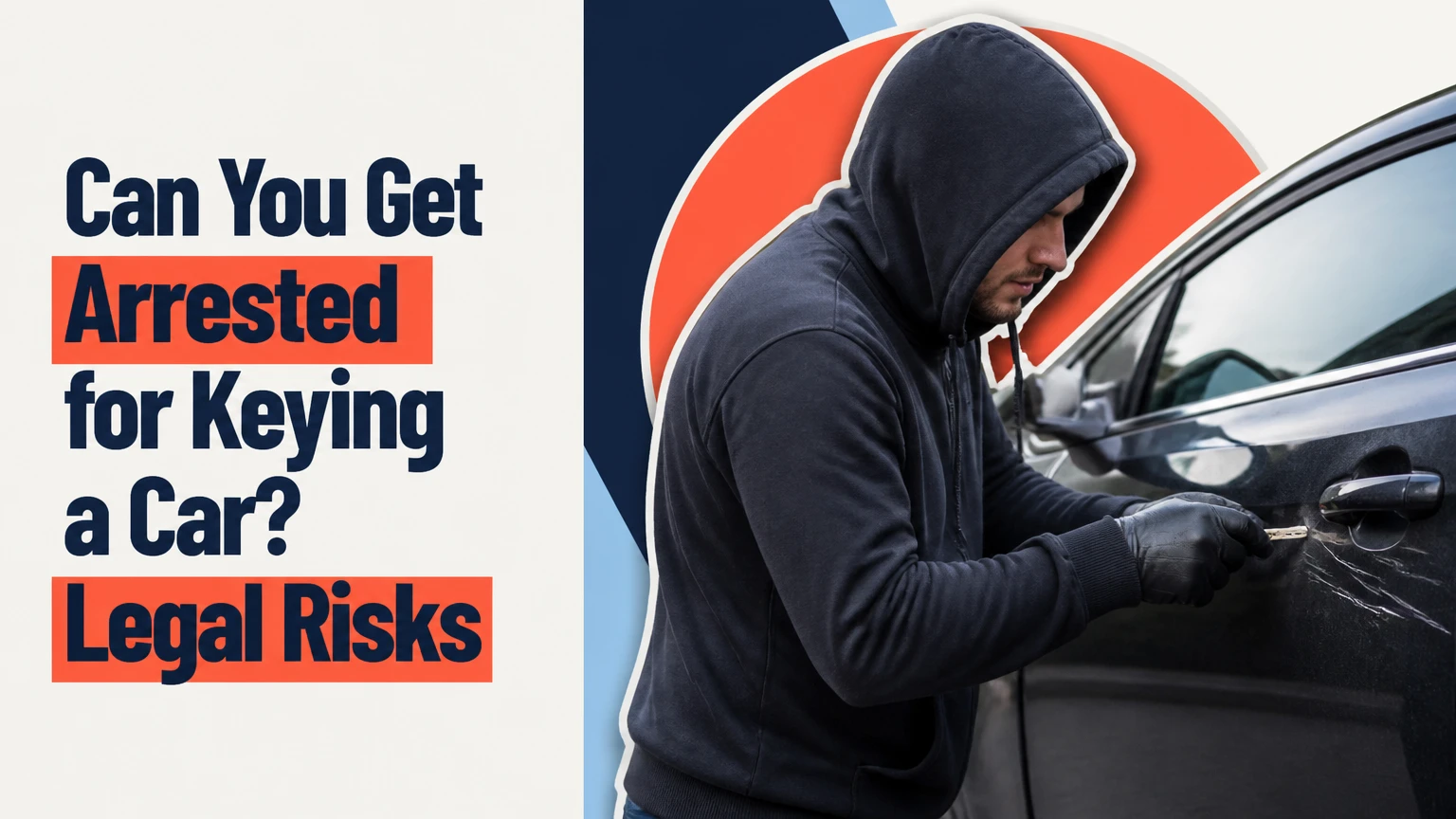
Yes, you can get arrested for keying a car because intentionally scratching someone else’s vehicle is usually treated as criminal damage, vandalism, criminal mischief, or malicious mischief. The charge level depends mainly on jurisdiction, repair cost, intent, prior record, and aggravating facts. Police may arrest, issue a summons, or seek a warrant.
Key Facts
Keying a car is generally an intentional property-damage offense, not merely a private dispute.
Arrest requires lawful grounds such as probable cause; conviction requires proof beyond a reasonable doubt.
Repair cost often influences whether the offense is a misdemeanor or felony, but thresholds differ by jurisdiction.
Paying for repairs does not automatically prevent criminal charges or erase an existing case.
Security footage, witness accounts, messages, photographs, paint-transfer evidence, and admissions can identify a suspect.
A person contacted by police should avoid discussing the facts until consulting a local criminal-defense lawyer.
What Crime Is Keying a Car?
Keying a car usually falls under a state or local property-damage statute that prohibits intentionally damaging, defacing, or destroying another person’s property. “Vandalism” and “criminal mischief” are common descriptions, but the controlling charge is the wording enacted by the relevant legislature.
The legal elements commonly include a physical act, damage to property, lack of permission, and a required mental state such as intent, knowledge, or recklessness. A prosecutor may need to prove that the accused caused the scratch and acted deliberately, rather than merely showing that damage existed.
| Common legal label | Conduct covered | Typical mental state | Possible case type |
|---|---|---|---|
| Criminal mischief | Intentional damage to tangible property | Intent or knowledge | Misdemeanor or felony |
| Vandalism | Defacing or damaging property | Willful or malicious conduct | Misdemeanor or felony |
| Malicious mischief | Deliberate interference with property | Malice or intent | Criminal charge |
| Property damage | Economic loss caused to another’s property | Statute-specific | Criminal and civil claims |
A key scratch can therefore produce two separate legal tracks. The criminal case is brought by the government, while the vehicle owner may seek repair costs through restitution or a civil lawsuit. The owner cannot personally “drop” criminal charges in every jurisdiction because charging authority usually belongs to the prosecutor.
Can You Get Arrested for Keying a Car Without Being Caught at the Scene?
Police can arrest someone for keying a car without witnessing the act if facts create probable cause connecting that person to the damage. Probable cause is a lower standard than proof required for conviction, so an arrest can occur even when the case later ends in dismissal or acquittal.
Investigators may use nearby business cameras, apartment surveillance, doorbell recordings, vehicle cameras, eyewitness accounts, statements, social-media messages, location data obtained through lawful process, or physical evidence. Tesla Sentry Mode and other recording systems can be relevant, although the existence and quality of footage vary.
The usual sequence is:
- The owner photographs the damage and files a police report.
- Officers identify possible witnesses, cameras, and relevant messages.
- A body shop or insurer documents the probable repair cost.
- Police determine whether probable cause supports an arrest, citation, or warrant request.
- A prosecutor reviews the evidence and files, declines, or modifies charges.
- The defendant attends an arraignment and addresses release conditions.
- The case resolves through dismissal, diversion, plea, trial, or another lawful disposition.
An arrest is not a conviction. The United States Supreme Court stated in Gerstein v. Pugh (1975) that probable cause is the constitutional basis for significant pretrial restraints, while guilt at trial requires proof beyond a reasonable doubt.
How Much Damage Makes Keying a Car a Felony?
No universal dollar amount makes keying a car a felony because criminal-damage thresholds differ by state, territory, province, and country. In many United States jurisdictions, repair costs around $1,000, $2,000, $2,500, or higher can affect grading, but the exact threshold and statutory exceptions must be checked locally.
| Illustrative damage range | Common charging possibility | Typical financial exposure | Important qualification |
|---|---|---|---|
| $100-$499 | Lower-level misdemeanor | $100-$1,000 fine plus repair costs | Local statute controls |
| $500-$999 | Misdemeanor or enhanced misdemeanor | $500-$2,500 plus restitution | Prior convictions may increase exposure |
| $1,000-$2,499 | Higher misdemeanor or low felony | Restitution, probation, or jail risk | Threshold varies substantially |
| $2,500-$9,999 | Felony in some jurisdictions | Larger fine, restitution, possible prison | Aggregation rules may apply |
| $10,000 or more | Serious felony in some jurisdictions | Significant restitution and incarceration risk | Aggravating facts may matter more than value |
These figures are illustrative ranges, not a legal chart for every location. A repair estimate can include repainting, blending adjacent panels, clear-coat work, labor, calibration, rental transportation, and replacement parts. A single superficial scratch may cost less than a full panel refinish, while damage across several panels can exceed a statutory threshold.
Two counterintuitive rules matter. First, the owner’s initial estimate may not be the final legally accepted value; the prosecution may need reliable evidence connecting the claimed cost to the charged damage. Second, a low dollar amount does not make conduct lawful. A small scratch can still support a misdemeanor, restitution order, probation, or a protective order.
What Penalties Can Follow a Car-Keying Charge?
Penalties can include arrest, court costs, fines, restitution, probation, community service, counseling, a no-contact order, and jail or prison in more serious cases. The final result depends on the statute, damage amount, criminal history, age, plea negotiations, aggravating facts, and whether the defendant accepts responsibility through a lawful resolution.
| Outcome | Typical duration or amount | Record consequence | Usually affected by |
|---|---|---|---|
| Restitution | Repair estimate or court-approved amount | Criminal case may remain visible | Verified damage and payment ability |
| Probation | 6-36 months | Conviction or deferred disposition | Record, risk level, and compliance |
| Community service | 20-200 hours | May accompany conviction or diversion | Local program and offense grade |
| County jail | 1-365 days where authorized | Misdemeanor record possible | Prior history and aggravating facts |
| State prison | 1-5 years or more where authorized | Felony record and collateral effects | Felony grade and statutory factors |
| Fine and fees | Hundreds to tens of thousands | Does not replace restitution automatically | Statute and judicial order |
A conviction can affect employment screening, housing, licensing, immigration, professional credentials, insurance, and firearm rights. The consequences are not identical everywhere, and some jurisdictions offer record sealing, expungement, deferred adjudication, or diversion rather than a conventional conviction.
A criminal record is also not the only financial risk. The owner may pursue uninsured losses, diminished-value arguments where permitted, deductible recovery, rental-car expenses, and filing costs in a civil action.
Is Keying a Car a Civil or Criminal Matter?
Keying a car can be both criminal and civil because the same conduct may violate a criminal statute and create a private claim for monetary loss. The government decides whether to prosecute, while the owner decides whether to pursue insurance, restitution, small claims, or a larger civil lawsuit.
| Legal route | Who starts it | Main objective | Proof standard or basis |
|---|---|---|---|
| Criminal prosecution | Prosecutor or state | Punishment and public enforcement | Beyond reasonable doubt at trial |
| Restitution order | Criminal court | Repayment tied to the offense | Court-approved loss evidence |
| Insurance claim | Vehicle owner or policyholder | Payment under policy terms | Policy coverage and documentation |
| Small-claims action | Vehicle owner | Repair-cost recovery | Civil preponderance standard in many places |
| Civil lawsuit | Vehicle owner | Damages beyond small-claims limits | Civil liability and documented loss |
A civil settlement does not automatically terminate the criminal case. Some jurisdictions permit a civil compromise for limited property offenses, while others allow prosecutors to continue regardless of payment. A written settlement should be reviewed before signing because it can affect admissions, releases, insurance rights, and restitution.
What Evidence Proves Who Keyed the Vehicle?
Evidence identifying the person who keyed a vehicle usually combines direct observation, digital recording, motive evidence, physical clues, and admissions. No single evidence type is required in every case, but a clear video, credible eyewitness, or authentic message admitting the act can materially strengthen probable cause.
Common evidence includes:
- High-resolution footage showing the person, object, vehicle, and time.
- Witness testimony describing the act from a reliable viewing position.
- Texts, direct messages, photographs, or posts that discuss the damage.
- Paint chips, fibers, fingerprints, or tool evidence, when collected properly.
- Statements made to the owner, police, insurers, friends, or coworkers.
- Access records, timestamps, work logs, payment records, and location evidence.
- Repair estimates that connect the claimed cost to the observed scratches.
The owner should preserve original files rather than relying only on edited clips or screenshots. Investigators may need metadata, the complete recording, camera placement, time-zone settings, and a witness who can explain how the footage was obtained.
A practitioner rule of thumb is that motive is not identity. A breakup, parking dispute, or angry message may explain why someone could have acted, but it does not independently prove who caused the damage. Conversely, a weak motive does not defeat strong video evidence.
What Happens After Someone Reports a Keyed Car?
After a report, police generally document the damage, collect available evidence, identify possible suspects, and decide whether the facts justify enforcement action. The owner’s first report may be followed by a supplemental estimate, prosecutor review, a citation, an arrest warrant, or no immediate action if identification remains insufficient.
Case timing varies widely. A straightforward camera-based case may move within days or weeks, while footage requests, forensic review, insurance disputes, and prosecutor backlogs can extend the investigation for months.
| Case stage | Typical timing | Main decision | Document commonly created |
|---|---|---|---|
| Damage discovery | Same day | Whether to preserve evidence | Photos and incident notes |
| Police report | 1-7 days | Whether an investigation opens | Incident or case number |
| Camera preservation | 24-30 days commonly available | Whether footage still exists | Exported video or request record |
| Repair assessment | 2-14 days | Estimated loss amount | Body-shop estimate |
| Suspect contact | Days to several months | Interview, citation, or arrest | Officer notes or warrant |
| Charging review | Weeks to months | File, decline, or amend charge | Complaint or information |
| Court resolution | 1-12+ months | Plea, diversion, dismissal, or trial | Judgment or dismissal order |
A statute of limitations is the deadline for filing a charge, not a promise that police will investigate for only that period. General limitation periods often range from one to three years for lower-level offenses and three to five years or longer for felonies, but local law can create shorter, longer, or offense-specific rules.
Should You Pay for the Damage Instead of Fighting the Case?
Paying repair costs may reduce the owner’s loss and improve negotiation prospects, but payment does not guarantee dismissal, prevent arrest, or eliminate a criminal record. A person accused of keying a car should discuss any offer, admission, or settlement with a local lawyer before contacting the owner or insurer.
| Resolution path | Potential benefit | Main risk | Common eligibility issue |
|---|---|---|---|
| Diversion | Possible dismissal after completion | Violation can revive prosecution | Often first offense only |
| Plea agreement | Predictable charge or sentence | Guilty plea creates consequences | Prosecutor approval required |
| Civil compromise | May resolve eligible minor offense | Not available everywhere | Statutory limits apply |
| Trial | Chance of acquittal | Cost, delay, and conviction risk | Evidence and legal defenses |
| Restitution plan | Demonstrates repayment effort | Payment alone may not change charge | Court approval may be needed |
Diversion commonly requires restitution, classes, community service, counseling, and a clean compliance period of roughly six to twelve months. A plea bargain may reduce a felony to a misdemeanor, but the result depends on the prosecutor, facts, and local sentencing rules.
Do not delete messages, alter recordings, pressure witnesses, or create a false alibi. Destruction or concealment of evidence can produce separate legal problems, and threats or repeated contact can support harassment or witness-tampering allegations.
What Should an Accused Person Do?
An accused person should preserve relevant records, avoid discussing the facts with the owner or police, and obtain legal advice promptly. The safest concise response to investigative questioning is: “I am invoking my right to remain silent, and I want to speak with a lawyer.”
Practical steps include:
- Ask whether officers are requesting a voluntary interview or executing legal process.
- Do not consent to a search without understanding the request and legal advice.
- Preserve texts, photographs, receipts, work records, and location information.
- Do not delete, edit, rename, or overwrite potentially relevant files.
- Write a private timeline for counsel while memories remain clear.
- Comply with a subpoena, summons, or warrant through proper legal channels.
- Follow every release condition, including no-contact and appearance requirements.
A lawyer may negotiate a citation, surrender procedure, diversion application, charge reduction, or restitution plan. That does not guarantee a favorable result, but early legal advice can prevent avoidable admissions and missed deadlines.
Being falsely accused requires a different approach. Gather time-stamped alibi material lawfully, identify witnesses, preserve relevant camera footage, and avoid confronting the accuser. Do not manufacture evidence or ask another person to coordinate a story.
What Should a Vehicle Owner Do After Discovering Damage?
A vehicle owner should photograph the scratches before washing, repairing, or moving the car, then report the incident and preserve possible video quickly. Insurance coverage commonly depends on the policy’s vandalism provisions, deductible, exclusions, and proof of loss.
The owner should:
- Photograph each panel from close and wide angles.
- Record the vehicle location, discovery time, and last known undamaged time.
- Request preservation of footage from businesses, residences, garages, and transit systems.
- Obtain at least one written repair estimate, preferably from a qualified body shop.
- Ask the insurer whether a police report, inspection, or multiple estimates are required.
- Keep invoices, rental-car receipts, deductible records, and correspondence.
- Avoid publicly accusing a suspected person without verified evidence.
Comprehensive auto coverage often addresses vandalism, subject to the deductible and policy language. Liability coverage for the person who caused the damage may also become relevant, but insurance payment does not determine whether criminal charges are filed.
An expert practical point is speed. Many security systems overwrite footage after approximately 7-30 days, and some residential systems retain event clips for shorter periods depending on the subscription. The owner should ask for preservation immediately rather than waiting for a repair appointment.
How Do Juvenile, Leased, and Repeat Cases Differ?
Juvenile, leased-vehicle, and repeat-offender cases can produce different procedures and consequences even when the physical damage is identical. Age, ownership status, prior convictions, supervision conditions, and the victim’s legal interest can change charging, restitution, and sentencing decisions.
A juvenile may enter a youth or family court system rather than adult criminal court, although serious or repeated conduct can trigger transfer rules in some jurisdictions. Parents or guardians may face separate civil issues, but liability varies by local statute and facts.
For a leased or financed car, the owner may not be the person who discovered the damage. The lessee, registered owner, finance company, insurer, and repair facility can each have documentation relevant to loss valuation and authority to approve repairs.
Repeat property offenses commonly increase sentencing exposure. Prior convictions may elevate a new offense, reduce diversion eligibility, or persuade a court that supervision and restitution conditions should be stricter.
What Defenses or Disputes Can Matter?
Potential defenses and disputes include mistaken identity, lack of intent, insufficient proof of causation, unreliable footage, permission, inaccurate repair valuation, and failure to establish the required legal elements. A defense is fact-specific and should not be treated as a guaranteed strategy.
Examples include:
- The accused was elsewhere, supported by independent timestamps.
- The scratch existed before the alleged incident.
- The video does not identify the person or show the actual contact.
- The damage resulted from an accidental event not covered by the statute.
- The repair estimate includes unrelated pre-existing damage.
- The owner or another authorized person permitted the conduct.
- Police obtained evidence through a legally challengeable process.
A person should not independently investigate by trespassing, accessing private accounts, contacting witnesses repeatedly, or recording conversations unlawfully. Counsel can request discovery, challenge identification, analyze video continuity, and obtain competing repair estimates through lawful procedures.
Can Insurance Pay for a Keyed Car?
Comprehensive auto insurance commonly covers vandalism, including deliberate scratching, but the insurer usually applies the policy deductible and requires reasonable proof of the loss. Collision coverage generally addresses impact damage rather than deliberate defacement, although exact coverage depends on the policy and jurisdiction.
If the repair estimate is $1,200 and the comprehensive deductible is $500, the potential covered payment may be approximately $700 before policy adjustments. A $400 repair would normally fall below that deductible, making an insurance claim financially unnecessary even if coverage exists.
Insurance may investigate suspected fraud, conflicting accounts, staged damage, or inflated estimates. The owner should provide accurate facts and should not exaggerate the repair scope to increase a claim.
Frequently Asked Questions
Can a first-time offender go to jail for keying a car?
A first-time offender can face jail exposure where the governing statute authorizes incarceration, but many lower-level cases resolve through probation, restitution, community service, diversion, or a reduced plea. Jail risk increases with high repair costs, threats, repeat conduct, multiple vehicles, prior records, or violation of release conditions.
Can a car owner press charges for a scratch?
A car owner can report the scratch and provide evidence, but the prosecutor or police usually decides whether criminal charges proceed. The owner can support the case with photographs, estimates, witness details, and preserved footage, yet cannot guarantee arrest or require a particular charge in most jurisdictions.
Does keying a car count as a hate crime?
Keying a car may qualify as a hate-crime enhancement only when the conduct is connected to a legally protected characteristic and the jurisdiction’s statute covers the offense. A personal dispute, insult, or discriminatory motive does not automatically satisfy every hate-crime law, so local legal review is essential.
Can you be arrested months after keying a car?
Yes, an arrest or summons can occur months after the incident if investigators later identify a suspect and the filing deadline has not expired. Delayed action commonly results from obtaining footage, locating witnesses, verifying ownership, calculating repair costs, or waiting for prosecutor review.
What if someone keyed my car but I have no video?
A case can still proceed without video if credible witnesses, admissions, messages, physical evidence, or circumstantial facts identify the person. The owner should document the damage, report it, ask nearby property owners to preserve footage, and avoid confronting a suspected person directly.
The Bottom Line
Can you get arrested for keying a car? Yes. Intentional vehicle scratching is commonly investigated as vandalism, criminal mischief, malicious mischief, or property damage, and the consequences can include arrest, restitution, fines, probation, jail, or felony prosecution when local law and repair value support it. Exact exposure depends on jurisdiction, evidence, intent, damage amount, and criminal history. If accused, preserve information and speak with a local lawyer before discussing the incident. If you own the damaged car, photograph it, preserve footage, obtain a documented estimate, and report the loss promptly.