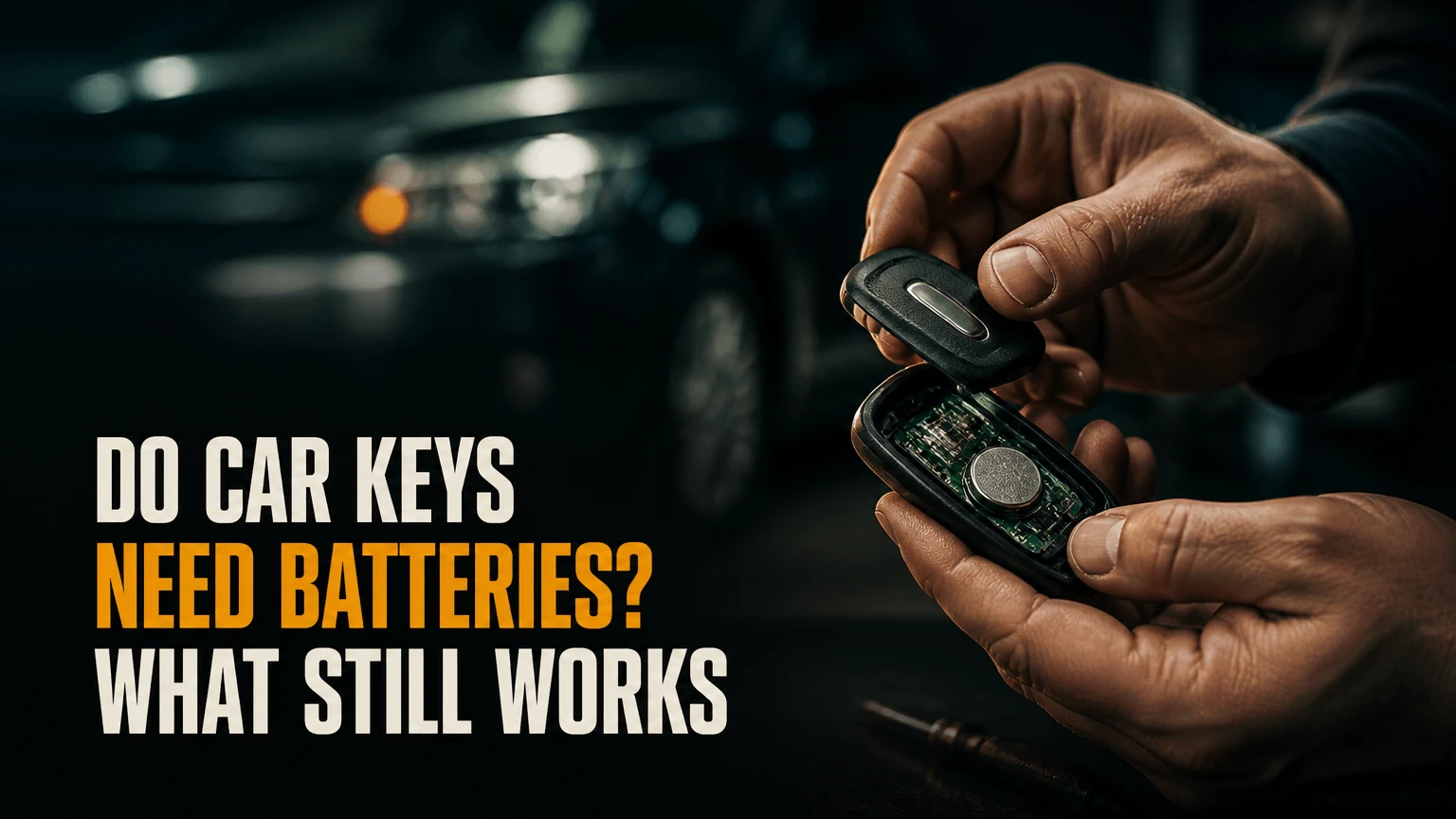
Most modern car keys need a battery for remote locking, unlocking, alarms, and passive-entry functions, but the battery does not power every part of the key. A metal key blade can still unlock some doors, while a passive immobilizer transponder may still authorize starting without its own battery. Push-button vehicles require a model-specific backup procedure.
Key Facts at a Glance
- A remote key fob needs a button-cell battery to transmit lock and unlock commands.
- A mechanical key blade does not need a battery, but it may only unlock the driver’s door.
- A passive immobilizer transponder can often authorize the engine without fob-battery power.
- Common batteries include CR2032, CR2025, CR2016, CR1620, and CR1616, all nominally 3 volts.
- Typical fob battery life is 2-4 years, but proximity keys often last 1-2 years.
- A replacement cell usually costs $2-$7, while complete key replacement and programming can cost $100-$600.
Which Car Keys Need Batteries?
Remote, flip, and smart keys need batteries because they transmit electronic commands, while a plain metal key does not. The important distinction is function: a battery powers the remote transmitter and proximity electronics, not necessarily the mechanical blade or immobilizer chip.
| Key type | Battery requirement | Typical cell | Main battery-powered function |
|---|---|---|---|
| Plain metal key | No | None | Mechanical door and ignition operation |
| Transponder key | Usually no for immobilizer | None or CR2032 if buttons exist | Remote buttons, if fitted |
| Fixed remote key | Yes | CR2016, CR2025, or CR2032 | Lock, unlock, trunk, panic |
| Flip or switchblade key | Yes | CR2025 or CR2032 | Remote commands and alarm control |
| Smart proximity fob | Yes | Usually CR2032 | Passive entry, push-button authorization, remote commands |
A transponder key can look like a traditional key while containing an electronic chip in its plastic head. The chip may draw energy inductively from an antenna around the ignition switch, so a dead remote battery does not automatically mean the immobilizer has failed.
Do traditional car keys need batteries?
A traditional metal car key needs no battery when it has no buttons, transmitter, or electronic remote circuit. Some traditional-looking keys contain a passive transponder, but that chip usually receives power from the vehicle’s ignition antenna rather than from a replaceable cell.
A key with lock, unlock, trunk, or panic buttons is not purely mechanical, even if a metal blade is attached. Its buttons stop working when the cell is exhausted, while the blade and passive chip may continue to perform their separate jobs.
How Does a Car Key Battery Work?
A car key battery supplies low-voltage power to a circuit board, which encodes a button command and sends it through a radio-frequency transmitter to the vehicle’s receiver. A proximity fob also supports low-frequency wake-up communication, allowing the car to detect the fob near a door or inside the cabin.
Most automotive remotes use radio frequencies around 315 MHz in North America or 433.92 MHz in many European and other markets, although the exact frequency, modulation, encryption, and regional approval depend on the manufacturer. Owners do not normally select the frequency; the replacement fob must match the vehicle’s system.
The battery powers the transmitter, microcontroller, indicator LED, and often passive-entry circuitry. The immobilizer transponder is a separate security component. That separation explains why a fob can stop locking doors while the engine still starts normally.
Does the battery power the engine immobilizer?
The key-fob battery usually does not power the immobilizer transponder. The vehicle’s antenna energizes the passive chip during authorization, but the car must still recognize the programmed transponder and accept its encrypted identity.
A dead fob battery therefore differs from an unprogrammed key. Replacing the cell restores electrical power, but it cannot program a new transponder, repair a failed circuit board, or bypass an immobilizer fault.
Can a Car Start With a Dead Key-Fob Battery?
A car can often start with a dead key-fob battery if the vehicle has a passive transponder and the driver follows the manufacturer’s backup detection procedure. A mechanical ignition switch may accept the key normally, while a push-button vehicle usually requires the fob to touch or approach a designated reader.
| Vehicle system | Dead-fob response | Typical backup action | Important limitation |
|---|---|---|---|
| Metal ignition key | Often starts normally | Insert key and turn ignition | Transponder must remain programmed |
| Remote key with ignition slot | Often starts normally | Insert fob or emergency key | Slot location varies |
| Push-button start | Usually displays key warning | Touch fob to start button or marked backup area | Procedure differs by model |
| Passive-entry door handle | Remote unlock may fail | Use hidden mechanical blade | Alarm may sound after entry |
| Vehicle with discharged 12-volt battery | Will not start | Restore vehicle battery first | A new fob cell cannot supply engine power |
Toyota manuals commonly instruct drivers to touch the Toyota-emblem side of the electronic key to the engine switch before pressing the switch. Other manufacturers place the backup reader in a center console, cupholder, steering-column area, or a slot.
The owner’s manual is authoritative for the exact procedure. Do not assume that holding the fob against the start button works on every vehicle.
How Do You Identify the Correct Key Battery?
The correct key-fob battery is identified by the old cell’s code, the owner’s manual, or the vehicle manufacturer’s parts information. Match the code and physical thickness exactly, because two 3-volt cells can have different dimensions and retaining-tab clearances.
| Battery code | Nominal voltage | Diameter | Thickness | Common key-fob use |
|---|---|---|---|---|
| CR1616 | 3.0 V | 16 mm | 1.6 mm | Compact Toyota and Honda remotes |
| CR1620 | 3.0 V | 16 mm | 2.0 mm | Selected compact remotes |
| CR2016 | 3.0 V | 20 mm | 1.6 mm | Thin remote housings |
| CR2025 | 3.0 V | 20 mm | 2.5 mm | Many remote and flip keys |
| CR2032 | 3.0 V | 20 mm | 3.2 mm | Common smart and proximity fobs |
CR2025 and CR2032 are not automatically interchangeable. Both provide 3 volts and measure 20 mm across, but the CR2032 is 0.7 mm thicker and can prevent the case from closing or deform the contacts when a holder is designed for a CR2025.
The code on the battery is more reliable than the vehicle’s model year alone. Mid-year production changes, regional variants, aftermarket cases, and replacement fobs can create exceptions.
Is a rechargeable battery suitable?
A standard lithium coin cell is normally the correct replacement for a car fob designed for a CR-series battery. Rechargeable LIR2032 cells have a higher nominal voltage, commonly about 3.6-3.7 volts, and should not replace a CR2032 unless the manufacturer explicitly specifies them.
Do not substitute an alkaline LR-series coin cell by appearance alone. Chemistry affects voltage, capacity, discharge behavior, and leakage risk.
How Do You Replace a Car Key Battery?
Most replaceable fob batteries can be changed at home in 5-10 minutes, using the correct cell and a plastic pry tool or small flat screwdriver. The determining factor is the case design: some shells have a release notch, while sealed or glued housings require a locksmith or replacement shell.
Before You Start
| Requirement | Typical value | Why it matters |
|---|---|---|
| Time | 5-10 minutes | Includes opening and testing |
| Battery cost | $2-$7 | Brand-name lithium coin cell |
| Tools | 1 plastic pry tool, 1 small screwdriver | Prevents shell and circuit damage |
| Battery quantity | 1 correct cell, 1 spare | Supports immediate replacement and backup |
| Workspace | Dry, well-lit surface | Reduces lost clips and contamination |
Step 1: Confirm the battery code
Read the existing cell before removing it, or consult the owner’s manual. Photograph the battery orientation and the internal layout so the positive and negative sides are not reversed.
Success checkpoint: The replacement code, diameter, and thickness match the old battery.
Common mistake: Buying a CR2032 because it is more common, without checking whether the fob takes a CR2025 or CR2016.
Step 2: Remove the emergency key
Press the release tab and slide out the hidden metal blade where the design permits. The blade often exposes a slot that opens the two halves of the fob.
Success checkpoint: The mechanical key comes out without forcing the release tab.
Common mistake: Twisting the blade sideways and breaking the retaining mechanism.
Step 3: Open the housing carefully
Place the blade tip or a plastic tool into the marked seam or notch. Twist gently rather than cutting around the case, because circuit boards, rubber button membranes, and retaining clips sit close to the shell.
Success checkpoint: The case separates evenly and no buttons or springs fall out.
Common mistake: Using excessive force at an unmarked seam, which can crack the housing.
Step 4: Remove and inspect the old cell
Note the orientation, then release the battery from its retaining clip without bending the contact prongs. Inspect for white residue, corrosion, moisture, or a loose solder joint.
Success checkpoint: The retaining contacts remain flat and firmly press against the cell.
Common mistake: Levering directly against a delicate soldered contact instead of the battery edge.
Step 5: Install the new cell
Insert the replacement with the same polarity as the original, usually the side marked with a plus sign facing upward. Hold the battery by its edges because fingerprints and oils can contaminate contacts, especially in damp environments.
Success checkpoint: The cell sits level and the case closes without pressure.
Common mistake: Forcing a thicker battery into a holder, which can bend the contacts or stop the buttons from working.
Step 6: Close and test the fob
Snap the housing together, reinstall the emergency blade, and test lock, unlock, trunk, and panic functions near the vehicle. Check the LED if the fob has one, but remember that an LED does not prove the vehicle accepted the encrypted signal.
Success checkpoint: The vehicle responds consistently from a normal distance.
Common mistake: Testing only one button and assuming all circuits are functioning.
How Long Does a Key-Fob Battery Last?
A standard remote battery typically lasts 2-4 years, while a smart proximity-fob battery often lasts 1-2 years. Passive-entry systems can consume more energy because the fob periodically responds to vehicle polling, especially when stored close to the car.
| Usage condition | Typical life | Main reason |
|---|---|---|
| Infrequent remote use | 3-5 years | Few transmission cycles |
| Daily lock and unlock use | 2-4 years | More button activity |
| Smart proximity fob | 1-2 years | Passive polling and response |
| Fob stored beside vehicle | Under 1-2 years possible | Repeated wake-up communication |
| Wet, hot, or damaged fob | Weeks to 1 year | Leakage, corrosion, or current drain |
Heat accelerates battery degradation. A fob left on a dashboard or in a hot vehicle may need replacement earlier than one kept indoors.
A low-battery warning should prompt replacement soon, not after the remote stops operating. Exact lifespan is not a maintenance guarantee because usage, temperature, transmitter design, and cell quality vary.
How Much Does Car-Key Battery Replacement Cost?
DIY replacement typically costs $2-$7 for one reputable coin cell and takes 5-10 minutes. A retailer or locksmith may install the battery for about $5-$25, while a dealership may charge roughly $15-$50 for battery service, depending on the vehicle and local labor rate.
| Service or item | Typical price | Typical time | What the price includes |
|---|---|---|---|
| Single CR2032 cell | $2-$7 | Immediate purchase | Battery only |
| Auto-parts counter installation | $5-$25 | 5-15 minutes | Cell and basic installation |
| Dealership battery service | $15-$50 | 15-30 minutes | Cell, labor, and basic test |
| Locksmith fob repair | $30-$100 | 30-90 minutes | Diagnosis, contacts, shell, or repair |
| Replacement programmed key | $100-$600 | 30 minutes to several hours | Fob, cutting, programming, and labor |
Prices vary by region and vehicle brand. Battery replacement is not the same service as key programming, which pairs a replacement transmitter or transponder with the vehicle.
Why Does a New Battery Not Fix the Key?
A new battery will not fix a car key when the problem comes from damaged contacts, water corrosion, broken buttons, transmitter failure, vehicle interference, lost programming, or a weak vehicle battery. Diagnosis should separate the fob, the car, and the radio environment before another battery is installed.
| Symptom | Likely cause | First check | Next action |
|---|---|---|---|
| Shorter range | Weak cell or interference | Test a fresh matching cell | Move away from metal or electronics |
| No LED and no response | Dead cell or open contact | Check polarity and clips | Repair holder or replace fob |
| LED works, car does not respond | Wrong programming or transmitter fault | Try spare key | Locksmith or dealer diagnosis |
| One button fails | Worn rubber pad or switch | Test other buttons | Replace membrane or circuit board |
| “Key not detected” while driving | Fob battery, antenna, or vehicle fault | Try backup location | Consult manual and scan vehicle |
| Both keys fail | Vehicle-side issue | Check 12-volt battery | Test car battery and receiver |
The vehicle’s 12-volt battery is a separate power source. A discharged vehicle battery can prevent locks, receivers, and push-button starting from working even when the key-fob cell is new.
Radio interference can also imitate a weak battery. Try the spare key, move the fob away from a phone or wireless accessory, and test close to the driver’s door before replacing electronic parts.
What should you do if the key still fails?
Test the spare key first, then test the replaced fob at close range and inspect its contacts. If both keys fail in the same way, investigate the vehicle battery, receiver, antenna, or immobilizer system rather than repeatedly changing coin cells.
A locksmith is often suitable for shell damage, broken contacts, or fob testing. A dealership may be necessary for manufacturer-specific programming, immobilizer pairing, or vehicles requiring online security access.
What Mistakes Damage a Key Fob?
The most damaging mistakes are installing the wrong thickness, bending the battery contacts, losing a loose transponder, closing the shell over a misaligned button membrane, and exposing the circuit board to moisture. Careful opening matters more than speed because many fobs use fragile clips and soldered terminals.
Practitioner rules that prevent avoidable failures
- Never force the case closed. Resistance usually means the battery, rubber membrane, or circuit board is misaligned.
- Do not scrape corrosion aggressively. Removing protective plating can create a permanent contact problem; a locksmith should assess heavy corrosion.
- Keep the old battery until testing is complete. It confirms orientation and provides a reference if the replacement code was misread.
- Avoid storing the spare cell loose. Coins or keys can short a lithium coin cell, causing heat and rapid discharge.
- Do not keep the spare in a hot glovebox. A cool, dry household location protects the battery better, although it will not help during a remote roadside emergency.
Some older aftermarket keys contain a loose transponder capsule. If that capsule falls out during opening, the vehicle may crank or refuse to start even though the remote buttons work.
Should You Replace the Battery or the Entire Key?
Replace only the battery when the fob case, buttons, circuit board, and contacts are intact. Replace or repair the key when a fresh cell produces no signal, the case is water-damaged, the buttons are physically broken, or the transmitter has lost programming.
| Condition | Battery replacement | Repair | Complete key replacement |
|---|---|---|---|
| Weak range with clean contacts | Appropriate | Not needed | Not needed |
| Cracked shell with working board | Not enough | Shell replacement | Optional |
| Corroded board | Usually insufficient | Sometimes possible | Often required |
| Lost programming | Not relevant | Programming service | New programmed key |
| Lost key with no spare | Not relevant | Not relevant | Locksmith or dealer |
| Damaged emergency blade | Not relevant | Blade cutting | Key or shell service |
A complete replacement can cost many times more than a coin cell. Confirm that the old battery is actually depleted before authorizing programming or ordering a new fob.
What Should Different Drivers Do?
Budget-conscious drivers should identify the code, buy a reputable cell, and replace it at home if the housing has a clear opening notch. Drivers who are uncomfortable handling small parts should use an auto-parts store, locksmith, or dealership, especially when the fob contains a loose transponder.
Smart-key owner
Replace the cell when the dashboard reports low battery or range decreases, rather than relying on a fixed 18-month schedule. Learn the backup start location before traveling, because a dead fob battery and an unfamiliar emergency reader can create an avoidable lockout.
Driver with one working key
Keep the working key protected and obtain a spare before it fails. Programming a second key is usually easier and less expensive when one authorized key remains available.
Driver stranded with a dead fob
Use the hidden mechanical blade to unlock the door, then follow the owner’s manual’s backup-start procedure. If the alarm activates, keep the fob inside the vehicle and try the designated reader location rather than repeatedly pressing the start button.
Driver whose vehicle will not respond at all
Check whether the interior lights, horn, or dashboard work. If the car’s 12-volt battery is discharged, fob-battery replacement will not restore vehicle operation.
FAQ
Does a spare car key need a battery?
A spare key needs a battery only if it has powered remote or proximity functions. A plain metal key and many passive transponder keys can remain stored without a battery, although a remote spare should receive a fresh cell before it is needed.
Does a key-fob battery affect remote starting?
A key-fob battery powers the transmitter used for remote starting, so a dead cell normally prevents the remote-start command from reaching the vehicle. Remote start may also require a valid hood switch, closed doors, sufficient fuel, and manufacturer-specific security conditions.
Can a dead key fob lock the car?
A dead key fob cannot transmit a normal lock command, but the vehicle can usually be locked with the mechanical blade or the interior lock controls. Some vehicles provide a mechanical keyhole under a door-handle cover, and the owner’s manual explains how to secure every door.
Why does the car say key not detected after battery replacement?
A “key not detected” warning after replacement can result from reversed polarity, an incorrect cell thickness, poor contact, damaged circuitry, lost programming, interference, or a weak vehicle battery. Test the fob in its backup reader location and compare its behavior with the spare key.
Can a locksmith replace a car-key battery?
A locksmith can usually replace the battery, test the transmitter, repair contacts, replace the shell, and program a compatible key. A dealership may be required for some immobilizer systems, encrypted key registration, or models that require manufacturer security access.
How do you dispose of a used coin-cell battery?
Tape the terminals of a used lithium coin cell and take it to a battery-recycling collection point or household hazardous-waste program. Do not place loose lithium coin cells in ordinary recycling, where short circuits can create fire hazards.
The Bottom Line
Do car keys need batteries? Remote and smart car keys generally do, but a mechanical blade and passive immobilizer may continue working without fob-battery power. Identify the exact cell code, match its thickness and polarity, replace it carefully, and use the vehicle’s documented backup-start procedure if the fob dies. A new battery cannot repair a damaged transmitter, lost programming, failed vehicle receiver, or discharged 12-volt battery.