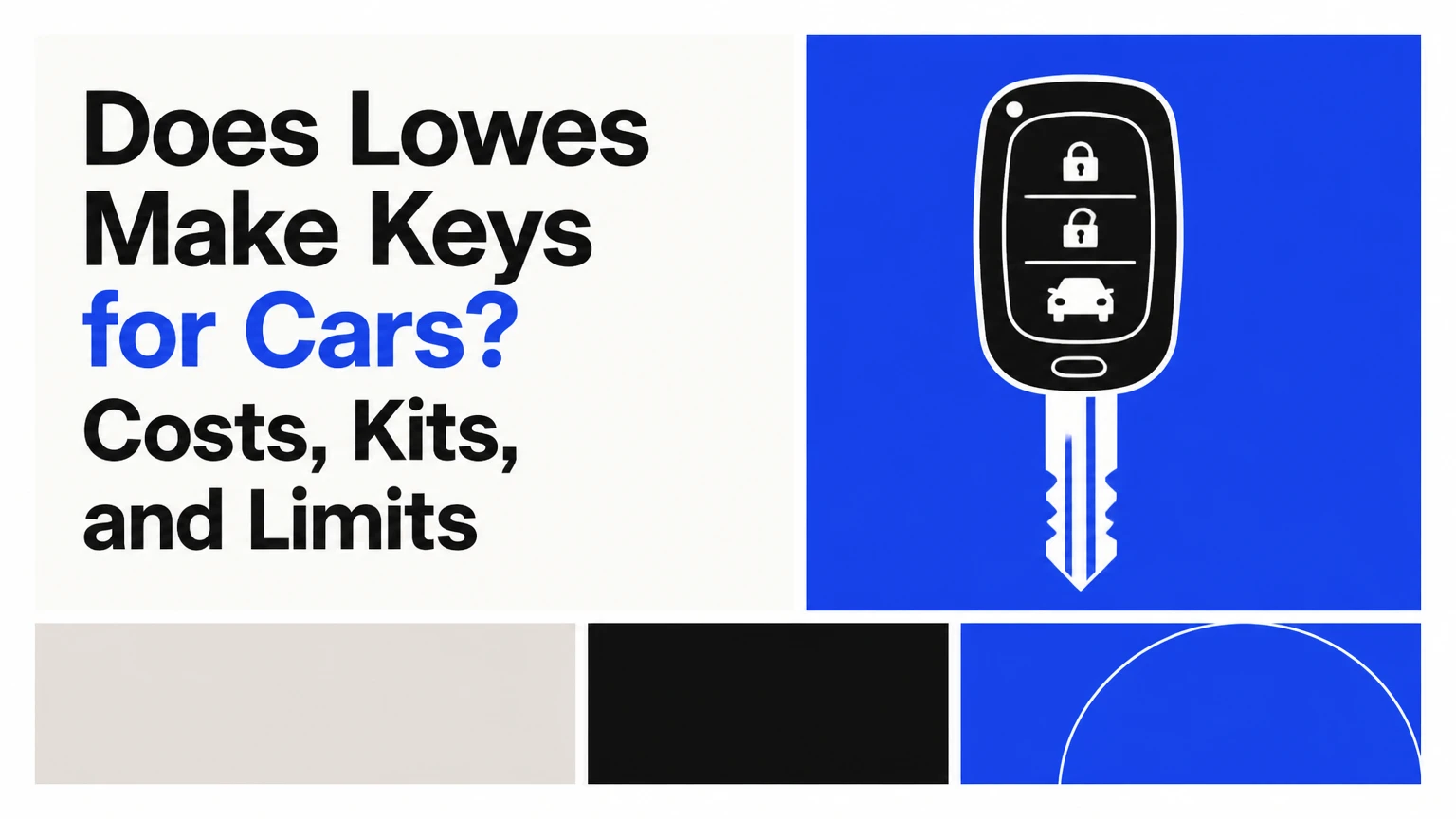
Lowe’s can make some car keys, but the available service depends on the vehicle’s key type, electronic security system, and local store inventory. Lowe’s may cut a basic metal key, sell a compatible Car Keys Express or Simple Key kit, or provide access to a self-service kiosk, but most stores do not provide full automotive locksmith programming.
Key Facts at a Glance
- Lowe’s can usually duplicate a basic, non-electronic metal car key when the correct blank and cutting equipment are available.
- A transponder key must contain a programmed electronic code before the vehicle will start, even if the blade turns the ignition.
- Car Keys Express and Simple Key kits generally require exact vehicle compatibility and often require one working key.
- Typical Lowe’s-related costs range from about $3-$6 for a basic duplicate and $60-$130 for many DIY electronic-key kits.
- Lowe’s cannot guarantee every vehicle make, model, key frequency, blade style, or immobilizer system.
- A mobile automotive locksmith is usually the correct first call when every key is lost, the vehicle is locked, or programming fails.
Does Lowes Make Keys for Cars?
Yes, Lowe’s makes or sells solutions for some car keys, but Lowe’s is not a universal car-key replacement service. A store may cut a conventional metal key, operate a Minute Key or similar kiosk, or sell a vehicle-specific electronic-key kit that the customer programs independently.
The important distinction is between cutting, copying, and programming. Cutting reproduces the blade’s mechanical pattern. Programming authorizes a transponder, remote, or smart key to communicate with the vehicle’s immobilizer and body-control systems. A newly cut blade can fit the ignition and still fail to start the engine.
Lowe’s official service pages and product listings describe key-making availability, while Car Keys Express product documentation controls compatibility and programming requirements for its kits. Store services, kiosk models, and shelf inventory change, so a Lowe’s website listing is not proof that a nearby branch can complete the job.
What Lowe’s does not provide
Most Lowe’s locations do not have a licensed automotive locksmith on site who can originate every key from a vehicle identification number. Store associates generally cannot bypass an immobilizer, retrieve restricted security codes, decode a damaged ignition, or program unsupported European smart keys.
That limitation matters most when a customer has no working key. A locksmith or dealership can use ownership documentation and vehicle-specific diagnostic equipment, while a retail kiosk normally needs an existing key to copy or clone.
How Do Lowe’s Car-Key Options Work?
Lowe’s car-key options fall into two groups: mechanical duplication and customer-operated electronic replacement. Mechanical duplication can take roughly 1-5 minutes; an electronic kit commonly takes 15-30 minutes after compatibility, cutting, and programming requirements are confirmed.
Option 1: Cut a basic metal key
A conventional metal key has no transponder chip and no remote buttons. The key works when the blade’s cuts match the lock cylinder and ignition, so a kiosk or key counter can often duplicate it from an existing key.
The usual process is straightforward:
- Bring an intact working key.
- Ask whether the store has the correct automotive blank.
- Have the blank copied at the counter or supported kiosk.
- Test the duplicate in the door and ignition without forcing it.
- Confirm that the key turns smoothly before leaving.
A duplicate that fits the door but does not turn the ignition may have the wrong blank profile or inaccurate cuts. Do not repeatedly twist a rough duplicate because a poorly cut key can damage a worn ignition cylinder.
Option 2: Use a Minute Key or similar kiosk
Self-service key kiosks scan an existing key and cut a duplicate according to the scanned profile. Kiosk pricing for basic keys is commonly about $3-$6, although the final amount depends on the blank design and local equipment.
Kiosk capability is not uniform. Some newer machines advertise automotive or transponder-key functions, while other machines handle only standard metal duplicates. A kiosk that copies a transponder signal may create a clone of the original key rather than add a distinct key identity to the vehicle.
That distinction affects features such as separate driver profiles, key-count limits, and Ford MyKey management. A cloned key may start the car while remaining electronically identical to the source key.
Option 3: Buy a Simple Key or Car Keys Express kit
A compatible DIY kit generally includes a replacement key or remote, a cuttable blade, and a programming device or procedure. Car Keys Express product pages list applications by make, model, year, button configuration, and sometimes FCC identification.
The customer normally cuts the blade at Lowe’s or another participating key counter, then completes programming at the vehicle. Some kits use an OBD-II connection under the dashboard; others rely on an existing key and an onboard sequence.
The box and manufacturer compatibility checker matter more than the vehicle brand alone. A kit labeled for Honda, Ford, Toyota, or Nissan may fit only selected years and trims.
Which Type of Car Key Do You Have?
The correct Lowe’s option depends on the key’s electronics and blade geometry, not simply whether the car is old or new. Vehicle age is a useful shortcut, but a 1990s vehicle can have a transponder and a newer fleet vehicle can use a conventional metal key.
| Key type | Identifying feature | Lowe’s pathway | Typical cost |
|---|---|---|---|
| Basic metal key | Metal blade, no buttons, no chip | Counter or supported kiosk | $3-$6 |
| Transponder key | Chip inside plastic head, no remote buttons | Compatible clone or DIY kit | $20-$70 |
| Remote-head key | Blade and lock buttons in one housing | Vehicle-specific kit | $60-$120 |
| Smart key fob | Push-button start, proximity detection | Limited compatible kit | $90-$130 |
| Laser or sidewinder key | Central groove or complex milled track | Usually locksmith or dealer | $80-$250 |
| European encrypted key | BMW, Mercedes, Audi, or VW security system | Usually specialist provider | $200-$600+ |
Can Lowe’s program a transponder key?
Lowe’s can support transponder-key duplication in limited situations, but cutting the blade alone does not program the immobilizer. A kiosk may clone an eligible chip, while a compatible Simple Key kit may add a replacement key through a prescribed vehicle procedure.
Transponder systems use a coded chip that the vehicle checks before enabling engine operation. The exact process varies by manufacturer, model year, immobilizer generation, and whether an authorized key is present. Some vehicles allow onboard self-programming; others require diagnostic equipment.
Test both functions separately. First verify that the blade enters and turns the lock. Then verify that the vehicle starts and that the security indicator behaves normally. A duplicate that unlocks the door but leaves a flashing security light is not a successful replacement.
Can Lowe’s replace a remote or smart key?
Lowe’s may sell a compatible remote-head key or smart-fob kit, but product availability is model-specific and programming is not guaranteed at the store. Remote locking and engine authorization are separate functions, so a key can start the vehicle while its lock buttons remain unpaired.
Push-button-start vehicles require additional caution. Some smart keys use proximity antennas, rolling codes, immobilizer authentication, and emergency mechanical blades. A kit must match the vehicle’s frequency, FCC ID, button layout, transponder system, and programming method.
How Much Does a Lowe’s Car Key Cost?
A basic metal duplicate typically costs $3-$6, while a compatible electronic DIY kit commonly costs $60-$130 before any extra cutting or service charge. A locksmith or dealership usually costs more, but the higher price includes equipment, key origination, programming, and support for situations Lowe’s cannot handle.
| Replacement route | Typical price | Typical time | Working key needed |
|---|---|---|---|
| Basic metal duplicate | $3-$6 | 1-5 minutes | Yes |
| Transponder clone | $20-$70 | 5-20 minutes | Usually yes |
| Remote-head DIY kit | $60-$120 | 15-30 minutes | Often yes |
| Smart-fob DIY kit | $90-$130 | 20-40 minutes | Kit-dependent |
| Mobile automotive locksmith | $100-$350 | 30-90 minutes onsite | No, in many cases |
| Dealership replacement | $200-$600+ | 1-5 business days | No, with ownership proof |
These are typical consumer ranges, not a Lowe’s price guarantee. Vehicle complexity, key design, local labor rates, emergency timing, and whether all keys are lost can change the total substantially.
A low-priced kit is economical only when the application is supported and the customer follows the programming procedure correctly. Buying the wrong frequency or an incompatible immobilizer kit can turn a $90 purchase into a second replacement expense.
How Do You Use a Lowe’s DIY Car-Key Kit?
Use a Lowe’s DIY kit by confirming compatibility, cutting the blade, preparing the vehicle, and following the manufacturer’s programming sequence. The most important success factor is the exact year, model, trim, FCC ID, and existing-key requirement, not the kit’s general brand label.
Before you start
- Time: Allow 30-45 minutes, including reading instructions and testing.
- Difficulty: Moderate for a supported vehicle; unsuitable for an unsupported immobilizer.
- Cost: Usually $60-$130 for the kit, plus cutting if charged separately.
- Materials: Kit, one working key when required, vehicle, and a stable vehicle battery.
- Documents: Keep the product receipt and record the original key’s FCC ID if visible.
Step 1: Confirm the exact application
Match the kit to the vehicle identification details printed on the package or manufacturer website. Check model year, trim, button count, blade style, FCC ID, frequency, and whether the vehicle has ignition-key start or push-button start.
Do not rely on a similar-looking remote. Two keys can share a housing but use different frequencies or immobilizer systems.
Success checkpoint: The compatibility tool lists the exact vehicle application and programming method.
Common mistake: Selecting a kit from the same brand without checking the model year.
Step 2: Check the working-key requirement
Many DIY kits need one functioning programmed key to authorize another key. The existing key may be required to turn the ignition, start the vehicle, or initiate the onboard learning sequence.
Read the kit instructions before opening or cutting anything. Some products support selected all-keys-lost applications, but that capability cannot be assumed from the phrase “programmable.”
Success checkpoint: The instructions clearly state whether one or two working keys are required.
Common mistake: Cutting the new blade before discovering that the vehicle requires a locksmith when no key remains.
Step 3: Cut the replacement blade
Take the kit’s blank blade to a Lowe’s key counter only if the store has compatible equipment and agrees to cut that blank. Bring the working key as the pattern, and inspect the cut before leaving.
The blade must match the ignition and door profile. A remote can pair electronically while the metal blade remains unusable.
Success checkpoint: The new blade turns the door and ignition smoothly without excessive pressure.
Common mistake: Assuming a key that enters the cylinder is correctly cut.
Step 4: Prepare the vehicle
Park safely with the transmission secured, switch off lights and accessories, and keep the original key and new kit together. A weak vehicle battery can interrupt programming, especially when the ignition remains on during several learning cycles.
Locate the OBD-II port if the kit includes an EZ Installer or similar device. The port is commonly below the steering wheel, but the vehicle manual identifies its exact location.
Success checkpoint: The device powers on normally and the vehicle battery remains stable.
Common mistake: Attempting programming with a weak battery or a loose diagnostic connection.
Step 5: Program and test the key
Follow the kit’s exact button presses, ignition cycles, or OBD-II prompts. Do not substitute a generic internet sequence because manufacturers use different timing and security procedures.
Test engine starting, remote lock, unlock, trunk operation, panic function, and the dashboard security indicator. Keep the original key away from the vehicle only when the instructions require separation.
Success checkpoint: The engine starts and each advertised button performs its intended function.
Common mistake: Declaring success after the remote locks the doors without testing immobilizer authorization.
What Is Lowe’s Unable to Handle Well?
Lowe’s is a poor choice when the vehicle needs key origination, advanced diagnostic programming, restricted security access, or precision cutting that the local store does not support. European vehicles, sidewinder blades, damaged ignitions, and all-keys-lost cases often require a mobile automotive locksmith or dealer.
Laser-cut and sidewinder blades
Sidewinder keys have a milled track, often down the center or side of the blade, rather than simple edge cuts. Standard hardware-store duplicators usually cannot reproduce that geometry accurately.
Some stores may have newer equipment, but customers should confirm the specific branch before buying a blank. A locksmith with a laser key machine can identify the profile and cut it from a code or working key.
European and luxury vehicles
BMW, Mercedes-Benz, Audi, Volkswagen, and some newer Volvo models can combine encrypted remotes, proprietary immobilizers, rolling codes, and dealer-controlled authorization. A visually similar aftermarket fob may not communicate with the vehicle.
A specialist locksmith may offer a lower-cost alternative to the dealer, but the provider should demonstrate experience with the exact model. Ask whether the quote includes cutting, immobilizer programming, remote pairing, emergency blade cutting, and ownership verification.
Broken, worn, or missing keys
Copying a severely worn key reproduces its errors. If the original blade is bent, cracked, or rounded, a locksmith may decode the lock or use a key code instead of copying the damaged pattern.
When every key is lost, Lowe’s usually cannot create and authorize a replacement from only the VIN. The dealer or locksmith will normally request registration, title, insurance, and government identification before performing security-related work.
Lowe’s Versus a Locksmith or Dealership
Lowe’s is usually the cheapest route for a simple duplicate or supported DIY kit, while a mobile automotive locksmith is more capable for all-keys-lost and onsite programming situations. A dealership is the most vehicle-authorized option, but it commonly has the highest price and longest turnaround.
| Decision factor | Lowe’s | Mobile locksmith | Dealership |
|---|---|---|---|
| Basic metal duplicate | $3-$6, 1-5 minutes | $50-$150, 20-60 minutes | $50-$150, 1-5 days |
| One working key available | Often suitable | Suitable | Suitable |
| All keys lost | Usually unsuitable | Often suitable | Suitable |
| Sidewinder blade | Store-dependent, often unavailable | Common capability | Common capability |
| Smart-key programming | Kit-dependent | Model-dependent equipment | Factory-compatible equipment |
| Vehicle location | Customer travels to store | Onsite service | Customer usually tows or drives |
| Ownership documents | Usually not requested for copying | Usually required for programming | Required |
Choose Lowe’s when the vehicle has a basic metal key or a clearly supported kit, one working key is available, and minimizing cost matters most. Choose a locksmith when the car is immobilized, every key is gone, the blade is sidewinder-style, or programming requires professional equipment.
Choose the dealership when the vehicle has a restricted security system, warranty concerns, or a key application that independent providers cannot verify. Call first because some dealerships order keys by VIN rather than producing them immediately.
Common Problems and How to Fix Them
The new key unlocks the door but will not start the car
The blade is mechanically correct, but the transponder is unprogrammed, incompatible, or defective. Recheck the kit application and security-light behavior; if the instructions require diagnostic equipment, stop repeating the sequence and contact a locksmith.
The remote buttons do nothing
The remote may need separate pairing, a correctly installed battery, or a matching frequency. Confirm the battery orientation, FCC ID, button layout, and kit instructions before assuming the vehicle’s receiver is defective.
The programming device will not connect
Inspect the OBD-II plug, ignition position, vehicle battery, and device compatibility. Aftermarket accessories or a damaged diagnostic port can interrupt communication, while an unsupported model cannot be corrected through repeated attempts.
The key cuts poorly
A wrong blank, worn source key, or misaligned machine can produce a key that binds in the cylinder. Stop using it, return to the cutting counter with both keys, and request a profile check rather than forcing the ignition.
The kit appears incompatible after purchase
Do not cut or program a questionable kit. Record the vehicle year, trim, FCC ID, and product number, then ask Car Keys Express or the retailer whether the kit matches the application; cutting may affect return eligibility.
The kiosk rejects the original key
A bent, damaged, nonstandard, or restricted key may not scan accurately. A locksmith can decode the lock or cut from a code, which is safer than making multiple inaccurate copies.
How Can You Verify Lowe’s Availability?
Verify the individual Lowe’s location before driving there because key kiosks, automotive blanks, cutting machines, and associate availability vary by store. Use the Lowe’s website for the branch phone number, check the kiosk or service listing, and ask specifically about the key profile and blank.
Give the associate four details:
- Vehicle year, make, and model.
- Key type, such as metal, transponder, remote-head, or smart fob.
- Whether at least one working key remains.
- Whether the replacement blank was purchased at Lowe’s.
Ask whether the store will cut a customer-supplied blank, whether its equipment supports sidewinder profiles, and whether the kiosk handles automotive transponder keys. These questions prevent a common failure: arriving with a kit that the store can sell but cannot cut.
Which Option Should You Choose?
- Basic metal key with one working copy: Use the counter or kiosk. Budget $3-$6 and allow 1-5 minutes.
- Common vehicle with one working electronic key: Compare a compatible Simple Key kit with a locksmith quote. Budget $60-$130 for many kits.
- Push-button-start vehicle: Verify the exact smart-fob application before purchase. A locksmith is safer when compatibility is uncertain.
- No working keys: Call a mobile automotive locksmith or dealership first. Lowe’s is usually not equipped to originate the complete replacement.
- Sidewinder, European, or luxury key: Contact a specialist locksmith or dealer and ask about programming capability before booking.
- Damaged ignition or broken key: Use a locksmith rather than copying the damaged blade.
Frequently Asked Questions
Can Lowe’s make a car key from the VIN?
Lowe’s generally does not originate and program a complete car key from the VIN alone. A VIN identifies the vehicle, but the replacement may still require a key code, security authorization, diagnostic programming, and proof of ownership. A dealership or automotive locksmith is the appropriate provider for a VIN-based replacement.
Can Lowe’s copy a car key that has a chip?
Lowe’s may copy some eligible transponder keys through a supported kiosk or product, but chip compatibility is vehicle-specific. The machine must duplicate or authorize the correct electronic code, and the blade must also match the ignition. Always test engine starting, not only door access, before treating the copy as usable.
Does Lowe’s make keys for older cars?
Lowe’s is most likely to help with older cars that use a conventional metal blade without an immobilizer chip. Some vehicles built before 2000 still use transponders, while certain newer vehicles retain simple keys, so the presence of a chip matters more than the registration year.
Is a Lowe’s car-key kit returnable after cutting?
Return eligibility depends on the retailer’s policy, product condition, and whether the blade has been cut or the electronics used. Cutting a blank can make it a customized item, so confirm compatibility before cutting and retain the receipt, packaging, and programming documentation.
How many spare car keys should you have?
Keep at least two programmed keys for a vehicle that supports them, with one stored away from the everyday key ring. Some vehicles require two existing keys for onboard enrollment, and maintaining a spare avoids the higher cost and delay of an all-keys-lost replacement.
Should you use Lowe’s or a locksmith for a spare key?
Use Lowe’s for a simple metal duplicate or a confirmed DIY kit when one working key remains and the vehicle is supported. Use a locksmith when the key is electronic but unsupported, the blade is sidewinder-style, the car is immobilized, or every programmed key has been lost.
The Bottom Line
Does Lowes make keys for cars? Yes, Lowe’s can cut some basic car keys and sell selected electronic replacement kits, but the service is limited by key design, vehicle compatibility, programming requirements, and local inventory. Lowe’s is usually the low-cost choice for a simple duplicate or supported kit; a locksmith or dealership is the better solution for all-keys-lost, sidewinder, encrypted, or unsupported vehicles.