Yes, Walmart can copy some car keys, usually through a third-party MinuteKey or KeyMe kiosk rather than a Walmart employee at a service counter. A kiosk commonly duplicates compatible mechanical metal keys, while transponder, laser-cut, and push-to-start keys may require mail ordering, a compatible DIY kit, a locksmith, or a dealership.
Key Facts at a Glance
- Walmart does not provide identical automotive key services at every store.
- A basic metal key may cost approximately $3-$10 and take 1-2 minutes.
- Cutting a transponder-key blade does not program the chip that starts the vehicle.
- KeyMe and MinuteKey kiosks are third-party services, so kiosk support handles transaction problems.
- Push-to-start remotes and high-security keys require vehicle-specific compatibility checks.
- A locksmith is usually the fastest complete solution when the key is lost or needs programming.
Does Walmart Copy Car Keys?
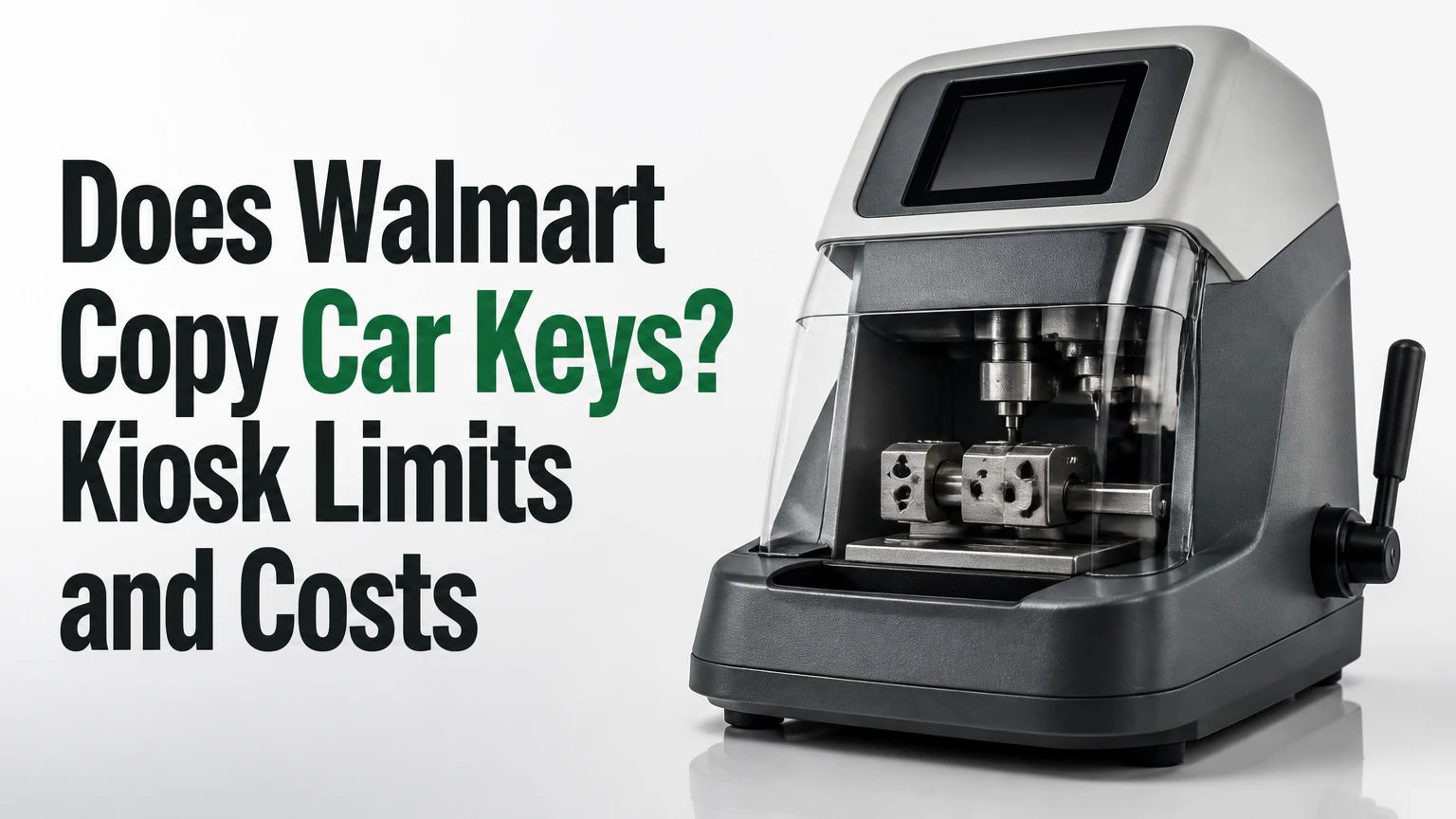
Walmart copies compatible mechanical car keys at some locations, but the service is generally provided by an automated third-party kiosk. The kiosk can trace or scan a working key and cut a duplicate blank; Walmart associates typically do not perform the automotive duplication themselves.
The word “car key” covers several different products. A plain metal key has a physical blade only. A transponder key adds an immobilizer chip, while a smart key or proximity fob communicates electronically with the vehicle. Walmart’s ability to copy the first type does not mean the store can complete the other two.
The most reliable answer is therefore conditional: Walmart may cut a basic duplicate immediately, but Walmart is not a universal replacement-key or programming service. Store inventory, kiosk brand, vehicle compatibility, and local availability can change.
How do you verify a nearby Walmart kiosk?
Check the Walmart store locator, inspect the area near the entrance or customer service desk, and call the specific store before driving there. MinuteKey and KeyMe locator tools can also identify participating kiosks, but a listed kiosk does not guarantee that every automotive key blank is stocked.
Ask two precise questions:
- Is there an automotive key kiosk in this store today?
- Does the kiosk support a duplicate for my year, make, and model?
Do not rely only on a general Walmart web page. Walmart Marketplace listings, in-store kiosk menus, and local store services can represent different fulfillment channels.
Which Car Keys Can Walmart Copy?
Walmart kiosks are most suitable for standard mechanical keys with a simple, supported blade profile. They are less suitable for keys whose operation depends on an electronic transponder, encrypted remote, proximity signal, or high-security milling pattern.
| Key type | Physical cutting at kiosk | Electronic programming | Typical route |
|---|---|---|---|
| Plain metal key | Often available | Not applicable | Kiosk duplicate |
| Metal key with rubber or plastic grip | Model-dependent | Sometimes required | Kiosk or locksmith |
| Transponder key | Blade may be cut | Usually not at kiosk | Locksmith, dealer, or mail service |
| Laser-cut or sidewinder key | Often unavailable | Model-dependent | Automotive locksmith or dealer |
| Remote-head key | Model-dependent | Vehicle-specific | Locksmith, dealer, or approved kit |
| Smart key or proximity fob | Not generated at a basic cutter | Required | Locksmith, dealer, or compatible DIY kit |
A plastic head alone does not prove that a key contains a chip. Conversely, some older-looking keys contain transponder electronics. The vehicle manual, key part number, or a locksmith’s diagnostic test provides a more dependable answer than appearance.
What is the difference between cutting and programming?
Key cutting creates the physical shape that enters and turns the lock. Programming associates an electronic chip or remote with the vehicle’s immobilizer, body control module, or keyless-entry system.
Those functions are independent. A kiosk can produce a blade that locks and unlocks the doors but still cannot start the engine. The distinction explains many complaints about “bad” duplicate keys that are mechanically correct but electronically unpaired.
Can Walmart Program a Chipped Key?
A Walmart kiosk generally should not be treated as an on-the-spot transponder programming service. The kiosk may identify a compatible blank, cut its blade, or offer a mail-order replacement, but programming depends on the vehicle’s immobilizer system and usually requires a specialized tool or pairing procedure.
A transponder key contains a small RFID-style chip that the vehicle reads during ignition. If the code is absent or unrecognized, the starter may crank without allowing the engine to run, or the security indicator may remain illuminated.
Some vehicles permit owner programming when one or more already-programmed keys are available. Others require an automotive diagnostic device, security code, or access to the vehicle’s body control system. The exact procedure varies by manufacturer and model year.
Why does a copied key open the door but not start the car?
A copied key can open the door but fail at the ignition because the blade was duplicated without pairing its transponder chip. The lock cylinder checks the blade shape, while the immobilizer checks the electronic identity.
Test the replacement without forcing it:
- Insert it fully into the driver’s door and turn it smoothly.
- Check that the ignition rotates without binding.
- Observe the security or key-shaped warning light.
- Start the vehicle only if the blade turns normally.
- Remove the key if the ignition resists or the security light behaves abnormally.
A new blade cannot solve an absent or incorrectly programmed chip. Use the vehicle manual’s pairing procedure only when the instructions specifically support that model. Otherwise, use a locksmith or dealership.
How Does the Walmart Key Kiosk Process Work?
A compatible mechanical duplicate usually involves six steps: locate the kiosk, insert the working key, allow the scan, select the blank or design, pay electronically, and collect the duplicate. The physical cutting portion commonly takes about 1-2 minutes, although queues, blank selection, and a failed scan can extend the visit.
Step 1: Locate the automotive kiosk
Look near the store entrance, customer service area, or front checkout zone. Confirm that the machine advertises automotive keys, because some kiosks cut only house, mailbox, or padlock keys.
Step 2: Insert a working original
Place the key into the marked slot in the orientation shown on the screen. The kiosk needs a usable reference; a key with a severely damaged blade may produce an inaccurate result.
Step 3: Review the compatibility result
The screen may identify a compatible blank or reject the key. Treat a rejection as useful information rather than repeatedly forcing the same key through the machine.
Step 4: Select the blank
Choose a standard metal blank or an available design. For advanced keys, the screen may offer vehicle information and a delivery order instead of immediate cutting.
Step 5: Pay at the kiosk
Card payment is common, while cash acceptance depends on the machine. Keep the receipt because the kiosk operator, not the Walmart service desk, normally manages refunds and remake requests.
Step 6: Inspect and test the duplicate
Compare the new blade with the original, then test the door lock and ignition gently. A duplicate that sticks, requires unusual pressure, or fails to rotate should not be forced.
Computer vision and multi-angle scanning can reduce errors from a worn key in some kiosk models. Scanning cannot identify every hidden electronic fault, guarantee a vehicle’s immobilizer compatibility, or repair a mechanically incorrect original.
How Much Does a Walmart Car Key Cost?
A Walmart kiosk duplicate for a basic mechanical car key typically costs about $3-$10. A transponder blade, mailed programmed key, DIY remote kit, locksmith service, or dealership replacement costs substantially more, with typical totals ranging from approximately $25 to more than $500 depending on vehicle technology and service requirements.
| Replacement option | Typical price | Typical time | What the price covers |
|---|---|---|---|
| Basic metal kiosk key | $3-$10 | 1-2 minutes | Blade cutting |
| Transponder blade only | $25-$70 | Minutes | Physical blade, no guaranteed programming |
| Mailed programmed key | $70-$120 | 3-5 business days | Key product and delivery, model-dependent |
| DIY remote or fob kit | $85-$120 | 10-30 minutes | Compatible remote and programming equipment |
| Mobile automotive locksmith | $100-$250 | 20-60 minutes | Cutting, programming, and possible travel |
| Dealership replacement | $200-$500 or more | 1-3 hours or appointment | OEM key, programming, and dealer labor |
These are typical consumer ranges, not Walmart’s guaranteed prices. Vehicle year, blank type, regional labor rates, proof-of-ownership requirements, shipping, and whether all keys were lost can change the total.
A $5 duplicate is attractive when the car uses a plain blade. It is false economy when the car requires a $100 programmed transponder key and the buyer purchases only a door-opening blank.
How Long Does Copying Take?
A basic mechanical key usually takes 1-2 minutes once the kiosk accepts the original, while an ordered electronic key commonly takes 3-5 business days for delivery. Locksmith and dealership timing ranges from roughly 20 minutes to several hours, depending on programming, travel, parts, and appointment availability.
| Situation | Expected duration | Main delay |
|---|---|---|
| Compatible plain metal key | 1-2 minutes | Queue or blank selection |
| Kiosk scan rejection | 5-15 minutes | Finding another provider |
| Mailed programmed key | 3-5 business days | Manufacturing and shipping |
| Mobile locksmith visit | 20-60 minutes | Travel and vehicle access |
| Dealership key order | Same day to several days | OEM part availability |
| Lost-all-keys service | 30 minutes to several hours | Security verification and programming |
A kiosk is fast only for the service it can actually complete. A cut key that still needs programming is not a finished replacement.
Can Walmart Copy a Lost Car Key?
A Walmart kiosk generally cannot copy a lost car key because duplication requires a physical reference key. Some advanced replacement services can create a key from the vehicle identification number, key code, or model information, but that is a separate ordering or locksmith process rather than ordinary kiosk copying.
When every key is missing, gather the vehicle identification number, registration, title, driver’s license, and the vehicle’s location. A locksmith may decode the lock, cut a key, and program it at the vehicle. A dealership may require proof of ownership and may order an OEM key using the VIN.
Do not assume the VIN alone supplies a complete finished key. Some models have multiple key profiles, immobilizer generations, regional configurations, or factory security restrictions.
What About Smart Keys and Key Fobs?
Walmart may sell replacement remotes, smart keys, and DIY kits, but a product listing does not prove that the item fits or programs every vehicle. A compatible kit normally depends on the exact year, make, model, trim, FCC ID, part number, frequency, and programming method.
| Electronic key option | Typical price | Vehicle requirement | Main risk |
|---|---|---|---|
| Replacement key-fob shell | $10-$25 | Existing internal circuit board | Shell may not fit the board |
| Uncut remote-head key | $25-$70 | Matching blade and chip | Cutting does not finish programming |
| DIY programmable kit | $85-$120 | Supported model and OBD-II port | Wrong kit will not pair |
| Used OEM fob | $30-$150 | Reusable or resettable module | Many used modules cannot be reused |
| New OEM fob | $100-$350 | Exact part number | Dealer or locksmith programming may remain |
| Locksmith-supplied smart key | $150-$400 | Vehicle diagnostic compatibility | Labor and travel vary |
Many DIY kits use a vehicle-specific process, sometimes involving an OBD-II programming module. The car must have a compatible diagnostic system, adequate battery voltage, and the required number of functioning keys. Follow the kit’s instructions exactly and confirm return eligibility before opening the package.
A replacement shell is different from a replacement fob. A shell changes the plastic casing; it does not replace a missing transponder, remote circuit, or immobilizer identity.
Is a Locksmith Better Than Walmart?
A locksmith is usually better when the car has a transponder, sidewinder blade, smart key, or no working original. Walmart is usually better for a cheap, immediate duplicate when the key is a supported plain mechanical design and the original works accurately.
| Decision factor | Walmart kiosk | Automotive locksmith | Dealership |
|---|---|---|---|
| Basic metal duplicate | $3-$10 | $50-$150 | Often unavailable as a standalone service |
| Transponder programming | Usually unavailable immediately | Usually available | Available |
| Mobile service | No | Often available | Rarely available |
| Lost-all-keys work | Limited | Often available | Available with verification |
| High-security blade | Limited | Common capability | Available |
| Same-visit completion | Minutes for basic keys | 20-60 minutes typical | 1-3 hours typical |
| OEM-only requirement | No | Sometimes aftermarket | Yes |
| Best use case | Simple spare key | Broad vehicle support | OEM assurance and complex security |
The professional option costs more because it combines cutting, code reading, vehicle diagnostics, and programming. A dealer is not automatically the best value, especially for common vehicles supported by a reputable mobile locksmith.
Who should choose a Walmart kiosk?
Choose a kiosk when the vehicle uses a plain metal key, a working original is available, the local machine confirms the blade profile, and the priority is a low-cost spare. Older Ford, Honda, Chevrolet, Toyota, and similar vehicles may fit this category, but model-year assumptions are unsafe.
Who should choose a locksmith?
Choose a locksmith when the key has a chip, remote buttons, a laser-cut profile, or a proximity function. A locksmith is also the practical choice when the original is worn, the vehicle is immobilized, or all keys are lost.
Who should choose a dealership?
Choose a dealership when the vehicle uses a restricted OEM key, a newer encrypted smart-key system, or a security process that local locksmiths cannot support. Bring ownership documents and expect higher parts and labor costs.
How Should You Test the Replacement Key?
Test a newly cut key in the door and ignition before discarding the original or leaving the store. A correct mechanical duplicate should enter, rotate, and release smoothly without scraping, binding, or requiring the original key as leverage.
Use this sequence:
- Compare the blade’s shoulder, length, and groove pattern with the original.
- Test the driver’s door with the engine off.
- Test the trunk or hatch if the mechanical key controls it.
- Insert the key into the ignition without twisting hard.
- Start the vehicle if the ignition turns normally.
- Test remote lock, unlock, panic, and trunk buttons separately.
A remote-button failure does not necessarily mean the blade is bad. It may indicate a dead battery, wrong frequency, unpaired remote, or incompatible circuit board.
What Problems Can Occur at a Walmart Kiosk?
The most common failures involve unsupported blanks, worn reference keys, incorrect electronic expectations, and third-party transaction support. Walmart’s customer service desk may be unable to refund or remake a kiosk transaction because the machine is operated by MinuteKey, KeyMe, or another external provider.
The kiosk rejects the original
Try a different working key only if one exists and is less worn. Do not continue if the blade is bent, cracked, heavily rounded, or missing material, because the duplicate may reproduce the damage.
The new key sticks
Stop turning immediately. Compare the duplicate against the original, clean loose metal filings from the lock area, and request a kiosk remake through the support number printed on the receipt. A locksmith can verify the cut with a code or decode the lock.
The duplicate starts the car but the remote fails
Check the battery, buttons, FCC ID, frequency, and programming instructions. A mechanical blade and a remote transmitter are separate components, so one can work while the other does not.
The key opens the door but the engine will not run
The blade probably lacks a programmed or compatible transponder. Use the vehicle’s supported pairing procedure or obtain programming from a locksmith or dealer.
The kiosk charged you but did not finish
Retain the receipt, transaction time, store location, and payment record. Contact the kiosk operator directly; the Walmart desk may only be able to identify the machine’s location.
The key is unavailable after payment
Check whether the order was for delivery rather than immediate dispensing. The kiosk screen, receipt, and confirmation email should show whether the purchase was a cut key, mail order, or product redemption.
What Should You Bring Before Buying a Duplicate?
Bring the working original, vehicle year and model, payment card, and enough time to test the result before leaving. For an electronic replacement, also record the original key’s part number, FCC ID, button layout, and the vehicle identification number.
A registered owner may need identification and registration when using a locksmith or dealership. A retailer may not verify ownership for a basic duplicate, but copying a key does not remove the owner’s responsibility to protect vehicle access.
The best practical rule is simple: buy a spare before the only key becomes worn or lost. A duplicate made from a healthy original is more reliable than one copied from a damaged emergency key.
FAQ
Does every Walmart have a car key machine?
No. Walmart automotive key services vary by store, region, kiosk operator, equipment, and current inventory. Check the specific store and the MinuteKey or KeyMe locator before visiting, then confirm that the machine supports automotive keys rather than only residential blanks.
Can Walmart copy a Toyota, Honda, or Ford key?
Walmart may copy a Toyota, Honda, Ford, or other vehicle key when the blade is a supported mechanical profile. The vehicle brand alone is insufficient because model year, trim, transponder equipment, and blade design determine compatibility.
Can I copy a key with a plastic head?
Sometimes. A plastic head may contain a transponder, but some plastic-headed keys are only mechanical or remote-head designs. Ask whether the replacement includes a chip and programming, because a cut blade alone may unlock the doors without starting the car.
Can Walmart make a duplicate from a picture?
No. A photograph does not provide the precise blade depth, spacing, shoulder position, or electronic identity required for a reliable automotive duplicate. Use a working original, a manufacturer key code, or a qualified locksmith’s decoding service.
Should I buy a blank key online and cut it at Walmart?
Only after confirming the blank’s exact profile and compatibility with the kiosk. An inexpensive online blank can fail because of incorrect groove design, poor tolerances, wrong transponder type, or an incompatible plastic head, and many kiosks will not accept customer-supplied blanks.
Is a dealership key always more reliable?
A dealership supplies the correct OEM part and factory-compatible programming process, but it is not always the least expensive or fastest option. A reputable automotive locksmith can often provide a compatible replacement for less money while completing mobile programming at the vehicle.
The Bottom Line
Walmart does copy car keys when a local third-party kiosk supports the vehicle’s physical blade, with basic mechanical duplicates typically costing $3-$10 and taking about 1-2 minutes. Walmart is not a universal transponder, laser-cut, or smart-key programming solution.
Use the kiosk for a supported plain metal spare. Use a locksmith for electronic, high-security, worn, or lost keys, and use a dealership when OEM security compatibility is the overriding requirement. Verify the exact key type before paying, then test every mechanical and electronic function immediately.