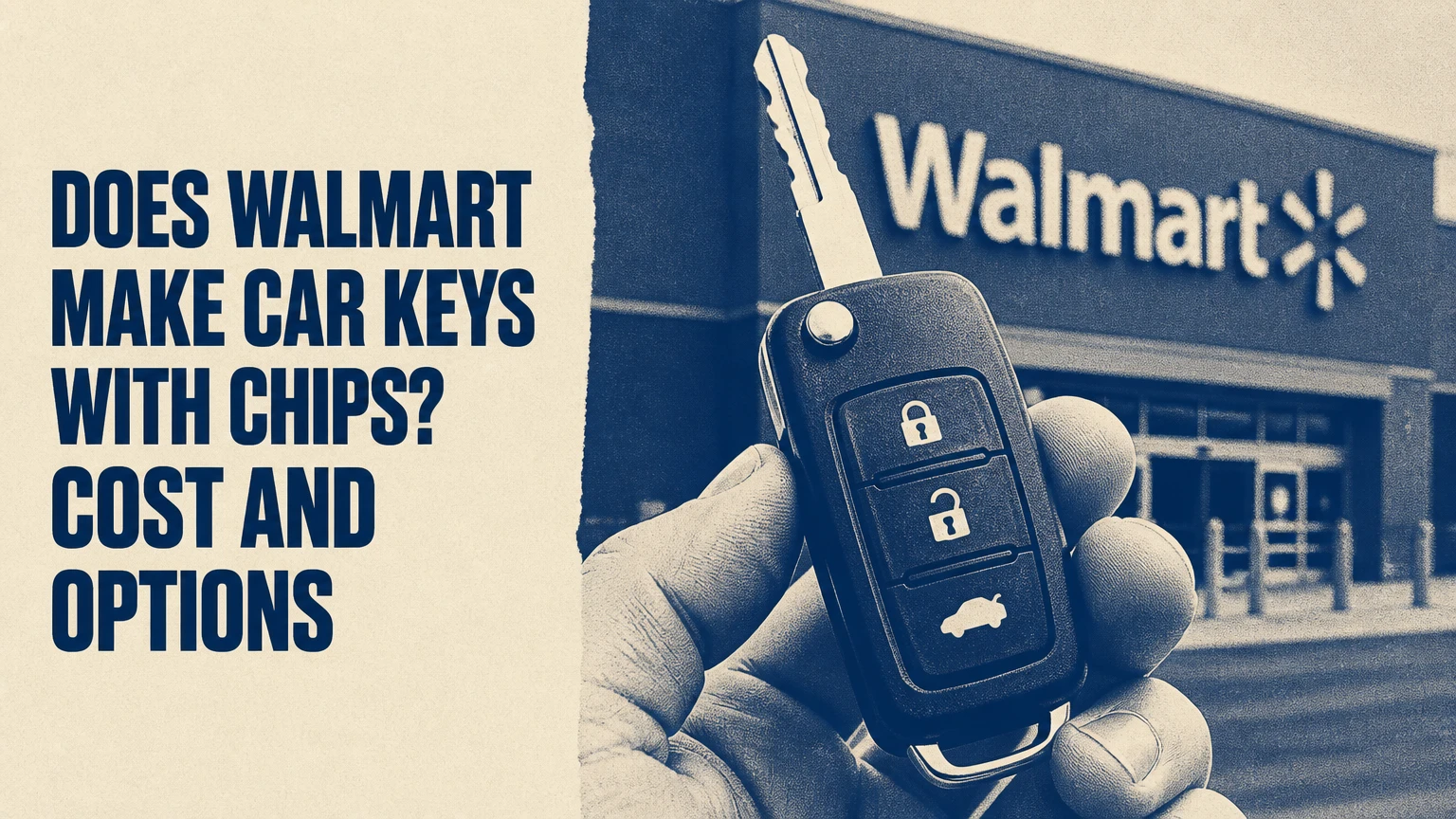
Walmart does not generally have store employees cut and program chipped car keys, but some Walmart locations host third-party KeyMe or Minute Key kiosks that may duplicate supported transponder keys. A working original key is usually required, and advanced laser-cut keys, remote-head keys, and smart fobs may require mail delivery, separate programming, a locksmith, or a dealership.
Key Facts at a Glance
- Walmart store employees usually do not program automotive transponder keys at the service desk.
- KeyMe and Minute Key availability, supported vehicle models, prices, and capabilities vary by kiosk and location.
- A working chipped key is normally required for duplication; replacing the only lost key is a different service.
- Typical kiosk pricing ranges from about $50-$90 for supported edge-cut transponder keys and $90-$200 for some remote or smart-fob replacements.
- A key can turn the ignition and still fail to start the vehicle if its immobilizer chip is not recognized.
- A dealership supplies manufacturer-compatible programming, while an automotive locksmith often offers the best lost-key and mobile-service coverage.
Does Walmart Make Car Keys With Chips?
Walmart makes or sells some replacement automotive keys through third-party kiosk services, but Walmart employees generally do not cut and program chipped keys themselves. The practical answer depends on the kiosk brand, vehicle, key design, and whether the customer still has a working original.
A standard metal house key and a transponder car key are different products. A conventional key only needs a correctly cut blade. A transponder key also needs an electronic identity that the vehicle’s immobilizer accepts.
The kiosk may scan the original blade and, for supported models, copy or supply a replacement containing a compatible chip. Some keys are produced immediately, while others are ordered at the kiosk and shipped to the customer. Store associates typically do not diagnose failed programming, verify immobilizer faults, or operate older in-store automotive key equipment.
The most reliable first step is checking the specific Walmart location’s kiosk listing or inspecting the machine in person. A kiosk’s presence does not prove that the kiosk supports every vehicle parked in the lot.
How Does a Chipped Car Key Work?
A transponder key uses a passive RFID chip to identify itself to the vehicle’s immobilizer system. The ignition antenna or start-system receiver energizes the chip, reads its code, and allows engine operation only when the code matches an authorized key.
The chip normally sits inside the plastic key head or remote housing. The metal blade operates the lock and ignition cylinder, but the chip performs the security function. In a push-button vehicle, the fob may communicate through a more complex combination of low-frequency signals, radio-frequency commands, rolling codes, and proximity detection.
A failed blade and a failed chip create different symptoms. A poorly cut blade may not enter, turn, or operate the lock smoothly. An unprogrammed or incompatible transponder may turn the ignition but leave the engine disabled, often with a flashing security or immobilizer indicator.
A vehicle’s exact system varies by manufacturer and model year. Ford PATS, General Motors PASS-Key and related systems, Toyota immobilizer systems, Honda transponder systems, and European platforms use different procedures and security credentials.
Why Can a New Key Turn the Ignition but Not Start the Car?
A replacement key can rotate the ignition while its transponder remains unrecognized by the immobilizer. Mechanical cutting controls cylinder movement, whereas electronic authorization controls fuel, ignition, or engine-start permission.
This symptom usually means the blade profile is close enough mechanically but the chip is wrong, unread, damaged, or not enrolled. A dead remote battery does not always disable the passive transponder, so replacing the coin cell may fix buttons without fixing an immobilizer-programming problem.
Do not repeatedly cycle an unknown replacement key if the vehicle enters a security lockout or programming mode. Consult the vehicle manual, kiosk support, locksmith, or dealer procedure for that model.
Which Automotive Keys Can a Walmart Kiosk Handle?
A Walmart kiosk is most likely to help with a supported edge-cut transponder key when the customer has a functioning original. High-security blades, integrated remotes, and proximity fobs require more compatibility checks and may involve shipping or professional programming.
| Key type | Physical design | Typical Walmart kiosk outcome | Main limitation |
|---|---|---|---|
| Edge-cut transponder | Ridges cut along blade edges | Possible same-visit duplication | Vehicle and chip support must match |
| Laser-cut transponder | Center groove on a thicker blade | Often mail-order or unavailable | Requires specialized cutting equipment |
| Remote-head key | Blade plus lock buttons | Replacement blank or mail-order key | Remote and immobilizer functions differ |
| Proximity smart fob | Push-button start, no ignition blade | Possible replacement purchase | Pairing procedure varies by vehicle |
| Dealer-only security key | Restricted credential or encrypted system | Commonly unsupported | VIN, PIN, or OEM equipment may be required |
Standard Edge-Cut Transponder Keys
Edge-cut keys are the simplest chipped-key category for kiosk duplication. They have a familiar metal blade with cuts along one or both edges and a plastic head containing the transponder.
A kiosk may read the blade pattern and identify the vehicle application from the year, make, and model. Some services can duplicate a compatible transponder from the original; others sell a replacement that still requires a defined programming step. The on-screen result is more reliable than assuming every edge-cut key is supported.
Older Ford, Chevrolet, Toyota, Honda, Nissan, and Hyundai models may have broader aftermarket coverage than newer vehicles with encrypted or restricted systems. Vehicle year alone is insufficient because trim, engine, key frequency, and immobilizer generation can change within the same model.
Laser-Cut and High-Security Keys
Laser-cut keys have a thicker blade with a sidewinder-style groove or internal track. The profile is not normally cut by the basic key machine used for ordinary household keys.
A Walmart kiosk may accept an order for a supported high-security key and ship it, but customers should verify whether the shipped key arrives cut and programmed or only cut and equipped with a compatible chip. Those are separate outcomes.
High-security blades also expose a common mistake: a visually similar blank can have the wrong groove depth, shoulder position, or transponder housing. The key may look correct but fail to enter or turn smoothly.
Remote-Head Keys and Smart Fobs
A remote-head key combines a mechanical blade with buttons for locking, unlocking, trunk release, or remote start. A smart fob may have no conventional ignition blade and instead communicates with a push-button start system.
Remote buttons and immobilizer authorization are separate functions. A fob can lock the doors but fail to start the engine, or start the engine while a damaged button circuit prevents remote locking. Customers must match the vehicle application, FCC ID where applicable, frequency, button layout, and emergency-blade style.
Some aftermarket services provide self-programming instructions or an OBD-II programming device for particular vehicles. That option is not universal, and a procedure that works for one model year can fail on another.
How Much Does a Chipped Key Cost at Walmart?
A supported edge-cut transponder key typically costs about $50-$90 through a kiosk, while high-security keys often cost approximately $60-$120 and some remote or smart-fob replacements range from $90-$200. These are typical market ranges, not guaranteed Walmart prices.
| Replacement route | Typical price | Typical time | Best-fit situation |
|---|---|---|---|
| Walmart kiosk, edge-cut transponder | $50-$90 | 2-10 minutes if dispensed onsite | Working original, supported older vehicle |
| Walmart kiosk, laser-cut key | $60-$120 | 3-7 business days | Supported high-security blade |
| Walmart kiosk, remote-head key | $90-$160 | 3-7 business days | Correct blank and remote application |
| Walmart kiosk, smart fob | $100-$200 | 3-7 business days | Supported push-button vehicle |
| Mobile automotive locksmith | $100-$300 typical | 30-120 minutes onsite | Lost key, urgent service, programming needed |
| Dealership replacement | $200-$500 or more | Same day to several days | OEM key, restricted system, complex vehicle |
Automotive locksmith and dealership amounts vary by region, vehicle, labor, emergency timing, towing, and whether all keys were lost. A low kiosk price may exclude programming, shipping, or a required replacement battery.
What Determines the Final Price?
The vehicle’s key category determines more of the price than the word “chip.” A basic transponder key has fewer components than a proximity fob with multiple antennas, buttons, rolling-code logic, and an emergency blade.
The final bill can include the blank, cutting, transponder duplication or enrollment, remote pairing, shipping, taxes, and an OBD-II tool. Ask whether the quoted amount includes each function before paying.
A dealership quote may appear higher because it includes an OEM part and manufacturer-specific programming. A locksmith quote may include travel, diagnosis, cutting, programming, and a functional test in one visit.
What Is the Walmart Kiosk Process?
The kiosk process usually takes six stages: locate the machine, identify the vehicle key, scan the original, confirm compatibility, pay for the chosen service, and test the delivered or dispensed key. The decisive prerequisite is a working original key.
Step 1: Locate the Automotive Key Kiosk
Find the yellow KeyMe or green Minute Key kiosk near the front of the store, customer service area, or automotive department. Not every Walmart has both brands, and some locations have no automotive-capable kiosk.
Record the kiosk operator’s name and customer-support number before starting. Walmart checkout staff may not administer the machine or process a kiosk-specific technical refund.
Step 2: Select the Vehicle-Key Service
Choose the car, vehicle, transponder, remote-head, or smart-fob category shown on the screen. Enter the vehicle year, manufacturer, model, and requested features accurately.
Do not select a similar model simply because the blade looks identical. Trim equipment, remote-start buttons, frequency, FCC ID, and immobilizer generation can alter compatibility.
Step 3: Scan the Working Original
Insert or present the original key as directed. The kiosk may inspect the blade profile and attempt to read the electronic identifier.
A worn key can create a misleading scan. If the original blade has rounded cuts, cracks, water damage, or intermittent starting behavior, have a locksmith inspect it before ordering a duplicate.
Step 4: Confirm the Delivery Method and Programming
The kiosk should show whether the key is dispensed immediately or shipped. Read the programming description carefully, because “cut,” “duplicated,” and “programmed” do not always mean the same thing.
For a mail-order fob, confirm whether the package includes an OBD-II device, whether self-programming applies to the exact vehicle, and whether professional programming is still required.
Step 5: Pay and Keep the Receipt
Save the printed receipt, order number, vehicle information, and support contact. A kiosk transaction is separate from an ordinary Walmart automotive purchase.
Check the return conditions before leaving. Cut keys and programmed electronics may have different replacement rules from unused blanks.
Step 6: Test Every Function
Test the blade in the door and ignition, remote lock and unlock buttons, trunk release, panic function, remote start, and engine start where applicable. Perform the test beside the vehicle before discarding or altering the original.
A successful result requires both mechanical operation and electronic authorization. The replacement should start the car without an abnormal security-light pattern.
Can Walmart Make a Key If You Lost the Only One?
A Walmart kiosk usually cannot create a new transponder key from nothing when no working key remains. A mobile automotive locksmith or dealership is the more appropriate provider because the vehicle may need VIN-based key generation, security-code access, or immobilizer enrollment.
The distinction matters. Duplicating a known working key copies an existing reference. Replacing the only lost key requires proving ownership, cutting a blade without the original, obtaining the correct security data, and often programming the vehicle into an all-keys-lost mode.
Prepare the vehicle identification number, registration, government-issued identification, and insurance information. A legitimate provider may request these documents before producing a security key.
A locksmith can often travel to the vehicle, cut the blade, and program a replacement without towing. A dealership may require the car at its service department, especially when manufacturer software or online authorization is necessary.
Is KeyMe or Minute Key Better for Car Keys?
Neither kiosk brand is universally better because vehicle coverage, local inventory, fulfillment method, and support policies matter more than color or brand name. Compare the exact on-screen result for the vehicle rather than assuming that a kiosk can duplicate every transponder.
| Decision factor | KeyMe kiosk | Minute Key kiosk | Practical interpretation |
|---|---|---|---|
| Kiosk color commonly seen | Yellow | Green | Color identifies brand, not universal capability |
| Basic household keys | Broad kiosk service | Broad kiosk service | Not evidence of automotive support |
| Automotive availability | Location and model dependent | Location and model dependent | Check the exact kiosk |
| Immediate dispensing | Possible for selected keys | Possible for selected keys | Inventory and machine type control this |
| Mail-order fulfillment | Used for some advanced keys | Used for some advanced keys | Confirm delivery and programming details |
| Customer support | Operator support number on receipt | Operator support number on receipt | Walmart staff may not resolve technical issues |
The best choice is the kiosk that confirms the exact year, make, model, key type, and completion method. If neither kiosk offers a clear programming path, stop before payment and use a locksmith.
What Are the Alternatives to Walmart?
A mobile automotive locksmith is usually the strongest alternative when the customer has lost all keys, needs programming onsite, or cannot safely move the vehicle. A dealership is the safest compatibility choice for restricted, luxury, or late-model systems, although it commonly costs more.
| Situation | Walmart kiosk | Automotive locksmith | Dealership |
|---|---|---|---|
| Working edge-cut key | Convenient if supported | Reliable, usually more expensive | Reliable, often unnecessary |
| Only key lost | Usually unsuitable | Often capable onsite | Capable with required documents |
| Vehicle will not move | No mobile service | Travels to the vehicle | May require towing |
| Push-button start | Model-dependent | Broad equipment coverage | Highest OEM compatibility |
| BMW, Mercedes-Benz, or similar | Frequently limited | Specialist required | Strongest manufacturer support |
| Urgent nighttime replacement | Usually unavailable as emergency service | Possible with dispatch fee | Usually appointment-based |
| Warranty and OEM assurance | Limited kiosk policy | Provider-specific | Manufacturer-backed part and procedure |
Consumer Reports, Edmunds, and automotive security providers consistently distinguish basic key cutting from electronic key programming. That distinction explains why a cheap blade purchase may not solve a no-start condition.
A locksmith should provide a total estimate before dispatch. Ask about the service-call fee, key type, programming labor, warranty, and whether the provider can make the key without an original.
What Mistakes Cause Kiosk Key Failures?
The most common kiosk failures come from an inaccurate vehicle selection, a damaged original, an incorrect remote identifier, or an assumption that cutting automatically includes immobilizer programming. Customers can prevent many failures by checking the original key and the vehicle documentation first.
- Using a failing original: If the original key intermittently starts the vehicle, its chip or housing may be damaged. Use a known-good spare or obtain a locksmith diagnosis.
- Choosing the wrong trim: A remote-start button, trunk button, or proximity feature can require a different fob.
- Ignoring FCC ID or frequency: A matching shell and blade do not guarantee matching radio electronics.
- Confusing remote pairing with immobilizer enrollment: Door-lock buttons may work while the engine remains immobilized.
- Assuming every Walmart has the same machine: Kiosk inventory and supported applications differ by location.
- Discarding the receipt: The operator needs the order number to handle a failed shipment, incorrect cut, or refund request.
A dead remote battery is a narrower issue than many customers assume. The battery powers buttons and some active communications, but many passive transponder chips can still communicate without that coin cell. Battery replacement is worth trying, but it does not substitute for correct key programming.
What Should You Do If the New Key Does Not Start the Car?
First, test the key’s mechanical operation and inspect the dashboard security indicator. If the blade turns but the engine remains disabled, contact the kiosk operator or a qualified automotive locksmith rather than repeatedly forcing the ignition or ordering another similar blank.
Remove other keys and electronic fobs from the ignition area during testing. Interference is not the most common cause, but isolating the replacement eliminates a simple variable.
If the key works mechanically and the security lamp flashes rapidly, report an immobilizer or transponder problem. If the key will not enter or turn, report a cutting or blade-profile problem. Give support the receipt, vehicle details, and exact symptom.
Do not ask an ordinary Walmart cashier to reprogram the key. The machine operator, locksmith, or dealership owns the relevant technical process.
Which Option Fits Your Situation?
Walmart is the sensible first choice for a supported older vehicle when a fully working original edge-cut transponder key is available and the kiosk displays a clear completion method. It is not the right default for an all-keys-lost emergency, a complex European vehicle, or a replacement whose programming requirements are unclear.
Working Spare-Key Owner
Choose a Walmart kiosk when the original starts the car consistently, the blade is visibly intact, and the kiosk confirms the exact vehicle. The likely benefit is a lower price and a short visit for a supported basic transponder.
Keep the original as the reference key. Test the duplicate before relying on it for travel.
Driver With No Remaining Key
Choose a mobile automotive locksmith first. The provider can usually verify ownership, cut a key from the vehicle information, and program the immobilizer at the vehicle’s location.
A dealership remains appropriate when the manufacturer restricts key credentials or the locksmith lacks equipment for that model.
Push-Button Start Owner
Check whether the service supplies a complete proximity fob or only a shell and emergency blade. Ask who performs immobilizer pairing and whether an OBD-II device is included.
For late-model vehicles, obtain a locksmith and dealer quote before ordering. A visually identical fob can have incompatible radio hardware.
Luxury or Security-Restricted Vehicle Owner
Use a specialist locksmith or authorized dealership. BMW, Mercedes-Benz, Land Rover, Porsche, and some newer vehicles may use encrypted credentials, online authorization, or specialized diagnostic procedures that retail kiosks do not support reliably.
The higher price buys compatibility and a documented programming path. That trade-off is preferable to an unusable key or a locked immobilizer system.
How Should You Verify Support Before Visiting Walmart?
Verify the exact kiosk, vehicle, key design, completion method, and total price before making the trip. The five-minute check prevents the most expensive mistake, which is purchasing a key that is cut correctly but cannot be programmed.
Use this checklist:
- Confirm that the store has a KeyMe or Minute Key kiosk with automotive services.
- Photograph the original key, including its buttons and manufacturer markings.
- Record the vehicle year, make, model, trim, and push-button or keyed ignition type.
- Check the original fob for an FCC ID, part number, or frequency marking.
- Ask whether the quoted service includes cutting, transponder duplication, remote pairing, shipping, and programming.
- Confirm the refund and replacement procedure with the kiosk operator.
- Keep one working key untouched until the replacement passes every test.
Vehicle manuals and manufacturer parts catalogs may identify the key type, but they do not guarantee third-party kiosk compatibility. The kiosk’s supported-vehicle result and the operator’s written terms matter more for that transaction.
Frequently Asked Questions
Can Walmart Cut a Regular Car Key Without a Chip?
Walmart may cut some regular metal car keys through an in-store key machine or kiosk, depending on location and blank inventory. A non-chip key only needs an accurate blade profile, so it is simpler than a transponder key. Call the store or inspect the machine before bringing the vehicle key.
Does a Chipped Key Need a Battery?
A basic passive transponder chip typically does not need a battery because the vehicle’s antenna energizes it. A remote-head key or smart fob does need a battery for buttons, proximity functions, and active radio communication. Replacing the battery may restore remote functions but will not program an unrecognized immobilizer chip.
Can I Program a Transponder Key Myself?
Some vehicles support an owner programming sequence when two previously programmed keys are available, while others require diagnostic equipment, a security PIN, or manufacturer authorization. The vehicle manual is the correct starting point. Do not assume an ignition-cycle procedure works across different years or models.
How Long Does a Replacement Car Key Take?
A supported edge-cut duplicate may take roughly 2-10 minutes if the kiosk dispenses it onsite. Laser-cut keys, remote-head keys, and smart fobs may take 3-7 business days when shipped. Locksmith service can take 30-120 minutes after arrival, while dealership fulfillment may take hours or several days.
Is a Locksmith Cheaper Than a Dealership for a Chipped Key?
A qualified automotive locksmith is often cheaper than a dealership, especially for mobile all-keys-lost service, but local pricing varies. Typical locksmith totals range from $100-$300, while dealership replacement often reaches $200-$500 or more. Compare the complete price, including travel, cutting, programming, towing, and the key part.
Can Walmart Replace a Lost Smart Key?
A Walmart kiosk may offer a compatible smart-fob replacement for selected vehicles, but availability and self-programming requirements vary. If the only key is lost, a mobile locksmith or dealership is usually more suitable because the vehicle may require security-code retrieval and formal immobilizer enrollment.
The Bottom Line
So, does Walmart make car keys with chips? Walmart does not usually have employees perform the cutting and electronic programming themselves, but a KeyMe or Minute Key kiosk at a participating location may duplicate a supported transponder key. Bring a reliable working original, verify the exact vehicle application, and confirm whether the service includes programming.
Choose the kiosk for a straightforward, supported spare-key job. Choose an automotive locksmith for a lost-only-key situation or mobile programming, and choose a dealership when OEM compatibility or restricted security credentials matter more than price.