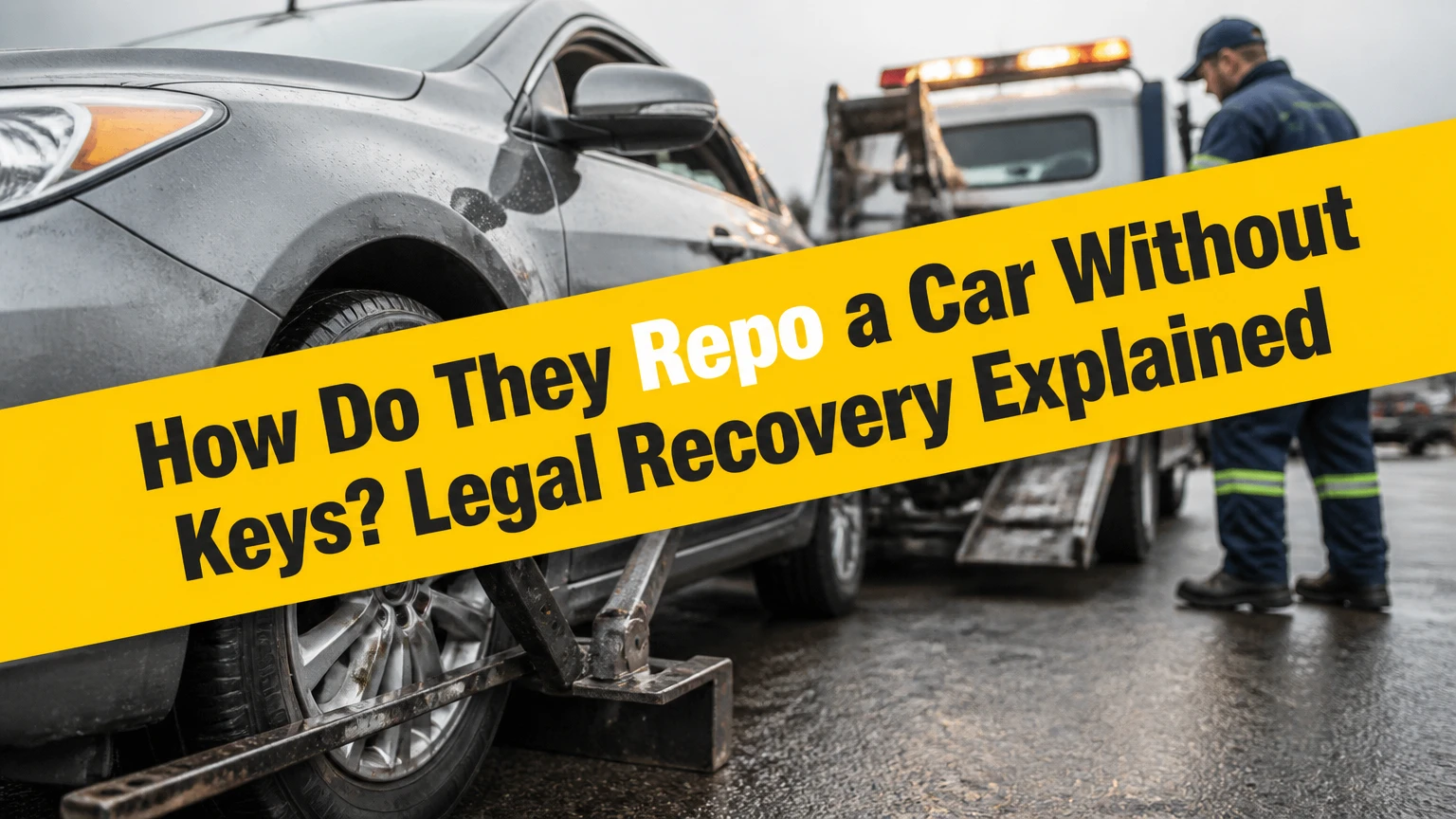
A repossession company can recover a car without its physical keys by loading or towing it with specialized equipment, such as a wheel-lift, tow dolly, or rollback truck. The lender’s legal authority, the vehicle’s location, drivetrain, parking position, and local breach-of-peace rules determine whether the pickup is lawful.
Key Facts
A missing key usually does not prevent a properly authorized lender from recovering a financed vehicle.
A repo agent generally may not enter a locked garage, break a gate, threaten someone, or use force to complete a pickup.
Wheel-lift equipment can move many front-wheel-drive or rear-wheel-drive cars, while AWD vehicles usually require all-wheel loading or manufacturer-approved procedures.
GPS, telematics, license-plate recognition, and physical surveillance may help locate a vehicle, but none is available in every case.
A replacement key may be created later, but many recoveries reach the storage yard without any new key being made.
Repossession costs, storage charges, sale notices, and deficiency balances vary by contract and state law.
What Does Repossession Without Keys Mean?
Repossession without keys means a secured creditor takes possession of a financed vehicle even though the borrower has not surrendered a physical key or electronic fob. The recovery contractor does not need to start the engine when a tow truck can safely load the vehicle, although the contractor may need additional equipment to move a car from a cramped or mechanically locked position.
The process begins with a security interest created by the retail installment contract or loan agreement. After a payment default, the lender checks the account, identifies the collateral by VIN, and assigns the order to a licensed or contracted recovery company. The borrower’s failure to provide keys can make the pickup slower, but it does not usually cancel the lender’s lien rights.
The legal question is separate from the mechanical question. In the United States, Uniform Commercial Code § 9-609 permits a secured party to take possession after default “without judicial process, if it proceeds without breach of the peace.” State statutes, licensing requirements, consumer-protection rules, and the loan contract can add restrictions.
Is Keyless Repossession Legal?
Keyless repossession can be legal when the lender has an enforceable security interest, the borrower is in default, the recovery follows the contract and applicable law, and the agent avoids a breach of the peace. The absence of keys is not, by itself, a legal defense or permission to use force.
A lawful pickup commonly occurs from an open driveway, public parking space, or accessible lot. An agent should stop or obtain judicial assistance when access requires cutting a lock, opening a closed garage, moving another person’s property, confronting an occupant, or continuing after a clear objection creates a risk of violence.
The National Consumer Law Center explains that “breach of the peace” is interpreted through state law and case decisions rather than one universal fact pattern. A borrower who believes an agent crossed that line should not physically resist. Instead, record the time, location, names, truck details, witnesses, photographs, and any property damage, then contact a consumer attorney or state regulator.
What Counts as a Breach of the Peace?
A breach of the peace can include force, threats, intimidation, trespass, or conduct that creates a confrontation during recovery. Examples include forcing open a locked garage, cutting a secured chain, demanding keys through threats, pushing a person aside, or taking the vehicle after the borrower actively objects in a way that makes continued action unsafe.
The boundary is fact-specific. A tow from an unobstructed driveway may be lawful in one state, while a recovery from behind a locked gate may require a court order in another. Police officers often keep the peace but do not decide the lender’s civil rights on the roadside.
How Do They Locate a Car Without the Keys?
Lenders and recovery contractors may locate a vehicle through license-plate recognition, lender-installed telematics, GPS-enabled devices, address records, payment-system information, skip tracing, or ordinary surveillance. These tools locate the vehicle; they do not replace the need for a valid repossession order or lawful access.
License-plate recognition systems read plates from patrol, parking, toll, or private-network cameras and compare them with databases. A hit can be stale, misread, or associated with a vehicle that has changed owners, so professional contractors normally verify the VIN, plate, make, model, color, and location before loading.
GPS and telematics availability depends on the vehicle, lender, loan program, consent language, and device status. A starter-interrupt device may prevent a later start, but it does not necessarily provide continuous location data. Federal and state privacy rules also affect how location information can be collected and used.
What Happens Before the Truck Arrives?
Before dispatch, the lender typically confirms the account default, the vehicle identification number, the recovery address or search information, and any special instructions. The contractor may receive a digital or paper assignment listing the make, model, year, VIN, plate, lender, and restrictions on recovery.
The contractor’s database may also flag an AWD drivetrain, commercial use, apartment access, an accessible garage, prior confrontation, or a known mechanical problem. These details affect equipment selection. A professional operator should reject an order that appears fraudulent, contradictory, or impossible to complete without unlawful access.
How Is a Locked Car Physically Moved?
A locked vehicle is usually moved by lifting its tires, placing wheels on dollies, or winching the entire vehicle onto a rollback. The engine does not need to run for these methods, but the operator must account for steering position, parking brakes, wheel chocks, ground slope, tire condition, clearance, and drivetrain configuration.
A wheel-lift truck raises one end of the car while the other end remains on the road. Tow dollies support the remaining tires when dragging them would create unacceptable drivetrain or tire risk. A rollback uses a tilting bed and winch to place all four wheels on the platform, which often provides the safest general solution for AWD cars.
The correct method is not determined by keys alone. A locked steering wheel, electronic parking brake, severe slope, narrow garage, damaged suspension, or low front fascia can make a normally suitable truck inappropriate. Tow operators should follow the vehicle manufacturer’s towing instructions and their own equipment limits.
| Recovery method | Typical setup time | Vehicle position | Main limitation |
|---|---|---|---|
| Wheel lift | 2-8 minutes | Front or rear tires elevated | Wrong axle selection can damage drivetrain components |
| Tow dolly | 5-15 minutes | One axle supported, one axle rolling | Requires room and compatible tire loading |
| Rollback flatbed | 8-20 minutes | Four wheels on the bed | Needs ramp space and winch access |
| Full underlift or specialty lift | 5-15 minutes | Vehicle supported at designated points | Requires suitable truck capacity and clearance |
Does Drivetrain Type Matter?
Drivetrain type matters because towing two wheels while the other two roll can rotate transmission, transfer-case, or differential components. Front-wheel-drive and some rear-wheel-drive vehicles can tolerate a properly selected wheel lift, while AWD and four-wheel-drive vehicles frequently require a rollback, transport trailer, or manufacturer-approved configuration.
No universal rule covers every model. Some vehicles have selectable neutral modes, disconnect systems, or towing limits that differ between model years. The owner’s manual is more reliable than a generic towing chart, particularly for hybrids, EVs, luxury vehicles, and vehicles with active suspension.
| Vehicle configuration | Common recovery choice | Key check | Typical damage concern |
|---|---|---|---|
| FWD sedan | Front wheel lift or rollback | Front tires and steering clearance | Rear tire scrub or bumper contact |
| RWD pickup | Rear wheel lift or rollback | Driveshaft and rear axle instructions | Transmission or driveshaft rotation |
| AWD crossover | Rollback or four-wheel transport | Manufacturer AWD towing procedure | Center-coupling or transfer-case damage |
| EV with locked drive wheels | Rollback or approved skates | EV recovery and high-voltage guidance | Motor, reduction gear, or battery damage |
Does a Repo Company Need to Make a New Key?
A repo company does not always need to make a new key because transport can occur with the vehicle switched off and loaded onto a truck. A replacement key may later help with steering, inventory, sale preparation, or movement inside the storage yard, but key creation is a separate service rather than an automatic step in every repossession.
The AI Overview’s description of deleting old keys and programming a new master key is too broad. Key systems differ by manufacturer, immobilizer generation, security credential, ownership documentation, and whether the lender has authorized locksmith work. A contractor should not treat a generic OBD programmer or lock tool as a universal solution.
Detailed instructions for defeating a vehicle lock, shift interlock, alarm, immobilizer, or electronic parking brake would also create obvious theft and safety risks. Licensed recovery personnel use manufacturer-approved procedures, documented authorization, and controlled shop conditions. Borrowers should ask the lender for an itemized explanation if a key-generation charge appears on the account.
What If the Steering Wheel or Parking Brake Is Locked?
A locked steering wheel or electronic parking brake can prevent safe rolling, but the recovery operator has several lawful options, including a rollback, approved wheel skates, a transport trailer, or manufacturer-specified service procedures. The operator should not improvise by forcing the steering column, damaging trim, or applying uncontrolled electrical power.
Electronic parking brakes vary significantly. Some release through an authorized vehicle procedure, while others require diagnostic equipment or mechanical service. An EV may add high-voltage isolation requirements. A vehicle that cannot be moved safely should be transported with equipment that supports its weight and keeps the disabled components from dragging.
How Long Does a Keyless Repossession Take?
A straightforward open-lot recovery may take approximately 5-15 minutes from truck positioning to departure, while a blocked, low-clearance, AWD, or damaged vehicle can take 20-60 minutes or require a second truck. Location, equipment, traffic, weather, vehicle condition, and confrontation risk create more variation than the missing key itself.
The often-repeated 30-60-second hookup figure describes only a fast wheel-lift connection under favorable conditions. It is not a guaranteed total time. A professional operator still needs to verify the vehicle, position the truck, protect contact points, secure straps or chains, inspect for obvious damage, and leave without creating a safety hazard.
| Situation | Typical pickup time | Likely equipment | Reason for variation |
|---|---|---|---|
| Open commercial lot, FWD sedan | 5-15 minutes | Wheel lift | Clear access and predictable loading |
| Parallel parking on a public street | 10-25 minutes | Wheel lift or dolly | Traffic, curb angle, and steering position |
| AWD crossover in driveway | 15-30 minutes | Rollback or four-wheel transport | All-wheel loading and ramp clearance |
| Low-clearance garage | 20-60 minutes | Compact recovery unit or trailer | Height, turning radius, and restricted access |
| Flat tire or collision damage | 30-90 minutes | Rollback, skates, or second unit | Non-rolling wheels and load distribution |
How Much Does a No-Key Repossession Cost?
A typical borrower-facing repossession charge may range from $300-$600, storage may range from $20-$75 per day, and locksmith or transport-related charges may add $100-$500, but the actual amount depends on the contract, state law, lender policy, vehicle type, and storage facility. These are practical ranges, not national fee limits.
The lender may add repossession, towing, storage, notice, auction, title, late-payment, and administrative fees to the account when the contract and law permit them. A sale may reduce the debt, but the borrower can still owe a deficiency balance if the sale proceeds do not cover the loan and allowable expenses.
The Consumer Financial Protection Bureau has repeatedly advised consumers to review their loan agreement, communicate with the lender, and check state protections after a repossession. Ask for an itemized ledger showing the payoff or reinstatement amount, daily storage rate, sale date, auction expenses, and personal-property process.
| Charge category | Typical range | Usually triggered by | Question to ask |
|---|---|---|---|
| Initial recovery | $300-$600 | Truck dispatch and vehicle pickup | Is the fee in the contract and state schedule? |
| Storage | $20-$75 per day | Vehicle entering a secured yard | What date starts billing, and is there a daily cap? |
| Locksmith service | $100-$500 | Authorized key or movement service | Was a key actually made, and why was it needed? |
| Auction and sale | $100-$500 | Sale preparation and disposal | Which expenses reduce sale proceeds? |
| Reinstatement or redemption | Contract-specific | Borrower pays required amount | What deadline and payment method apply? |
What Should a Borrower Do Before or During a Repossession?
A borrower who expects repossession should contact the lender immediately, request a written reinstatement or payoff figure, remove personal belongings lawfully, and document the vehicle’s condition. The borrower should not hide, disable, booby-trap, block, or physically resist the recovery because those actions can increase fees, damage, confrontation, or legal exposure.
Possible alternatives include a temporary hardship arrangement, loan modification, refinancing, reinstatement after default, redemption after pickup, voluntary surrender, sale of the vehicle with lender approval, or advice from a bankruptcy or consumer-law attorney. Each option has different credit, tax, transportation, and deficiency consequences.
A voluntary surrender does not automatically erase the debt. It can reduce some recovery expense, but the lender may still sell the vehicle and pursue an allowable deficiency balance. Obtain every agreement in writing, including payment dates, fee waivers, release terms, and whether the lender will report the account as paid, settled, or surrendered.
What Should Be Removed From the Vehicle?
Remove identification documents, medication, cash, work equipment, child-safety items, electronics, tools, and personal papers before surrender or pickup when possible. Do not remove installed parts, lender-owned equipment, title documents required by the lender, or accessories that the contract treats as collateral without asking for legal advice.
If the vehicle has already been taken, contact the lender or storage yard promptly and request the personal-property procedure in writing. Make a dated list of missing items and retain receipts or photographs. Rules differ, but a lender generally cannot treat ordinary personal belongings as its own collateral merely because they were inside the car.
Can a Borrower Hide a Car From Repossession?
Hiding a financed vehicle can delay recovery but does not eliminate the lien, and moving or concealing collateral can create additional legal and financial risk. Parking in another public location, changing the plate, disabling a tracker, or placing the vehicle behind a locked gate may also increase storage, investigative, or legal costs.
A lender may use lawful location methods or seek judicial remedies when voluntary recovery fails. The safer response is to negotiate with the lender, verify whether the account is actually in default, and obtain advice about state-specific defenses. A payment posting error, military-service protection, bankruptcy filing, or notice defect may change the available options.
What If the Agent Damages the Car?
A borrower should photograph or video the vehicle immediately after recovery, record mileage and warning lights, preserve tow-yard documents, and compare the condition with earlier photographs. Damage claims are stronger when they identify the exact panel, wheel, suspension component, bumper, or drivetrain symptom and connect the condition to a documented recovery event.
Common disputes involve scraped bumpers, bent underbody components, tire damage, broken gates, missing personal property, and drivetrain damage from incorrect towing. Do not authorize expensive repairs before notifying the lender, insurer, and recovery company, unless safety requires immediate work. Request the tow photographs, condition report, driver identity, truck number, and insurance information.
A damage claim does not necessarily cancel the underlying loan. The lender may remain entitled to recover the collateral while the parties separately resolve repair costs, improper fees, or statutory violations.
Which Recovery Method Is Safest?
A rollback or four-wheel transport method is generally the safest choice for AWD vehicles, EVs, collision-damaged cars, and vehicles with uncertain drivetrain instructions because all wheels can remain supported. A wheel lift is often faster and less expensive for a suitable FWD or RWD vehicle in an open location, but speed does not justify using the wrong axle or dragging locked wheels.
| Decision factor | Wheel lift | Tow dolly | Rollback | Transport trailer |
|---|---|---|---|---|
| FWD sedan | 5/5 suitability | 4/5 | 5/5 | 4/5 |
| AWD crossover | 2/5 | 2/5 | 5/5 | 5/5 |
| Low-clearance garage | 4/5 | 3/5 | 2/5 | 2/5 |
| Collision-damaged car | 2/5 | 1/5 | 5/5 | 5/5 |
| Typical setup cost | $300-$600 recovery | $350-$700 recovery | $400-$800 recovery | $500-$1,000 recovery |
| Main risk | Wrong axle or tire loading | Limited maneuvering space | Ramp and winch access | Trailer clearance and capacity |
The safest decision depends on the manufacturer’s towing instructions and the vehicle’s actual condition. No equipment type is automatically safe for every model.
What Happens After the Car Reaches the Yard?
After arrival, the storage facility normally records the VIN, mileage, visible damage, keys received, contents, photographs, and condition. The lender then sends legally required notices explaining the borrower’s redemption or reinstatement rights, the intended sale process, deadlines, and the amount needed to recover the vehicle where state law provides those rights.
The borrower should ask four questions immediately: where the car is stored, what amount stops the sale, what documents are required, and how personal property can be collected. Missing a sale deadline can eliminate the practical opportunity to recover the vehicle even when a later deficiency dispute remains possible.
The vehicle may be sold at a dealer auction, public auction, or another commercially reasonable sale. The lender generally applies sale proceeds to allowable expenses and the loan balance, then handles any surplus or deficiency according to the contract and applicable law.
What Are the Alternatives to Repossession?
The main alternatives are reinstatement, redemption, voluntary surrender, negotiated sale, refinancing, hardship modification, and legal protection through bankruptcy or consumer-law litigation. The best option depends on whether the borrower can cure the default, afford the vehicle, protect transportation needs, and challenge the lender’s calculation or procedure.
- Reinstatement: Pay overdue installments and permitted charges to restore the loan.
- Redemption: Pay the full required balance and expenses after recovery, subject to the applicable deadline.
- Voluntary surrender: Return the vehicle without a contested pickup, while recognizing that a deficiency may remain.
- Approved private sale: Sell the vehicle with the lender’s cooperation so the lien can be paid.
- Hardship agreement: Request a written deferment, modified payment, or due-date change.
- Legal advice: Ask a qualified attorney about notice errors, military protections, bankruptcy, discrimination, or breach-of-peace conduct.
Never rely on a telephone promise that a repossession is paused. Request a written hold, payment confirmation, and updated account status.
The Bottom Line
How do they repo a car without keys? A recovery company usually locates the vehicle through authorized account information, surveillance, LPR, or telematics, then loads it with a wheel lift, dolly, rollback, or trailer without starting the engine. The lawful outcome depends on default, lien rights, equipment selection, and whether the agent avoids a breach of the peace.
The missing key is usually the least important part of the event. Drivetrain, access, vehicle condition, local law, notice deadlines, and the borrower’s next communication with the lender matter more. Document the vehicle, protect personal belongings, ask for an itemized balance, and get jurisdiction-specific legal advice if force, damage, improper notice, or disputed ownership is involved.
Frequently Asked Questions
Can a repo company take a car from a locked driveway?
A repo company may be able to recover a car from an open driveway, but a locked gate, closed garage, chain, or clear physical objection can create a breach-of-peace problem. The precise rule depends on state law and the circumstances. An agent should stop rather than force entry or escalate a confrontation.
Can a repo truck move a car in Park?
A repo truck can often load a vehicle that remains in Park by using equipment designed for non-rolling wheels, but the method must account for steering, parking brakes, tire condition, clearance, and drivetrain. Dragging a vehicle without proper support can cause damage. Manufacturer towing instructions and equipment limits control the safe procedure.
Will a car alarm prevent repossession?
A car alarm usually does not prevent repossession because the vehicle can be loaded while switched off. An alarm may slow the process or create a safety issue, but disabling, cutting, or tampering with the alarm can create separate damage and legal disputes. Do not confront the operator or attempt to interfere with the truck.
Can a lender repossess a car that is not in the borrower’s name?
A lender generally enforces its lien against the collateral identified in its contract and title records, not simply against whoever currently possesses the car. Transfers, joint ownership, divorce orders, inheritance, and title errors complicate the analysis. A person who is not the borrower should gather title documents and seek legal advice before obstructing recovery.
Can the lender charge for a replacement key after repossession?
A lender may be able to charge an authorized, reasonable key-related expense when the contract and state law permit recovery costs, but the charge should correspond to a service actually performed. Request an itemized invoice, the reason the key was needed, and the contractual or statutory basis for the fee before disputing or paying it.