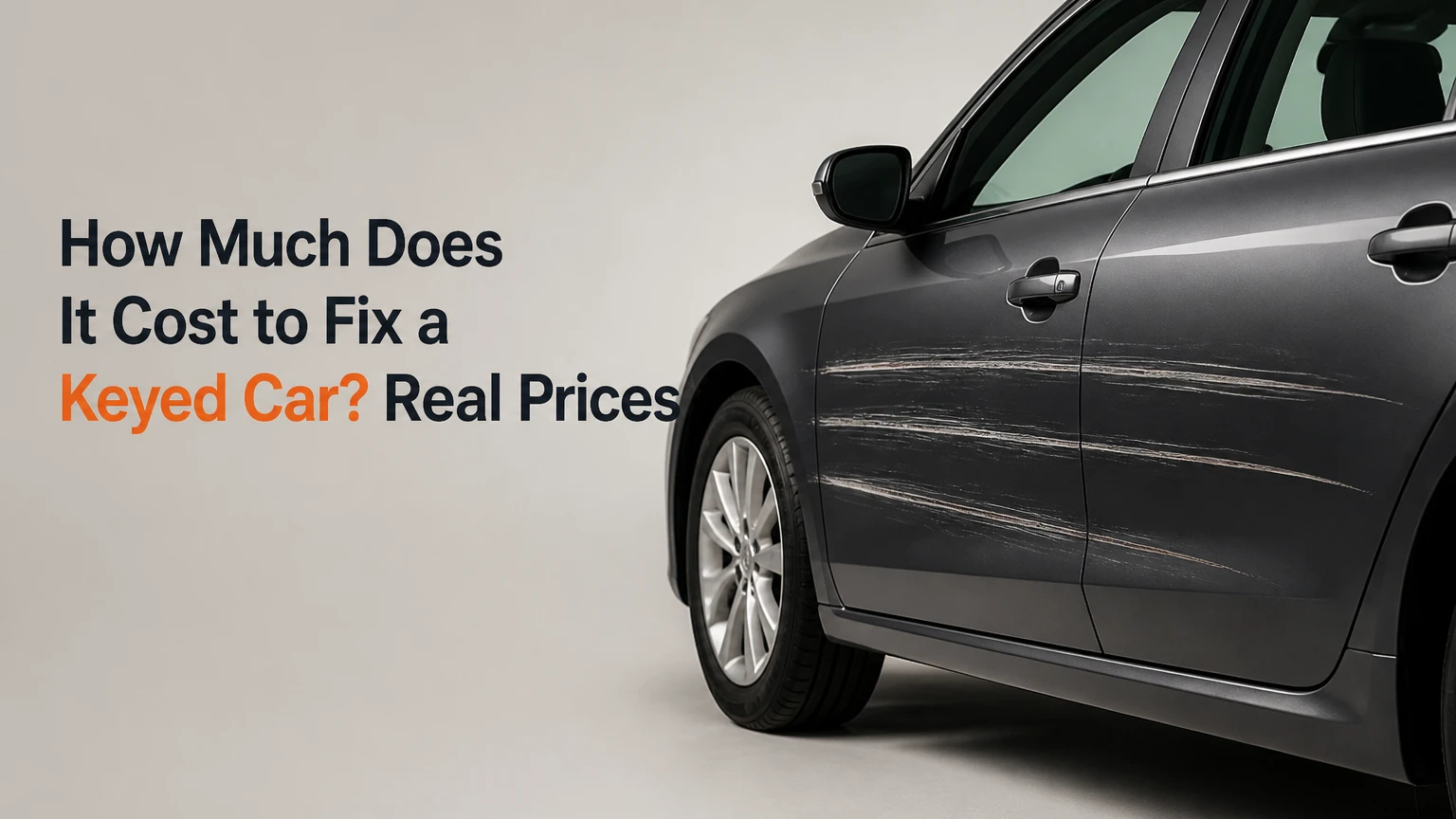
Fixing a keyed car typically costs $150-$3,500 or more in the United States. A shallow clear-coat mark may cost $150-$300 to polish, while a scratch through the color and primer can cost $800-$1,500 for a panel respray; bare metal, multiple panels, rust, and premium paint increase the bill.
Key Facts at a Glance
- A keyed-car repair costs approximately $150-$300 for clear-coat damage, $300-$800 for color-coat damage, and $800-$3,500 or more for primer or bare-metal damage.
- One damaged door or fender usually costs less than two or three adjacent panels because paint blending may extend across the vehicle.
- Comprehensive auto insurance generally covers intentional keying as vandalism, subject to the policy deductible and claim rules.
- A fingernail that catches usually indicates damage deeper than the clear coat, but the test cannot determine the exact repair price.
- Touch-up paint can seal exposed metal temporarily, but it rarely recreates a factory-level finish.
- A professional estimate should identify paint depth, panel count, blending requirements, corrosion, trim removal, and calibration needs.
How Much Does It Cost to Fix a Keyed Car?
The typical cost to fix a keyed car is $150-$3,500 or more, with most variation coming from scratch depth, panel count, vehicle type, paint color, and local labor rates. Clear-coat correction is the low-cost case; a deep gouge through paint and primer can require body filler, corrosion treatment, and a full-panel refinish.
A single shallow scratch on a conventional painted door may take 1-3 hours and cost $150-$300. A deep mark across a door and fender can require two refinish operations, color blending, trim removal, and 2-5 business days, producing a $1,500-$3,500 bill.
These are typical U.S. consumer ranges, not guaranteed estimates. Dealership body departments often charge more than independent collision shops, while a mobile technician may charge less for isolated cosmetic damage but cannot reproduce every factory finish.
| Damage condition | Typical repair price | Typical shop time | Likely repair method |
|---|---|---|---|
| Clear coat only, one panel | $150-$300 | 1-3 hours | Compound, polish, wet-sand |
| Color coat exposed, one panel | $300-$800 | 1-2 days | Touch-up, spot repair, clear coat |
| Primer exposed, one panel | $800-$1,500 | 2-3 days | Sand, prime, paint, clear coat |
| Bare steel or aluminum | $1,200-$2,500 | 2-4 days | Corrosion treatment and respray |
| Deep gouge with body damage | $1,500-$3,500+ | 3-5+ days | Filler, panel repair, full refinish |
| Two or more keyed panels | $2,000-$6,000+ | 3-7 days | Multiple refinishes and blending |
What Determines the Repair Price?
Scratch depth determines the basic repair method, but panel count and paint complexity often determine the final invoice. A quote that appears expensive for one scratch may include adjacent-panel blending, clear-coat removal, trim reinstallation, and corrosion protection.
The main pricing variables are:
- Paint layer affected: Clear coat is polishable; color and primer damage usually require paint.
- Number of panels: A line crossing a door, quarter panel, and fender may involve three repair areas.
- Panel material: Aluminum, steel, plastic, and composite panels require different preparation.
- Paint system: Tri-coat pearl, matte, candy, and metallic finishes require more careful matching.
- Vehicle value and finish standard: Luxury and collector vehicles justify higher preparation and inspection costs.
- Geographic labor rate: Metropolitan collision centers generally charge more than rural independent shops.
- Existing paint condition: Faded, oxidized, or previously repaired paint complicates color blending.
- Hidden damage: A gouge can distort a door edge, damage molding, or expose a seam to corrosion.
A professional estimate should separate labor, materials, paint and clear coat, body repair, blending, parts, shop supplies, taxes, and any rental-car charge. Ask whether the stated price covers one panel or the entire visible repair zone.
How Deep Is the Keyed Car Scratch?
A keyed-car scratch is usually categorized by the deepest automotive paint layer it reaches: clear coat, base coat, primer, or the underlying metal or plastic. The layer determines whether polishing can remove the defect or whether technicians must add and refinish material.
Modern automotive finishes normally contain a substrate, primer, pigmented base coat, and transparent clear coat. The clear coat protects color from ultraviolet exposure and provides gloss, but it is only a thin protective film. Removing too much of it during aggressive sanding can create a larger repair.
What Does the Fingernail Test Show?
The fingernail test gives a quick indication of scratch depth. If a clean fingernail glides across the mark, the damage may be limited to the clear coat; if the nail catches, the scratch likely reaches the color coat or deeper layers.
Wash and dry the panel first, then move a fingernail gently across the scratch without pressing hard. A catching nail does not identify whether the mark reached primer or bare metal, so it cannot replace a technician’s inspection.
What Does the Scratch Color Mean?
The exposed color provides a useful clue, but lighting and road contamination can mislead the owner. White or light gray may indicate primer, silver may indicate metal, and black or dull gray may indicate plastic or shadow inside the gouge.
Use bright, indirect light and clean the area with automotive soap. Do not scrape the scratch with a blade or abrasive pad to identify the layer. A clean photograph beside a ruler helps a repairer estimate panel count and length before an in-person inspection.
Does the Wet Test Work?
The wet test can distinguish some clear-coat scratches from deeper damage. If clean water temporarily makes the scratch disappear, the water may be optically filling a shallow clear-coat defect; if the mark remains visible, color or substrate damage is more likely.
The wet test is not definitive because water can darken oxidized paint, hide dust, or change reflections. Use it only as an initial clue, then let the panel dry before applying any compound, solvent, or touch-up paint.
How Are Keyed-Car Repairs Priced by Paint Layer?
Clear-coat damage is priced as paint correction, while deeper damage is priced as paint repair or body refinish work. The transition from polishing to spraying creates the largest cost jump because technicians must control color match, overspray, cure time, and clear-coat edges.
| Paint layer affected | Typical visible sign | Price per panel | Finish expectation |
|---|---|---|---|
| Clear coat | Nail does not catch; color remains uniform | $150-$300 | High if paint is healthy |
| Base coat | Factory color is interrupted | $300-$800 | Good, with possible spot-repair edge |
| Primer | White or gray underlayer visible | $800-$1,500 | Good after full-panel refinish |
| Bare steel | Silver metal or orange corrosion | $1,200-$2,500 | Good if corrosion is fully removed |
| Plastic substrate | Black or gray bumper material | $500-$1,200 | Depends on bumper texture and shape |
| Deep body gouge | Uneven metal, ridge, or dent | $1,500-$3,500+ | Requires body and paint repair |
Clear-Coat-Only Damage
A clear-coat scratch usually costs $150-$300 for professional compounding, polishing, and possibly localized wet-sanding. A detailer may use a dual-action polisher, a measured abrasive compound, and finishing polish to level the surrounding clear coat.
The repair fails when the scratch is deeper than assumed or when the operator removes excessive surrounding clear coat. A polished mark can reappear after oils wash away, so inspect the panel after cleaning and under direct sunlight.
Base-Coat Damage
Base-coat damage typically costs $300-$800 because the color layer must be filled, blended, or resprayed before clear coat is restored. Metallic and pearl colors increase the chance of a visible repair edge because flake orientation changes with spray angle and overlap.
A touch-up pen may stop water intrusion at the lowest price, but the repaired line can remain visible at close range. A mobile SMART repair can improve appearance within several hours, although the blend may show under strong sunlight or on a highly reflective panel.
Primer and Bare-Metal Damage
Primer exposure commonly costs $800-$1,500 for a full-panel refinish, while bare metal and body distortion can raise the price to $1,500-$3,500 or more. Steel requires prompt sealing because moisture can begin corrosion beneath an incomplete repair.
Aluminum does not form red rust like steel, but it can oxidize and create paint-adhesion problems. A shop should identify the substrate, remove unstable corrosion, apply the correct primer, and follow the paint manufacturer’s curing procedure.
Which Repair Option Should You Choose?
A body shop is the best choice for deep, multi-panel, metallic, luxury, leased, or resale-sensitive damage. A mobile technician suits isolated cosmetic scratches, while DIY touch-up paint is appropriate mainly as a temporary seal or for owners who accept a visible finish.
| Repair option | Typical price | Completion time | Best use case | Main limitation |
|---|---|---|---|---|
| DIY paint pen | $15-$60 | 30-90 minutes plus cure | Exposed paint or temporary sealing | Visible ridge and color mismatch |
| DIY aerosol kit | $50-$180 | 1-2 days | Small removable panel repair | Overspray and poor blending risk |
| Mobile SMART repair | $200-$700 | 2-6 hours | One isolated cosmetic scratch | Limited for deep or multi-panel damage |
| Independent body shop | $500-$2,500 | 2-5 days | Durable panel-level repair | Vehicle remains at the shop |
| Dealership collision center | $800-$3,500+ | 3-7 days | Warranty, lease, luxury vehicle | Higher labor and material rates |
| Insurance-covered repair | Deductible plus claim cost | 2-7 days | Damage exceeds deductible substantially | Claim history and policy conditions |
When Is a Body Shop Worth the Cost?
A body shop is worth the cost when the scratch reaches bare metal, crosses multiple panels, includes a dent, or must meet lease-return and resale standards. Collision technicians can remove trim, measure panel condition, blend adjacent paint, and document the completed repair.
Request at least two written estimates for non-emergency work. Confirm whether the shop uses a paint code, spray-out card, or spectrophotometer, and ask how it will match faded paint on adjacent panels.
Is Mobile Scratch Repair Cheaper?
Mobile scratch repair typically costs $200-$700 and can be about 30%-60% less than a conventional body-shop refinish for isolated cosmetic damage. The lower price comes from targeted preparation, fewer removed parts, and mobile operating costs, not from a universally equivalent process.
Mobile repair is not a good choice for deep corrosion, sharp panel edges, large paint failures, severe dents, or matte finishes that require uniform panel treatment. Ask for photographs of comparable repairs and a written statement about warranty coverage.
Can DIY Touch-Up Paint Fix a Keyed Car?
DIY touch-up paint can seal a small exposed scratch for approximately $15-$60, but it rarely makes a long keyed line disappear. The owner must match the manufacturer’s paint code, clean the channel, apply thin layers, allow curing, and avoid flooding the surrounding clear coat.
Touch-up paint is useful when immediate corrosion prevention matters more than appearance. It is a poor choice for a leased vehicle, a new luxury car, a broad door-length scratch, or a repair that will be inspected at close range.
How Do You Repair a Keyed Car Without Making It Worse?
A safe repair starts with documentation and paint-depth assessment, not sanding. Photograph the damage, wash the panel, verify the paint code, and test a small area only when the scratch appears limited to clear coat.
Step 1: Document the Damage
Take wide and close photographs before washing the vehicle or touching the scratch. Record the date, location, panel names, approximate length, and whether the damage crosses body gaps or trim.
If vandalism may be involved, photograph nearby marks, debris, cameras, and the vehicle’s position. Save security footage and obtain a police report where required by the insurer or local authority.
Step 2: Clean and Assess the Panel
Wash with automotive shampoo, rinse thoroughly, and dry with a clean microfiber towel. Perform the fingernail and wet tests under bright light, then inspect for exposed primer, metal, plastic, dents, and paint flaking.
Do not use household rubbing alcohol, acetone, kitchen sponges, or coarse sandpaper. These products can stain plastics, soften finishes, or enlarge a defect that initially needed only polishing.
Step 3: Select the Least Aggressive Repair
Use compound and polish only when the scratch remains the same color as the surrounding paint and the nail does not catch. Use touch-up paint for a small exposed channel, and obtain a professional estimate for primer, metal, plastic, or body damage.
A practical rule is to stop when the defect improves but remains visible. Repeated sanding cannot restore missing paint and may force a full-panel respray.
Step 4: Protect Exposed Substrate
Cover a small exposed metal scratch with correctly matched automotive touch-up primer and paint according to the product instructions. Keep the vehicle dry while the material cures, and do not seal moisture, dirt, or active rust beneath the coating.
The repair is ready for finishing only when the material has cured for the manufacturer’s stated period. A raised touch-up ridge should not be wet-sanded immediately because uncured paint can smear into the surrounding clear coat.
What Mistakes Increase the Final Bill?
The most expensive DIY mistake is treating a deep scratch as a polishing problem. Once an owner sands through surrounding clear coat or contaminates the surface, the technician must enlarge the preparation area and may need to refinish the entire panel.
Common cost-increasing errors include:
- Using the color name instead of the paint code: “Black” or “blue” does not identify a manufacturer’s exact formula.
- Applying paint in direct sun: Rapid drying can cause texture, poor adhesion, and trapped solvent.
- Sanding without a rigid block: Finger pressure creates valleys and uneven edges around the scratch.
- Using coarse abrasive paper: Coarse grit can leave scratches that require larger paint preparation.
- Polishing exposed primer or metal: Abrasive correction cannot replace missing pigment or corrosion protection.
- Applying clear coat over contamination: Wax, silicone, dust, and moisture can cause fisheyes and peeling.
- Ignoring a panel edge: Paint failure at an edge often requires trim removal and more extensive blending.
- Assuming a warranty covers vandalism: Paint warranties commonly exclude external damage and improper repairs.
One practitioner rule matters most: never chase a scratch until it is invisible if the scratch has already removed clear coat. The surrounding finish may become thinner than the repaired area, creating premature peeling or a visible halo.
Will Insurance Pay for a Keyed Car?
Comprehensive auto insurance generally covers intentional keying because insurers classify it as vandalism, while collision coverage usually applies to impact with another vehicle or object. Coverage depends on the policy, deductible, exclusions, state rules, and evidence requirements.
Use deductible math before filing. If a repair estimate is $600 and the comprehensive deductible is $500, the theoretical insurer payment is only $100 before any policy-specific effects. If three panels cost $2,500 and the deductible is $500, a claim may be financially reasonable.
| Repair estimate | Comprehensive deductible | Approximate insurer payment | Typical decision |
|---|---|---|---|
| $300 | $500 | $0 | Pay privately |
| $600 | $500 | $100 | Compare claim consequences |
| $1,200 | $500 | $700 | Consider filing |
| $2,500 | $500 | $2,000 | Usually worth evaluating |
| $3,500 | $1,000 | $2,500 | Consider filing promptly |
| $5,000 | $2,000 | $3,000 | File if policy permits |
Call the insurer before authorizing repairs if the damage may exceed the deductible. Ask whether a police report is needed, whether the insurer requires a preferred shop, whether rental coverage applies, and whether a claim can affect underwriting or renewal even when the premium increase is not automatic.
Do not wash away evidence if the insurer or police may inspect the vehicle. Photograph first, preserve relevant video, and avoid assuming that a comprehensive claim can never influence future pricing.
How Long Does a Keyed-Car Repair Take?
A keyed-car repair takes about 1-3 hours for clear-coat correction, 1-2 days for a small painted repair, and 3-7 days for deep or multi-panel refinishing. Scheduling, paint curing, parts availability, weather, and insurance authorization can extend the calendar time beyond active labor.
A shop may keep a vehicle overnight even when technicians spend only several hours on it. Clear coat, primer, and base coat require controlled flash and cure intervals, and the vehicle may need final inspection before delivery.
| Repair scenario | Active labor estimate | Calendar time | Main delay |
|---|---|---|---|
| Polish one clear-coat scratch | 1-3 hours | Same day | Inspection and drying |
| Touch-up one short line | 1-2 hours | 1 day | Paint curing |
| Refinish one steel door | 4-8 labor hours | 2-3 days | Booth schedule and cure |
| Repair one dented panel | 6-12 labor hours | 3-5 days | Filler and paint stages |
| Refinish two adjacent panels | 10-18 labor hours | 3-6 days | Color blending |
| Insurance repair with rental | 8-20 labor hours | 4-10 calendar days | Estimate approval and parts |
What Changes for Leased, Luxury, and Older Cars?
Leased vehicles usually justify professional refinishing because inspectors evaluate visible paint damage against the leasing company’s wear standards. An inexpensive touch-up may stop rust but still produce a charge for poor color match, paint texture, or unrepaired panel damage.
Luxury and collector vehicles need a shop familiar with the manufacturer’s paint system. Porsche, Lexus, Mercedes-Benz, Tesla, and other brands may use complex metallic, pearl, aluminum, or multi-stage finishes that require careful blending and documented material compatibility.
Older daily drivers create a different calculation. A $700 repair on a vehicle worth $4,000 may not increase resale value by $700, especially when the surrounding paint is already faded. In that case, a $250-$500 mobile repair or correctly applied touch-up may provide the sensible balance between corrosion control and appearance.
Ceramic coating and paint-protection film do not restore keyed paint. A ceramic coating can make future cleaning easier, while paint-protection film can protect intact paint from some surface damage, but both must be removed or repaired if the underlying finish is already gouged.
What If the Scratch Starts Rusting?
A scratch through paint and primer should be sealed promptly because exposed steel can corrode when moisture and oxygen reach the surface. The often-repeated 48-hour “rust clock” is not a universal deadline, since humidity, salt, temperature, and contamination determine corrosion speed, but waiting increases the risk.
Surface orange rust may require cleaning and corrosion treatment before primer. Flaking paint, bubbling, dark staining, or rust extending beneath intact paint indicates a larger preparation area and a higher repair price.
Avoid household rust converter unless its label specifically supports automotive refinishing. Incompatible residue can prevent primer adhesion and cause peeling months later. A body shop should remove unstable material rather than painting over corrosion.
How Do You Find a Fair Estimate?
A fair estimate identifies the affected panels, repair method, labor hours, materials, blend panels, parts, taxes, and warranty. Compare estimates only when they describe the same finish standard, because a $350 spot repair and a $1,200 full-panel refinish are not equivalent services.
Ask each repairer these questions:
- Is the scratch limited to clear coat, or does it expose primer or substrate?
- Will the technician repair the scratch locally or refinish the complete panel?
- Which adjacent panels require blending?
- Does the price include trim removal, corrosion treatment, and clear coat?
- Will the repaired finish carry a written warranty?
- Is color matching based on the paint code, a spray-out card, or visual judgment?
- Are taxes, shop supplies, storage, and rental-car costs included?
A written estimate also protects against scope confusion. If the shop discovers a dent, rust, or prior poor repair after sanding, it should obtain authorization before increasing the price.
Frequently Asked Questions
Can a keyed car scratch be buffed out?
A keyed car scratch can be buffed out only when damage remains within the clear coat. If a fingernail catches or the scratch exposes a different color, buffing alone cannot replace missing paint and may thin the surrounding finish. A technician should inspect deeper marks before using abrasive correction.
Is it cheaper to repaint a door or replace it?
Repainting a door is usually cheaper than replacing it when the door shell is structurally sound. Typical refinishing costs are $800-$1,500, while a replacement door can exceed $1,500-$4,000 after parts, paint, hardware, labor, and alignment. Replacement becomes more sensible when the shell is severely distorted or corroded.
Does keying a car lower its value?
Keying a car can lower its value when damage remains visible, rust develops, or the repair history is undocumented. A professional paint repair with invoices and photographs usually protects value better than an uneven touch-up, although a paint-meter reading may reveal refinishing to a future buyer.
Should I report a keyed car to the police?
Report a keyed car to the police when vandalism evidence, surveillance footage, repeated incidents, or an insurance claim is involved. The report may document the event for the insurer and establish a pattern, but local requirements differ. Photograph the vehicle before cleaning or repairing it.
Can a scratch through paint be repaired without repainting the whole car?
A scratch through paint can usually be repaired without repainting the whole car, but the affected panel normally needs localized paint or a full-panel refinish. Technicians may blend color into an adjacent panel and clear-coat a larger area to hide the transition.
Does comprehensive coverage pay the entire repair bill?
Comprehensive coverage generally pays the covered repair amount above the deductible, subject to policy limits, exclusions, and insurer approval. A $2,500 covered repair with a $500 deductible would commonly leave approximately $500 for the owner and $2,000 for the insurer, before policy-specific conditions.
The Bottom Line
The cost to fix a keyed car is usually $150-$3,500 or more: $150-$300 for clear-coat correction, $300-$800 for color-coat repair, and $800-$3,500 or more for primer, metal, dents, rust, or multiple panels. Choose the least aggressive repair that safely restores the affected paint layer, then compare that estimate with your comprehensive deductible.
Document the damage before cleaning, verify the paint code, and obtain a written estimate that explains blending and corrosion treatment. For deep, multi-panel, leased, luxury, or resale-sensitive damage, a reputable body shop is usually worth the additional cost.