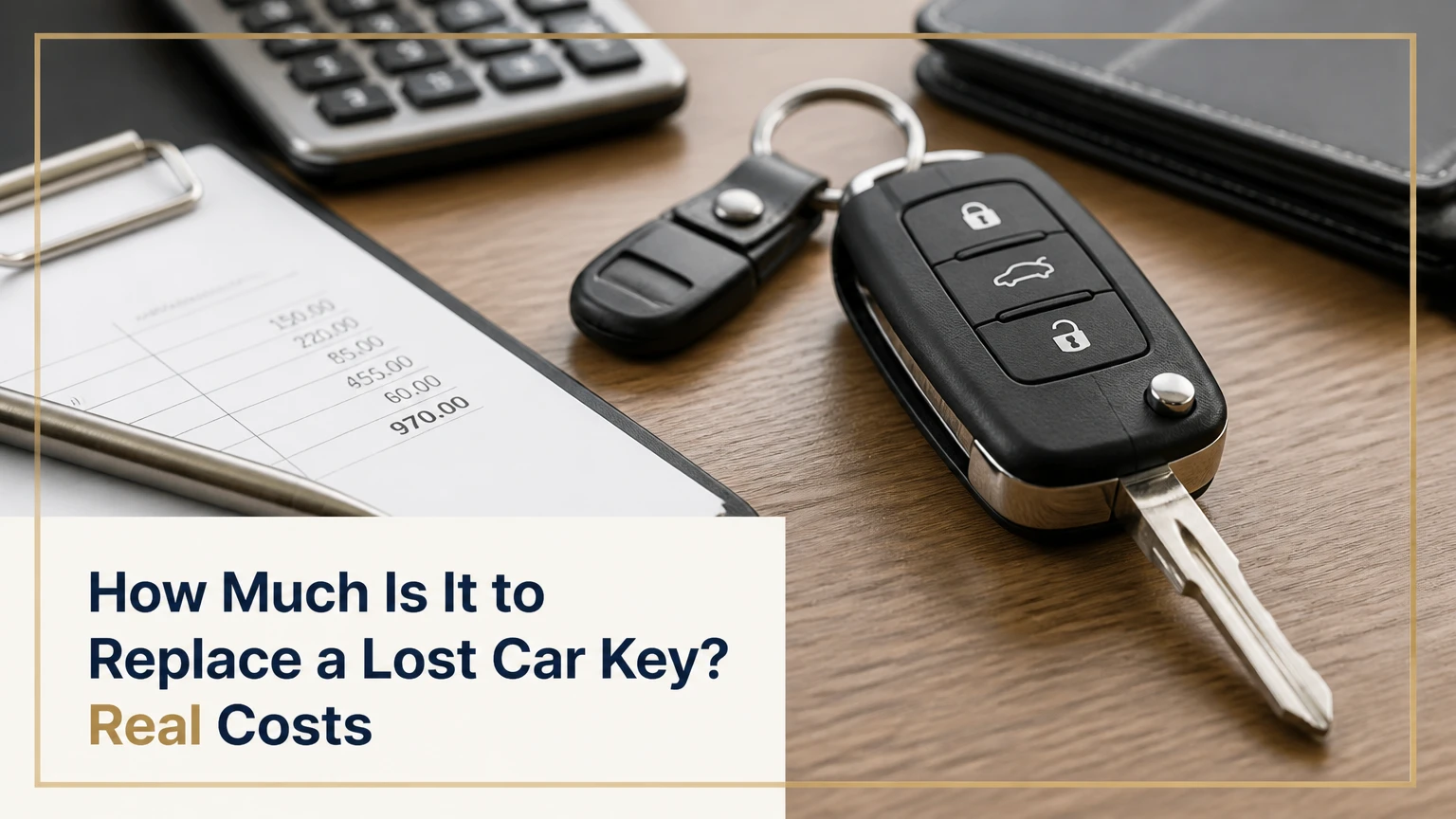
Replacing a lost car key typically costs $50-$450 or more in the United States, with basic metal keys at the low end and smart proximity fobs, luxury vehicles, emergency service, or towing pushing the total higher. The final price depends on the key technology, whether any working key remains, vehicle security requirements, location, and provider.
Key Facts at a Glance
- A basic metal car key typically costs $50-$100 to cut.
- A transponder key commonly costs $120-$250, including programming.
- A remote key or flip key generally costs $175-$350.
- A smart proximity fob often costs $250-$450 or more.
- A mobile automotive locksmith can often program the key at the vehicle, avoiding a dealership tow.
- A lost key should be removed from the vehicle’s authorized-key memory when the system supports deletion.
How Much Is It to Replace a Lost Car Key?
The usual replacement price is $50-$450+, but a realistic quote must identify the key type and separate the service charges. A 1990s vehicle with a mechanical ignition may need only a cut key, while a newer push-button-start vehicle may require an OEM fob, security credentials, diagnostic programming, and a mobile service call.
Typical US pricing below assumes a standard passenger vehicle during normal business hours. Rural travel, nights, weekends, luxury brands, imported vehicles, and all-keys-lost situations can increase the invoice.
| Replacement situation | Typical total cost | Typical time | Main cost drivers |
|---|---|---|---|
| Basic metal key | $50-$100 | 10-20 minutes | Key blank and cutting |
| Transponder ignition key | $120-$250 | 20-45 minutes | Chip, blade, programming |
| Remote flip key | $175-$350 | 30-60 minutes | Remote, chip, cutting, pairing |
| Smart proximity fob | $250-$450+ | 30-90 minutes | OEM fob, security access, programming |
| All keys lost, standard vehicle | $180-$500 | 45-120 minutes | Code retrieval, programming, security reset |
| Luxury or restricted vehicle | $400-$1,200+ | 1-7 days | OEM ordering, encrypted credentials, dealer access |
The largest price mistake is comparing a bare online fob price with a complete replacement invoice. A $35 shell or unprogrammed remote is not equivalent to a cut, compatible, programmed key that starts the vehicle.
What Type of Car Key Did You Lose?
The key type determines whether the replacement needs cutting, programming, pairing, or all three. Physical appearance helps, but the vehicle’s model year and ignition system provide a more reliable identification method.
| Key type | How to identify it | Electronic requirement | Typical examples |
|---|---|---|---|
| Mechanical metal key | All-metal blade, no buttons | None | Older Ford, Honda, Toyota vehicles |
| Transponder key | Plastic head, often one to four buttons | Immobilizer chip programming | Ford H72, GM PK3, many 1996-2010 vehicles |
| Remote flip key | Foldable blade and lock buttons | Chip programming plus remote pairing | Volkswagen, Chrysler, Ford flip keys |
| Smart proximity fob | Push-button start, no blade used for ignition | Proximity authorization and vehicle programming | Toyota Smart Key, Nissan Intelligent Key |
| Fob with emergency blade | Push-start vehicle with hidden mechanical blade | Fob programming, blade cutting if needed | Honda, Hyundai, Kia, BMW systems |
A transponder key can look nearly identical to a conventional key, yet the car will not start unless its chip is accepted by the immobilizer. A smart fob may unlock the doors but still fail to start the engine if its proximity credentials are not registered.
Does the vehicle’s age change the price?
Vehicle age often changes the price because older cars use simpler blanks and less restrictive programming systems. Vehicles built before approximately 1995 are more likely to use only a mechanical key, while many vehicles from the mid-1990s onward introduced immobilizer chips; the exact transition varies by manufacturer and market.
A newer vehicle is not automatically expensive. Some late-model economy cars use relatively common fobs, while an older European vehicle may require costly security access. The make, model, year, trim, ignition design, and regional specification matter more than age alone.
Why Is a Modern Car Key So Expensive?
Modern car-key pricing rises because the replacement is an electronic security credential, not merely a shaped piece of metal. The blade opens the lock, but the immobilizer checks a digital identifier before allowing the engine-control system to authorize starting.
A diagnostic programmer communicates with the vehicle through the diagnostic connector, commonly the standardized SAE J1962 connector associated with OBD-II systems. The tool may need manufacturer-specific software, a security PIN, an online account, or a time-limited authorization token before it can add the replacement key.
The process can involve four separate operations:
- Mechanical code retrieval: The technician obtains the cut code from the VIN, manufacturer records, a lock cylinder, or decoding equipment.
- Blade cutting: A conventional or laser-style machine creates the physical key profile.
- Immobilizer registration: The transponder or smart fob identifier is added to the vehicle’s authorized-key memory.
- Remote or proximity pairing: Lock, unlock, trunk, proximity, and push-start functions are synchronized.
The vehicle may accept the remote buttons while rejecting the immobilizer chip. Those are separate functions, so testing only the door locks does not prove the key is fully programmed.
What Does a Locksmith Charge Compared With a Dealership?
A mobile automotive locksmith typically costs less and provides the service at the vehicle, while a dealership usually costs more but offers direct access to factory parts and restricted programming systems. The best choice depends on the vehicle’s security architecture, urgency, warranty needs, and whether the car can be driven.
| Provider | Typical total | On-site service | Parts and programming | Main limitation |
|---|---|---|---|---|
| Mobile automotive locksmith | $120-$450 | Usually yes | Aftermarket or OEM, model dependent | May lack access for restricted models |
| Dealership | $250-$900+ | Rarely | Usually OEM and factory systems | Towing and appointment delays |
| Online parts retailer | $20-$250 before service | No | Hardware only in most cases | Cutting and programming remain |
| Roadside-assistance contractor | $100-$500 | Often yes | Varies by subcontractor | Coverage limits and capability vary |
When is a mobile locksmith the better choice?
A mobile locksmith is usually the better first call when the vehicle is stranded, the model is commonly supported, and avoiding a tow matters. The technician can verify ownership, cut the key, connect a programmer, test the ignition, and often provide a complete invoice at the parking location.
Ask for the total price, not only the service-call fee. Confirm whether the quote includes the key or fob, cutting, programming, travel, after-hours labor, tax, and deletion of the lost key.
A locksmith is not automatically the right provider for every car. Recent BMW, Mercedes-Benz, Audi, some Land Rover vehicles, and certain high-security systems may require manufacturer credentials or an ordered key that an independent technician cannot supply.
When should you use a dealership?
A dealership is the safer choice when the vehicle uses restricted security credentials, the key must be ordered by VIN, the vehicle remains under a service arrangement, or an independent locksmith confirms that factory access is required. Dealership replacement can also be preferable when an OEM warranty is more important than the lowest price.
The trade-off is logistics. If the car cannot move, towing may add $75-$200 or more, depending on distance and local rates. Call a qualified mobile locksmith before authorizing a tow, but disclose the exact make, model, year, and whether the vehicle has push-button start.
How Do You Replace a Lost Car Key Without the Original?
A qualified locksmith or dealership can usually create a replacement without the original key by verifying ownership, retrieving the mechanical code, and programming a new electronic credential. All-keys-lost service takes longer because the technician must establish a new authorized-key record rather than copy an existing one.
Follow these steps:
- Collect vehicle information.
Prepare the VIN, make, model, year, registration or title, and government-issued identification. The VIN appears on the driver-side dashboard, door-jamb label, registration, insurance documents, and sometimes the manufacturer’s mobile app. - Confirm the exact key system.
Identify whether the vehicle uses a blade key, transponder, remote combination key, or proximity fob. State whether the ignition has a key slot, a push button, or a concealed emergency slot. - Count every working key.
Tell the provider whether you have zero, one, or multiple working keys. Some vehicles require all existing keys to be present during programming, and a missing key may remain authorized unless the technician performs a reset. - Request an itemized quote.
Obtain separate figures for the key, cutting, programming, travel, emergency labor, and taxes. Ask whether the price changes if the vehicle requires an OEM part. - Verify ownership at the appointment.
A reputable provider should inspect documentation before programming. This security step protects against unauthorized key creation. - Have the blade cut and the electronics programmed.
The technician may use a code from manufacturer records, decode a lock, or remove a cylinder if the code cannot be obtained electronically. - Test every function.
Check door locks, trunk release, alarm response, ignition authorization, remote range, and the emergency blade. Testing the key outside the vehicle is incomplete. - Ask whether old keys were deleted.
Deletion capability varies by model. Confirm which keys remain authorized after the procedure and request documentation of the final key count.
A typical all-keys-lost appointment takes 45-120 minutes for a supported vehicle. Dealer ordering can take one to seven days when the replacement must arrive from a regional or national parts warehouse.
Is Buying a Replacement Key Online Cheaper?
Buying online can reduce hardware cost, but the complete project is cheaper only when the part is precisely compatible and a local technician agrees to cut and program it. Online listings often show an uncut shell, a remote board, or a fob without the immobilizer chip required for starting.
Check these identifiers before ordering:
| Compatibility check | Required match | Common failure |
|---|---|---|
| Vehicle identity | Exact make, model, year, trim | Similar model uses a different system |
| Part number | Matching OEM or aftermarket number | Seller lists several revisions |
| FCC ID | Same transmitter identification | Buttons work poorly or cannot pair |
| Frequency | Often 315 MHz or 433 MHz, market dependent | Wrong regional frequency |
| Transponder type | Vehicle-specific chip family | Doors unlock, engine remains disabled |
| Blade profile | Correct keyway and length | Blade cannot turn the ignition |
| New or used status | New, virgin, or resettable part | Used fob remains locked to another car |
A shell replacement is appropriate when the electronics already work and only the plastic housing is damaged. It does not replace a lost key because there is no existing circuit board or immobilizer credential to transfer.
Many locksmiths refuse customer-supplied parts because they cannot guarantee compatibility or warranty a failed component. Ask before purchasing. The cheapest online hardware can become the most expensive option after two shipping charges, a rejected programming attempt, and a second service call.
What Should You Do if All Car Keys Are Lost?
If all keys are lost, secure the vehicle first, then arrange verified on-site replacement or dealer service. Do not leave registration papers, garage remotes, or identifying documents inside the vehicle, especially when the lost key may be linked to your home address.
Use this response sequence:
- Move the vehicle into a locked garage or monitored location if possible.
- Report a stolen key to local law enforcement when theft is suspected.
- Contact the vehicle insurer, roadside plan, fleet manager, or leasing company.
- Ask the technician to check whether lost keys can be deleted from the immobilizer module.
- Remove garage-door codes and digital vehicle access from the manufacturer app.
- Change connected-app passwords if the key was lost with a phone or wallet.
- Request a second key if the vehicle uses an all-keys-lost reset procedure.
Deleting a key from the vehicle does not recover the physical key or disable every mechanical lock. A person holding the lost blade may still open a door, and some systems retain mechanical access even after electronic authorization changes.
Does Insurance or Roadside Assistance Pay for a Lost Key?
Insurance and roadside plans sometimes cover lost-key replacement, but coverage depends on the policy, deductible, exclusions, and whether the loss is treated as theft or accidental loss. Comprehensive auto insurance may cover stolen keys when the incident is part of a covered theft claim, while ordinary loss may be excluded.
Check these sources before paying:
| Coverage source | Possible benefit | Verify before service |
|---|---|---|
| Comprehensive auto policy | Theft-related replacement or rekeying | Deductible, exclusions, claim impact |
| Roadside plan | Locksmith dispatch or fixed reimbursement | Annual limit and key-programming cap |
| Manufacturer warranty | Limited defects, rarely loss | Warranty terms and vehicle age |
| Lease or fleet agreement | Required replacement process | Approved provider and OEM requirement |
| Credit-card purchase benefit | Rare key or roadside coverage | Card terms and documentation deadline |
A $250 claim may not make financial sense under a $500 comprehensive deductible. Ask the insurer whether filing a theft claim changes the calculation, and keep the itemized invoice, police report, ownership documents, and photographs of any damage.
How Long Does Car Key Replacement Take?
Most supported mobile replacements take 20-60 minutes, while all-keys-lost jobs commonly take 45-120 minutes and dealer-ordered keys may take one to seven days. Programming time depends less on cutting speed than on security authorization, vehicle access, and whether the correct part is in stock.
| Situation | Typical appointment time | Likely delay |
|---|---|---|
| Duplicate mechanical key | 10-20 minutes | Incorrect blank |
| Transponder key, one working key | 20-45 minutes | Chip or software mismatch |
| Remote flip key | 30-60 minutes | Remote pairing procedure |
| Smart fob, supported model | 30-90 minutes | Security token or battery |
| All keys lost | 45-120 minutes | Module reset or PIN retrieval |
| Dealer OEM order | 1-7 days | Parts availability and appointment |
An emergency nighttime call may arrive quickly but cost more because of after-hours labor and travel. A daytime appointment with the vehicle accessible and documents ready usually produces the lowest total.
Can a Lost Key Still Start the Car?
A lost key can still start the car if its electronic identifier remains authorized and the vehicle’s immobilizer is within range of the key. Replacing the key without deleting the missing credential may solve access problems while leaving the vehicle vulnerable to anyone who finds it.
The technician should explain the vehicle’s key-management behavior. Some systems allow individual key deletion; others erase all stored keys and require every remaining key to be programmed again. A remote’s lock buttons and an immobilizer’s start authorization may also use separate memory records.
For higher-risk losses, consider mechanical rekeying in addition to electronic deletion. Rekeying changes the lock cylinder’s operating pattern, while electronic programming changes which chips or fobs the vehicle accepts.
Why Does the New Key Not Work?
A new key that unlocks the doors but will not start the engine usually has an unprogrammed or incompatible transponder, while a remote that works intermittently more often has a weak battery, damaged board, or radio-frequency interference. Diagnosis should separate mechanical, remote, and immobilizer functions.
| Symptom | Likely cause | Correct response |
|---|---|---|
| Blade will not enter lock | Wrong keyway or burr | Recut using the correct profile |
| Blade turns, engine will not start | Unprogrammed chip | Perform immobilizer registration |
| Doors unlock, engine remains disabled | Remote paired without transponder | Replace or program correct chip |
| Buttons work intermittently | Weak CR2032 or CR2025 battery | Install the specified battery |
| No programming communication | Blown diagnostic-port fuse | Inspect the vehicle fuse circuit |
| Key works only near the button | Weak fob battery or antenna issue | Test battery, antenna, and receiver |
| Vehicle rejects every key | Immobilizer or module fault | Obtain manufacturer-level diagnosis |
A fresh battery cannot fix the wrong FCC ID, an incompatible transponder, or a vehicle-side immobilizer fault. Do not repeatedly attempt programming if the tool reports a security lockout, because some modules impose a timed delay after failed attempts.
What Mistakes Increase the Replacement Cost?
The most expensive mistakes happen before the technician arrives: ordering by appearance, authorizing a tow without comparing mobile service, and accepting a low base price that excludes programming. A precise vehicle description and an itemized quote prevent most avoidable charges.
Avoid these errors:
- Ordering by photograph alone.
Two fobs can share the same shape but use different FCC IDs, frequencies, chips, or regional systems. - Assuming a used fob is programmable.
Some used smart keys are permanently paired to another vehicle and cannot be reset economically. - Ignoring the trim level.
A base model with a conventional key may share a model name with a premium trim using proximity start. - Towing immediately.
A mobile locksmith may complete the job at the vehicle, eliminating a tow and dealer storage charges. - Skipping the lost-key deletion question.
Electronic replacement does not always remove the missing key from memory. - Testing only the remote buttons.
A working lock command does not confirm engine-start authorization. - Leaving the car inaccessible.
A technician may need open access to the driver door, ignition area, battery, or diagnostic connector.
One practitioner rule is especially useful: request the out-the-door total for your VIN and location. A generic “starting at $99” price cannot predict a smart-fob replacement.
What Is the Cheapest Safe Way to Replace a Lost Car Key?
The lowest safe cost is usually a qualified mobile locksmith using a compatible replacement part, provided the vehicle is supported and the provider includes cutting, programming, testing, and security review. For a basic mechanical key, a hardware store may be sufficient, but that option does not apply to immobilizer-equipped vehicles.
Use this decision path:
- Mechanical key only: Compare an automotive locksmith with a reputable key-cutting shop.
- One working transponder key remains: Ask for a duplicate, because cloning or adding a key is often simpler than an all-keys-lost reset.
- Remote or smart fob: Compare a mobile locksmith’s complete quote with the dealer’s OEM quote.
- Luxury, high-security, or very new vehicle: Confirm dealer-level access before buying parts or arranging a tow.
- Lost key associated with your address: Prioritize deletion, rekeying, garage security, and app access over the lowest price.
Duplicating a working key is commonly less expensive than originating a replacement with no original. The technician can read the existing cut and sometimes use an established programming path, although some vehicles still require a full security procedure.
How Can You Get an Accurate Quote?
An accurate quote requires the provider to know the VIN or exact vehicle details, key count, location, and required functions. Send a photograph of the ignition and any remaining key, but use the VIN and model information as the final verification.
Provide:
- Vehicle identification number
- Make, model, year, and trim
- Push-button or keyed ignition
- Number of working keys
- Key or fob type
- Exact location and access conditions
- Whether the vehicle is locked, damaged, or in a garage
- Whether the loss may involve theft
- Desired OEM or aftermarket part
Ask five direct questions:
- Is programming included?
- Is cutting included?
- Does the total include travel and after-hours labor?
- Will the technician test every function?
- Can the missing key be deleted from vehicle memory?
The answer should identify the final price range, expected arrival time, payment terms, and documentation required. Refusal to explain separate charges is a reason to obtain another quote.
FAQ
Can a locksmith make a car key from the VIN?
A locksmith can often obtain the mechanical key code from the VIN, but VIN access alone does not guarantee electronic programming. The provider must also support the vehicle’s immobilizer system, verify ownership, obtain any required security credentials, and cut or program the correct key type.
Can I start my car with the physical emergency key?
A physical emergency blade usually opens the door and may operate a conventional ignition, but it normally cannot start a push-button vehicle by itself. The smart fob’s electronic credential must be detected, sometimes by holding the fob against a marked backup reader or start button.
Is a replacement car key covered by a warranty?
A new key may have a limited parts or programming warranty, but vehicle warranties generally do not cover keys lost through customer error. Ask whether the warranty covers the fob battery, remote circuit board, transponder programming, labor, and failures caused by customer-supplied parts.
How much does a spare car key cost after I find the lost one?
A spare key commonly costs less than an all-keys-lost replacement because the existing key provides a cut and programming reference. Typical pricing is about $50-$200 for simpler keys and $150-$400 for remote or smart fobs, depending on the vehicle and provider.
Should I replace a key that is only broken?
A broken key may cost less to repair than a lost key if the transponder and remote electronics still work. A locksmith can often transfer a circuit board into a new shell or cut a duplicate from the remaining blade, but a damaged chip or missing fragments may require complete replacement.
The Bottom Line
The answer to how much is it to replace a lost car key is usually $50-$450+, with the exact total controlled by key technology, vehicle security, provider, location, and whether any working key remains. Get an itemized mobile-locksmith and dealership quote, verify compatibility before buying online, test every function, and ask whether the lost key can be removed from the vehicle’s authorized-key memory.