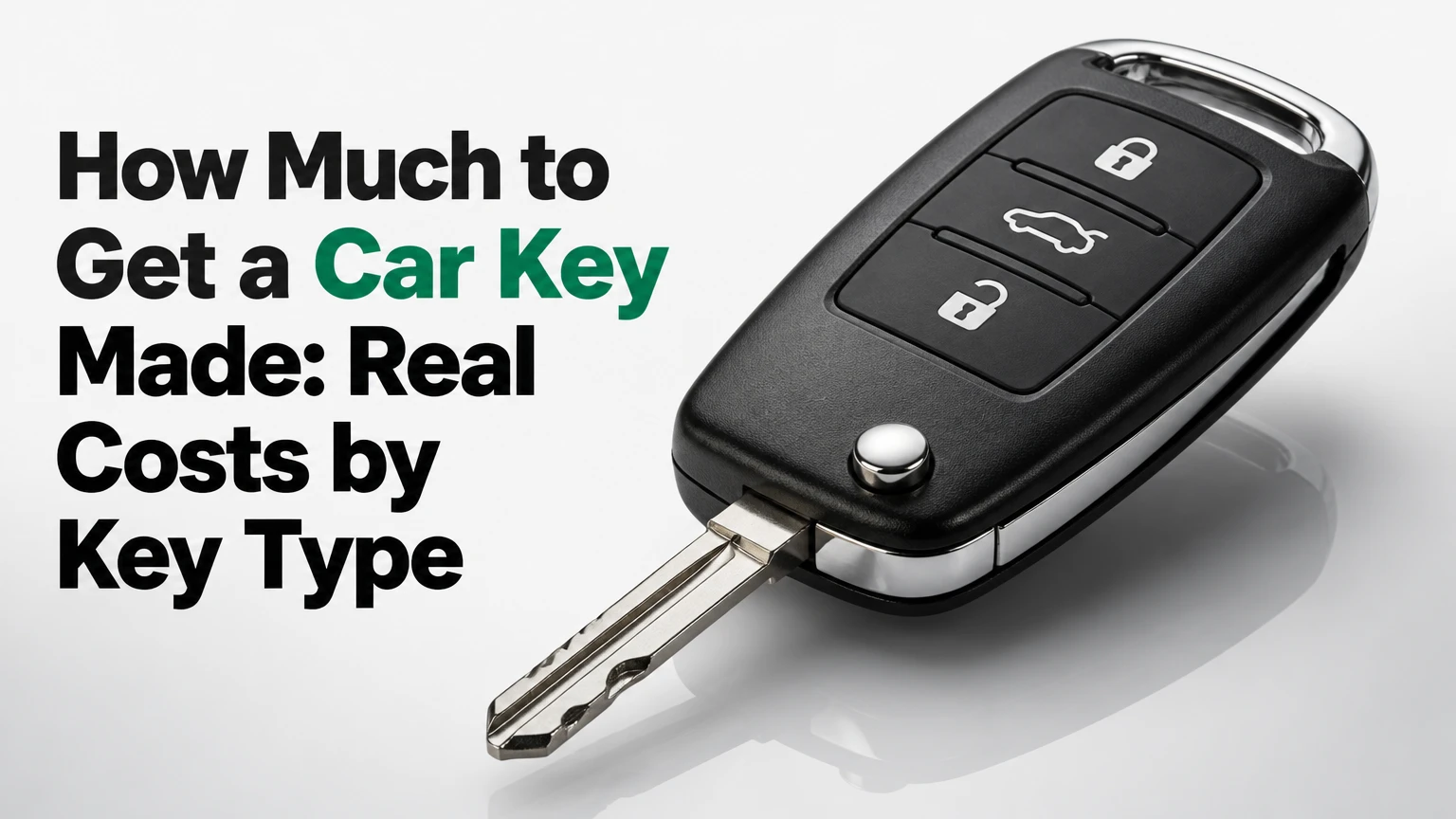
Getting a car key made typically costs $10-$500 or more in the United States. A basic mechanical duplicate may cost $10-$30, while a transponder key commonly costs $75-$175 and a smart proximity fob often costs $200-$500+, including cutting and programming. Vehicle age, key technology, provider, location, and whether you still have a working key determine the final price.
Key Facts at a Glance
- A basic mechanical car-key duplicate typically costs $10-$50 and usually takes 5-15 minutes.
- A transponder key commonly costs $75-$175, including electronic programming, and takes 20-30 minutes.
- A remote-head key generally costs $150-$300, while a smart proximity fob often costs $200-$500+.
- A dealership usually charges more than an automotive locksmith, but newer luxury vehicles may require dealer software or authorization.
- A working original key normally reduces replacement cost because the technician can copy its blade and often add a key without recovering the vehicle’s lost-key data.
- A weak fob battery, commonly a CR2032, can cause lock-button failure without requiring a new key.
What Is the Typical Cost to Get a Car Key Made?
The typical cost to get a car key made is $10-$500+, with the key’s electronics creating the largest price difference. A metal-only key is inexpensive because cutting is the only major operation; a smart key costs more because the fob, vehicle-specific security credential, diagnostic equipment, and programming labor are all included.
The following are typical U.S. consumer prices, not guaranteed quotes. Sales tax, mobile travel, emergency hours, towing, unusual key blanks, and luxury-brand software can increase the invoice.
| Key type | Typical total cost | Typical time | Main cost driver |
|---|---|---|---|
| Mechanical metal key | $10-$50 | 5-15 minutes | Blank and blade cutting |
| Transponder key | $75-$175 | 20-30 minutes | Immobilizer chip and programming |
| Laser-cut high-security key | $150-$250 | 30-45 minutes | Special blade and machine setup |
| Remote-head key | $150-$300 | 30-45 minutes | Integrated remote and transponder |
| Smart proximity fob | $200-$500+ | 30-60 minutes | Encrypted fob, programming, and vehicle software |
A price advertised for a blank alone is not the same as a completed replacement. A $25 online shell may still need a compatible transponder, blade cutting, remote pairing, and immobilizer programming.
What Makes a Car-Key Replacement More Expensive?
The main price increases come from electronic security, keyless-entry hardware, vehicle rarity, and the condition of the existing key system. All-keys-lost service also costs more because the provider may need to identify the lock code, erase missing keys, access the immobilizer system, and create a new working credential.
Typical additions include:
| Price factor | Typical added cost | Why it matters |
|---|---|---|
| Mobile locksmith travel | $20-$100 | Technician travels to the vehicle |
| After-hours or emergency callout | $50-$150 | Labor and dispatch occur outside normal hours |
| All keys lost | $50-$200+ | More decoding, security access, and programming |
| Dealer-only software | $50-$200+ | Brand-specific diagnostic access may be required |
| Towing | $75-$200+ | Vehicle must reach a dealership or equipped shop |
| Luxury or rare vehicle fob | $300-$1,000+ | Proprietary hardware and restricted programming |
A reliable quote should state whether the price includes the blank or fob, blade cutting, programming, mobile service, taxes, and a warranty. Ask for the complete price before authorizing work.
Which Key Type Does the Car Use?
A car may use a mechanical key, a transponder key, a remote-head key, or a proximity fob, and the correct replacement method depends on the vehicle’s immobilizer design. The visible shape is not enough: two keys that look alike can use different transponder chips, radio frequencies, or programming procedures.
| Key technology | How to identify it | Starts engine without electronics? | Programming needed? |
|---|---|---|---|
| Mechanical key | Metal blade with no plastic head or buttons | Usually yes | No |
| Transponder key | Plastic head, often no remote buttons | No | Yes |
| Laser-cut key | Thick blade with central or complex groove | Usually no if chipped | Usually yes |
| Remote-head key | Buttons built into the key head | No if immobilizer-equipped | Yes |
| Proximity smart key | Push-button start and pocket-operated fob | No | Yes |
How Does a Mechanical Car Key Work?
A mechanical car key works when the blade’s ridges align the pins or wafers inside a lock cylinder. The correct alignment allows the cylinder to turn, so a metal-only duplicate does not require electronic pairing.
Older vehicles and some commercial equipment still use this design. A hardware store or locksmith can usually duplicate a working key in minutes, but a copied blade will not start a vehicle that also uses a hidden transponder chip.
Why Does a Transponder Key Need Programming?
A transponder key needs programming because a small chip must exchange an authorized identification code with the vehicle’s immobilizer. The blade may turn the ignition, but the engine control system can keep the starter, fuel, or ignition disabled when the chip is absent or unrecognized.
The chip generally does not rely on the coin-cell battery inside the remote housing. That distinction matters: a key can unlock doors poorly because of a dead remote battery while still starting the engine, or it can have a fresh battery and still fail immobilizer programming.
How Do Smart Keys and Rolling Codes Work?
A smart key allows passive entry and push-button starting when the vehicle detects an authorized fob nearby. Many systems use changing or encrypted credentials rather than one permanent radio command, which limits the usefulness of a captured signal.
A smart fob can contain several separate functions: passive-entry detection, lock and unlock buttons, an immobilizer credential, and a mechanical emergency blade. Replacing the coin battery may restore button range, but it cannot create a missing immobilizer credential or repair damaged circuitry.
What Should You Prepare Before Ordering?
Prepare the vehicle’s year, manufacturer, model, trim if known, VIN, registration, photo identification, and every remaining key before requesting a quote. The provider uses those details to identify the correct blade profile, fob part number, transponder system, and programming method.
The National Highway Traffic Safety Administration describes a vehicle identification number as “a unique 17-character code given to a vehicle by the manufacturer.” The VIN appears on the driver-side dashboard near the windshield, the driver-door label, registration, insurance documents, and title.
Before sharing a VIN online, verify that the seller or locksmith is legitimate. A VIN identifies the vehicle and may help obtain key information, but it does not by itself prove that an online requester owns the car.
What Documents Prove Ownership?
A valid driver’s license plus vehicle registration is commonly sufficient for locksmith or dealership service. A title, lease agreement, insurance card, or fleet authorization may be requested when the registration is unavailable or the vehicle belongs to someone else.
Bring:
- Government-issued photo identification
- Current registration or title
- Lease or fleet authorization, when applicable
- The original key, if one remains
- The vehicle, unless the provider has another verified procedure
Ownership checks protect against unauthorized key creation. A provider that skips all verification is a poor choice, even if its advertised price is low.
How Is a New Car Key Made and Programmed?
A replacement car key is made through five practical stages: vehicle identification, key selection, blade cutting, electronic programming, and functional testing. A straightforward duplicate usually takes 20-60 minutes, while an all-keys-lost case, unusual vehicle, or dealer authorization can take substantially longer.
Step 1: Identify the Vehicle and Key System
Give the technician the year, make, model, VIN, and current key situation. State whether the vehicle uses a conventional ignition, remote-head key, or push-button start.
Success checkpoint: The provider confirms the exact key type and a complete price.
Common mistake: Ordering by appearance alone, without checking the part number or FCC ID.
Step 2: Confirm the Blank or Fob
The technician matches the blade profile, transponder type, frequency, button layout, and vehicle compatibility. Some vehicles use different fobs within the same model year because of a mid-year design change.
Success checkpoint: The replacement part has a confirmed part number, FCC ID where applicable, and return policy.
Common mistake: Assuming a similar-looking fob will pair with the vehicle.
Step 3: Cut the Mechanical Blade
The provider cuts the blade from the original key, a lock-cylinder code, or a manufacturer database. High-security blades require compatible cutting equipment and cannot always be duplicated accurately on a basic key machine.
Success checkpoint: The key turns the door and ignition smoothly without excessive force.
Common mistake: Testing only the remote buttons and overlooking a poorly cut emergency blade.
Step 4: Program the Immobilizer and Remote
The technician uses an approved diagnostic tool, onboard procedure, or manufacturer service system to add the key to the vehicle. Some systems require one existing key; others require security credentials, PIN access, or an internet-connected scan tool.
Success checkpoint: The engine starts, the security indicator behaves normally, and each remote function responds.
Common mistake: Confusing remote pairing with immobilizer programming. A fob may lock doors but still fail to start the vehicle.
Step 5: Test Every Function
Test ignition, door locks, trunk release, panic button, passive entry, push-button start, and the emergency blade. The technician should also confirm that missing keys were removed from the vehicle’s authorized-key memory when the owner requests that security action.
Success checkpoint: The replacement performs every function required by the vehicle.
Common mistake: Leaving before confirming the engine start and security light.
Which Provider Usually Costs Less?
An automotive locksmith usually costs less than a dealership for common transponder and smart-key jobs, especially when mobile service avoids towing. A dealership is often the safer option for a new luxury vehicle, restricted programming system, warranty-sensitive repair, or a key that requires factory-only authorization.
| Provider | Typical completed price | Typical turnaround | Best use case | Main limitation |
|---|---|---|---|---|
| Automotive locksmith | $75-$350 | 20-60 minutes | Common vehicles and mobile all-keys-lost service | Coverage varies by make and model |
| Dealership | $200-$600+ | Same day to several days | New, luxury, or dealer-authorized systems | Towing and appointment delays |
| Hardware store | $10-$80 | 5-30 minutes | Metal-only duplicates | Usually cannot program immobilizers |
| Online seller plus locksmith | $40-$250 | 1-7 days plus service | Price-sensitive owners with a working key | Wrong parts may be nonreturnable |
| Automotive repair shop | $100-$400 | Same day to 2 days | Shops with brand-compatible scan tools | Not every shop cuts or programs keys |
A locksmith’s lower price does not automatically mean lower quality. Confirm insurance, business identification, parts warranty, programming capability for the exact vehicle, and the final out-the-door price.
Can a Hardware Store Make a Car Key?
A hardware store can usually make a metal-only car-key duplicate and may program selected older transponder keys through an automated kiosk or service counter. Hardware stores are generally unsuitable for smart fobs, proximity systems, high-security blades, and all-keys-lost situations.
Hardware-store duplication is valuable when a simple working spare is needed. It is not a universal replacement solution. Call first with the year, make, model, and key photo, because service availability varies by location and machine inventory.
Is a Dealership Required for a Replacement Key?
A dealership is not required for every replacement key, but some vehicles restrict programming to dealer equipment or factory online credentials. A mobile locksmith can often handle common Ford, Toyota, Honda, Chevrolet, Nissan, Hyundai, Kia, and other mainstream models, subject to year and security system.
A dealership becomes more attractive when the vehicle is under warranty, less than three years old, equipped with a new encrypted smart-key system, or supported by a manufacturer-specific recall or security procedure. Compare the total dealer cost, including towing, with a confirmed mobile locksmith quote.
How Can You Lower the Price Safely?
The safest way to lower car-key replacement cost is to make a spare while one working key remains, compare a complete locksmith and dealer quote, and verify any online part before purchase. A cheap blank becomes expensive when its chip, frequency, blade profile, or programming status is wrong.
Use this process:
- Photograph the front and back of the existing key.
- Record the FCC ID, part number, button count, and frequency if printed.
- Confirm compatibility using the VIN and exact model year.
- Choose OEM, reputable aftermarket, or refurbished hardware with a return policy.
- Ask the locksmith whether customer-supplied parts are accepted.
- Confirm separate costs for cutting, programming, travel, and failed attempts.
- Keep the original until the new key passes every test.
OEM parts generally offer the most predictable fit and electronics. Reputable aftermarket parts can reduce the hardware price, but quality and compatibility vary. Refurbished fobs may contain worn buttons, weak batteries, or previously locked programming modules.
Is Buying a Car Key Online Worth It?
Buying a car key online can reduce hardware cost, but the purchase is worthwhile only when the exact part number, FCC ID, frequency, transponder type, and return terms match the vehicle. Online buying is a poor choice when all keys are lost, the vehicle is new or luxury-branded, or the seller cannot verify compatibility.
A technician may refuse a customer-supplied fob because counterfeit or previously programmed electronics can waste diagnostic time. Ask before ordering. The lowest-risk online purchase includes a clear vehicle-compatibility list, an unused or reset chip, a functional battery, and a return policy that covers programming failure.
What Changes When All Keys Are Lost?
All-keys-lost replacement usually costs more than duplicating a working key because the technician must create a key without a physical reference and may need to remove missing keys from the immobilizer memory. Typical additional labor is $50-$200+, although some vehicles require towing, security-code retrieval, or dealer service.
The provider may decode the lock, obtain a key code through authorized databases, read the immobilizer system, or use manufacturer security access. The exact method depends on vehicle architecture and local rules.
When the final key disappears, tell the provider whether the vehicle is locked, whether the battery is dead, and where it is parked. A mobile automotive locksmith can often complete the work at the vehicle, avoiding a tow, but not every technician supports every brand.
How Long Does Car-Key Replacement Take?
Car-key replacement commonly takes 5-15 minutes for a mechanical duplicate, 20-45 minutes for a transponder or remote-head key, and 30-60 minutes for a smart fob when the correct part is available. Dealer orders for uncommon keys may take one to several business days.
Time increases when the vehicle is inaccessible, the ignition is damaged, the key code is unavailable, the fob must be ordered, or all keys are lost. After-hours dispatch adds travel time before cutting and programming begins.
A provider promising a ten-minute smart-key replacement without first confirming the vehicle and part may be quoting only a blank or a basic duplicate. Ask whether the stated time includes cutting and programming.
What If the New Key Does Not Work?
A new car key that does not work usually has one of four problems: incorrect cutting, incorrect fob hardware, failed immobilizer programming, or a depleted battery. A flashing security or padlock indicator after the blade turns commonly points to an authorization or programming issue rather than a mechanical-cut problem.
Use this diagnostic sequence:
| Symptom | Likely cause | Safe first action |
|---|---|---|
| Blade will not enter lock | Wrong profile or damaged blade | Stop forcing it and compare key profile |
| Blade turns but engine will not start | Transponder not programmed | Return to the programmer for immobilizer testing |
| Remote buttons do nothing | Dead battery or wrong frequency | Install the specified battery and verify part number |
| Push-button car says key not detected | Weak battery, interference, or failed fob | Hold fob at the emergency detection location |
| Security light flashes repeatedly | Unauthorized key credential | Request programming diagnosis, not another cut |
| Key works intermittently | Worn buttons, battery contact, or damaged chip | Test a known-good battery and inspect housing |
Do not repeatedly attempt random programming procedures. Some vehicles can enter a locked or restricted state after failed security attempts, increasing diagnostic time.
Is the Fob Broken or Only the Battery?
A key fob that stops locking or unlocking doors may need only a new coin-cell battery, commonly CR2032 or CR2025, rather than a replacement fob. A dead battery usually affects remote range and buttons, while a damaged transponder, unpaired fob, or immobilizer fault can prevent starting even with a fresh battery.
Check the battery number printed on the old cell or specified in the owner’s manual. Install it with the correct polarity, inspect the metal contacts, and retest close to the vehicle.
Many push-button vehicles include a backup detection position for a weak fob. The owner’s manual identifies that location, which may be a console pocket, cupholder, steering-column area, or other marked compartment.
When Should You Make a Spare?
Make a spare immediately when one working key remains, because duplication is usually cheaper and simpler than all-keys-lost recovery. A practical household target is two functioning keys for a primary vehicle and a separately stored emergency blade or fob where the vehicle design supports one.
Creating a spare protects against lockouts, water damage, battery failure, and accidental loss. It also gives a locksmith a physical reference for the blade and a known-good credential for some programming systems.
The cheapest spare is not always the right spare. A metal duplicate may open the door but cannot start a transponder-equipped car, so confirm that the spare supports the engine immobilizer, not only the lock cylinder.
Which Replacement Option Fits Your Situation?
The best replacement option depends on the key technology, urgency, vehicle age, and whether a working key remains. A mobile locksmith is usually the practical value choice for a common vehicle, while a dealership has a stronger case for restricted systems and recent luxury vehicles.
| Situation | Preferred provider | Expected cost | Expected time | Reason |
|---|---|---|---|---|
| Working metal key, older vehicle | Hardware store or locksmith | $10-$30 | 5-15 minutes | Cutting is the only operation |
| One working transponder key | Automotive locksmith | $75-$150 | 20-30 minutes | Duplicate programming is efficient |
| All keys lost at home | Mobile locksmith | $150-$400 | 30-90 minutes | Avoids towing in supported vehicles |
| New luxury push-button vehicle | Dealership or specialist locksmith | $300-$800+ | 1 hour to several days | Factory authorization may be required |
| Vehicle stranded after hours | Insured mobile locksmith | $150-$500+ | Dispatch plus 30-90 minutes | On-site service avoids delay |
| Remote buttons fail but engine starts | Battery or fob repair shop | $5-$150 | 5-45 minutes | Diagnose before replacing the entire key |
Roadside assistance, comprehensive insurance, vehicle service contracts, and extended warranties may cover part of the cost, but coverage often has a per-incident limit. Check the policy before paying for towing or authorizing duplicate service.
Common Mistakes That Increase the Bill
The most expensive car-key mistakes involve paying for the wrong part, replacing a functioning battery-related component, or waiting until every key is gone. A short compatibility check before purchase can prevent a second service call and a nonrefundable fob.
- Buying by appearance: Match FCC ID, part number, frequency, blade profile, and vehicle year.
- Assuming remote pairing starts the car: Door-button programming and immobilizer authorization are separate functions.
- Using a cheap blank with a poor chip: A locksmith may spend labor diagnosing hardware that can never pair.
- Towing before calling a mobile locksmith: Confirm mobile capability first, particularly for common vehicles.
- Ignoring the final working key: A duplicate made proactively usually costs less than an all-keys-lost job.
- Replacing the fob for a $5 battery fault: Test battery voltage, polarity, and contacts first.
- Leaving before testing: Verify ignition, remote, passive entry, trunk, panic function, and security-light behavior.
One practitioner rule is worth remembering: never accept a quote that separates the advertised key price from unspecified programming or travel charges. The relevant number is the completed, tested, out-the-door price.
Frequently Asked Questions
Can a locksmith make a car key from the VIN?
A locksmith may use the VIN to retrieve an authorized key code or identify the correct key system, but the VIN alone does not physically create a working key for every vehicle. The technician may still need ownership documents, a lock-cylinder decode, diagnostic access, or an existing key, depending on the manufacturer.
How much does it cost to program a car key?
Programming labor commonly costs $40-$150 when charged separately, although many providers bundle programming into a $75-$500 replacement price. Dealer programming can cost more when factory software, security credentials, or a vehicle scan procedure is required.
Can I program a transponder key myself?
Some older vehicles support an owner procedure when two working keys already exist, but many vehicles require a diagnostic scan tool or security authorization. The owner’s manual is the safest source for model-specific instructions; random online procedures can waste time or trigger security lockouts.
Will insurance pay for a replacement car key?
Some comprehensive policies, roadside plans, warranties, and vehicle-service contracts cover replacement keys or lockout service, but limits and exclusions vary. Check the policy’s key-replacement benefit, deductible, approved-provider rules, and maximum reimbursement before ordering a dealer key.
How many car keys should I have?
Keep at least two fully functioning keys for a daily-use vehicle whenever possible. A spare made while one key works is typically cheaper than recovering an all-keys-lost vehicle, and a separate emergency blade can provide limited access when the main fob battery fails.
Does a dead key-fob battery prevent the engine from starting?
A dead key-fob battery may prevent remote buttons or passive entry from working, but many vehicles can still detect the fob through a backup antenna location. Follow the owner’s manual for the emergency starting position; a damaged or unprogrammed transponder remains a separate fault.
The Bottom Line
The answer to how much to get a car key made is typically $10-$500+: $10-$50 for a mechanical duplicate, $75-$175 for a transponder key, $150-$300 for a remote-head key, and $200-$500+ for a smart proximity fob. Compare complete locksmith and dealership quotes, verify the exact part, and make a spare before the last working key disappears.