Making a car key typically costs $10-$600 or more in the United States. A basic metal duplicate may cost $10-$30, while a transponder key commonly costs $100-$250 and a modern proximity smart key often costs $250-$600, including cutting and programming.
Car Key Costs at a Glance
- A basic mechanical key usually costs $10-$30 when a working key is available.
- A transponder replacement typically costs $100-$250 from an automotive locksmith.
- A remote-head, flip, or switchblade key commonly costs $150-$350.
- A proximity smart key usually costs $250-$600, with luxury vehicles sometimes exceeding $800.
- Programming, not metal cutting, creates most of the cost on modern vehicles.
- A working spare can reduce the price and completion time because the vehicle’s key system remains accessible.
These are typical U.S. consumer ranges, not guaranteed quotes. Vehicle year, trim, key frequency, security system, location, aftermarket availability, labor, tax, and whether the vehicle is already at the provider can change the final bill. A 2005 Toyota Corolla and a 2025 BMW X5 do not represent the same replacement task, even if both owners describe it as “making a car key.”
A useful quote must identify the vehicle, key type, ownership documentation, programming method, and whether the estimate includes travel. A $29 advertised service call may exclude the blank, cutting, programming, or emergency labor.
How Much Does It Cost to Make a Car Key?
The most common total cost is $50-$300 for an ordinary vehicle, while a basic duplicate can be under $30 and a high-security proximity key can exceed $600. The decisive question is whether the vehicle needs only a cut blade or also an electronically registered immobilizer key.
| Key type | Typical locksmith total | Typical dealer total | Typical completion time |
|---|---|---|---|
| Mechanical edge-cut key | $10-$60 | $50-$150 | 5-20 minutes |
| High-security laser-cut key | $50-$150 | $100-$250 | 15-30 minutes |
| Transponder key | $100-$250 | $200-$400 | 20-45 minutes |
| Remote-head or flip key | $150-$350 | $300-$500 | 30-60 minutes |
| Proximity smart key | $250-$600 | $400-$800+ | 30-90 minutes |
| All-keys-lost emergency service | $180-$600+ | $400-$1,000+ | 1-4 hours including travel |
A hardware-store duplicate is inexpensive only when the blade is genuinely mechanical. Many vehicles use a metal-looking key that also contains an immobilizer transponder; the doors may unlock with an unprogrammed copy, but the engine will not start.
What changes the quoted price?
The provider normally prices six separate elements: the key blank or fob, blade cutting, immobilizer programming, remote-button synchronization, mobile travel, and emergency or after-hours labor. A dealer may also charge a parts-ordering fee or require towing when the vehicle cannot be driven.
The vehicle identification number helps the technician identify the correct factory configuration, but the VIN alone does not guarantee that an online fob will work. The replacement must also match the physical blade, transponder family, radio frequency, remote protocol, and sometimes the vehicle’s security generation.
What Is the Difference Between Cutting and Programming?
Cutting creates the physical key shape; programming authorizes the vehicle to start or communicate with the remote. A metal blade can be perfectly cut and still fail because the immobilizer does not recognize its transponder or the remote does not match the vehicle’s radio system.
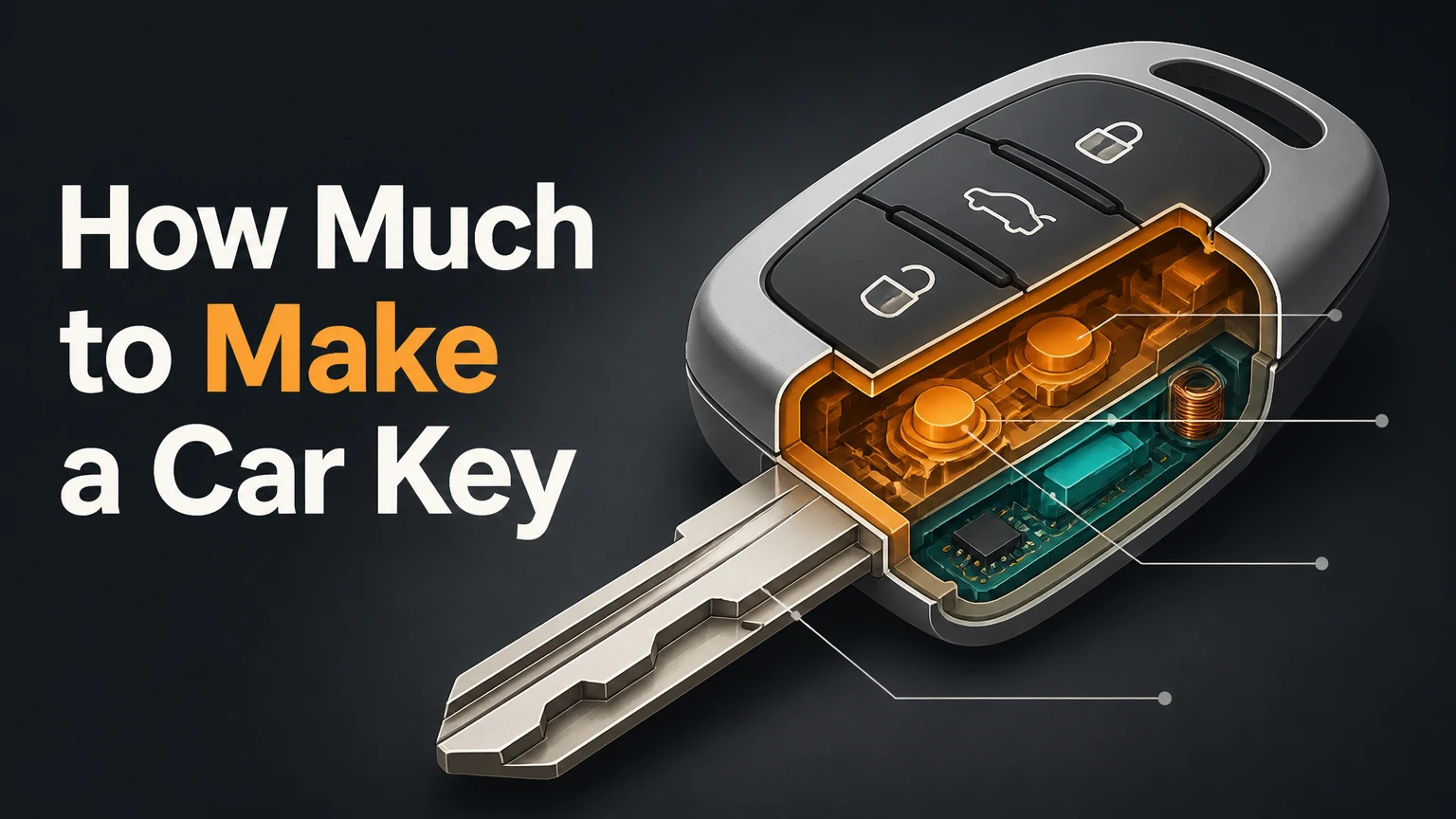
A mechanical key uses grooves or milled tracks that match the door and ignition cylinders. A transponder key adds a passive chip, usually inside the plastic head, that communicates with the immobilizer near the ignition. A remote fob adds buttons for locking, unlocking, trunk release, or panic functions, but those buttons and the engine-start authorization may use separate systems.
A proximity key normally contains a low-frequency detection circuit, a radio transmitter, a transponder function, and a physical emergency blade. Push-button ignition does not mean the vehicle can start without electronic authorization. Some vehicles provide a backup start position for a dead fob battery, but the exact procedure is manufacturer-specific.
Does every car key need programming?
No. A solid metal key for a vehicle without an electronic immobilizer normally needs only accurate duplication. Keys with transponder chips, remote controls, or proximity functions usually require programming, although some older models allow an owner to add a duplicate through a documented ignition or onboard sequence.
The 2000s brought immobilizers into many mainstream vehicles, and model-year boundaries vary by manufacturer and market. A parts counter, locksmith, or owner’s manual can confirm whether a specific VIN requires programming. Remote lock-button pairing is also separate on some vehicles, so a key may start the engine while its buttons remain inactive.
Which Key Type Is Cheapest to Make?
A plain mechanical key is the cheapest option, usually costing $10-$30 for a duplicate and $50-$150 when a locksmith must originate the cut without an existing key. The cheapest compatible option is not always the lowest-risk option because an incorrect transponder or remote can make a low-cost online purchase unusable.
| Replacement situation | Typical parts cost | Programming or cutting cost | Typical total |
|---|---|---|---|
| Working mechanical key copied | $5-$15 | $5-$20 | $10-$30 |
| Working transponder key duplicated | $25-$80 | $50-$150 | $75-$230 |
| Aftermarket remote-head key | $40-$150 | $75-$175 | $115-$325 |
| Aftermarket proximity fob | $80-$250 | $100-$300 | $180-$550 |
| OEM proximity fob | $180-$500 | $100-$300 | $280-$800+ |
A working original usually lowers the cost because the technician can duplicate its blade and, on some systems, add a new key without recovering access through a locked security module. The vehicle may also require fewer diagnostic steps when at least one authorized key remains.
How much is a duplicate car key with a working spare?
A duplicate car key commonly costs $50-$250 when one working key is available. Mechanical copies can cost less than $30, while transponder and smart-key duplicates require a compatible blank or fob plus programming labor.
Ask the provider whether the quote covers the complete duplicate or only cutting. Some vehicles require two recognized keys before owner-added programming works, and newer vehicles may require a diagnostic tool even when the original key is present. Making a spare before the last key fails is usually cheaper than an all-keys-lost call.
Is a Locksmith or Dealership Cheaper?
An automotive locksmith is usually cheaper and faster for standard domestic, Asian, and many European vehicles, while a dealership is more predictable for restricted systems, uncommon keys, and vehicles requiring factory server authorization. The best choice depends on security architecture, not only the advertised price.
| Decision factor | Mobile automotive locksmith | Dealership service department | Online DIY route |
|---|---|---|---|
| Typical total for transponder key | $100-$250 | $200-$400 | $40-$180 before labor |
| Typical total for smart key | $250-$600 | $400-$800+ | $100-$400 before programming |
| Vehicle access | On-site | Usually requires vehicle delivery | Owner handles access |
| Parts choice | OEM or aftermarket | Mostly OEM | Mostly aftermarket |
| Programming capability | Many mainstream systems | Manufacturer-authorized systems | Only supported procedures |
| Emergency availability | Same day, often 24/7 | Business hours, appointment-based | No immediate service |
| Main risk | Variable skill and quote quality | Higher cost and towing | Wrong part or failed programming |
A locksmith should be able to explain the key’s part number, programming requirement, total price, ownership verification, and warranty before beginning. Dealer service is often necessary when a manufacturer restricts security access to its own network or when a replacement fob must be ordered from a VIN-controlled parts system.
Online parts can work for older vehicles with owner-programmable procedures. They are a poor choice when the fob’s FCC ID, frequency, chip type, blade profile, or software generation cannot be verified.
Which provider should you choose?
Choose a mobile automotive locksmith when the vehicle is stranded, the model is supported, and the provider gives a complete written estimate. Choose a dealership when the vehicle uses restricted security software, an OEM-only fob, or a system that local technicians cannot legally or technically access.
For an ordinary Ford, Toyota, Honda, Chevrolet, Hyundai, Kia, Nissan, or Subaru, a reputable locksmith often offers the best balance of price and convenience. For late-model Mercedes-Benz, BMW, Audi, Porsche, Jaguar, Land Rover, and some electric vehicles, confirm capability before authorizing work.
What Is the Replacement Process?
A professional replacement normally takes 20-90 minutes after the technician has the correct key, although an ordered OEM part or a complex all-keys-lost job can take several days. The process combines vehicle identification, physical key production, security registration, and functional testing.
- Verify the vehicle and ownership. The technician records make, model, year, VIN, registration, title, or another accepted ownership document.
- Identify the key system. The technician determines whether the vehicle uses an edge-cut blade, laser or sidewinder profile, transponder, remote-head key, or proximity fob.
- Decode or confirm the blade. A working key may be duplicated; when every key is missing, the lock or manufacturer code may establish the required cut.
- Cut the blade. A code cutter or duplicator creates the physical profile, followed by testing in the driver-door and ignition cylinders where applicable.
- Connect a diagnostic programmer. The tool communicates with the immobilizer through the vehicle’s approved diagnostic interface or another manufacturer-supported method.
- Register the new key. The technician adds the transponder or fob and pairs remote functions when the vehicle requires separate synchronization.
- Test every function. The final check covers starting, locking, unlocking, trunk release, panic operation, proximity detection, and the emergency blade.
Security access is not a universal OBD-II procedure. Some vehicles allow local programming, while others require a PIN, a token, an online account, a manufacturer server, or a time-based security gateway. A competent technician will not promise identical programming steps for every make and model.
Should lost keys be erased from the vehicle?
Yes. If a key was stolen or permanently lost, request an all-keys-lost or key-clearing procedure that removes the missing key from the vehicle’s authorized-key memory. Cutting a replacement without revoking the old credential can leave the stolen key able to unlock or start the vehicle, depending on the system.
Ask whether the provider can confirm the number of keys currently stored after programming. Mechanical door access and electronic engine authorization are separate, so changing a lock cylinder may be necessary when physical theft risk is high.
Can You Make a Car Key Yourself?
You can sometimes cut or program a car key yourself, but DIY works reliably only when the vehicle supports owner programming and the exact replacement part is verified. The most common failures involve an incorrect FCC ID, frequency, transponder type, blade profile, or a fob that resembles the original but uses incompatible electronics.
Before ordering, compare the original fob’s FCC ID, part number, button layout, frequency, chip identification, and blade style with the seller’s compatibility list. Do not rely on photographs. Two visually identical shells may contain different transponders or radio boards.
DIY can be reasonable for a mechanical key or an older vehicle with a published self-programming sequence. It is less suitable for a proximity fob, a vehicle with a security gateway, an all-keys-lost condition, or a replacement requiring EEPROM, PIN, token, or server access. Failed attempts can waste the part cost, but improvised electrical work can also damage an immobilizer module.
What should an online replacement include?
A usable online replacement should identify the exact vehicle application, FCC ID or manufacturer part number, frequency, transponder type, blade profile, and whether the item is new, refurbished, unlocked, or previously paired. The seller should state who performs cutting and programming and whether returns are allowed after cutting.
A replacement shell is different from a complete electronic fob. A shell may solve broken buttons or cracked plastic while retaining the original circuit board and transponder. That is often safer than transferring an unknown aftermarket board into the vehicle.
Can a Key Fob Be Repaired Instead of Replaced?
A key fob can often be repaired when the fault is a depleted battery, damaged shell, worn buttons, or a broken battery contact; a failed circuit board, water damage, or missing transponder usually requires replacement. Repairing the existing electronics can preserve programming and reduce cost.
| Symptom | Likely cause | Typical remedy | Typical cost |
|---|---|---|---|
| Buttons work intermittently | Worn button pad or contact | Shell or button repair | $10-$60 |
| No remote response | Dead coin-cell battery | Correct battery replacement | $5-$20 |
| Shell cracked, vehicle starts | Housing damage | Transfer original electronics | $20-$80 |
| Vehicle starts, buttons fail | Remote-board fault | Board repair or fob replacement | $50-$300 |
| Doors unlock, engine will not start | Missing or unrecognized transponder | Programming or complete key | $100-$600 |
| Proximity functions fail after water exposure | Corroded circuit board | Board diagnosis or replacement | $100-$500 |
Use the battery size specified for the vehicle, often CR2032 or CR2025, rather than assuming the old marking is correct. A dead battery may disable buttons but does not necessarily erase the fob’s stored authorization.
Many push-button vehicles have a backup-start procedure that places the fob against a marked area or directly against the start button. The location differs by model, so the owner’s manual is safer than a generic internet instruction.
What Should You Do When All Keys Are Lost?
When all keys are lost, expect $180-$600 or more from a mobile locksmith and $400-$1,000 or more through a dealer, depending on the vehicle and whether towing or an ordered OEM fob is required. All-keys-lost work costs more because the technician must establish the blade cut, gain security access, and create a new authorized credential.
Prepare the VIN, registration, title or finance documentation, photo identification, exact vehicle location, and information about whether the steering wheel is locked. Tell the provider whether the vehicle has push-button start, a dead battery, aftermarket alarms, or a damaged lock.
A non-destructive vehicle entry is normally preferable to drilling or forced lock damage. Ask for a complete quote that includes travel, entry, key blank, cutting, programming, emergency labor, taxes, and any second-key recommendation.
How can you avoid a locksmith bait-and-switch?
Request a written or texted total estimate before the technician starts, and ask for the business name, physical address, technician identity, credentials, warranty, and payment terms. A very low service-call price that excludes the key and programming is not a meaningful replacement quote.
The Federal Trade Commission advises consumers to verify a locksmith’s identity and local business information before allowing work, because misleading mobile listings and inflated final bills are recurring consumer complaints. A professional should explain any price change before performing additional work, not after the vehicle is opened.
Why Does a Smart Key Cost So Much?
A smart key costs more because it combines a fob, proximity antennas, encrypted communication, immobilizer authorization, remote functions, and specialized programming. The price rises again when the manufacturer requires an OEM part, security token, online authorization, or a dealer-only server connection.
A proximity fob may communicate with several vehicle antennas to determine whether the key is inside the cabin, near a door, or outside the trunk. That system requires more hardware and testing than a single metal blade. Luxury brands may also use rolling codes or cryptographic credentials that cannot be copied like a basic remote.
Electric vehicles still need secure access credentials. Tesla, Rivian, BMW, Mercedes-Benz, Audi, and other EV systems may use phone apps, NFC cards, key cards, digital keys, or conventional fobs, but the replacement process remains manufacturer-specific.
Do not assume every high-end vehicle must go to a dealer. Some qualified locksmiths support selected European systems, but call with the exact year, model, trim, and VIN before relying on that option.
What Are the Most Common Replacement Mistakes?
The most expensive mistakes usually come from treating a car key as one interchangeable object. A replacement must match the mechanical cut, electronic identity, radio behavior, and vehicle security system.
- Ordering by appearance: Match the FCC ID, part number, frequency, chip, and vehicle application instead of comparing the plastic shape.
- Confusing a shell with a fob: A shell contains no working electronics unless the original circuit board is transferred.
- Ignoring programming: Cutting a transponder blade does not authorize engine starting.
- Failing to clear stolen keys: Ask for key-memory deletion when a missing key may be misused.
- Accepting an incomplete quote: Confirm parts, labor, programming, travel, emergency fees, taxes, and warranty.
- Using the wrong battery: Verify the specified coin-cell type and polarity.
- Disconnecting the vehicle battery to fix programming: Battery removal does not reliably reset an immobilizer and can create radio, window, alarm, or module problems.
A newly cut blade that will not turn should not be forced. Check whether the steering lock is loaded, test the duplicate in the door cylinder, and have the cut verified; lubricant cannot correct an incorrect key profile or a worn ignition cylinder.
How Can You Lower the Cost?
The lowest-risk savings usually come from making a spare while the original still works, comparing two complete quotes, and using an aftermarket part only when compatibility and warranty are clear. Cutting the price by buying an unverified fob can create a second bill for diagnosis or replacement.
Use this decision sequence:
- Identify the key type, not merely the vehicle brand.
- Check whether the current key starts the vehicle.
- Ask for the complete locksmith and dealer totals.
- Confirm OEM versus aftermarket equipment.
- Verify programming capability for the exact year and trim.
- Request key erasure when a key is stolen or missing.
- Check roadside assistance, insurance, warranty, fleet, or lease coverage.
Roadside plans may cover lockout entry or towing but exclude the replacement key itself. Insurance policies vary, and a deductible can make a low-cost mechanical duplicate uneconomical to claim.
Frequently Asked Questions
How long does it take to make a car key?
A mechanical duplicate may take 5-20 minutes, while a transponder key usually takes 20-45 minutes and a proximity fob commonly takes 30-90 minutes. Dealer orders can add one or more business days when the correct OEM key is not in stock. All-keys-lost jobs take longer when security authorization or lock decoding is required.
Can AutoZone or a hardware store program a car key?
Some retailers cut mechanical keys and support selected remote or transponder products, but coverage varies by vehicle. A store may not perform immobilizer programming for a specific model even when it sells a compatible-looking blank. Confirm the complete service, not only the cutting price, before purchasing.
Can I drive with a key that only unlocks the doors?
Usually, no. A mechanical blade may unlock the doors while an unprogrammed transponder prevents the engine from starting. Some older vehicles use no immobilizer, but modern cars commonly separate door access from engine authorization, so successful unlocking does not prove the key is fully functional.
Does a VIN provide the key code?
A VIN can help an authorized provider identify a factory key specification or retrieve a cut code, but access rules differ by manufacturer and country. The VIN does not automatically program a fob, and providers normally require proof of ownership before releasing security-related information.
Is an aftermarket car key safe to use?
An aftermarket key can work safely when its part number, frequency, transponder, blade profile, and programming compatibility match the vehicle. OEM keys offer more predictable fit and support, while aftermarket products vary in battery life, button quality, water resistance, and warranty. Keep the original key until the replacement passes every test.
Should I make a spare before losing my last key?
Yes. A spare made while one authorized key works generally costs less than an all-keys-lost replacement and avoids emergency travel or towing charges. For many vehicles, keeping two working keys also preserves owner-programming options that disappear when the last key is lost.
The Bottom Line
How much to make a car key depends primarily on whether the vehicle needs a metal duplicate, a transponder credential, or a proximity smart fob. Budget $10-$30 for a simple mechanical copy, $100-$350 for many transponder or remote keys, and $250-$600 or more for smart keys, with dealerships and luxury systems often costing more.
Get a complete quote that includes the blank, cutting, programming, travel, taxes, and warranty. Verify compatibility by part number and FCC ID, erase stolen keys from vehicle memory, and make a spare while the current key still works.