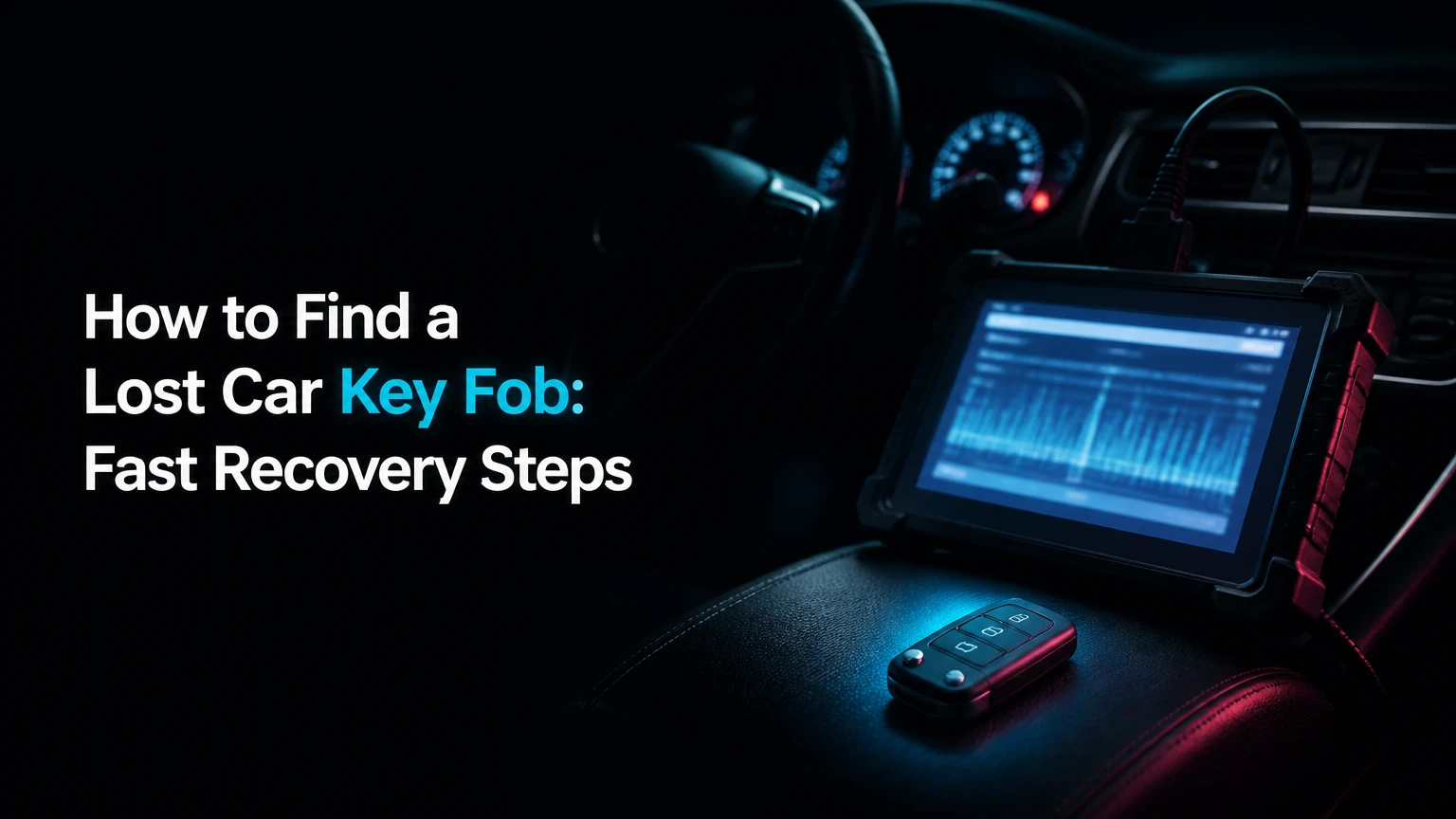
To find a lost car key fob, retrace the last route where you used it, search transitional drop zones, inspect the vehicle cabin and trunk, and test the vehicle’s proximity system. A disciplined 20-30 minute search usually beats random checking; if the fob remains missing, verify the exact vehicle configuration before contacting a mobile automotive locksmith or dealership.
Key Facts at a Glance
A systematic car key fob search should begin with the last confirmed use and move outward through connected locations.
Push-button ignition detection distance varies by vehicle, so a successful start does not prove the fob is exactly 3 feet away.
An AirTag, Tile, or Samsung SmartTag can locate a key ring only if the tracker was attached and has battery power.
A dead fob battery may still allow emergency starting through the vehicle’s passive transponder procedure.
Typical U.S. replacement costs range from about $80 for some older basic remotes to more than $600 for proprietary smart keys.
A stolen fob should be treated as a vehicle-security issue, not merely a misplaced object.
What Should You Do First?
The first action is containment: stop driving, stop moving bags and clothing between rooms, and write down the last moment when the car key fob was definitely in your hand. A short pause prevents the most common search error, which is contaminating the trail by carrying the same jacket, backpack, or groceries through several new locations.
Record the vehicle’s current state. Note whether the car is locked, whether the engine was recently running, where you parked, and which clothes or bags you used. If the vehicle is in an unsafe location, move yourself to safety before beginning a roadside search.
Before You Start
| Requirement | Typical value | Why it matters |
|---|---|---|
| Search time | 20-30 minutes | Covers the primary route and major drop zones |
| People needed | 1 searcher, 2 for a large property | Prevents duplicated areas |
| Useful tools | Phone, flashlight, laundry basket, spare key | Organizes and illuminates the search |
| Replacement budget | $80-$600+ | Covers basic remotes through proprietary smart keys |
| Vehicle information | Year, make, model, VIN, FCC ID | Prevents buying an incompatible fob |
How a Car Key Fob Can Be Found Efficiently
A car key fob is easiest to find when the search follows time and movement rather than room names. Search the last confirmed location first, then inspect every transition where the fob could have left a pocket, hand, cup holder, bag, or surface.
Modern key fobs normally combine several functions. Remote buttons transmit a short-range radio signal, while an immobilizer transponder identifies the key to the vehicle; a proximity fob may also communicate with antennas inside the cabin and around the doors. These systems explain why a fob can unlock doors, fail to operate remotely because of a weak battery, and still start the vehicle through a passive backup process.
The exact radio frequency, antenna arrangement, and programming method depend on the manufacturer and model year. Ford, Toyota, Honda, Hyundai, BMW, Mercedes-Benz, and other manufacturers do not use one universal replacement procedure.
Step 1: Reconstruct the Last Confirmed Route
Walk backward from the last moment you remember using the car key fob. Mark each place where you opened a door, paid for something, carried groceries, changed clothes, sat down, or placed your phone and wallet.
Search transitions before destinations. Driveways, doorways, elevator lobbies, stair landings, parking spaces, checkout counters, and the area beside a child’s car seat receive more accidental drops than the center of a room.
Use your phone’s location history, recent photographs, calendar appointments, delivery records, and payment notifications to rebuild the route. Contact businesses or building managers promptly if the route includes a store, office, gym, school, restaurant, or rideshare vehicle.
You’ll know this step worked when: you have a dated route with every stop and transition listed.
Common mistake: searching the most likely room before confirming where the fob was last seen.
Step 2: Search the Ground and Transitional Zones
Search the walking route at eye level and ground level, using a flashlight even during daylight. A fob under a vehicle, hedge, porch step, or dark floor can disappear from normal standing height.
Check cracks in pavement, drainage channels, grass edges, vehicle wheel paths, and the space beneath benches. Look inside open trash or recycling containers only when safe, and check delivery bags, shopping baskets, reusable grocery bags, and packages handled during the same trip.
A fob dropped outdoors may be damaged by water, road grit, or impact even when the casing looks intact. Do not repeatedly press buttons on a wet fob because moisture can bridge contacts inside the housing.
You’ll know this step worked when: each route segment has been searched once from both standing and low angles.
Common mistake: walking the route quickly without stopping at places where both hands were occupied.
Step 3: Search the Vehicle Cabin, Trunk, and Exterior
Search the driver’s seat gap, passenger seat gap, seat rails, floor mats, center console, door pockets, glove compartment, cup holders, and under the pedals without entering an unsafe roadway. Then inspect the trunk, cargo wells, spare-tire compartment, luggage, and child-seat area.
Remove floor mats and move the front seats through their full travel. Key fobs commonly slide beneath a seat rail or into the narrow gap between a seat and the center console, where a casual visual check cannot see them.
Inspect the ground around all four tires and the area beneath the bumpers. If the fob may have fallen near a parked vehicle, use a flashlight and do not place your body under a vehicle supported only by a jack.
You’ll know this step worked when: every compartment has been opened and every seat has moved.
Common mistake: checking only the ignition area or cup holder because the fob was used there previously.
Step 4: Test Push-Button Proximity Correctly
If the vehicle has push-button ignition, sit in the driver’s seat with all doors closed and follow the normal starting procedure. A successful start indicates that the vehicle recognized an authorized fob or an enrolled digital key within its detection zone, but the zone is model-specific and is not reliably limited to 3 feet.
If the dashboard displays “Key not detected,” try the manufacturer’s backup starting position described in the owner’s manual. Common locations include holding the fob against the start button, placing it in a marked console pocket, or positioning it near a steering-column antenna.
A successful start does not locate the fob by itself. The fob may be in the cabin, trunk, a nearby bag, or close enough to an exterior antenna for the vehicle to detect it.
You’ll know this step worked when: the vehicle either starts normally or produces a documented key-detection message.
Common mistake: assuming a failed start proves the fob is absent; a weak battery, interference, vehicle battery problem, or incorrect procedure can produce the same message.
Step 5: Search Household Drop Zones Systematically
Empty every pocket from the clothes worn during the last trip, including coats, work uniforms, gym clothing, and laundry hampers. Check bags completely by removing their contents rather than feeling only the top layer.
Inspect sofa cushions, recliners, blankets, bedside tables, kitchen counters, charging stations, bathroom shelves, desk drawers, and the floor beneath low furniture. Search near pet beds, children’s toy bins, and laundry appliances if the fob was carried while doing chores.
Place checked items in one container. This physical separation prevents a second searcher from repeating the same pockets and makes it obvious which areas remain unexamined.
You’ll know this step worked when: every garment and bag from the last trip has been emptied and moved to a checked area.
Common mistake: checking the current jacket while forgetting yesterday’s jacket or a bag used only briefly.
Can a Tracker or Signal Blocker Find the Fob?
A Bluetooth tracker can find a car key fob only when the tracker was attached before the loss; a signal blocker cannot reveal the fob’s location. AirTag, Tile, and Samsung SmartTag devices report their own location through Bluetooth networks, while a car fob’s radio signal is not normally exposed through a phone application.
Open the tracker’s app and check its last known location, battery status, and time stamp. If the tracker is nearby, use its sound function, walk slowly through likely areas, and account for walls, metal cabinets, appliances, and vehicle bodies that reduce Bluetooth range.
A signal-blocking pouch or box is useful for security testing, not ordinary recovery. Placing a suspected fob inside one can show whether a vehicle’s passive entry stops responding, but the test can confuse diagnosis and does not measure distance.
Search Technology Limits
| Tool | Typical range or limit | Best use | Important failure |
|---|---|---|---|
| Apple AirTag | Bluetooth nearby; network location when detected | Finding a tagged key ring | No location if untagged or battery is depleted |
| Tile tracker | Bluetooth range varies by model and obstruction | Nearby sound and last location | Phone must support the Tile app and Bluetooth |
| Samsung SmartTag | Bluetooth nearby; Galaxy network features vary | Samsung phone households | Limited usefulness outside supported networks |
| RF signal detector | Model-dependent, often short range | Detecting active transmissions | Cannot identify the correct fob or passive chip |
| Signal-blocking pouch | Blocks radio communication | Theft-risk checks | Does not locate a missing fob |
What If You Find the Fob but It Does Not Work?
Replace the coin-cell battery with the exact type listed in the owner’s manual or printed inside the fob. Keep the battery orientation correct, inspect the contacts for corrosion, and test lock, unlock, panic, and trunk functions beside the vehicle.
A weak fob battery usually affects remote range before it causes complete failure. A damaged case, broken button membrane, water intrusion, desynchronization, or failed circuit board requires a different repair than a battery replacement.
Do not assume a replacement battery erased programming. Most vehicles retain the fob’s pairing, although some models require a resynchronization sequence after battery replacement.
Dead Fob Versus Lost Fob
| Symptom | Likely cause | Safe next action | Avoid |
|---|---|---|---|
| Range dropped gradually | Weak coin-cell battery | Install the specified battery | Using a different voltage |
| Buttons feel loose | Damaged switch or case | Inspect housing and contacts | Flooding the case with cleaner |
| Vehicle says key not detected | Dead battery or interference | Use the manual’s backup position | Repeatedly forcing the start button |
| Unlock works, start fails | Immobilizer or vehicle fault | Check manual and dashboard codes | Assuming remote buttons prove authorization |
| No light or response after water exposure | Moisture damage | Remove battery and seek repair | Heating the fob with high heat |
Which Replacement Option Should You Choose?
A mobile automotive locksmith is usually the fastest and least expensive option for a standard transponder key, remote-head key, or common proximity fob. A dealership is the safer choice when the manufacturer restricts programming, the vehicle is under warranty or lease, or all keys have been lost and security reauthorization is required.
Before authorizing work, ask whether the quoted price includes the fob, mechanical blade, cutting, programming, travel, diagnostic fee, emergency service, and tax. Confirm that the provider will test the new key and explain whether the missing fob can be deleted from the vehicle’s authorized-key list.
Replacement Options Compared
| Option | Typical U.S. price | Typical time | Best fit |
|---|---|---|---|
| Mobile automotive locksmith | $150-$350 | 30-90 minutes | Common vehicle, stranded owner |
| Dealership replacement | $250-$600+ | 1-5 business days | OEM or restricted programming |
| Online aftermarket fob | $30-$120 | 2-5 days shipping | Older, well-documented vehicle |
| Used OEM fob | $40-$180 before programming | 1-3 days shipping | Supported models with reusable units |
| Towing plus dealership | $350-$900+ total | 1-5 business days | Vehicle cannot be serviced roadside |
These are typical practitioner ranges, not guaranteed prices. Luxury vehicles, immobilizer resets, missing all keys, emergency travel, regional labor rates, and scarce parts can push the total above $600.
What Information Does the Technician Need?
Provide the vehicle identification number, year, make, model, trim, current location, and whether any working key remains. A locksmith may also request registration, title, driver’s license, or other ownership evidence before cutting or programming a key.
Compare the fob’s FCC ID, part number, frequency, button arrangement, blade style, and board compatibility before purchasing online. A visually identical shell can contain a different circuit board or operate at a frequency unsupported by the vehicle.
What Are the Main Fob Types?
A basic remote fob controls locks but may have no engine-start transponder. A transponder key or remote-head key combines a metal blade with an immobilizer chip, while a switchblade key folds the blade into its electronic housing.
A smart or proximity fob allows passive unlock and push-button starting through interior and exterior antennas. Programming requirements differ sharply among these types, so the physical appearance alone cannot establish compatibility.
Fob Type and Replacement Requirements
| Fob type | Physical feature | Programming need | Common replacement issue |
|---|---|---|---|
| Basic remote | Plastic remote with separate metal key | Remote pairing on some models | Wrong FCC ID or frequency |
| Transponder key | Metal blade with coded chip | Immobilizer registration | Key cuts but engine remains disabled |
| Remote-head key | Buttons molded into key head | Blade cutting plus coding | Laser-cut blade may require special equipment |
| Switchblade key | Folding metal blade | Blade cutting plus immobilizer coding | Weak hinge or incorrect housing |
| Proximity smart key | No routine blade use | High-security diagnostic programming | Proprietary authorization or restricted supply |
What If the Fob Is Locked Inside the Car?
Use the manufacturer’s connected-car app only if the vehicle was already enrolled, has cellular service, and the account remains authenticated. A spare key, roadside-assistance service, or licensed automotive locksmith is safer than forcing a window, prying a door frame, or inserting tools around weather seals.
Many proximity fobs include a removable emergency blade. A small release slider or button usually frees the blade, and the driver’s door lock cylinder may sit beneath a removable handle cap. Follow the owner’s manual because forcing the cap can damage painted trim, clips, or the lock cover.
A dead fob battery and a missing fob are different situations. The emergency blade may open the door, but it does not necessarily start a vehicle whose immobilizer requires a recognized transponder.
What If the Fob Was Stolen?
Treat a stolen car key fob as an active security credential. Contact the dealer or a qualified automotive locksmith and ask whether the missing fob can be erased from the vehicle’s authorized-key memory, then notify your insurer if the vehicle or home was exposed.
Change the access code for a connected-car account and remove unknown digital keys from the manufacturer’s application. If the fob was taken with an address, garage opener, registration, or home keys, secure the garage and consider changing the home locks.
Keyless-entry theft can involve relay attacks that extend communication between a vehicle and a nearby fob. The UK’s Police Digital Security Centre recommends storing keyless fobs away from doors and windows; a tested Faraday pouch can reduce passive-entry exposure, but owners should verify that the pouch blocks the fob before relying on it.
Common Search Failures and Their Fixes
- Searching randomly: Divide the route into zones and assign each zone one pass.
- Assuming the car is empty: Remove mats, move seats, open cargo compartments, and inspect seat rails.
- Buying a look-alike fob: Match FCC ID, part number, frequency, vehicle year, and programming support.
- Using a blocker as a locator: Use the tracker app or a professional diagnostic process instead.
- Forcing a hidden door-lock cover: Read the manual or call a locksmith to avoid trim damage.
- Ignoring ownership proof: Keep identification and registration available for legitimate key service.
- Towing an immobilized vehicle incorrectly: Use the owner’s towing instructions, especially for AWD and electric vehicles.
How Should You Handle Different Situations?
If You Are Stranded Away From Home
Move to a safe, well-lit location and call roadside assistance, a mobile locksmith, or the manufacturer’s emergency service. Give the provider the exact parking location and vehicle details before they dispatch, then ask for the complete out-the-door price.
If the Car Is Safely Parked at Home
Perform the full route and household search before ordering a replacement. If the fob is still missing after 30-45 minutes, obtain two replacement quotes and check comprehensive insurance, roadside-assistance benefits, lease coverage, or manufacturer protection plans.
If the Vehicle Is Older
An independent locksmith and a compatible aftermarket fob often provide the lowest total cost. Confirm that the vehicle supports owner programming before buying, because some older remotes pair at home while their transponder keys still require professional equipment.
If the Vehicle Is Luxury, Leased, or Recently Purchased
Start with the manufacturer or an authorized dealer when the vehicle uses proprietary smart keys, subscription-based digital access, or restricted immobilizer programming. An independent locksmith may still help, but verify credentials, warranty implications, and whether the missing key can be disabled.
How Can You Prevent Losing the Next Fob?
Attach a tracker before the next loss, keep a spare fob in a fixed location, and use one designated drop point at home. Apple AirTag, Tile, and Samsung SmartTag can provide useful location history, but each tracker needs its own battery and compatible phone ecosystem.
Store the spare away from the primary fob. Test both keys twice a year, replace weak coin-cell batteries, record the fob’s part number, and photograph the vehicle identification label without publishing the VIN online.
A digital car key can provide a backup for supported vehicles and phones, but it is not a universal substitute. Digital keys depend on prior enrollment, device battery, account access, vehicle compatibility, and sometimes manufacturer subscriptions.
Frequently Asked Questions
Can I find a key fob with the car’s horn or panic button?
Only if the fob is close enough for its button signal to reach the vehicle and the fob still has power. Pressing the panic button from random locations rarely helps because walls, metal vehicles, and low battery voltage reduce range. A previously attached Bluetooth tracker provides a more useful locating method.
Can I program a replacement fob myself?
Some vehicles permit owner programming when one working key remains and the owner’s manual documents the procedure. Many modern vehicles require an immobilizer-capable scan tool, security credentials, or dealer authorization, so an online fob can remain unusable even when its buttons match the original.
Does a key fob work after its battery dies?
The remote buttons may stop working, but many smart fobs retain a passive transponder that can authorize emergency starting. The required position varies by vehicle. Consult the manual rather than assuming every car starts by pressing the dead fob against the start button.
Will insurance pay for a lost car key fob?
Coverage depends on the policy, deductible, roadside plan, and reason for the loss. Some comprehensive policies or premium roadside programs cover locksmith service, towing, or key replacement, while ordinary liability coverage generally does not. Ask the insurer whether programming and a second key are included.
Should I buy an aftermarket or used OEM fob?
Choose an aftermarket or used OEM fob only when the exact part number, FCC ID, frequency, board, and programming method are confirmed. A new OEM fob costs more, but it reduces compatibility uncertainty for newer vehicles, restricted systems, and leased cars.
The Bottom Line
To find a lost car key fob, retrace the last confirmed route, inspect transitions, search the vehicle in detail, test push-button proximity, and empty household drop zones in a controlled order. If recovery fails, compare a mobile locksmith with the dealership using the vehicle’s year, fob type, programming restrictions, and total quoted cost. Secure or deauthorize the missing fob when theft is possible, then add a tracker and keep a tested spare.