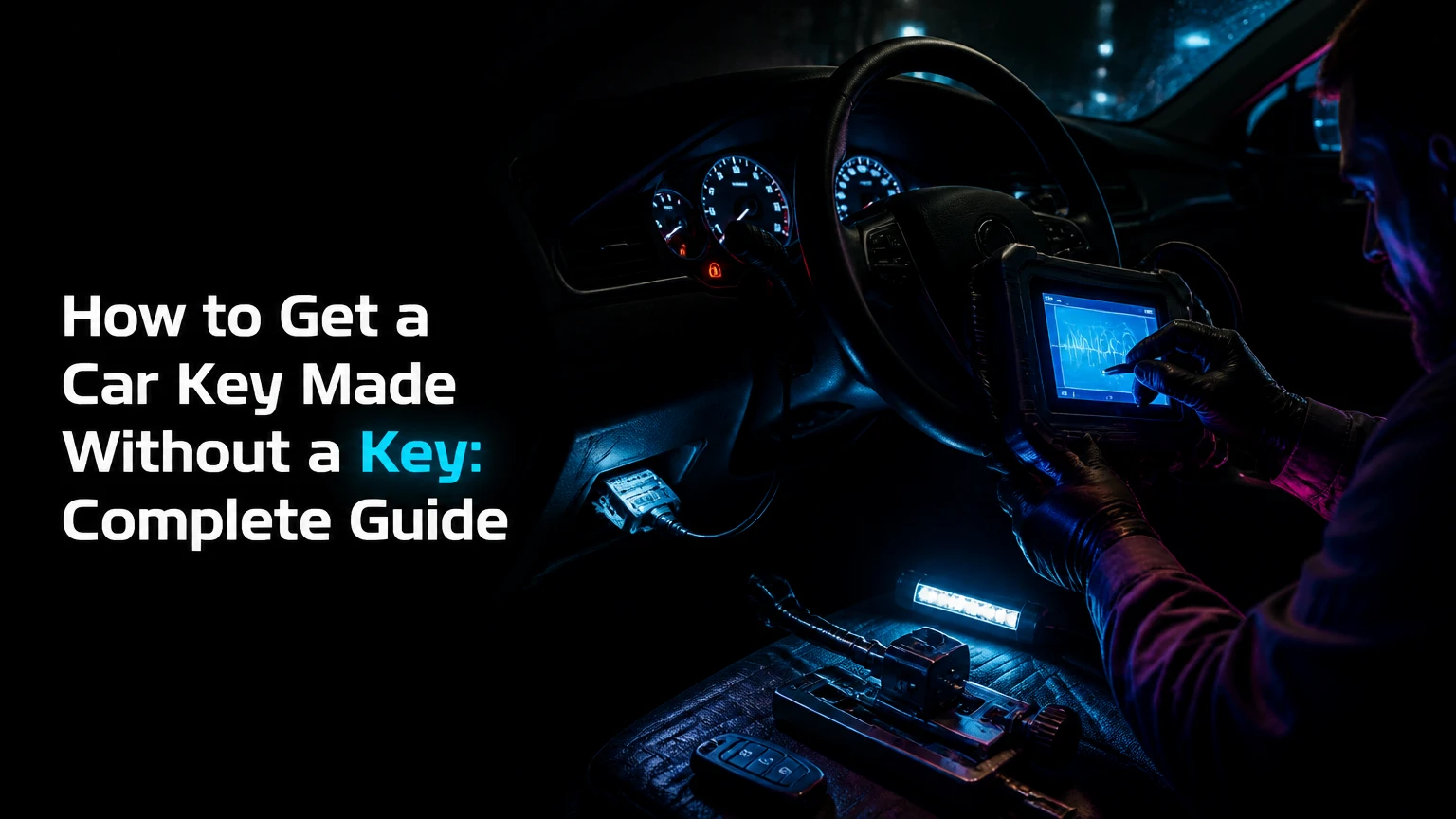
A car key can be made without the original by a qualified automotive locksmith or vehicle dealership using the vehicle identification number, lock-cylinder information, and manufacturer-specific programming equipment. A mechanical key may take 10-30 minutes, while a transponder key or smart fob commonly takes 20-60 minutes, provided the correct part and security credentials are available.
Key Facts
A 17-character VIN identifies the vehicle, but it does not guarantee that a key code can be cut from the VIN alone.
A metal key can unlock and turn a lock without programming; a transponder or smart key usually requires immobilizer registration.
A mobile automotive locksmith often avoids towing and can cut and program keys at the vehicle’s location.
Typical 2026 U.S. replacement costs range from $50-$100 for a basic metal key to $250-$600 or more for a proximity fob.
Proof of ownership normally includes a government-issued photo ID plus matching registration, title, or insurance documentation.
Erasing a lost key from vehicle memory is model-specific and should be confirmed rather than assumed.
How to Get a Car Key Made Without a Key
A replacement provider creates a new key through key origination, not ordinary duplication. The technician identifies the vehicle, determines the mechanical cut through a manufacturer key code or lock decoding, supplies the correct blank or fob, and programs the immobilizer when the vehicle uses electronic security.
The process works because a vehicle contains more identifying information than the missing key. The VIN establishes year, make, model, and production configuration, while the door, trunk, or ignition cylinder can reveal the physical bitting when database information is unavailable. Electronic programming then links the replacement transponder or proximity fob to the immobilizer system.
The VIN is not a universal magic code. Some manufacturers restrict key-code access, some databases return incomplete information, and a replacement ignition cylinder may no longer match the original factory configuration. A reputable technician verifies the cut at the vehicle instead of promising that every VIN produces a usable key.
What Information Should You Gather First?
Gather the VIN, exact vehicle configuration, ownership documents, key type, and vehicle location before requesting a quote. A provider can usually determine equipment compatibility from the VIN, but the technician still needs to know whether the vehicle has a conventional ignition, transponder, remote-head key, or push-button start.
Step 1: Record the Vehicle Details
Write down the following information:
- VIN: The VIN is usually visible through the lower driver-side windshield and printed on registration or title documents. In the United States, a standard VIN contains 17 characters. Copy every letter and number carefully.
- Year, make, model, and trim: A 2018 Toyota RAV4 LE may use a different fob or programming procedure from a 2018 RAV4 XLE.
- Ignition style: Record whether the vehicle uses a metal key in an ignition cylinder or a Start/Stop button.
- Vehicle location: A mobile provider needs the street address, parking restrictions, and whether the car is accessible.
- Ownership evidence: Prepare a driver’s license or other photo ID, registration, title, or insurance record showing your relationship to the vehicle.
Success checkpoint: The provider repeats your VIN and vehicle configuration correctly and gives a quote that identifies cutting, programming, parts, service-call, and tax charges.
Common mistake: Sending only “2015 Honda” produces an unreliable quote because key frequency, blade profile, trim, and immobilizer system can vary within one model year.
Step 2: Choose a Qualified Provider
Call two or three automotive locksmiths and the dealership parts department. Ask whether the provider performs all-keys-lost service for your exact vehicle, whether the quoted price includes programming, and whether the replacement is original-equipment or aftermarket.
Ask these questions before authorizing work:
- What is the complete estimated price, including travel, cutting, programming, and tax?
- Can the technician work at the vehicle’s current location?
- Which key or fob part number and FCC ID will be used?
- Is a working mechanical blade included with the smart fob?
- Will the vehicle require a dealer-only security credential or online connection?
- What warranty covers a defective part or failed programming?
- What documents must be shown on arrival?
Success checkpoint: You receive a written or texted estimate with a total range and a statement of what happens if the first programming attempt fails.
Common mistake: Choosing the lowest advertised callout price without asking about the final programmed-key cost.
How Is a Key Cut Without the Original?
A technician can cut a replacement blade from an authorized key code or decode a compatible lock cylinder. The key code specifies the depth and position of cuts, while physical decoding reads the internal wafers or pins when the factory code is unavailable or no longer matches the car.
Manufacturer Key Code
Some locksmiths and dealers can retrieve a key code from a restricted manufacturer or professional database after verifying ownership. The code drives a code-cutting machine that produces the blade pattern for a particular lock configuration.
VIN-based cutting works best when the vehicle still has its original locks. It can fail after an ignition replacement, door-lock repair, theft recovery, or undocumented modification. A code may also describe a door key while the ignition uses a different cylinder.
Lock Decoding
A trained automotive locksmith may decode the door, trunk, or ignition cylinder with specialist equipment. The procedure is vehicle-specific and should be performed by a professional because removing or manipulating a lock can damage wafers, retainers, trim, or the cylinder housing.
Some older cars can also be impressioned or manually fitted, but success depends on the lock design and cylinder condition. A worn lock may produce an inaccurate reading, so a replacement cut might unlock the door yet bind in the ignition.
Success checkpoint: The finished blade turns the relevant lock smoothly in both directions and does not require force.
Common mistake: Assuming a blade that unlocks the door must also operate the ignition. Separate cylinders or previous repairs can create different key patterns.
Which Car Key Type Does the Vehicle Need?
The required replacement depends on the vehicle’s mechanical lock and immobilizer architecture, not on the key’s appearance alone. A key that looks like a simple plastic-headed blade may still contain a transponder chip, while a proximity fob may contain a hidden emergency blade.
| Key type | Typical vehicle feature | Programming requirement | Typical 2026 U.S. cost |
|---|---|---|---|
| Basic metal key | Older vehicle, no immobilizer | None | $50-$100 |
| Transponder key | Turn-key ignition with chip | Immobilizer registration | $120-$250 |
| Laser-track key | High-security sidewinder blade | Cutting and immobilizer programming | $175-$300 |
| Remote-head key | Blade plus lock/unlock buttons | Remote and often immobilizer programming | $200-$400 |
| Proximity smart fob | Push-button start | Smart-key registration | $250-$600+ |
Basic Metal Keys
Older vehicles may use an all-metal key with edge cuts and no electronic chip. A hardware store can sometimes duplicate this type, but a locksmith remains preferable when the original is missing because the replacement must be originated from a code or lock.
Transponder Keys
A transponder key contains a passive RFID chip that communicates with the vehicle’s immobilizer. The engine may crank but fail to run when the blade is correctly cut and the chip is not registered.
Laser-Track and Sidewinder Keys
“Laser-cut” commonly describes a blade with a routed track rather than conventional edge notches. The term does not mean that every blade is actually cut by a laser. High-security machines and the correct blank are required, and some vehicles combine this blade with a transponder.
Remote-Head Keys
A remote-head key combines a physical blade, buttons, a battery, and frequently a transponder. Remote locking and engine authorization can be separate functions, so a key may lock the doors while remaining unable to start the vehicle.
Smart and Proximity Fobs
A proximity fob authorizes starting when the fob is inside the cabin or placed at a designated backup location. The fob usually includes an emergency blade for unlocking the driver’s door, but that blade alone cannot replace the electronic starting function.
How Does Electronic Key Programming Work?
Electronic programming registers the replacement transponder or smart fob with the vehicle’s immobilizer and body-control systems. A technician connects approved diagnostic equipment, follows the manufacturer’s security procedure, and verifies starting, locking, remote functions, and emergency operation.
The OBD-II port provides the diagnostic connection on many modern vehicles, but the port alone does not bypass security. Some systems require a PIN, timed access procedure, manufacturer server authorization, or an existing programmed key. Other vehicles use proprietary gateways that limit independent diagnostic access.
A successful programming session may add one key, learn several keys, or perform an all-keys-lost procedure. The available options vary by manufacturer, model year, immobilizer generation, and software version. “Delete the old key” is therefore not a universal feature.
Success checkpoint: The vehicle starts normally, the security indicator behaves as expected, every remote button works, and the technician demonstrates the emergency blade.
Common mistake: Testing only the door buttons. Remote operation does not prove that the immobilizer recognizes the key.
How Much Does a Replacement Key Cost?
A typical 2026 U.S. replacement costs $50-$600 or more, with the key type, vehicle brand, programming method, provider, and urgency determining the final price. Luxury brands, imported vehicles, encrypted smart keys, towing, and expedited parts shipping can raise the total above $900.
| Situation | Mobile locksmith typical total | Dealer typical total | Typical completion |
|---|---|---|---|
| Older metal key | $50-$100 | $80-$180 | 10-30 minutes |
| Transponder key, common model | $120-$250 | $200-$450 | 20-60 minutes |
| Remote-head key | $200-$400 | $300-$600 | 30-90 minutes |
| Push-button smart fob | $250-$600+ | $400-$900+ | 45 minutes to 5 days |
| European encrypted system | $400-$900+ | $500-$1,200+ | 1-5 business days |
These are typical planning ranges, not guaranteed prices. A quote can change when the vehicle needs a second blade, a new battery, a failed aftermarket part, a security-code fee, a tow, or a replacement lock cylinder.
Can Insurance or Roadside Assistance Pay?
Roadside memberships sometimes cover lockout assistance but exclude the cost of a replacement key. Comprehensive auto insurance, rental policies, and dedicated key-cover products may reimburse lost or stolen keys after a deductible, subject to policy limits.
Check the policy before authorizing work. Request an itemized invoice, proof of payment, and documentation showing whether the key was lost or stolen.
Which Provider Should You Use?
A mobile automotive locksmith is usually the most practical first call for a common vehicle at home, work, or a roadside location. A dealership is the safer route when the vehicle needs proprietary credentials, a factory-ordered smart key, or a security procedure unavailable to independent technicians.
| Provider | Mobile access | Common completion time | Best use case | Main limitation |
|---|---|---|---|---|
| Automotive locksmith | Yes | 20-90 minutes | Common cars and urgent all-keys-lost jobs | Equipment coverage varies |
| Dealership | Usually no | Same day to 5 days | Proprietary or factory-only systems | Tow and higher labor cost |
| Online parts seller | No | 2-7 shipping days | Pre-purchasing a verified fob | Cutting and programming remain |
| Roadside membership | Yes for lockout | 30-120 minutes | Immediate access or towing | Replacement key may be excluded |
Mobile Locksmith
A mobile technician brings cutting and programming equipment to the vehicle, which can eliminate a tow. Confirm that the provider has the correct software and blank before the appointment, especially for hybrids, newer models, and European brands.
Dealership
A dealer can order a VIN-matched OEM key and access factory systems, but the vehicle may need to be present for programming. Ask whether the part is in stock and whether all keys must be presented before paying for a tow.
Online Fob Seller
Online purchasing can reduce parts cost when the exact OEM part number, FCC ID, frequency, blade profile, and compatibility are confirmed. It is a poor choice when the vehicle is stranded or the seller cannot guarantee returns for an unprogrammed part.
What Should You Do If the Key Was Stolen?
Treat a stolen key as a vehicle-security incident, not merely a replacement inconvenience. Ask the locksmith or dealer whether the vehicle can erase the missing key, reprogram all remaining keys, change the mechanical lock, or disable remote functions.
The theft response depends on the vehicle. Some systems support all-keys-lost erasure, some retain lost fobs unless a full relearn occurs, and some require dealer software. Ask for the exact result in writing.
If the key was stolen with registration, address information, or a garage opener, move the vehicle to a secure location and report the theft to the relevant authorities and insurer. Replacing only the blade may leave the electronic key authorization unchanged.
What If the Replacement Key Does Not Work?
A replacement that turns the lock but will not start usually has a programming, transponder, immobilizer, or wrong-part problem. A replacement that starts the engine but has nonfunctional buttons usually has a remote pairing, battery, frequency, or body-control issue.
| Symptom | Likely cause | Safe first check | Correct repair path |
|---|---|---|---|
| Blade will not enter lock | Wrong blank or damaged cut | Compare blade profile | Recut or replace blank |
| Blade turns, engine will not run | Unregistered transponder | Check security indicator | Repeat immobilizer programming |
| Buttons work, engine will not start | Fob recognized remotely only | Use vehicle backup-fob position | Program correct immobilizer chip |
| Engine starts, remote buttons fail | Dead battery or remote pairing | Install specified battery | Pair remote or replace fob |
| No response from fob | Wrong frequency or damaged part | Verify FCC ID and battery | Use compatible fob |
| VIN code does not match lock | Replaced cylinder | Test another lock cylinder | Decode the current cylinder |
Do not force a tight blade or repeatedly cycle an unfamiliar programming sequence. Some vehicles can enter a security lockout or consume timed access attempts, increasing the cost of recovery.
What Variations Change the Process?
Vehicle location, key availability, age, and ignition design change the best route. A parked car permits quote comparison, while an occupied roadside situation prioritizes a mobile provider that confirms equipment before dispatch.
If You Are Stranded
Move to a safe, visible location and call roadside assistance or a mobile automotive locksmith. Provide the exact location, VIN, vehicle type, and whether the key is lost, locked inside, broken, or stolen.
Ask whether the technician can make the key on-site. A provider that only offers lockout entry may still require a dealership tow for programming.
If the Car Is at Home
Use the extra time to compare a locksmith and dealer quote, verify the fob part number, and ask for a spare at the same visit. Programming two keys during one session can cost less than a second emergency call, although some vehicles charge per key.
If the Vehicle Has Push-Button Start
Confirm that the replacement includes the correct proximity fob and emergency blade. A dead fob battery may prevent normal detection, but many vehicles provide a backup detection position described in the owner’s manual.
If the Car Is Older or Modified
Tell the provider about replaced doors, ignition cylinders, imported status, salvage history, or previous rekeying. The VIN may describe the original configuration rather than the lock currently installed.
How Can You Avoid Ordering the Wrong Fob?
Match the replacement by exact part number, FCC ID where applicable, frequency, button layout, blade style, immobilizer type, and vehicle compatibility. Appearance alone is insufficient because visually identical fobs can use different frequencies, cryptographic systems, or internal transponders.
Use this ordering checklist:
- Photograph the vehicle information label and record the VIN.
- Compare the old fob shell, if available, with the seller’s part number.
- Check whether the listing includes a transponder chip or only a remote board.
- Confirm whether the blade is included, cut, or sold separately.
- Ask the programmer whether aftermarket parts from that seller are accepted.
- Verify the return policy before the part is cut or programmed.
A cheap shell can be useful when the electronics remain functional. A cheap complete fob is risky when the vehicle requires an encrypted or locked-to-vehicle component.
How Long Does the Whole Process Take?
A common vehicle with a compatible key available locally usually takes 20-60 minutes after the technician arrives. Dealer orders, European vehicles, unavailable parts, failed security authorization, and replacement lock cylinders can extend completion from one business day to five.
| Stage | Typical time | Delay trigger |
|---|---|---|
| Identity and VIN verification | 5-15 minutes | Missing registration or mismatched documents |
| Key identification | 5-20 minutes | Unclear trim or imported vehicle |
| Mechanical cutting | 10-30 minutes | No code or damaged cylinder |
| Electronic programming | 10-45 minutes | Security gateway or all-keys-lost mode |
| Functional testing | 5-15 minutes | Remote or emergency-blade issue |
| Dealer part order | 1-5 business days | Factory stock or encrypted fob |
The fastest path is not always the cheapest. A mobile locksmith can finish a common vehicle in one visit, while an online part may save $100 but add several shipping days and a separate programming charge.
Common Mistakes and How to Fix Them
Paying for a Tow Before Calling a Mobile Locksmith
Many ordinary vehicles can be serviced at their parking location. Call a qualified mobile provider first, but use the dealer when the locksmith confirms that the vehicle requires factory-only programming.
Quoting the Wrong Vehicle Configuration
A model name and year may cover several key systems. Provide trim, ignition type, market, and VIN so the provider can identify the correct part before arrival.
Buying by Appearance
Two fobs can share a case shape while using different FCC IDs or frequencies. Verify the internal part number and programming compatibility.
Omitting Ownership Documents
Professionals should verify authorization before originating a key. If registration and title are unavailable, ask the provider what alternative documentation is accepted.
Forgetting Remote and Emergency Tests
Check starting, locking, unlocking, trunk release, panic function, manual door operation, and backup start detection before the technician leaves.
Assuming Lost-Key Deletion Occurred
Ask whether the vehicle performed a complete relearn, added a key, or merely programmed a new credential. Those outcomes are not equivalent.
Frequently Asked Questions
Can a hardware store make a car key without the original?
A hardware store may cut some basic metal keys from a code or duplicate a supplied key, but it usually cannot originate and program modern transponder keys or proximity fobs. A locksmith or dealer is required when the vehicle’s immobilizer must recognize a new electronic credential.
Can the VIN be used to make any car key?
The VIN can help identify the correct blank, fob, and factory configuration, but the VIN alone does not guarantee a usable key code. Manufacturer database access, ownership verification, lock changes, regional specifications, and security programming determine whether VIN-based origination will work.
Can a car start with a key that only unlocks the doors?
A mechanical blade may unlock the doors without starting the engine when the vehicle has a transponder immobilizer. The vehicle needs both a correctly cut blade and a programmed chip, unless the car uses an older mechanical ignition without electronic authorization.
Is an aftermarket car key safe to use?
A reputable aftermarket key can work when its part number, frequency, chip, and programming method match the vehicle. Unknown parts create failure and return-policy risks, particularly for encrypted proximity systems, so confirm compatibility with the technician before purchase.
Should I make a spare after losing my only key?
Yes, making two programmed keys during the same service is usually more convenient than arranging a second all-keys-lost appointment. Store the spare separately from the primary key and record its part number, battery type, and emergency-blade location.
The Bottom Line
To get a car key made without a key, collect the VIN and ownership documents, identify the ignition and fob type, compare a mobile automotive locksmith with the dealership, and request both cutting and programming when electronic security is present. Expect roughly $50-$600 or more and 20-60 minutes for common vehicles, with dealer orders and encrypted systems taking longer. The exact keyword, how to get a car key made without a key, describes key origination, not ordinary duplication, so verify the final key by starting the vehicle and testing every function before the service call ends.