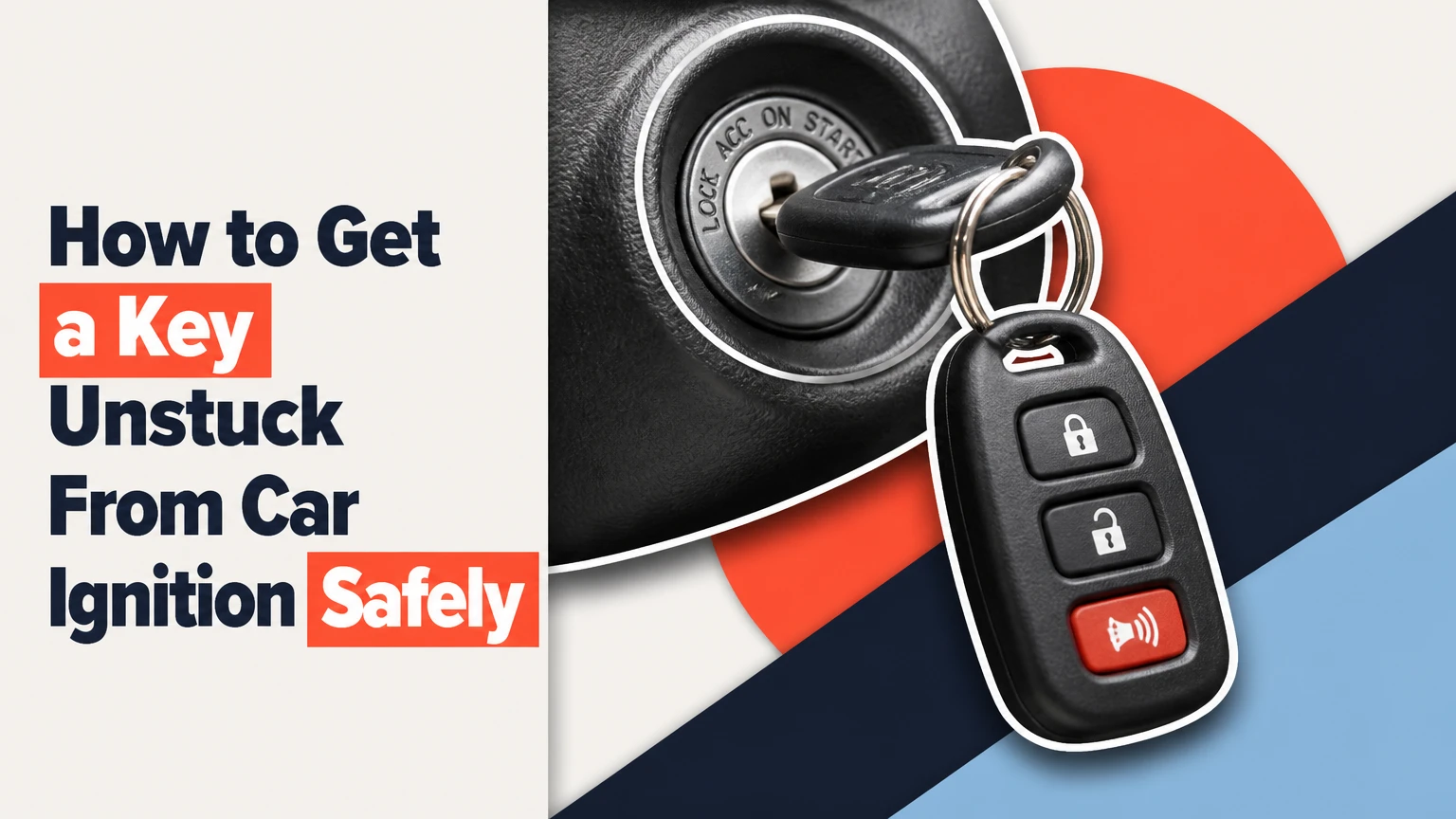
To get a key unstuck from a car ignition, set the parking brake, place the transmission fully in Park, relieve steering-wheel pressure, and gently return the key toward the Lock position while pulling lightly. Stop if the key bends, the cylinder spins freely, or the key will not move after controlled attempts, because those symptoms indicate internal damage.
Key Facts at a Glance
A locked steering wheel can bind the ignition cylinder and prevent the key from turning to Lock.
An automatic vehicle usually releases the key only when the shifter and Park-position interlock agree.
A dead battery can affect electronic release systems, but it does not universally trap a conventional metal key.
Dry PTFE or graphite lock lubricant is safer for a contaminated keyway than penetrating oil or grease.
Pliers and excessive twisting can break a nickel-silver key blade inside the lock cylinder.
A mobile automotive locksmith typically costs about $85-$250, while dealer repairs commonly cost $300-$750.
What mechanism holds the key in the ignition?
A car key remains trapped because the ignition lock cylinder has not reached its permitted removal position, or because the cylinder, steering lock, shifter interlock, or key blade cannot align correctly. The ignition lock is a mechanical pin-tumbler assembly connected to an ignition switch and, on many vehicles, a steering-column lock.
The key’s cut pattern positions spring-loaded pins along the cylinder’s shear line. When the cuts are worn, contaminated, or misaligned, the cylinder core may resist rotation. The transponder chip in a modern key authorizes engine starting, but the chip normally does not physically pull the key from the cylinder.
Automatic vehicles add a separate condition. A shift-lock or key-interlock system may require the selector to register Park before the cylinder can return fully to Lock. Some designs use a cable, microswitch, solenoid, or body-control module. The exact arrangement varies by make, model, year, and ignition design.
Which part is probably causing the resistance?
The symptom usually identifies the subsystem more effectively than the vehicle’s battery condition. A key that turns but will not reach Lock points toward the shifter interlock or a worn cylinder, while a key that will not turn at all often points toward steering-wheel load, a damaged key, or seized tumblers.
| Symptom | More likely cause | First check | Stop point |
|---|---|---|---|
| Key will not turn from Run | Steering-lock load or damaged key | Rock wheel gently while holding light key pressure | Key begins bending |
| Key turns to Accessory but not Lock | Park interlock, cable, or microswitch | Push selector firmly into Park | Shifter indicator disagrees |
| Key reaches Lock but will not withdraw | Cylinder wear or incomplete rotation | Press key inward, then rotate gently | No movement after two attempts |
| Key spins freely through positions | Broken cylinder linkage or tailpiece | Stop turning immediately | Any continued rotation |
| Key is visibly bent or cracked | Damaged blade | Use a spare key if available | Blade starts separating |
| Key is frozen in cold weather | Ice or moisture in keyway | Warm the key and lock area safely | Heat damages nearby trim |
How to get a key unstuck from car ignition step by step
Most uncomplicated cases take 5-20 minutes and require no parts, but success depends on identifying whether steering tension or the Park interlock is preventing the final rotation. Use the following sequence once, carefully, instead of repeatedly increasing force.
Before you start
| Requirement | Typical value | Why it matters |
|---|---|---|
| Time | 5-20 minutes | Allows controlled checks without rushing |
| Difficulty | Low for checks, moderate for extraction | The cylinder can be damaged by leverage |
| Cost | $0-$15 for lubricant | A locksmith may be safer than continued DIY work |
| Tools | Flashlight, spare key, dry lock lubricant | Avoids improvised metal tools |
| Vehicle state | Parking brake applied | Prevents movement during shifter checks |
| Key condition | Unbroken and mostly accessible | Extraction changes if the blade has snapped |
Turn off accessories if possible. Keep the vehicle on level ground, set the parking brake, and keep your foot on the brake pedal while testing an automatic selector. Do not work underneath the dashboard or unplug a restraint-system connector merely to remove a key.
Step 1: Confirm the key’s position
Press the key inward slightly, then rotate it gently toward the Lock or Off marking while applying only light outward tension. Many cylinders require the key to be fully inserted and seated before the release position works.
You will know this step worked when the key rotates cleanly into Lock and slides out with two fingers. The common mistake is pulling outward continuously while trying to rotate, which can tilt the blade against the cylinder pins and increase binding.
If the key is already in Lock but remains captive, continue to the transmission and steering checks. Do not twist the key harder.
Step 2: Relieve steering-wheel tension
Hold the key with light turning pressure toward Lock. With your other hand, move the steering wheel several centimeters left and right, concentrating on the direction that permits movement. The steering lock pawl can press against the column gear when the front wheels are loaded against a curb or parked on an incline.
You will know this step worked when the steering wheel releases slightly and the key turns into Lock. The common mistake is jerking the wheel violently, which can damage column components and does not provide better alignment.
A rigid wheel is not automatically evidence of a failed cylinder. If the wheel has modest movement but the key remains completely fixed, proceed without escalating force.
Step 3: Reseat the transmission selector
For an automatic transmission, press the brake pedal, move the shifter firmly into Park, and verify that the instrument display shows P. If the selector is already in Park, move it through the positions once and return it decisively to Park, keeping the brake applied.
You will know this step worked when the key turns from Accessory or Run into Lock after the selector reaches its actual Park detent. The common mistake is relying on the lever’s apparent position when a stretched cable, obstructed linkage, or misadjusted range sensor leaves the transmission in a different position.
For a manual transmission, confirm that the vehicle is stationary, the parking brake is set, and the key is not being retained by a model-specific clutch or ignition interlock. Manual vehicles generally do not use the same Park-release mechanism found in automatics.
Step 4: Check battery and electronic release conditions
Turn the key to an accessory position only if it moves normally, then check whether the interior lights, instrument panel, or central locking operate. If the battery is completely discharged, a vehicle with an electronically controlled ignition or selector may not release its interlock.
A jump-start can restore voltage, but it is not a universal stuck-key solution. Conventional keyed cylinders often permit mechanical removal without battery power, while some newer systems need a functioning solenoid or body-control module.
You will know this step worked when normal vehicle voltage restores the selector display or an audible release and the key returns to Lock. The common mistake is connecting a jump pack to unknown terminals or assuming a dead battery proves the ignition cylinder is defective.
Follow the vehicle owner’s manual for jump-start polarity. If the battery is swollen, leaking, frozen, or inaccessible, request roadside service instead.
Step 5: Lubricate a dirty or dry keyway
Use a small amount of automotive lock lubricant labeled dry PTFE, dry Teflon, or graphite, following the product instructions. Insert the nozzle at the keyway entrance, apply a brief burst, and work the key in and out gently several times.
You will know this step worked when the key moves more smoothly without requiring additional torque. The common mistake is flooding the cylinder, because excess material can migrate into electrical components or collect debris inside the keyway.
Penetrating oils and general-purpose lubricants are poor first choices for a precision lock. Products such as WD-40 may displace moisture in some situations, but they are not the same as a purpose-made dry lock lubricant and can leave residue that attracts contamination over time.
Step 6: Use micro-movement, not leverage
Push the key inward, apply light rotation toward Lock, and move the blade up and down by only a fraction of a millimeter. Alternate that motion with a gentle outward pull. If the cylinder face is accessible, steady it with a fingertip rather than pushing hard against the surrounding trim.
You will know this step worked when the key advances gradually instead of releasing suddenly under heavy force. The common mistake is using large side-to-side movement, which scrapes the keyway and can shear the blade.
A light tap on the cylinder housing with a plastic tool handle may help a sticking pin settle, but tapping the key itself with a metal object is unsafe. Stop after a few controlled cycles if the resistance does not change.
Step 7: Stop before the key breaks
Use an automotive key extractor only when the key is unbroken, the blade is accessible, and the tool can enter without scraping the cylinder. A hook or spiral extractor is inserted alongside the blade and withdrawn smoothly, not twisted aggressively.
You will know the method is appropriate when the key remains straight and the extractor does not require force to enter. The common mistake is improvising with a knife, paper clip, second key, or screwdriver, because those objects can push the key deeper or damage the pin stack.
A broken blade changes the job. Do not continue pulling on the remaining head, and do not apply superglue to another object inside the lock. Call a locksmith with automotive extraction tools, especially if the broken portion is flush with the cylinder.
Why does the key stay stuck after these checks?
A key remains captive after basic checks when the fault is inside the cylinder, the interlock is misreporting the vehicle position, or the key blade no longer matches the pin stack accurately. The correct repair depends on the key’s exact stopping position, whether the cylinder has normal resistance, and whether the vehicle can recognize Park.
| Additional symptom | Probable fault | Appropriate response | Typical service time |
|---|---|---|---|
| Worn cuts and loose key movement | Excessive key or cylinder wear | Try a factory-cut spare key | 5-15 minutes |
| Cylinder binds at the same angle | Damaged tumbler or spring | Locksmith inspection and cylinder service | 30-90 minutes |
| Selector says P but key remains in Accessory | Interlock cable or switch fault | Diagnose selector circuit | 1-3 hours |
| Key rotates with no resistance | Broken drive tailpiece or cylinder linkage | Stop operation, arrange repair | 2-5 hours |
| Key head separates from blade | Fractured key | Extract blade and cut replacement | 30-90 minutes |
| Problem appears only below freezing | Ice, moisture, or thickened contamination | Warm safely and use dry lubricant | 10-30 minutes |
A spare key is a valuable diagnostic tool. If the spare works immediately, the original blade is worn or distorted; if both keys bind at the same position, the cylinder or interlock is more likely responsible.
Can a dead battery trap a conventional ignition key?
A dead battery alone does not prove that a conventional mechanical key is trapped. Battery power may be relevant when a vehicle uses an electronic ignition release, a solenoid-controlled shifter, or a body-control module that must confirm Park, but many older cylinders release mechanically.
Check the owner’s manual for a shift-lock override or emergency key-release procedure. A model-specific override may sit beneath a small console cover, near the selector, or below the ignition trim. Do not insert tools into an unlabeled opening, because nearby wiring and restraint components may be vulnerable.
What if the steering wheel is locked solid?
A locked steering wheel can prevent key rotation when the locking pawl is loaded against the steering-column gear. Apply moderate pressure to the wheel in both directions while turning the key lightly toward Lock, but do not use your body weight or a tool for leverage.
If neither direction changes the key resistance, the issue may be a seized cylinder, damaged key, or column-lock failure. Continued force increases the chance of breaking the blade without correcting the underlying load.
Which removal option fits the situation?
DIY removal is reasonable for a straight, intact key with a clear steering or Park-interlock symptom. A mobile automotive locksmith is usually the best value when the key is damaged, the cylinder is worn, or the vehicle is stranded, while a dealership becomes more appropriate when immobilizer programming, a factory recall, or a vehicle-specific electronic module is involved.
| Option | Typical price | Typical time | Best use | Main limitation |
|---|---|---|---|---|
| Self-checks | $0-$5 | 5-20 minutes | Steering or Park alignment | Can worsen mechanical damage |
| Dry lubricant | $5-$15 | 5-10 minutes | Dry or lightly contaminated keyway | Does not repair worn parts |
| Mobile locksmith | $85-$250 | 30-90 minutes | Extraction, decoding, cylinder repair | Emergency or after-hours fees |
| Independent repair shop | $150-$500 | 2-8 hours | Interlock or ignition diagnosis | May require towing |
| Dealership | $300-$750 | 1-3 days | OEM housing and immobilizer work | Higher parts and programming cost |
Prices are typical North American ranges, not guaranteed quotations. Labor rates, vehicle security systems, key programming, towing distance, and after-hours dispatch can change the final amount substantially.
A locksmith may repair or rekey an ignition cylinder while preserving the vehicle’s existing key code. A dealer may replace the full housing and program a new transponder key, which can be the cleaner solution for a late-model vehicle but is rarely the cheapest first response.
When is DIY removal a bad choice?
DIY removal is a poor choice when the key is bent, the cylinder spins freely, the blade is partly broken, or the vehicle uses a high-security or electronic ignition system with limited access. It is also unsuitable when the car is parked in traffic, on a steep slope, or in a location where a failed attempt would require towing.
One failed gentle attempt is informative. Repeated force is not.
What should you avoid when removing the key?
Avoid force that changes the key’s shape or the cylinder’s alignment. Nickel-silver automotive blades can tolerate normal rotation, but pliers amplify torque at the weakest part of the blade and may leave a broken section inside the pin-tumbler assembly.
- Do not use locking pliers or vise grips on the key head.
- Do not hammer the key or insert a screwdriver beside it.
- Do not drill the cylinder unless a trained technician has identified the correct replacement procedure.
- Do not disconnect the battery as a generic bypass for every ignition design.
- Do not spray grease, heavy oil, or large quantities of solvent into the keyway.
- Do not force an automatic shifter past its detent.
- Do not turn the steering wheel violently against the lock.
Modern vehicles can contain airbag wiring, immobilizer antennas, and control modules near the ignition housing. Removing trim or disconnecting components without the service procedure can create warning lights, disable starting, or add diagnostic costs.
How do cold weather, spare keys, and push-button systems change the fix?
Cold weather, a worn spare key, and a push-button ignition require different diagnosis because the visible symptom may resemble a mechanical cylinder failure. Warm a frozen keyway gradually, compare the primary key with a known-good spare, and do not treat a key fob emergency key as equivalent to a traditional ignition key.
Cold-weather variation
If frost or freezing rain is present, warm the key in your hand and use a vehicle-approved lock de-icer sparingly. A hair dryer on low heat can warm the surrounding area from a safe distance, but an open flame can damage plastics, seals, paint, and fuel-system components.
Do not pour boiling water into the lock. The water can refreeze and worsen the obstruction.
Spare-key variation
Compare the blade edges and cuts. A key that has been used for years may have rounded cuts that no longer position the tumblers accurately, even though it still opens the doors.
A factory-cut replacement is preferable to duplicating a badly worn key. The transponder may also need programming, depending on the vehicle.
Push-button variation
A push-button vehicle usually has no conventional ignition cylinder holding the primary key fob. It may still include a hidden mechanical emergency key for the door, while the fob itself can fail to authorize starting because of a weak coin-cell battery, vehicle battery failure, radio interference, or an unrecognized key position.
Place the fob in the location specified by the owner’s manual, often a marked pocket, center console area, or backup reader. Do not insert the emergency blade into an unrelated dashboard slot.
How can you prevent another stuck ignition key?
Replace a visibly worn key, keep the keyway clean, and avoid loading the key ring with heavy accessories. Excess weight can stress the cylinder while the vehicle vibrates, although a heavy key ring is rarely the sole cause of a sudden failure.
| Preventive action | Suggested interval | Specific threshold | Benefit |
|---|---|---|---|
| Inspect key blade | Monthly | Replace if bent or deeply rounded | Prevents blade breakage |
| Use a spare key | Every 6-12 months | Compare smoothness with primary key | Detects wear early |
| Clean keyway area | Every 6 months | Remove visible grit and debris | Reduces pin contamination |
| Apply dry lock lubricant | Per product label | Use a brief burst only | Reduces dry friction |
| Check selector operation | At service visits | Indicator must match actual position | Finds interlock faults |
| Reduce key-ring load | Immediately | Keep heavy fobs and tools separate | Limits cylinder stress |
A key that has become progressively harder to turn is a maintenance warning, not a reason to carry more force. Repairing a worn cylinder before the key breaks usually costs less than extracting a fragment and arranging a tow.
What should you do after the key comes out?
After removing the key, inspect the blade for bent edges, cracks, metal burrs, and rounded cuts. Test a spare key in the ignition, confirm that the selector displays the correct gear, and check that the key turns through Lock, Accessory, and Run without sticking.
Do not treat successful removal as proof that the cylinder is healthy. A damaged tumbler may release once and fail during the next shutdown, leaving the vehicle immobilized in a less convenient location.
If the key came out only after steering-wheel manipulation, check whether the front tires were loaded against a curb. If it required lubricant, schedule inspection if resistance returns within days. If the cylinder spun freely, arrange repair before driving again because the ignition switch may no longer reliably control the vehicle.
Frequently Asked Questions
Can I pull a stuck ignition key out with pliers?
Pliers should not be the first tool because they increase twisting force and can snap the key blade. If the key is straight and fully accessible, use only light finger pressure after correcting Park and steering-wheel alignment. A locksmith is safer when the key is bent, cracked, or partly withdrawn.
Does putting the car in Neutral release the key?
Neutral does not normally release an automatic vehicle’s ignition key because most systems require Park, not Neutral. Neutral may be relevant for moving or servicing a vehicle, but the key-release interlock usually depends on the Park switch, selector position, or transmission range sensor.
Why does my key come out of the door but not the ignition?
A door lock tests the key blade in a different cylinder, so successful door operation does not prove that the ignition cylinder is healthy. The ignition may have worn tumblers, a steering-lock load, a damaged release mechanism, or a separate Park interlock.
Can I use graphite powder in every car ignition?
Graphite can help a dry mechanical cylinder, but it is not suitable for every design or environment. Some manufacturers specify a particular dry PTFE product, and excessive powder can contaminate nearby electronics or create residue. Follow the owner’s manual and lubricant instructions before applying it.
Will a new battery fix a key stuck in the ignition?
A new or charged battery can restore an electronic shift or ignition release, but it will not repair a bent key, seized tumbler, broken cylinder linkage, or misadjusted Park sensor. Test vehicle voltage when electronic symptoms are present, then diagnose the mechanical cause separately.
How much does broken key extraction cost?
A typical mobile locksmith visit costs about $85-$250 before unusual programming, parts, towing, or after-hours charges. Extraction may cost less than replacing the ignition cylinder, but a new key, cylinder repair, or immobilizer programming can raise the total. Request a complete estimate before authorizing drilling or replacement.
The Bottom Line
To get a key unstuck from car ignition, start with the parking brake, correct Park position, gentle steering-wheel relief, and a light return toward Lock. Use dry lock lubricant only when contamination or dryness is plausible, and stop before the key bends or the cylinder begins spinning freely. If controlled checks fail, a mobile automotive locksmith usually offers the quickest lower-cost path to extraction and diagnosis.