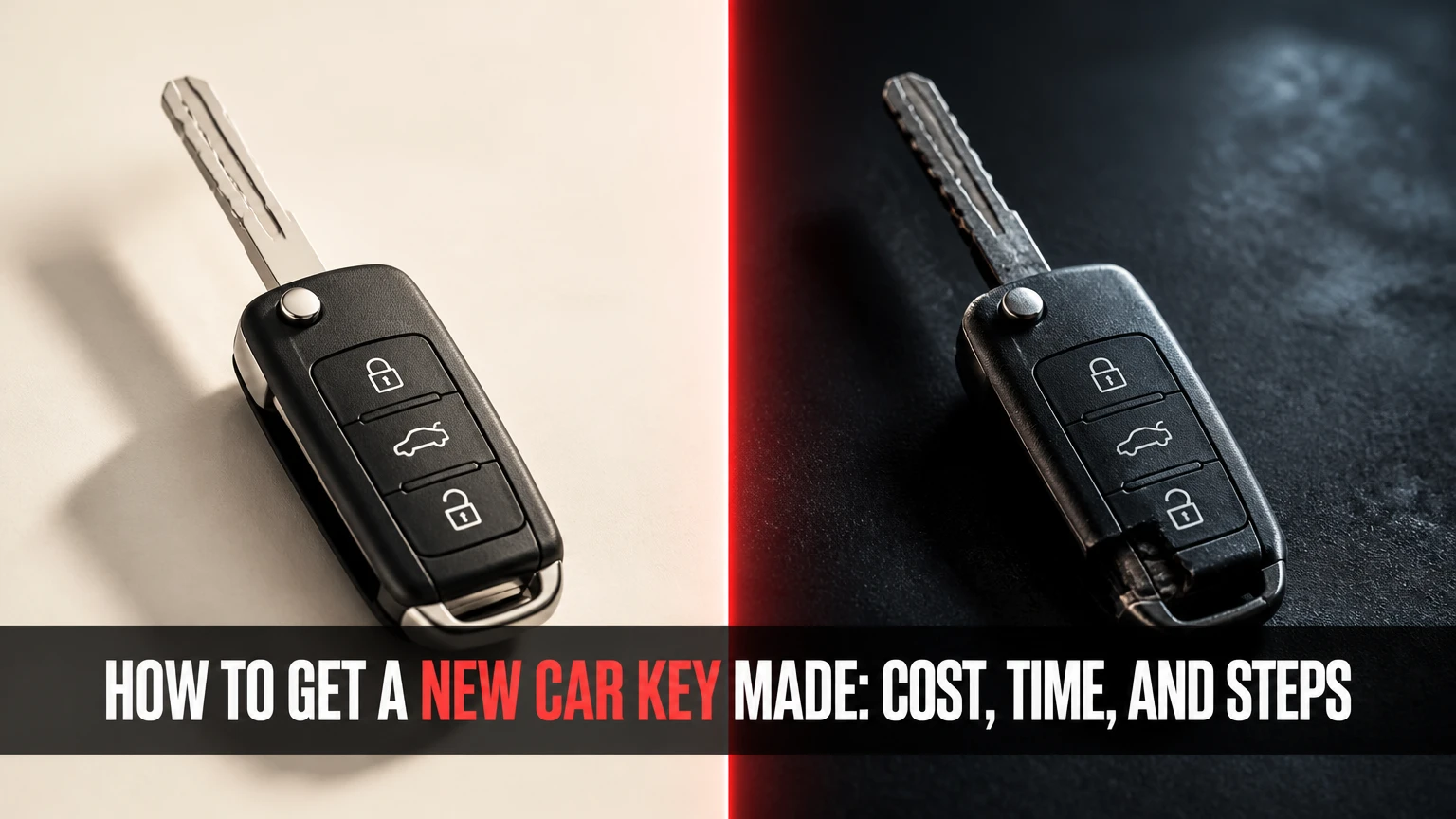
To get a new car key made, provide the vehicle identification number, proof of ownership, exact vehicle details, and any working key to an automotive locksmith or dealership. The provider identifies the key type, cuts the blade if needed, programs the transponder or fob to the immobilizer, and tests starting, locking, and remote functions.
Key Facts at a Glance
- A cut car key can unlock a door but still fail to start an immobilizer-equipped vehicle.
- A replacement key usually needs both mechanical cutting and electronic programming.
- One working key normally makes duplication faster, cheaper, and less disruptive than an all-keys-lost job.
- Automotive locksmiths commonly provide mobile service in 30-90 minutes, while dealerships may require ordering and vehicle access.
- Typical replacement prices range from about $20 for a basic metal key to more than $1,000 for some luxury proximity systems.
- A key-fob battery replacement is different from replacing or programming the entire fob.
What You Are Actually Replacing
A car key may contain four separate functions: a mechanical blade, a remote transmitter, a transponder immobilizer chip, and a proximity credential. The replacement price depends on which of those functions has failed or gone missing, because cutting metal alone does not reproduce an electronic identity.
A traditional key uses only a blade and lock cylinder. A transponder key adds a passive chip that the vehicle reads near the ignition. A remote-head key combines that chip with lock and unlock buttons. A smart key or proximity fob communicates with the vehicle while remaining in a pocket or bag.
The immobilizer is the security control that matters most for engine starting. When the vehicle does not recognize the transponder or fob credential, the engine may crank without starting, or the starter and fuel system may remain disabled. Remote locking and engine authorization are related but separate functions.
NHTSA vehicle-theft guidance states, “Always take your keys with you and lock your vehicle.” That basic advice remains relevant because a replacement key solves access and authorization problems, but it does not remove the risk created by a stolen programmed key.
Cut, chip, remote, and proximity functions
| Component | What it controls | Typical failure symptom | Replacement action |
|---|---|---|---|
| Metal blade | Door, trunk, and ignition lock cylinder | Key will not enter or turn | Decode or copy the blade |
| Transponder chip | Engine immobilizer authorization | Engine cranks but does not start | Program chip to vehicle |
| Remote transmitter | Lock, unlock, panic, trunk buttons | Vehicle starts, buttons do nothing | Sync remote or replace battery |
| Proximity credential | Passive entry and push-button start | “Key not detected” warning | Register compatible smart fob |
| Fob battery | Remote and proximity power supply | Short range or intermittent response | Install specified battery |
How to Get a New Car Key Made
The process normally takes six actions: identify the vehicle, determine the key type, choose a provider, cut or obtain the physical key, program the electronic credential, and test every function. A typical duplicate takes 20-60 minutes when one working key is available; an all-keys-lost job may take 60 minutes to several hours.
The vehicle’s exact model year, engine, trim, market, and security system determine compatibility. Two vehicles with the same badge can use different blade profiles, fob frequencies, FCC IDs, immobilizer systems, or programming procedures.
Before You Start
| Requirement | Typical detail | Why it matters |
|---|---|---|
| Vehicle information | Year, make, model, trim, engine, country market | Prevents incompatible key selection |
| VIN | 17-character vehicle identification number on most modern cars | Lets the provider verify configuration and obtain key data |
| Identity document | Driver’s license, passport, or national ID | Supports security and ownership checks |
| Ownership evidence | Registration, title, insurance record, or lease document | Reduces unauthorized key creation |
| Working key | Bring every surviving key | Allows duplication and identifies the correct system |
| Vehicle location | Accessible parking position with the car present | Needed for on-site programming and testing |
| Budget | Typical $20-$1,000-plus range | Helps compare complete quotes rather than blade prices |
Find the VIN on the dashboard near the windshield, the driver-side door-jamb label, registration documents, or insurance paperwork. Do not post the full VIN or key serial information publicly when requesting online advice.
Before booking, ask whether the quoted price includes the blank key or fob, mechanical cutting, immobilizer programming, remote synchronization, travel, emergency access, taxes, and a warranty. A low quote may cover only an uncut shell.
Step 1: Identify the Vehicle and Key Situation
Write down the exact year, make, model, trim, and VIN, then state whether you have one working key, a damaged key, or no keys at all. Tell the provider whether the vehicle uses a metal blade, an ignition key with buttons, or push-button start.
Inspect the existing key for a part number, FCC ID, frequency marking, manufacturer logo, or blade profile. A photograph helps a provider identify the shell, but a photograph does not confirm programming compatibility.
Also describe the failure accurately. A weak remote battery, a worn blade, a broken shell, and an unrecognized transponder require different remedies. If the vehicle starts normally but the buttons fail, test the fob battery before ordering a complete key.
You will know this step worked when: the provider can state the likely key type and programming method from the VIN and your description.
Common mistake: giving only the registration year. Model-year changes can occur before or after the calendar year, and imported vehicles may use different components.
Step 2: Confirm the Key Type and Required Parts
Match the replacement to the vehicle’s blade profile, transponder system, remote frequency, FCC ID, button layout, and smart-key part number. Do not rely on appearance alone, because visually identical fobs can contain different electronics.
| Key type | Common vehicle pattern | Programming requirement | Typical replacement range |
|---|---|---|---|
| Basic metal key | Older cars without an immobilizer | None, if purely mechanical | $5-$30 |
| Transponder blade key | Many late-1990s to 2010s vehicles | Chip registration often required | $50-$180 |
| Laser or sidewinder key | High-security blade systems | Specialized cutting and chip programming | $100-$300 |
| Remote-head key | Ignition key with lock buttons | Chip and remote synchronization | $100-$350 |
| Smart or proximity fob | Push-button-start vehicles | Vehicle-specific fob registration | $150-$1,000-plus |
A laser-cut or sidewinder blade is not automatically more secure in every respect, and the label does not identify the correct fob electronics. The key code, transponder type, remote frequency, and vehicle software determine whether the part works.
You will know this step worked when: the part number or compatible aftermarket specification matches the VIN, not merely the vehicle’s brand and body style.
Common mistake: ordering by year and model while ignoring frequency or FCC ID. A key can fit the ignition and still fail every electronic function.
Step 3: Choose a Locksmith, Dealership, or Supplier
Choose a mobile automotive locksmith for speed and often lower labor cost, a dealership for factory parts and proprietary systems, or a DIY supplier only when the vehicle supports owner programming and you can verify the part precisely.
| Provider | Typical total cost | Typical time | Best fit | Main limitation |
|---|---|---|---|---|
| Automotive locksmith | $80-$450 | 30-90 minutes | Mobile duplicates and many lost-key jobs | Equipment and brand coverage vary |
| Authorized dealership | $150-$1,000-plus | Same day to 3 days | Newer, luxury, or restricted systems | Higher labor and possible towing |
| Online key supplier | $30-$300 before labor | 2-7 days shipping | Verified part for a supported vehicle | Wrong part risk and separate programming |
| Hardware store | $5-$40 | 10-30 minutes | Basic non-electronic metal keys | Usually cannot program immobilizers |
| Roadside assistance | Membership-dependent, often $0-$200 service fee | 30-120 minutes | Immediate lockout or transport | May subcontract key work |
A locksmith is often the practical choice when the car is stranded and the system is supported by professional diagnostic equipment. A dealership becomes more attractive when the manufacturer requires online authorization, the vehicle uses a restricted smart key, or a replacement must be ordered by VIN.
A hardware store can cut a mechanical duplicate, but it is usually not equipped to register a modern transponder or proximity fob. Online DIY purchasing saves money only if the wrong-part risk is low and programming is genuinely available.
Expert rule: request a complete, written quote for “cut and programmed,” not a quote for “the key.” That wording separates the physical part from the labor and electronic registration.
Step 4: Have the Physical Key Cut or Obtain the Fob
The provider cuts the blade from a manufacturer key code, a decoded lock, or a working key, then checks that the blade enters and turns smoothly before programming. Smart-key vehicles may have no conventional ignition blade, but many fobs contain an emergency mechanical key for the door lock.
A code-based cut is usually preferable when available because it reproduces the intended profile without copying wear from an old blade. If a locksmith decodes a lock, the technician may need access to the door, trunk, or ignition cylinder.
Do not force a newly cut key. A blade that fits but binds can damage the ignition cylinder, and repeated turning can make a transponder diagnosis harder because the mechanical and electronic faults become mixed.
You will know this step worked when: the blade operates the relevant lock smoothly, or the smart fob’s emergency key fits the door cylinder without binding.
Common mistake: testing only the door. A key can unlock the door while being incorrectly cut for the ignition, trunk, or steering-lock cylinder.
Step 5: Program the Electronic Key
The technician registers the transponder or smart fob with the vehicle’s immobilizer using a manufacturer procedure, an approved diagnostic interface, or compatible locksmith equipment. The vehicle may require security credentials, an existing key, an ignition cycle, or an internet-connected authorization session.
Programming is vehicle-specific. Some older cars permit onboard sequences when two recognized keys already exist, while many modern vehicles require diagnostic equipment connected through the OBD-II port. The OBD-II connection provides access to vehicle modules, but it does not mean every key can be programmed with a generic scanner.
A new fob may also need separate remote synchronization. Engine authorization, passive entry, lock buttons, trunk release, and panic functions can use different registration steps. Ask the technician to confirm whether the procedure adds the new key while preserving existing keys or erases all previously stored credentials.
You will know this step worked when: the vehicle recognizes the key, the security indicator behaves normally, and the engine starts without an immobilizer warning.
Common mistake: assuming a remote that locks the doors can start the engine. Remote buttons may work while the transponder remains unregistered.
Step 6: Test Every Function Before Paying
Test engine starting, door locking, trunk release, panic operation, passive entry, emergency blade operation, and dashboard warnings before the technician leaves. Test the new key separately from the old one so a surviving key cannot hide a programming failure.
| Function to test | Test method | Acceptable result | If it fails |
|---|---|---|---|
| Mechanical entry | Unlock driver door with blade | Smooth rotation and release | Recut or inspect cylinder |
| Engine authorization | Start vehicle with new key | Starts within normal cycle | Recheck transponder programming |
| Remote lock | Press lock from 5-10 metres | Vehicle locks and confirms | Check battery or synchronization |
| Remote unlock | Press unlock from 5-10 metres | All intended doors unlock | Verify button mapping |
| Trunk or hatch | Use fob button and interior control | Latch releases when designed | Check vehicle configuration |
| Proximity start | Keep fob inside cabin, press start | Engine starts without warning | Check fob registration or battery |
| Existing keys | Test each surviving key | Prior keys still operate | Ask whether memory was erased |
Request the part number, programming confirmation, warranty terms, and the number of keys stored in the vehicle. Keep the receipt with the registration documents rather than inside the vehicle.
What Does a New Car Key Cost?
A new car key typically costs $5-$30 for a basic metal duplicate, $50-$350 for many transponder or remote-head keys, and $150-$1,000 or more for some proximity fobs. All-keys-lost service, luxury brands, imported parts, emergency travel, and towing can raise the total substantially.
These are typical consumer ranges in U.S. dollars, not universal prices. Local labor rates, taxes, currency, vehicle market, parts availability, and manufacturer security policies change the final quote.
| Situation | Typical part cost | Typical labor or service | Typical total |
|---|---|---|---|
| Basic mechanical duplicate | $5-$20 | $0-$20 | $5-$40 |
| One transponder spare | $30-$120 | $40-$150 | $70-$270 |
| Remote-head replacement | $60-$220 | $50-$180 | $110-$400 |
| Smart-fob replacement | $100-$700 | $50-$350 | $150-$1,050 |
| All keys lost, mainstream vehicle | $80-$300 | $100-$400 | $180-$700 |
| All keys lost, luxury or restricted system | $250-$800 | $200-$700 | $450-$1,500-plus |
The cheapest advertised price often excludes programming. Ask whether the price covers emergency unlocking, cutting, electronic registration, remote syncing, travel, and a replacement warranty.
Which provider should you choose?
| Your situation | Usually suitable provider | Reasonable target time | Decision warning |
|---|---|---|---|
| One working key and older car | Locksmith or verified DIY route | 20-60 minutes | Confirm immobilizer type |
| Lost key at home, mainstream vehicle | Mobile automotive locksmith | 30-90 minutes | Verify business identity |
| New push-button vehicle | Dealer or specialist locksmith | 1-3 hours or order time | Confirm online authorization |
| Luxury imported vehicle | Authorized dealer or brand specialist | 1-3 days common | Confirm part availability |
| Key stolen with vehicle nearby | Locksmith or dealer security service | Same day when supported | Erase old key credentials |
| Locked out with no replacement need | Roadside assistance or locksmith | 15-90 minutes | Request non-destructive entry |
Dealership service is not automatically safer, and locksmith service is not automatically cheaper. The relevant question is whether the provider has the correct cutting equipment, diagnostic access, security credentials, and compatible part.
Can a Key Be Made Without the Original?
A qualified automotive locksmith or dealership can often make and program a key without the original by using the VIN, lock decoding, manufacturer key data, and vehicle diagnostic access. The process is harder when all keys are missing because the technician must establish ownership and often reset or replace the stored key credentials.
A missing original does not prevent mechanical production in most cases. The provider may decode a lock, obtain a key code, or cut a blade from VIN-linked information.
Electronic access is the limiting factor. Some systems require an existing recognized key, a manufacturer security PIN, a timed security wait, or server authorization. Bring government identification and ownership documents because reputable providers may refuse an all-keys-lost request without them.
What changes when all keys are lost?
All-keys-lost work normally includes vehicle entry, key creation, immobilizer access, programming, and testing, so it costs more than copying a spare. A locksmith may also erase missing keys from the vehicle’s memory, but the exact behavior depends on the immobilizer system.
Tell the provider where the car is located and whether the steering wheel is locked, the battery is flat, or the vehicle is inside a restricted garage. A dealer may require towing because the vehicle must reach a diagnostic workstation.
Do not buy several used smart fobs before confirming that the vehicle accepts reused units. Some locked fobs cannot be reset, while others require specialist refurbishment or manufacturer replacement.
When Is DIY Key Replacement Practical?
DIY key replacement is practical for a basic metal key and for selected older vehicles with documented owner-programming procedures; it is a poor choice when the vehicle has one missing key, a restricted smart system, or uncertain part compatibility. The part must match the blade, chip, frequency, FCC ID, and vehicle software.
Before buying, verify the seller’s return policy and compare the advertised part number with the owner’s manual or manufacturer catalog. Confirm whether the key arrives cut, whether the transponder is new, and whether the remote battery is installed.
Owner programming procedures can vary by model, year, and market. Follow the vehicle-specific manual rather than a generic internet sequence, because an incorrect sequence may add no key, erase stored keys, or leave the vehicle immobilized.
DIY is usually unsuitable for a push-button vehicle when no working fob remains. A failed purchase can still require a professional visit, turning a low initial price into a higher total cost.
Common Problems and How to Fix Them
A new key that fails can have a mechanical, electronic, battery, compatibility, or vehicle-module cause. Diagnose the exact symptom before buying another part.
| Symptom | Most likely cause | First check | Corrective action |
|---|---|---|---|
| Key unlocks door but engine will not start | Unprogrammed or wrong transponder | Security light and second key | Reprogram or replace chip |
| Engine starts but buttons fail | Dead battery or unsynced remote | Fob battery voltage and contacts | Replace battery, then sync remote |
| “Key not detected” appears | Wrong fob, weak battery, antenna fault | Emergency start location in manual | Verify fob ID, battery, vehicle antenna |
| Key will not turn | Incorrect cut, worn cylinder, steering lock | Try neutral or gently move wheel | Recut blade or inspect cylinder |
| New key works, old key stops | Programming erased previous memory | Test every stored key | Add keys again or restore credentials |
| Remote range is very short | Weak battery, damaged antenna, interference | New specified battery | Repair or replace fob |
| Car battery is flat during programming | Low vehicle voltage | Measure battery, usually near 12.6 V at rest | Charge or stabilize before programming |
A key that turns but does not start the vehicle usually has a transponder problem, not a blade-cut problem. A remote that fails while the engine starts usually has a battery or synchronization problem, not an immobilizer problem.
If the vehicle recently experienced a flat battery, water intrusion, alarm fault, or aftermarket remote-start installation, tell the technician. Those conditions can create symptoms that resemble a bad replacement key.
What Should You Do After a Key Is Stolen?
If a programmed key is stolen, ask a dealer or qualified locksmith to erase the stolen key from the vehicle’s authorized-key memory, then reprogram the keys you still possess. Also secure the vehicle physically and notify your insurer if the policy requires reporting lost or stolen keys.
A replacement key does not necessarily invalidate an old key. Some systems allow selective deletion, while others require a complete key-memory reset followed by re-registration of every valid key.
Change any associated digital access codes, garage remotes, or connected-vehicle credentials if the stolen key was stored with identifying documents. Avoid leaving the registration, spare key, or vehicle address inside the car.
How to Avoid Paying for the Wrong Replacement
Use the vehicle’s VIN and an exact part-number match before ordering, and obtain a written quote that separates the key, cutting, programming, travel, taxes, and warranty. That procedure prevents the most common avoidable expense: paying for a fob that fits the shell but cannot communicate with the vehicle.
Use this provider checklist:
- Does the quote include cutting and immobilizer programming?
- Does the fob match the vehicle’s FCC ID or manufacturer part number?
- Is the replacement new, refurbished, or previously locked to another vehicle?
- Can the provider program the vehicle at its current location?
- Will existing keys remain active?
- Does the price include emergency entry, travel, tax, and testing?
- What happens if the part fails within the warranty period?
- Will the provider supply a spare mechanical blade or valet key?
A valet key may cost less, but it may not operate the glove box, trunk, or remote functions. Ask what the valet key can and cannot open before selecting it as the only backup.
FAQ
How long does it take to get a car key made?
A basic mechanical duplicate commonly takes 10-30 minutes. A transponder or remote-head key usually takes 30-90 minutes when a working key and compatible parts are available. A smart fob may take one to three hours, while an ordered dealer part or all-keys-lost job can take one to three days.
Can AutoZone, Walmart, or a hardware store program my car key?
A retail chain may cut some basic keys and sell batteries or replacement shells, but programming availability varies by location and vehicle. Many stores cannot register immobilizer chips or proximity fobs. Confirm the specific store’s equipment and vehicle coverage before purchasing a key there.
Should I replace the key battery before replacing the whole key?
Replace the battery first when the engine starts normally but remote buttons have weak range or stop responding. Use the battery type specified by the manufacturer, check contact orientation, and retest. A battery replacement will not repair a broken circuit board, damaged antenna, incorrect fob, or unprogrammed immobilizer chip.
Can I duplicate a car key from a photo?
A photo can help identify the shell and button layout, but it cannot reliably confirm the blade code, transponder type, frequency, FCC ID, or VIN-specific compatibility. A provider needs vehicle information and usually the original key, a lock code, or diagnostic access for an accurate replacement.
Is an aftermarket car key as good as an OEM key?
An aftermarket key can work reliably when its blade, transponder, frequency, firmware, and part number match the vehicle. OEM keys usually offer more predictable compatibility and warranty support, but they cost more. Avoid unverified used smart fobs because some are permanently locked to their original vehicle.
Does car insurance cover a replacement key?
Coverage depends on the policy and may come from comprehensive insurance, key-protection coverage, roadside assistance, a manufacturer plan, or a rental agreement. Ask the insurer whether lost, stolen, damaged, programming, towing, and emergency-service costs are covered before authorizing expensive work.
The Bottom Line
To get a new car key made, identify the exact vehicle and key system, gather the VIN and ownership documents, obtain a complete quote, and use a provider with the required cutting and programming equipment. One working key usually makes the job faster and cheaper, while all-keys-lost, stolen-key, luxury, and proximity-fob situations justify specialist or dealership assistance. Test every function before payment, and confirm that old stolen or missing keys have been removed from the vehicle’s memory.