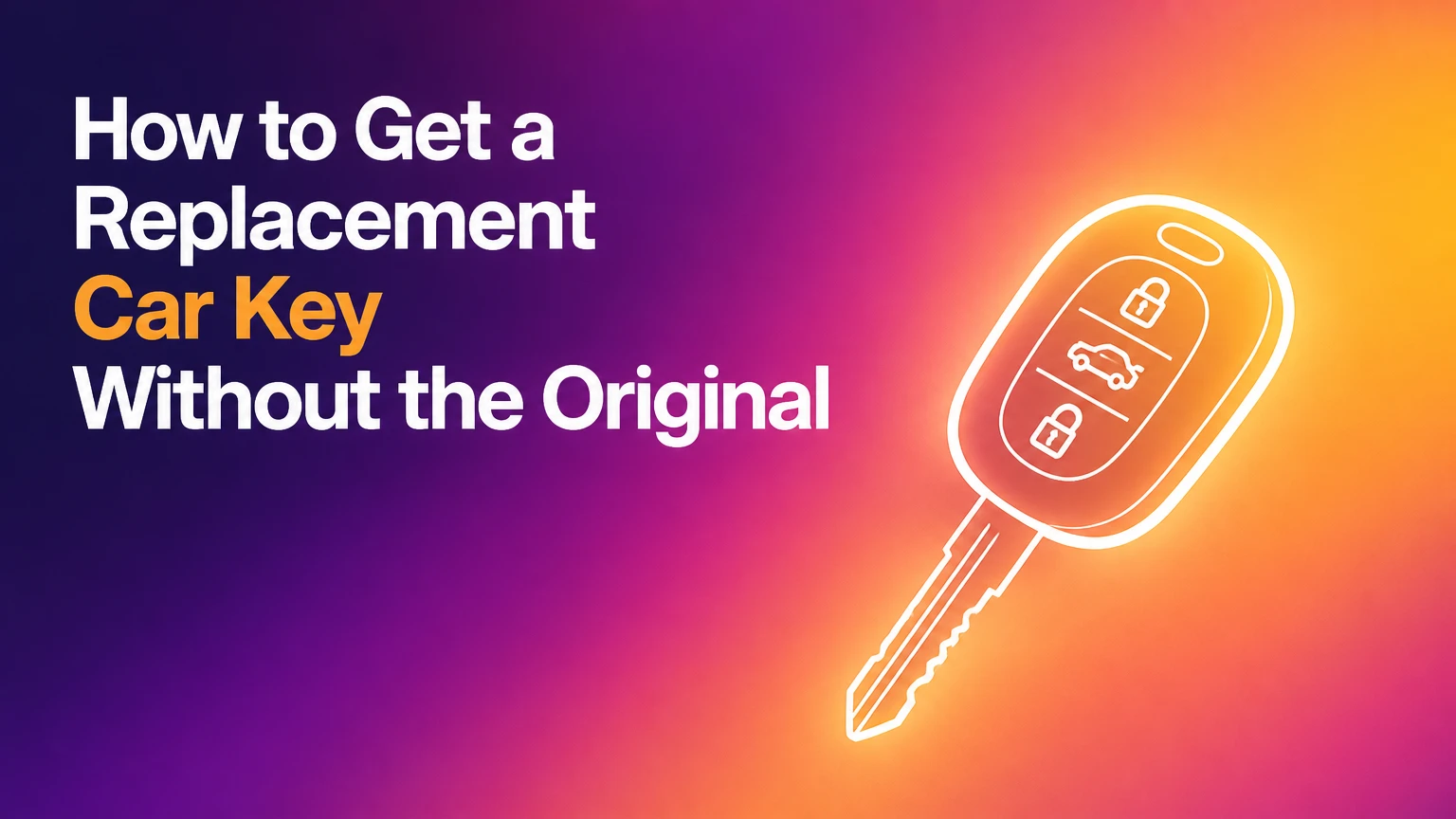
You can get a replacement car key without the original by hiring an automotive locksmith or dealership to originate, cut, and program a key from the vehicle identification number (VIN), lock cylinders, and immobilizer system. Bring government identification and proof of ownership. A mechanical key may take 15-30 minutes, while a modern smart key can take several hours or days.
Key Facts at a Glance
Key origination creates a new mechanical cut and does not copy an existing blade.
A VIN identifies the factory key code, but a replaced ignition may require physical lock decoding.
A transponder key must be authorized by the vehicle immobilizer before the engine will run.
Typical U.S. replacement costs range from $50 for a basic key to more than $800 for some smart keys.
A mobile automotive locksmith usually avoids towing and costs less than a dealership, but luxury vehicles may require dealer software.
If a key was stolen, ask whether all old keys can be deleted from the vehicle’s key memory.
Can You Get a Replacement Car Key Without the Original?
Yes, an automotive locksmith or authorized dealership can create a replacement without seeing the original key. The service is called key origination, or all-keys-lost replacement, and it combines mechanical cutting with electronic programming when the vehicle has an immobilizer.
A provider normally verifies ownership before accessing key codes or security functions. The provider may use the VIN to retrieve a factory code, decode the door lock, or use manufacturer diagnostic software to authorize the new transponder or smart fob.
A replacement that unlocks the door is not necessarily a replacement that starts the engine. Older vehicles may need only a correctly cut metal blade, while many vehicles built from the late 1990s onward use a chip, remote, proximity system, or encrypted immobilizer.
The main success factor is accurate vehicle identification. Make, model, model year, trim, market, key type, and security system can change the correct part and programming method.
What Should You Gather Before Calling?
Gather the VIN, government-issued photo identification, vehicle registration or title, exact vehicle details, and the vehicle’s location. Providers use those details to confirm ownership, identify the key system, quote the job, and decide whether mobile programming is possible.
Before You Start
| Requirement | Typical value | Why it matters |
|---|---|---|
| VIN | 17 characters on most modern vehicles | Identifies the vehicle and possible factory key code |
| Proof of ownership | Registration, title, or matching insurance record | Supports lawful security-service authorization |
| Personal identification | Driver license, passport, or state ID | Matches the customer to the vehicle documents |
| Vehicle battery | Preferably above 12.2 volts at rest | Prevents programming interruption during immobilizer learning |
| Service location | Vehicle accessible to the technician | Enables lock decoding, cutting, and OBD-II programming |
The VIN usually appears through the lower driver-side windshield, on the driver-door pillar, registration, title, insurance card, or finance documents. Do not post the full VIN publicly when requesting quotes online.
Tell the provider whether the vehicle has a metal key, transponder head, flip key, remote fob, or push-button start. Also report previous ignition, door-lock, body-control-module, or immobilizer repairs because factory key data may no longer match the installed locks or modules.
How Does the Replacement Process Work?
Key origination follows five practical stages: verify ownership, identify the key system, obtain or decode the mechanical cuts, cut the blade, and program the electronic security device. A successful job must pass both the physical lock test and the immobilizer test.
Step 1: Confirm the Vehicle Identity
Give the technician the VIN, make, model, year, trim, and current location. The technician may check the VIN against a manufacturer database, parts catalog, or locksmith security platform.
Success checkpoint: The provider identifies a specific key part number, blade profile, chip type, or smart-fob system rather than quoting only from the vehicle’s brand.
Common mistake: Giving the registration year instead of the model year. A vehicle registered in 2021 may be a 2020 model with a different fob.
Step 2: Prove Ownership
Show a photo ID and a document connecting you to the vehicle. A title, registration, lease document, or insurance record is commonly accepted, although requirements vary by provider and jurisdiction.
Success checkpoint: The provider confirms the documents before beginning security programming.
Common mistake: Arriving with a VIN but no ownership documentation. A legitimate locksmith may refuse the job rather than bypass that safeguard.
Step 3: Identify the Mechanical Cut
The technician retrieves the factory key code from the VIN when available, or decodes a compatible lock cylinder using specialized tools. A lock decoder can read the internal wafer or pin positions without an original key.
Success checkpoint: The new blade turns the driver door, trunk, and ignition where those cylinders are intended to match.
Common mistake: Assuming the VIN cut must fit every lock. A previous ignition replacement can leave the door locks and ignition using different codes.
Step 4: Cut the Key or Prepare the Fob
A key machine or computerized cutter creates the blade profile and depth pattern. Laser-track, side-milled, high-security, and conventional edge-cut blades require different blanks and cutting equipment.
Success checkpoint: The blade enters and turns smoothly without excessive force, scraping, or repeated wiggling.
Common mistake: Testing a poorly cut blade by forcing it. Excessive force can damage the ignition cylinder and turn a key replacement into a lock repair.
Step 5: Program the Immobilizer
The technician connects an approved diagnostic programmer through the vehicle’s diagnostic connector, often the OBD-II port, and places the vehicle into a learning or authorization procedure. The system pairs the new transponder or smart key with the immobilizer, engine control module, body control module, or related security module.
Success checkpoint: The engine starts, remains running, and the security indicator behaves normally.
Common mistake: Confusing remote-button programming with immobilizer programming. Lock and unlock buttons can work while the car still refuses to start.
Step 6: Delete Missing Keys and Test Every Function
If a key was lost or stolen, ask the technician to erase missing keys from the vehicle’s authorized-key list when the system supports that operation. Then test starting, locking, unlocking, trunk release, panic function, proximity detection, emergency blade operation, and dashboard warnings.
Success checkpoint: The replacement starts the vehicle and performs every function included in the quoted service.
Common mistake: Leaving before testing the emergency blade. A smart fob can lose its battery and still needs to unlock the door mechanically.
Which Type of Replacement Key Do You Need?
The required replacement depends on the vehicle’s ignition and security architecture, not the appearance of the old key. A metal blade, transponder key, remote-head key, and proximity fob have different parts, programming procedures, and failure points.
| Key type | Typical vehicle feature | Typical U.S. cost | Typical time |
|---|---|---|---|
| Mechanical blade | No electronic immobilizer | $50-$120 | 15-30 minutes |
| Transponder key | Metal blade with coded chip | $100-$300 | 30-60 minutes |
| Remote-head or flip key | Blade plus lock and unlock buttons | $180-$450 | 30-90 minutes |
| Proximity smart fob | Push-button start and passive entry | $250-$800+ | 45 minutes-3 days |
| High-security European key | Encrypted or server-authorized system | $400-$1,200+ | 1-7 days |
The often-repeated claim that all pre-1995 vehicles use only plain metal keys is too broad. Vehicle security systems vary by market, model, and aftermarket equipment, so the technician should verify the exact vehicle rather than infer the key type from age alone.
Smart keys also do not rely on one universal “frequency.” Radio frequency, encryption, rolling or challenge-response authentication, immobilizer authorization, regional configuration, and vehicle software all affect compatibility.
How Much Does a Replacement Car Key Cost?
A typical all-keys-lost replacement costs $50-$120 for a mechanical key, $100-$300 for many transponder keys, $180-$450 for remote-head keys, and $250-$800 or more for proximity fobs. Dealer labor, emergency hours, towing, programming access, and vehicle rarity can raise the total.
| Cost component | Typical range | When charged | How to reduce it |
|---|---|---|---|
| Mechanical key cutting | $20-$80 | Basic blade only | Use a local locksmith |
| Transponder blank | $40-$150 | Chip key replacement | Confirm compatible part number |
| Smart-fob hardware | $120-$600+ | Push-start vehicles | Compare genuine and supported aftermarket parts |
| Programming labor | $50-$250 | Immobilizer or remote pairing | Ask for an all-in quote |
| Emergency or after-hours fee | $50-$200 | Nights, weekends, holidays | Schedule during business hours |
| Towing | $100-$250 | Vehicle taken to a dealer | Request mobile service first |
These are typical U.S. practitioner ranges, not a guaranteed price list. A 2018 Ford sedan, a 2020 Toyota SUV, and a 2019 Mercedes-Benz may all require different software, parts, and security authorization.
Check roadside-assistance and insurance coverage before paying. Some plans cover emergency lockout but exclude key origination, while comprehensive insurance may cover stolen keys only under specific conditions and deductibles.
Which Provider Should You Choose?
Choose a mobile automotive locksmith for most standard vehicles when you need same-day service without towing. Choose an authorized dealership when the vehicle requires proprietary server access, a restricted European key, warranty-compatible OEM hardware, or a system the local locksmith cannot program.
| Provider | Typical total cost | Typical turnaround | Best fit | Main limitation |
|---|---|---|---|---|
| Mobile automotive locksmith | $100-$600 | 30 minutes-4 hours | Stranded owners and common vehicles | Equipment varies by technician |
| Authorized dealership | $250-$1,200+ | Same day-7 days | Restricted software and OEM parts | Towing and appointment delays |
| Online part plus locksmith | $100-$500 | 1-7 days | Cost-conscious planned replacement | Wrong parts may be nonreturnable |
| DIY programmer and blank | $50-$400 | 1-6 hours | Supported older vehicles | Compatibility and security risks |
Mobile Locksmith
A qualified automotive locksmith can retrieve key data, decode locks, cut a blade, and program many domestic and Asian vehicles at the vehicle’s location. Mobile service commonly avoids a $100-$250 tow and may cost 30-50% less than a dealership, although those savings are typical rather than guaranteed.
Ask for the business name, license requirements in your area, technician credentials, total price, warranty, parts source, and ability to delete lost keys. A low phone quote that excludes programming is not comparable with an all-in quote.
Dealership
A dealership provides direct access to brand parts and factory diagnostic systems. That advantage matters for vehicles with online immobilizer authorization, locked key slots, replacement control modules, or encrypted European security systems.
The dealership may require every vehicle key to be present, a physical appointment, a preordered fob, and a tow to the service department. Ask whether the quoted price includes cutting, programming, taxes, diagnostic fees, and key-memory deletion.
Online Parts and DIY Programming
Online parts can reduce hardware cost, but the savings disappear if the part has the wrong FCC ID, frequency, blade profile, chip type, region, or programming status. Used proximity fobs may remain locked to another vehicle, and some manufacturers do not support reuse.
DIY procedures are appropriate only when the manufacturer explicitly supports owner programming for that exact model. Many all-keys-lost systems require an immobilizer PIN, security token, two existing keys, or professional diagnostic access.
What If the VIN Cut Does Not Fit?
A VIN-derived cut may fail when a door lock, ignition cylinder, glovebox, or immobilizer module was replaced previously. Tell the technician about every known lock repair, because the technician may need to decode the current door or ignition cylinder instead of relying on factory VIN data.
A practical diagnostic sequence is:
- Test the new blade in the driver door before forcing the ignition.
- Compare whether the door and ignition use separate lock cylinders.
- Ask whether the ignition was replaced during theft recovery or a prior repair.
- Have the technician decode the installed cylinder.
- Confirm that the mechanical key and electronic transponder are being treated as separate problems.
A key can be electronically correct but mechanically wrong. The reverse is also possible: a blade can turn the ignition while the immobilizer rejects the transponder.
What Causes Programming Failure?
Programming failure usually comes from incompatible hardware, low vehicle voltage, an interrupted diagnostic connection, restricted security access, or a vehicle module that does not accept the selected procedure. A key that turns the ignition but will not keep the engine running has usually failed immobilizer authorization, not cutting.
| Symptom | Likely cause | Recommended check | Expected remedy |
|---|---|---|---|
| Blade will not enter lock | Wrong profile or damaged cut | Verify blade code and cylinder | Recut or replace blank |
| Engine cranks but will not run | Unprogrammed transponder | Check security light and key data | Repeat immobilizer pairing |
| Remote buttons do nothing | Dead fob battery or wrong remote | Check battery and FCC ID | Replace battery or fob |
| Programmer cannot connect | Low voltage, fuse, gateway block | Test battery and OBD-II power | Charge battery, repair circuit, authorize access |
| Smart fob is rejected | Used or region-incompatible fob | Check part number and lock status | Use supported new or reset hardware |
A weak battery can interrupt a security procedure and create unnecessary module faults. The technician should stabilize vehicle voltage according to the manufacturer’s procedure rather than repeatedly attempting programming with a failing battery.
An OBD-II port may lack power because of a blown accessory or cigarette-lighter fuse. Aftermarket stereos, alarms, remote starters, and damaged wiring can also interfere with diagnostic communication.
Do not keep trying random programming sequences. Repeated failed attempts can consume security attempts, trigger a timed lockout, or create diagnostic faults that require dealer-level recovery.
What Should You Do If the Key Was Stolen?
Treat a stolen key as a vehicle-security incident, not only a replacement purchase. Ask the locksmith or dealership to delete the stolen key from immobilizer memory, disable its remote authorization where supported, and inspect whether the key also opens another vehicle lock.
Remote deletion and immobilizer deletion are separate functions on some vehicles. A removed remote may no longer lock or unlock the car, while an immobilizer key may still need separate removal from the authorized-start list.
Until the work is complete, park in a monitored or well-lit location, use a steering-wheel lock when appropriate, and contact law enforcement if theft occurred with other property. Some vehicles require a complete key reset rather than simple individual-key deletion.
Is a Spare Key Worth Buying Immediately?
Yes, obtaining a spare during the replacement visit is usually cheaper and safer than waiting for another all-keys-lost emergency. A second key may add $50-$300 for common vehicles, but a smart-fob spare can cost several hundred dollars and may require the same programming appointment.
Record the part number, key type, programming method, and service provider. Store the spare away from the primary key, and avoid leaving both keys in the same bag, vehicle, or household drawer.
How Long Does the Process Take?
A mechanical replacement commonly takes 15-30 minutes, a transponder or remote-head key takes 30-90 minutes, and a smart-fob replacement takes 45 minutes to several hours when parts and software are available. Dealer orders for restricted or backordered fobs can extend the process to 3-7 days.
| Situation | Typical time | Main delay |
|---|---|---|
| Common mechanical key | 15-30 minutes | Lock decoding or travel |
| Common transponder key | 30-60 minutes | Security learning procedure |
| Remote-head key | 30-90 minutes | Remote and immobilizer pairing |
| Smart fob in stock | 45 minutes-3 hours | Diagnostic authorization |
| Smart fob backordered | 3-7 days | Part shipment or factory ordering |
Mobile response time is separate from job time. A technician may arrive in 30 minutes but need another two hours if the correct blank is not stocked.
How Can You Avoid Incompatible Online Fobs?
Match the complete part number, FCC ID where applicable, blade style, transponder type, vehicle market, and supported model-year range before ordering. Identical-looking shells can contain different electronics, and a remote’s button layout does not prove immobilizer compatibility.
Use a seller with a written compatibility and return policy. Confirm whether the part is new, refurbished, used, unlocked, or already assigned to another vehicle.
The cheapest part is not always the cheapest finished repair. A $45 incompatible fob can become a $45 loss plus a second service charge, while a verified $150 part may complete the job in one visit.
FAQ
Can a locksmith make a car key from the VIN alone?
A VIN can help a locksmith retrieve a factory key code and identify the correct blank, but the VIN alone does not physically prove the current locks match factory specifications. The technician still needs the vehicle, ownership documents, and sometimes a lock cylinder for decoding and programming.
Will a replacement key work if the car battery is dead?
The mechanical blade may unlock the door, but electronic programming generally requires stable vehicle voltage. Charge or support the battery before programming, and check the smart fob’s coin-cell battery separately because a dead fob battery can prevent remote entry without disabling the emergency blade.
Can I drive to a locksmith without any key?
No, a vehicle without an authorized key cannot normally be driven there. Request a mobile automotive locksmith, roadside assistance, or a tow. A mobile technician can perform many cutting and programming jobs at the vehicle’s location.
Does a replacement key erase the old key automatically?
No, replacement does not always erase missing keys automatically. Ask specifically for an all-keys-lost procedure and confirmation that old immobilizer credentials and remote functions were removed when the vehicle supports deletion.
Is an aftermarket key as reliable as an OEM key?
An aftermarket key can work reliably when its part number, electronics, region, and programming method exactly match the vehicle. OEM hardware is the safer choice for restricted systems, warranty-sensitive repairs, and vehicles where used or aftermarket fobs cannot be reset.
What should I do after receiving the replacement?
Test the blade in every intended lock, start the engine repeatedly, check the security indicator, operate every remote button, verify proximity entry, and test the emergency blade. Obtain a spare key before storing the replacement as your only working key.
The Bottom Line
To get a replacement car key without the original, gather the VIN and ownership documents, then contact a qualified mobile automotive locksmith or the vehicle dealership. The provider will originate the mechanical cut, prepare the correct key or fob, program the immobilizer, and test the vehicle. Use a locksmith for most common cars and mobile emergencies; use a dealership when proprietary software or restricted security hardware is required. If stolen keys are involved, request deletion of every missing key. This is the safest route for how to get a replacement car key without the original without paying for an unnecessary tow or incompatible online part.