To get a spare car key, identify your vehicle’s key type, gather proof of ownership and the VIN, then have an automotive locksmith or dealership cut and program a compatible duplicate. A basic metal key may take minutes, while a transponder or smart key commonly takes 30-90 minutes and costs approximately $75-$600 or more.
Key facts at a glance
A metal blade can unlock a door, but an immobilizer-equipped vehicle may still require a programmed transponder to start.
An automotive locksmith is typically the fastest and least expensive professional option when at least one working key remains.
A dealership is often necessary for restricted systems, certain newer European vehicles, and keys requiring manufacturer authorization.
Online hardware can reduce the part price, but the wrong part number, frequency, chip, or locked used fob can make the purchase unusable.
A spare made while one original key works is usually simpler and cheaper than an all-keys-lost replacement.
Vehicle year, make, model, trim, key system, location, and ownership verification determine the final price.
What Is a Spare Car Key?
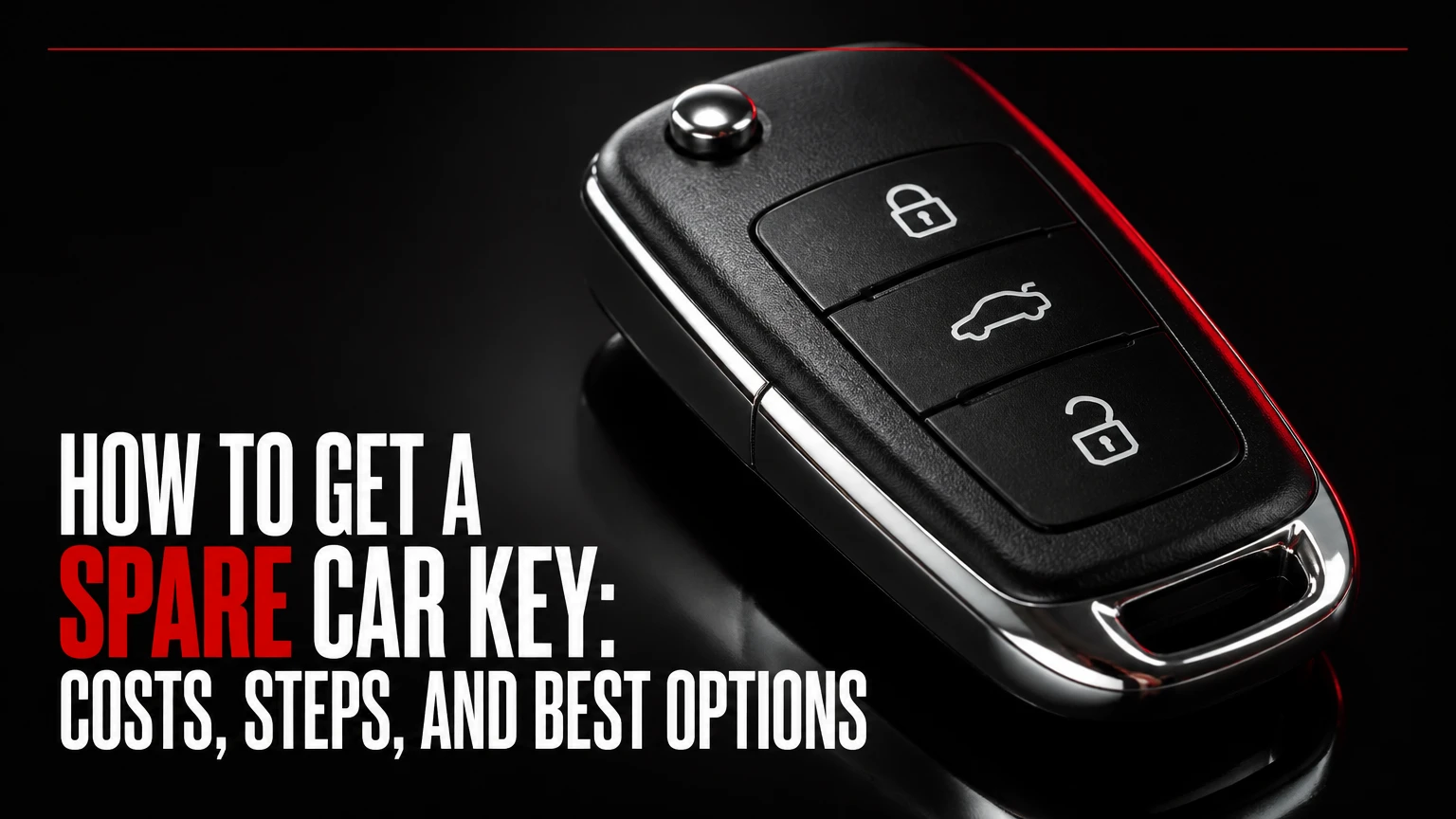
A spare car key is a second, functional key that duplicates the vehicle’s existing access and starting capability. Depending on the car, the duplicate may include a cut metal blade, an immobilizer transponder, remote lock buttons, a proximity chip, or all four components.
A spare is different from a replacement. A replacement restores access after the original is lost or damaged, while a spare is created before an emergency occurs. The distinction matters because a locksmith can usually copy key data from a working key more efficiently than they can recover the vehicle’s security data after every key has disappeared.
A vehicle may have separate key functions. The blade operates a mechanical lock, the remote controls central locking, and the transponder proves authorization to the engine control system. A key that performs only one function is not necessarily a complete duplicate.
Which key type does your car use?
The fastest identification method is to inspect the key and the starting system, then confirm the result with the vehicle’s owner’s manual or a qualified provider.
| Key type | Typical vehicle feature | Starting method | Programming requirement |
|---|---|---|---|
| Mechanical key | Metal blade with no electronics | Ignition cylinder | None on non-immobilizer vehicles |
| Transponder key | Plastic head containing a chip | Insert and turn | Immobilizer programming |
| Remote-head key | Blade and lock buttons in one housing | Insert and turn | Chip and remote pairing |
| Switchblade key | Folding blade inside fob | Insert folding blade | Chip and remote programming |
| Smart key | Proximity fob with no regular ignition slot | Push-button start | Proximity and immobilizer registration |
A plastic key head does not prove that a transponder is present, because some vehicles use plastic housings for non-electronic keys. Conversely, a push-button vehicle may contain an emergency mechanical blade for opening the door when the fob battery fails.
How Do Car Keys Work?
A modern car key combines mechanical alignment, radio communication, and immobilizer authentication. The blade must match the lock, the remote must transmit the correct signal, and the transponder must be recognized by the vehicle’s security module before the engine will run.
The blade contains cuts or laser-milled tracks that match the lock cylinder. The remote uses a vehicle-specific radio system, commonly operating at 315 MHz or 433 MHz depending on market and model. The immobilizer chip has a separate security role and may communicate through a low-frequency antenna around the ignition or inside the cabin.
The engine computer does not authorize a start merely because the blade turns. If the immobilizer rejects the chip, the starter may operate while fuel injection or ignition remains disabled. A remote that locks the doors can therefore be paired successfully even when the key still cannot start the engine.
What information does the locksmith need?
The provider normally needs the vehicle identification number, year, make, model, trim, current key count, and the location of the vehicle. A clear photograph of the existing key, including its markings, can reduce the risk of ordering the wrong housing or remote.
Common ownership documents include:
- Government-issued photo identification
- Vehicle registration
- Vehicle title, where required
- Insurance documentation in some jurisdictions
- VIN visible through the windshield or on the vehicle label
Providers request these details because programming a key grants access to a vehicle. A legitimate locksmith should verify authorization before cutting or programming, particularly when no working key is available.
How to Get a Spare Car Key in Six Steps
The reliable process is to identify the key system, collect vehicle details, obtain an itemized quote, choose a compatible part, arrange cutting and programming, and test every function before payment. Most ordinary duplicates take 30-90 minutes when a working key and suitable equipment are available.
Step 1: Identify the key system
Inspect the original key for a blade, remote buttons, folding mechanism, or proximity operation. Record the number of working keys and whether the current key starts the vehicle, locks the doors, opens the trunk, and operates remote start.
Check the owner’s manual for terms such as transponder, immobilizer, smart key, proximity key, or keyless access. A vehicle’s year alone is not enough to identify the correct part because trim level and production market can change the key system.
You will know this step is complete when: you can describe the key as mechanical, transponder, remote-head, switchblade, or smart.
Common mistake: ordering a visually similar fob before confirming the vehicle’s exact part number.
Step 2: Record the VIN and key markings
Write down the 17-character VIN and photograph every label on the existing key. Markings may include an FCC ID, manufacturer part number, frequency, model code, or transponder reference.
The VIN identifies the vehicle, but it is not the same as the key code. A key code describes the blade’s cut pattern, while the VIN helps an authorized provider retrieve vehicle-specific information. Some manufacturers restrict key-code access to dealers or credentialed locksmiths.
You will know this step is complete when: the provider has the VIN, model year, trim, current key count, and readable key markings.
Common mistake: relying on an online marketplace listing that matches only the vehicle’s year and model.
Step 3: Gather ownership documents
Prepare photo identification and registration before the appointment. If the vehicle is leased, rented, company-owned, or registered to another person, ask the locksmith or dealer which authorization documents are acceptable.
Do not send an unredacted title or identity document to an unverified seller. Provide documents directly to a reputable local provider through its normal verification process.
You will know this step is complete when: the provider confirms that the documents meet its local verification policy.
Common mistake: assuming a VIN alone proves ownership.
Step 4: Compare an automotive locksmith with a dealership
For most vehicles with one working key, request quotes from a licensed or properly credentialed automotive locksmith first. Ask whether the quote includes the key, cutting, immobilizer programming, remote pairing, service call, tax, and testing.
| Decision factor | Automotive locksmith | Dealership | Online part plus technician |
|---|---|---|---|
| Typical hardware cost | $40-$300 | $100-$500 | $20-$250 |
| Typical total cost | $75-$450 | $150-$700+ | $80-$400 |
| Typical appointment time | 30-90 minutes | 1-7 days if ordered | 2-10 days before service |
| Mobile service | Often available | Rarely available | No |
| OEM availability | OEM or aftermarket | OEM | OEM or aftermarket |
| Programming capability | Most mainstream models | Manufacturer-supported models | Depends on local technician |
The American Automobile Association warns that replacement key costs vary widely by vehicle and that modern keys may require programming rather than simple cutting. Pricing should therefore be treated as a vehicle-specific estimate, not a universal fee.
You will know this step is complete when: you have an itemized written quote and a confirmed appointment.
Common mistake: comparing a dealer’s complete price with an online hardware-only price.
Step 5: Have the blade cut and electronics programmed
The technician verifies the key blank, cuts the blade by code or by decoding the existing key, and connects a diagnostic programmer to the vehicle or uses an approved bench procedure. The technician then registers the transponder, remote, or proximity device with the vehicle’s security system.
Some manufacturers require an internet-connected subscription, security token, PIN, or manufacturer authorization. Mercedes-Benz, BMW, Audi, Volvo, and newer vehicles with encrypted systems may require a specialist Euro-locksmith or dealer rather than a generic key-cutting kiosk.
You will know this step is complete when: the duplicate unlocks the door, starts the vehicle, operates the trunk and remote buttons, and works from the expected distance.
Common mistake: accepting a key that starts the vehicle but has not been tested for remote locking, panic, trunk release, or emergency-blade operation.
Step 6: Test and store the spare
Test the duplicate while the technician is present. Insert-key vehicles should start repeatedly, and smart-key vehicles should start with the fob in the normal cabin position and in the manufacturer’s backup location.
Confirm that the original key still works. Some programming procedures can erase previously stored keys, especially when a system is placed into an all-keys programming mode. Ask the technician to verify the final number of registered keys.
Store the spare away from the primary key, ideally in a labeled and secure location at home. Keeping both keys together defeats the purpose of redundancy.
How Much Does a Spare Car Key Cost?
A spare car key typically costs $10-$30 for a basic mechanical duplicate, $75-$250 for a transponder key, $150-$350 for a switchblade or remote-head key, and $200-$600 or more for a smart key. Luxury systems, mobile service, restricted programming, and all-keys-lost situations increase the total.
| Key category | Hardware range | Programming range | Typical total |
|---|---|---|---|
| Mechanical key | $5-$20 | $0 | $10-$30 |
| Transponder key | $30-$120 | $40-$150 | $75-$250 |
| Remote-head key | $70-$180 | $60-$150 | $150-$300 |
| Switchblade key | $80-$220 | $70-$160 | $150-$350 |
| Smart or proximity fob | $100-$400 | $80-$250 | $200-$600+ |
These are typical consumer ranges rather than guaranteed prices. A 2012 compact vehicle with one working key may cost far less than a 2024 luxury SUV using encrypted proximity credentials.
What changes the final price?
The largest pricing variables are key type, vehicle security generation, OEM versus aftermarket hardware, location, programming method, and whether a working key remains. A mobile locksmith may charge a service-call fee but still cost less than towing the vehicle to a dealer.
| Situation | Typical time | Typical total cost | Main price driver |
|---|---|---|---|
| Mechanical duplicate | 5-15 minutes | $10-$30 | Blade blank |
| Transponder duplicate | 20-60 minutes | $75-$250 | Chip programming |
| Smart-key duplicate | 30-120 minutes | $200-$600+ | Proximity security |
| No working key | 1-3 hours | $150-$900+ | Vehicle entry and key generation |
| Restricted luxury system | 1-7 days | $400-$1,200+ | OEM authorization or module work |
Is a Locksmith or Dealership Better?
An automotive locksmith is usually the better choice for speed and value on mainstream vehicles, while a dealership is safer for restricted, encrypted, or warranty-sensitive systems. The correct choice depends primarily on the vehicle’s security architecture and whether at least one registered key remains.
When should you use an automotive locksmith?
Choose a mobile automotive locksmith when you need same-day service, have one working key, or own a mainstream vehicle supported by the technician’s programming equipment. A qualified locksmith can often cut and program the duplicate at your location without towing.
Ask four questions before booking:
- Does the quote include cutting and every programming function?
- Will the technician supply OEM, aftermarket, or refurbished hardware?
- Can the technician program the exact year, trim, and market version?
- What happens if the supplied key fails compatibility testing?
A locksmith is not automatically qualified because the business cuts house keys. Automotive programming requires vehicle-specific diagnostic equipment, security credentials, and experience with immobilizer systems.
When is the dealership worth the extra cost?
Use a dealership when the manufacturer restricts key ordering, the vehicle uses encrypted credentials, the car is under a relevant warranty, or local specialists cannot support the system. Dealerships provide OEM parts and manufacturer-backed procedures, although the key may need to be ordered using the VIN.
Dealership service is less convenient when the vehicle has no working key. The owner may need towing, an appointment, and additional labor for key registration. Ask whether the quoted price includes the physical key, programming, cutting, taxes, and towing.
Is buying a key online cheaper?
Online hardware is often cheaper, but the complete job is not necessarily cheaper because programming remains vehicle-dependent. Buy online only after matching the FCC ID, OEM part number, frequency, blade type, transponder type, buttons, and compatibility with the exact vehicle trim.
Used smart keys are particularly risky. Many proximity fobs retain security data from the first vehicle and cannot be reset for another car. A seller’s statement that a fob “looks new” does not prove that the electronic credential is reusable.
What If You Have Lost All Car Keys?
An all-keys-lost job is more expensive and technically different because the provider must create a key without copying a functioning credential. The technician may need to gain lawful entry, decode or retrieve the blade pattern, generate a compatible key, and erase or re-register missing keys.
| All-keys-lost factor | One working key | No working keys |
|---|---|---|
| Vehicle entry | Usually unnecessary | May require lock picking |
| Blade information | Copied or decoded quickly | Retrieved by code or lock decoding |
| Security action | Add one key | Often reset or re-register keys |
| Typical time | 20-90 minutes | 1-3 hours |
| Typical cost | $75-$600+ | $150-$900+ |
The owner should tell the provider that every key is missing before receiving a quote. A technician may need proof of ownership, the vehicle location, and information about whether the lost key could be used to access the vehicle.
Request that missing keys be removed from the vehicle’s memory when the system supports that function. This prevents a recovered lost key from remaining authorized, although mechanical access and remote functions may require separate security actions.
Can You Program a Spare Key Yourself?
DIY programming is possible on some older vehicles and supported aftermarket kits, but most modern vehicles require a diagnostic tool, security PIN, subscription, or online authorization. The ability to add a key through an ignition sequence depends on the exact model and is not a general method.
Some vehicles support onboard procedures such as cycling the ignition or pressing remote buttons in a specified order. These procedures generally pair a remote function and may not program the immobilizer chip. A remote can lock the doors while the engine still refuses to start.
Before buying a programmer, verify:
- Exact year, make, model, engine, and trim
- Supported key type and transponder
- Whether one working key is required
- Whether the kit includes a new key
- Whether the tool is one-time, rental, subscription, or reusable
- Whether the procedure can erase existing keys
DIY is a poor choice when the vehicle uses encrypted European systems, when all keys are lost, or when a failed procedure could disable communication with a security module. A professional quote may cost less than recovering from an incompatible programmer.
Why Will a New Key Not Start the Car?
A new key that unlocks the doors but will not start the vehicle usually has an unprogrammed or incompatible immobilizer chip. A new key that starts the engine but does not operate the locks usually needs remote pairing, a fresh battery, or the correct radio-frequency configuration.
| Symptom | Likely cause | First check | Proper remedy |
|---|---|---|---|
| Blade will not turn | Wrong cut or damaged cylinder | Compare blade and lock action | Recut or replace blade |
| Doors unlock manually only | Remote not paired | Test buttons and battery | Pair remote or replace fob |
| Doors work, engine will not start | Transponder rejected | Try original key | Program compatible chip |
| Fob works intermittently | Weak battery or interference | Install correct battery | Replace battery and retest |
| Smart key says not detected | Low battery or wrong location | Use backup detection spot | Replace battery or reprogram |
| New key erased old key | Incomplete registration session | Count registered keys | Re-add every authorized key |
A CR2032 battery may correct a weak remote, but it cannot replace immobilizer programming. Do not repeat an ignition-sequence procedure randomly because some systems can enter a deletion or learning mode.
Common Mistakes That Make Spare Keys Expensive
The most expensive mistake is waiting until every key is lost. A duplicate made from one working key usually avoids vehicle entry, lock decoding, and emergency towing, while an all-keys-lost job can add hundreds of dollars.
Other frequent errors include:
- Buying by appearance instead of FCC ID and part number
- Confusing the VIN with the key code
- Assuming every key-cutting kiosk can program an immobilizer
- Buying a used, locked proximity fob
- Comparing hardware-only online prices with complete professional quotes
- Failing to test the trunk, panic button, remote start, and emergency blade
- Allowing a programming session to erase the original key
- Storing the spare beside the primary key
- Ignoring insurance, roadside-assistance, or vehicle-service-plan coverage
- Failing to disclose that the vehicle is a European, hybrid, or high-security model
One practitioner rule is worth remembering: never leave the appointment until the duplicate starts the vehicle twice and operates every button. A key that works only at the shop door may fail later because the technician tested the wrong function.
What Is the Cheapest Reliable Spare-Key Strategy?
The cheapest reliable strategy is usually a basic transponder service key made by an automotive locksmith, provided the vehicle supports it and remote buttons are unnecessary. A service key may cost roughly $75-$150 compared with $200-$600 for a full smart fob, but it may not operate keyless entry or remote start.
A budget strategy should follow this order:
- Confirm whether the car needs a transponder to start.
- Ask for a service-key price and a full-fob price.
- Compare OEM and reputable aftermarket options.
- Include programming, travel, taxes, and testing.
- Keep the full-featured original as the primary key.
Do not choose a cheaper blank if the technician cannot guarantee compatibility. Hardware savings disappear when the key cannot be programmed or when a second appointment is required.
Timing, Documents, and Provider Checklist
Most ordinary spare-key appointments take 30-90 minutes, but ordering a restricted OEM smart key can take one to seven days. The appointment is fastest when the owner supplies the VIN, key photographs, proof of ownership, and confirmation that one working key remains.
Before booking, confirm:
- Vehicle year, make, model, trim, and location
- Key type and number of working keys
- OEM or aftermarket part
- Cutting method and programming method
- Total price, including service call and taxes
- Expected completion time
- Warranty for the key and programming
- Whether lost keys can be removed from memory
- Whether the technician tests all functions
- Whether the provider is licensed, insured, or appropriately credentialed locally
A written quote protects against the most common pricing dispute, which occurs when a low hardware estimate becomes a higher invoice after programming, travel, or diagnostic charges are added.
Frequently Asked Questions
Can a locksmith make a spare car key without the original?
Yes, an automotive locksmith can often create a key without the original by using the VIN, a manufacturer key code, lock decoding, or vehicle diagnostic data. The provider must still verify ownership, and the job may cost more because entry, blade determination, and immobilizer registration require additional work.
Do all spare car keys need programming?
No. A purely mechanical key does not need programming, but an immobilizer transponder, remote-head key, switchblade key, or smart key normally does. The metal blade may open a door without electronics, yet the vehicle can still block engine operation until the chip is registered.
How long does a spare key battery last?
A key-fob battery commonly lasts one to three years, depending on button use, passive-entry activity, temperature, and storage. Battery replacement fixes weak remote range or intermittent buttons, but it does not repair a wrong frequency, locked fob, damaged circuit board, or unprogrammed transponder.
Can a dealer program an aftermarket car key?
A dealership may refuse aftermarket hardware or may program only parts that meet its manufacturer policy. Some aftermarket keys work correctly when their part number, frequency, chip, and firmware match the vehicle, but the owner should confirm acceptance before buying the part.
Should you keep a spare car key in the vehicle?
No. A spare stored inside the vehicle does not help when the vehicle is locked and can increase theft risk. Keep the spare at a secure, separate location, and avoid attaching identifying registration or address information to the key ring.
Does car insurance cover a spare key?
Coverage depends on the policy and the reason for replacement. Comprehensive coverage, roadside assistance, manufacturer service plans, lease agreements, or aftermarket key insurance may contribute to a lost-key replacement, but deductibles and exclusions can make self-payment cheaper for low-cost mechanical keys.
The Bottom Line
The best way to get a spare car key is to identify the exact key system, collect the VIN and ownership documents, and obtain an itemized quote from an automotive locksmith or dealership. For most mainstream vehicles with one working key, a mobile locksmith offers the best balance of speed and cost. For restricted luxury systems, use a specialist or the manufacturer dealer.
Make the duplicate before the original disappears. Testing the blade, immobilizer, remote, trunk, panic function, and smart-entry system during the appointment prevents a partial copy from becoming an emergency later. A carefully verified spare car key is cheaper, faster, and safer than an all-keys-lost replacement.