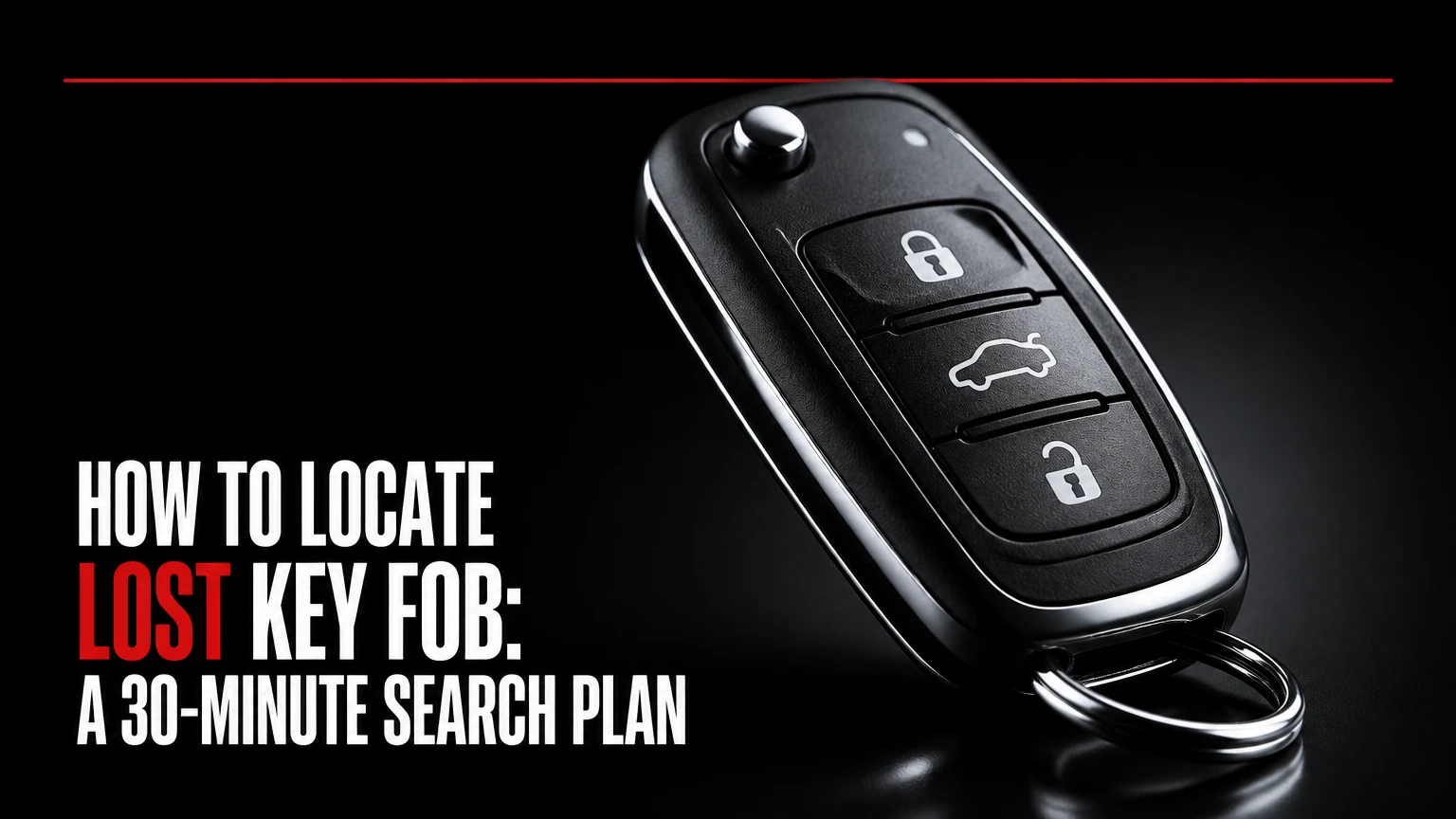
To locate a lost key fob, first inspect the vehicle and every transition zone, then retrace your last route using a timed room-by-room grid. A reliable search usually takes 15-30 minutes. Bluetooth tracking works only if a tracker is attached, while a replacement requires the vehicle identification number, exact model details, and compatible programming.
Key Facts at a Glance
A standard key fob usually cannot report its own location unless an AirTag, Tile, SmartTag, or similar tracker is attached.
A proximity key may be inside the vehicle even when the car remains unlocked or starts normally.
Pressing a remote button from a distance is more useful than randomly searching, but a dead fob battery can prevent any response.
A vehicle handle test cannot reliably prove that a fob is exactly 3-5 feet away because detection zones vary by model.
A mobile automotive locksmith is often faster and less expensive than a dealership, but compatibility for newer luxury vehicles varies.
If a fob was stolen, locating it is only half the problem. Ask the manufacturer or qualified technician whether the missing key can be deleted from vehicle memory.
How Does a Key Fob Work?
A key fob authenticates a vehicle through a coded wireless exchange, but the communication method depends on the fob type. Button-operated remotes send a radio-frequency command after a button press, transponder keys exchange identification near the immobilizer antenna, and proximity systems detect a fob through short-range vehicle antennas before authorizing entry or starting.
Most remote-entry fobs contain a microcontroller, coded memory, buttons, a coin-cell battery, and a radio transmitter. Modern vehicles commonly use rolling or cryptographic codes rather than transmitting one permanent unlock code, which makes a recorded previous transmission less useful to an attacker.
Proximity systems are more complicated than ordinary clickers. The vehicle can transmit a low-frequency wake-up signal around the cabin and door areas, while the fob returns information over a higher-frequency radio link. The precise frequencies, antenna locations, and detection distances differ by manufacturer, market, and model year.
That difference matters during a search. A normal fob does not provide GPS, cellular location, or an automatic map pin. The vehicle can sometimes confirm that a compatible proximity fob is nearby, but it generally cannot tell you which room, bag, or piece of furniture contains it.
What Should You Do Before Searching?
Before searching, prevent the common errors that waste time or create a security problem. Park the vehicle safely, gather a flashlight and wastebasket, open any tracker app, and write down the last confirmed time and location of the fob.
Before You Start
| Item | Typical requirement | Why it matters |
|---|---|---|
| Search time | 20-30 minutes | Prevents repetitive random searching |
| Flashlight | 1 phone light or LED torch | Reveals dark gaps under seats and furniture |
| Containers | 1 basket or box | Lets you empty bags without losing small items |
| Tracker app | 1 installed app, if applicable | May show last known Bluetooth location |
| Vehicle details | VIN, year, make, model, trim | Required if replacement becomes necessary |
| Working spare | 1, if available | Allows vehicle access and confirms the car battery status |
Do not repeatedly press a fob button while driving or while someone is walking near traffic. If you are in a public place, avoid announcing that a vehicle key is missing, and do not leave the vehicle unlocked while searching elsewhere.
How to Locate Lost Key Fob Without Guessing
A systematic key-fob search should move from high-probability locations to reconstructed travel routes, using one timed pass per area. Start with the vehicle, then search entry points, clothing, bags, surfaces, floor-level gaps, and containers in the order the fob was probably handled.
Step 1: Inspect the Vehicle First
Check the driver’s seat, passenger seat, center console, cupholders, door pockets, under-floor storage, trunk, cargo area, and the space beside each seat rail. A key fob often remains in the car because people place it down while loading groceries, children, tools, or luggage.
For a push-button vehicle, try the normal start procedure only if the car is safely parked and you have the authorized spare or the found fob. Do not repeatedly operate the locks if the vehicle is in a public area. A car that starts without a warning does not prove that the missing fob is inside, because some vehicles can continue running after the fob leaves the detection zone.
You will know this step is complete when: every compartment has been opened, lifted, or illuminated, including the area beneath removable mats.
Common mistake: checking only the visible seats. Dark fobs disappear against floor carpeting and can slide beneath seat rails.
Step 2: Search Transition Zones
Transition zones are the places where a person changes activity or crosses between spaces. Search the entry table, key bowl, kitchen counter, garage shelf, porch, stair landing, workbench, bedside table, and the floor beside doors.
Empty each bag completely rather than patting its outside. Check laptop sleeves, grocery totes, gym bags, stroller storage, coat pockets, reusable shopping bags, and the narrow space between a bag’s lining and shell. A fob can remain in a pocket after the clothing has moved to a chair, laundry basket, or dryer.
You will know this step is complete when: every container has been emptied onto a clear surface and every entry point has been checked from floor level upward.
Common mistake: searching the place where the fob normally belongs instead of the last place it was physically handled.
Step 3: Reconstruct the Last Confirmed Route
Write the last confirmed sequence as locations, not impressions. For example: vehicle, driveway, garage, mudroom, kitchen, bedroom, laundry room. Mark the last point where you remember holding, hearing, or using the fob.
Search in the same direction as the original movement. Look at waist height first, then chairs and counters, then the floor and gaps. Handle objects that could have displaced the fob, including mail, blankets, shopping bags, towels, and children’s toys.
Use a clockwise grid in each room. Divide a room into four zones, complete one zone before moving on, and do not carry loose objects between unfinished zones. This prevents a fob from being moved while you search.
You will know this step is complete when: each route segment has one completed pass and no zone contains an unchecked pile, pocket, or container.
Common mistake: repeatedly scanning a room from the doorway. Familiar surroundings create visual filtering, so the eye overlooks an object in its expected place.
Step 4: Search Low, Narrow, and Soft Areas
Use a flashlight held close to the floor. Shine the beam parallel to the surface under sofas, beds, cabinets, car seats, ottomans, and appliances. A low beam creates shadows behind a small object that overhead lighting can hide.
Check inside couch creases, under removable cushions, beneath rugs, behind curtains, between mattresses and walls, and inside laundry. Shake clothing one item at a time over the basket. Do not shake garments near drains, stairs, pets, or open outdoor areas.
A fob may also be attached to a key ring that has separated, hidden inside a coat lining, or fallen behind a drawer. Inspect the key ring itself if you find loose keys, because the missing fob may have detached rather than disappeared with the entire set.
You will know this step is complete when: soft furniture, laundry, and floor gaps have been inspected with hands or a flashlight, not merely viewed.
Common mistake: using a vacuum before completing the search. If the fob enters the vacuum, it may be damaged or difficult to retrieve.
Can the Vehicle Help You Find the Fob?
A vehicle can sometimes confirm that a compatible proximity fob is nearby, but the handle or start test cannot locate a standard remote fob and cannot map the exact position of a smart key. Detection distance depends on antenna layout, body panels, battery condition, vehicle battery voltage, and the manufacturer’s software.
If the vehicle has proximity entry, carry no other compatible key and test one door handle at a time. A response may indicate that the fob is within the vehicle’s detection zone, but the zone can extend through walls, windows, or adjacent spaces. Treat the result as evidence, not a measurement.
A button-operated remote can be tested by pressing lock or unlock from likely search areas. The car horn, hazard lights, or locks may respond if the fob battery and vehicle receiver work. No response does not prove the fob is absent because the battery may be depleted, the vehicle battery may be flat, or the fob may be shielded inside metal luggage.
The practical rule is simple: use the car to narrow a search, not to replace a physical grid search.
Can an AirTag or Tile Locate a Key Fob?
An AirTag, Tile, Samsung SmartTag, or similar Bluetooth tracker can help locate a key ring only when the tracker was attached before the fob went missing. The tracker app may show a recent location, provide Bluetooth proximity guidance, or trigger a sound, but an ordinary key fob has no built-in location service.
| Tracking method | Typical range or capability | Works without prior attachment? | Main limitation |
|---|---|---|---|
| Apple AirTag | Nearby Bluetooth finding; Find My network location | No | Battery and privacy alerts can limit usefulness |
| Tile tracker | Bluetooth proximity and last-seen location | No | Exact range varies by phone and obstruction |
| Samsung SmartTag | Galaxy-based Bluetooth and SmartThings location | No | Best results require compatible Samsung devices |
| Vehicle proximity test | Model-specific detection zone | Partly | Confirms presence only, not a precise room |
| Remote button test | Usually tens of feet outdoors, model dependent | Yes | Dead battery or shielding can block the signal |
Open the tracker app before moving objects. If the app shows a recent location at home, move slowly through the indicated area and use the sound function. If the last location is a shop, workplace, or parking lot, call the location before returning, since the tracker may have moved with another person.
Trackers are not a substitute for a theft response. Their location can be delayed, inaccurate indoors, or associated with the phone that last detected them.
How Do You Identify the Correct Replacement Fob?
Identify a replacement by the vehicle’s year, make, model, trim, VIN, fob FCC ID or regional equivalent, original part number, button layout, blade style, and programming method. Visual similarity alone is insufficient because two shells can contain different radio hardware, immobilizer systems, or software compatibility.
The VIN is usually visible through the driver-side windshield or on registration and insurance documents. A provider may also need proof of ownership and government identification before cutting or programming a key.
| Fob information | Where to find it | Why providers need it |
|---|---|---|
| VIN | Dashboard plate, registration, insurance card | Confirms vehicle identity and configuration |
| FCC ID or part number | Back of fob, internal circuit board, manual | Matches radio and immobilizer hardware |
| Frequency or market | Owner manual, manufacturer data | Prevents regional compatibility errors |
| Button layout | Existing spare, manual, product listing | Confirms lock, trunk, panic, and start functions |
| Blade type | Hidden emergency key or ignition slot | Determines cutting equipment and blank |
| Programming status | Owner manual or technician scan | Identifies DIY, onboard, or diagnostic programming |
If a working spare exists, photograph its front, back, markings, and emergency blade. Do not publish the VIN or key markings online. Send those details privately to a verified provider.
Which Replacement Path Is Usually Best?
A mobile automotive locksmith is usually the fastest lower-cost option for an ordinary vehicle, while a dealership is the safer choice for a newer, high-security, luxury, leased, or warranty-covered vehicle. Online hardware can reduce the initial price, but compatibility and programming failures can erase the saving.
| Provider | Typical hardware and service cost | Typical time | Best fit |
|---|---|---|---|
| Mobile automotive locksmith | $120-$450 | 30-120 minutes | Common vehicles, lockouts, on-site programming |
| Dealership | $250-$900 or more | Same day to several days | OEM security systems, luxury vehicles, warranty cases |
| Online fob plus technician | $70-$300 hardware and service | 1-7 days | Older vehicles with a verified part match |
| Roadside assistance referral | $100-$500 | 30-180 minutes | Immediate lockout or roadside recovery |
| Insurance-approved replacement | Deductible or covered amount | Policy dependent | Comprehensive coverage or key-care benefit |
Prices are typical US ranges, not universal quotes. Smart keys for premium brands, electric vehicles, all-keys-lost situations, and vehicles requiring dealer security codes can exceed these figures.
Ask every provider four questions before authorizing work: Is the replacement OEM or aftermarket? Does the quoted price include cutting and programming? Will existing keys remain active? What warranty covers a failed part or unsuccessful programming?
What Are the Main Fob Types and Costs?
Key-fob cost depends more on the vehicle’s immobilizer and programming requirements than on the plastic housing. A simple remote may cost less than $150, whereas a current proximity fob with dealer-only authorization can exceed $600 before towing or diagnostic charges.
| Key type | Main hardware | Typical replacement total | Typical service time |
|---|---|---|---|
| Remote with metal key | Radio remote and cut blade | $80-$250 | 20-60 minutes |
| Transponder key | Cut blade and immobilizer chip | $100-$300 | 20-60 minutes |
| Flip or laser-cut key | Folding housing and high-security blade | $150-$400 | 30-90 minutes |
| Smart proximity fob | Passive entry, push-start authentication | $250-$900+ | 45-180 minutes |
| Luxury or specialized smart key | OEM encrypted module and dealer access | $500-$1,500+ | 1-5 business days |
Insurance policies differ significantly. The Insurance Information Institute explains that comprehensive coverage generally addresses theft and vandalism, while lost-key replacement depends on the specific policy, roadside benefit, or added key-care coverage. Confirm the deductible before filing a claim, because a $250 replacement may not justify a $500 comprehensive deductible.
What Should You Do If the Fob Was Stolen?
If the fob may have been stolen, secure the vehicle first and ask whether the missing key can be removed from the vehicle’s authorized-key list. A replacement alone does not necessarily disable a stolen fob, although many vehicles allow a technician or dealer to erase and reprogram keys.
Move the vehicle to a locked garage or a monitored location if possible. Do not store registration papers, spare keys, or the vehicle address with the remaining fob. Contact the manufacturer, dealership, insurer, or qualified locksmith and describe the theft rather than an ordinary loss.
Ask for written confirmation of these services:
- Delete the missing fob from memory, where the vehicle supports deletion.
- Program the replacement and verify the working spare.
- Test door unlock, trunk release, immobilizer authorization, and emergency blade entry.
- Confirm whether remote-start permissions or digital keys require separate reauthorization.
What If You Lost the Only Fob?
If no working key remains, expect higher cost and longer service because the provider must verify ownership, gain entry, cut a key, and program a new authorized device. Some vehicles require a security code, online manufacturer account, or dealer diagnostic connection.
Do not attempt forced entry. Broken glass, bent door frames, and damaged weather seals cost more than many replacement services and can create a second security problem.
Common Mistakes and How to Fix Them
Buying by Appearance
A fob shell can match your vehicle while the circuit board, FCC ID, transponder, or frequency does not. Compare the original part number and markings with the replacement listing, then confirm compatibility with the technician before purchase.
Assuming All Frequencies Are Universal
Common remote frequencies include 315 MHz and 433.92 MHz, but market-specific variants and communication protocols differ. Frequency alone does not prove compatibility. The part number, immobilizer generation, button configuration, and vehicle market also matter.
Forgetting the Emergency Blade
Many smart keys contain a removable mechanical blade for unlocking the driver’s door when the coin-cell battery or vehicle battery is dead. Have the blade cut and test it in the door cylinder before leaving the provider.
Deleting the Spare Key
Some programming procedures can erase keys, while others add a new key without deleting existing devices. Tell the technician to preserve the spare and request a post-programming test.
Treating a Dead Battery as a Lost Fob
A failed CR2032 or CR2025 battery can make a nearby fob appear absent. Replace the coin cell with the correct orientation, keep the old battery away from children and pets, and follow the owner manual for emergency starting.
Why Might a Found Fob Still Not Work?
A found key fob may fail because of a depleted coin cell, water damage, broken solder joints, a damaged button membrane, vehicle battery failure, receiver faults, or lost programming. The symptom helps separate the fob problem from the vehicle problem.
| Symptom | Likely cause | First diagnostic action |
|---|---|---|
| No buttons work | Dead battery or damaged circuit | Replace the specified coin cell |
| Vehicle starts but remote fails | Remote battery or buttons | Test lock and unlock after battery replacement |
| Remote works but car says key not detected | Proximity antenna or fob battery | Use the manual emergency-start position |
| Spare also fails | Vehicle battery, receiver, or antenna | Check vehicle battery voltage and manual |
| Intermittent operation | Weak battery, water, damage, or interference | Inspect contacts and test away from electronics |
| Fob worked after washing | Liquid damage or corrosion | Stop repeated testing and seek repair advice |
Signal interference is possible, but it is often overdiagnosed. Test in an open area before blaming cell towers or household appliances. If the spare works normally in the same location, the found fob is more likely damaged or unprogrammed.
How Can You Prevent Losing the Fob Again?
Attach a tracker, create one fixed drop zone, and enable a left-behind alert when your phone supports it. Prevention works best when the key has one storage location and the alert is tested in the places where you regularly park.
Choose a tracker with a replaceable battery and a sound loud enough for furniture gaps. Attach it securely without blocking the emergency blade or stressing the fob housing. Review unwanted-tracking notifications and household privacy settings, especially when a tracker is shared between family members.
A fixed habit is more dependable than a more expensive fob. Put the key down only in the entry zone, use a bright case, and attach it to a larger ring that cannot slip into a seat rail.
FAQ
Can I call my car to make a lost key fob beep?
Usually no. Most vehicles can receive lock, unlock, or panic commands, but they cannot make an untracked fob emit a locating sound. A tracker such as AirTag, Tile, or SmartTag must already be attached for an app-based sound function.
Will a metal box block a key fob signal?
A conductive metal container can reduce or block radio communication, but effectiveness depends on gaps, construction, and frequency. A fob inside a metal case may not respond during a remote-button test, so inspect bags and containers physically instead of treating silence as proof of absence.
Can I start my car with a dead key-fob battery?
Often yes, if the vehicle has an emergency recognition procedure. Many models require placing the fob against a marked start-button area or inserting it into a backup slot, but the exact location varies. Use the owner manual rather than guessing.
Does changing a fob battery erase its programming?
Replacing the coin cell normally does not erase the vehicle’s authorization programming because the key’s memory is separate from the battery. Damage during opening, incorrect battery installation, or a model-specific fault can still cause failure, so test every function afterward.
Should I report a lost key fob to my insurer?
Report the loss when the policy includes key replacement, roadside coverage, theft protection, or a vehicle security requirement. Compare the replacement price with the deductible and ask whether the insurer requires an approved locksmith or dealership invoice.
How long should I search before ordering a replacement?
Complete one disciplined 20-30 minute search, check any tracker’s last location, and call places visited since the last confirmed use. Order a replacement sooner if you are stranded, have no spare, or suspect theft, because programming and security verification may take several hours.
The Bottom Line
To locate lost key fob, inspect the vehicle, retrace the last confirmed route, empty every bag and pocket, and search each room in a timed grid. A tracker can provide a location only when attached beforehand, and a proximity handle test offers limited confirmation rather than precise distance. If the fob remains missing, identify the VIN, part number, FCC ID, blade type, and programming requirements before comparing a mobile locksmith with the dealership. If theft is possible, request deletion of the missing fob from vehicle memory instead of merely adding another key.