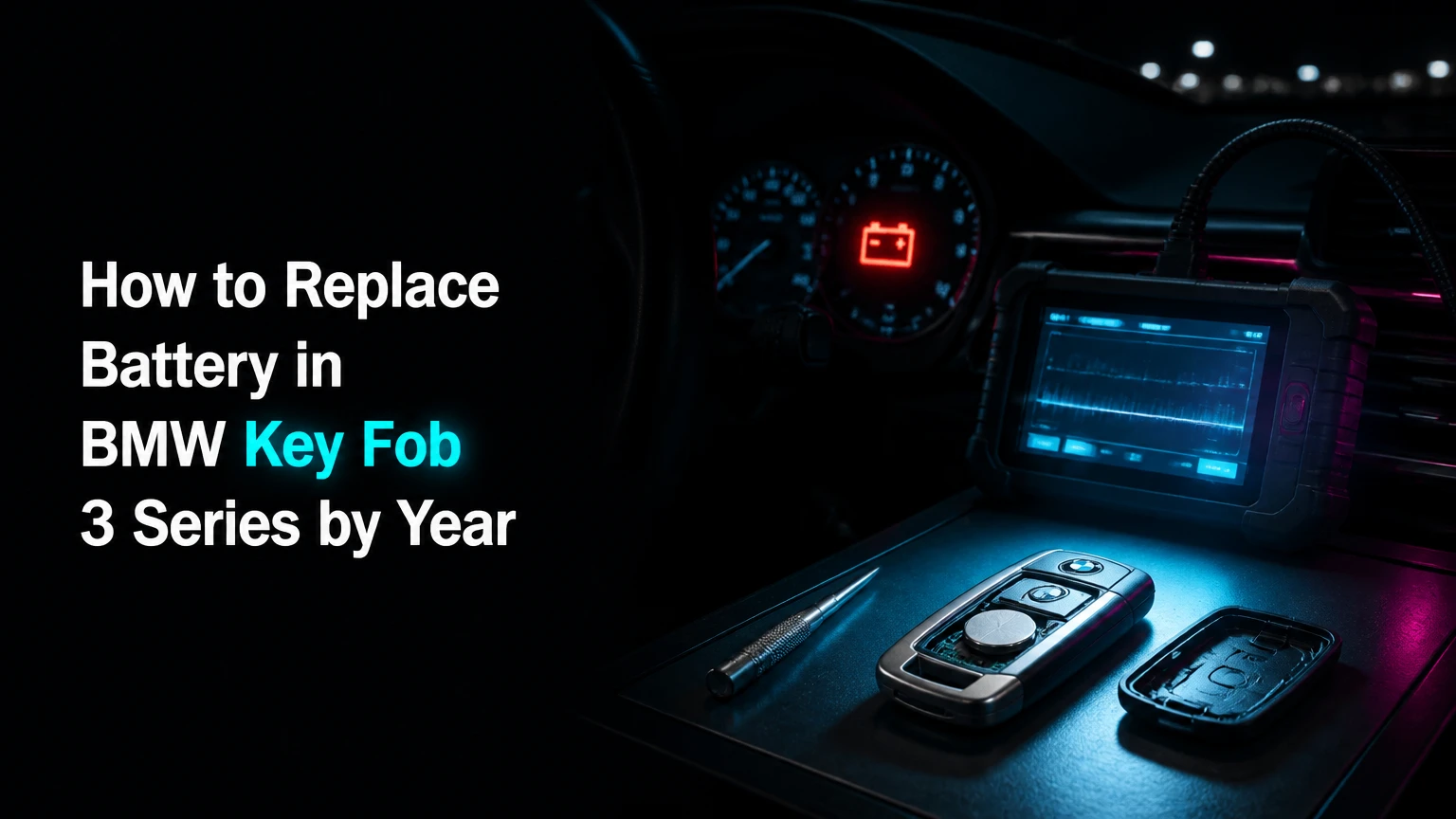
Replacing a BMW 3 Series key-fob battery usually takes 2-5 minutes, but the correct cell depends on the key design and model generation. F30 keys commonly use a CR2450, G20 keys commonly use a CR2032, while older sealed BMW keys may contain a rechargeable VL2020 that requires soldering rather than a simple battery swap.
Key Facts at a Glance
- A 2012-2018 BMW 3 Series F30 key commonly uses a CR2450 coin cell.
- A 2019-present BMW 3 Series G20 standard remote commonly uses a CR2032.
- A sealed diamond-style BMW key may use a rechargeable VL2020 battery.
- The number printed on the existing battery is more reliable than the vehicle year alone.
- Replacing a coin cell normally does not erase the BMW key’s immobilizer programming.
- A BMW Display Key uses internal rechargeable power and is not opened like a standard coin-cell remote.
Which Battery Does Your BMW 3 Series Key Need?
The key’s housing determines the battery more reliably than the BMW 3 Series model year. Compare the key with the table below, then confirm the marking printed on the installed cell or the replacement instructions for that exact remote.
| BMW generation or key type | Typical years | Battery or power source | Case design | Typical DIY time |
|---|---|---|---|---|
| G20 standard remote | 2019-present | CR2032, 3 volts | Slim case with removable rear cover | 2-4 minutes |
| F30 standard remote | 2012-2018 | CR2450, 3 volts | Sloped case with key-release slot | 2-4 minutes |
| E90 Comfort Access remote | 2006-2011 | Varies by remote revision | Battery door or serviceable rear section | 3-5 minutes |
| Older diamond-style remote | Usually before 2012 | Rechargeable VL2020 or equivalent | Factory-sealed case | 30-90 minutes |
| BMW Display Key | Selected newer models | Internal rechargeable battery | LCD touchscreen housing | 5-30 minutes for charging |
BMW used multiple remote designs during overlapping production periods and markets. An imported vehicle, replacement shell, or second-hand key can therefore make a year-based lookup misleading.
How can you identify the key without knowing the generation?
Remove the emergency blade and inspect the exposed recess, rear cover, and battery marking. A removable hatch indicates a serviceable design; a fully bonded or welded perimeter indicates a rechargeable sealed key that should not be pried open casually.
Check these details:
- Look for “CR2032,” “CR2450,” “VL2020,” or another code on the cell.
- Compare the battery thickness. A CR2450 is approximately 5.0 mm thick, while a CR2032 is approximately 3.2 mm thick.
- Check whether the rear cover has a notch, hatch, or visible seam.
- Confirm that the key has ordinary buttons rather than an LCD screen.
- Photograph the battery orientation before removing it.
The battery code is the final confirmation. Never force a thinner CR2032 into a holder designed for a CR2450, because weak spring pressure can cause intermittent locking and unlocking.
What Do You Need Before Starting?
A standard replaceable BMW 3 Series key requires one correctly sized 3-volt lithium coin cell and a small plastic pry tool or flat-head screwdriver. The job normally costs $4-$12 for a reputable battery and requires no key-programming equipment.
| Requirement | Typical specification | Quantity or range | Why it matters |
|---|---|---|---|
| Replacement cell | CR2032 or CR2450, 3 volts | 1 | Exact fit and voltage |
| Pry tool | Plastic trim tool, 1-3 mm tip | 1 | Reduces shell scratches |
| Small screwdriver | Flat blade, approximately 2-3 mm | 1 | Useful when no plastic tool exists |
| Clean work surface | Dry, light-colored table | 1 | Prevents lost clips and pins |
| Work time | Standard coin-cell remote | 2-5 minutes | Includes testing |
| Typical DIY cost | Panasonic, Energizer, Duracell, or equivalent | $4-$12 | Price varies by pack size |
Use a fresh battery in sealed retail packaging. Lithium coin cells lose useful service life when stored in hot vehicles, and a battery that has sat loose in a drawer may have a lower voltage before installation.
Which battery brands are suitable?
Panasonic, Energizer, Duracell, Maxell, and other major manufacturers are reasonable choices when the code and expiration date are correct. The brand matters less than authentic packaging, dry contacts, correct thickness, and a recent production date.
Do not stack two coin cells. Do not substitute a CR2025 for a CR2450 merely because the diameter matches. The thinner cell can move inside the holder, and the replacement may work only when the fob is squeezed.
How to Replace a BMW 3 Series Key-Fob Battery
The replacement procedure has five practical stages: identify the cell, remove the emergency blade, open the correct seam, install the new battery with matching polarity, and test every function. Stop if the housing resists normal hand pressure, because sealed rechargeable keys can be damaged by aggressive prying.
Step 1: Remove the Emergency Key
Press the small release button on the side or rear of the BMW key and pull the metal emergency blade from its slot. Place the blade beside the fob rather than using it immediately as a lever.
You should see a recessed opening or seam after removing the blade. Keep the emergency key available because some F30 covers are designed to release from the recess with the blade tip.
Success checkpoint: The metal blade comes out without bending, and the key housing remains intact.
Common mistake: Pulling on the blade without pressing the release button can damage the retention mechanism.
Step 2: Open the F-series case
For most 2012-2018 F30 remotes, insert a plastic pry tool or the tip of the emergency blade into the notch inside the blade recess. Twist gently to release the rear cover, then work around the perimeter only as far as necessary.
F30 shells can have tight clips. Use several small movements instead of one forceful twist, because a cracked cover can allow the CR2450 to move away from its contacts.
Success checkpoint: The rear cover separates evenly and the circuit board remains seated in the front half.
Common mistake: Inserting a screwdriver deeply into the housing can scratch the board or break the battery contact.
Step 3: Open the G20 case
For a standard 2019-present G20 remote, begin at the opening near the keyring loop or the designated rear-cover slot. Use a thin plastic tool or small flat blade and release the cover gradually along the seam.
The G20 remote design differs by market and equipment, so the exact starting slot can vary. If the cover does not release with light pressure, recheck the seam instead of forcing the buttons or screen area.
Success checkpoint: The rear panel lifts away while the buttons and circuit board stay in their original positions.
Common mistake: Prying against a button can dislodge the rubber button mat and create a second fault after the battery replacement.
Step 4: Install the replacement coin cell
Lift the old battery from the holder without bending the metal spring. Install the new CR2450 in a typical F30 remote or CR2032 in a typical G20 remote, matching the polarity marking inside the housing.
In most standard BMW remotes, the positive side marked “+” faces upward. Confirm the orientation against the old cell and the molded diagram, because the circuit-board layout can differ between key revisions.
Success checkpoint: The cell sits flat, the retaining clip engages its edge, and no metal contact is trapped underneath.
Common mistake: Touching both battery faces repeatedly with greasy fingers can leave residue on the contact surfaces. Hold the cell by its edge and wipe it with a clean, dry cloth if needed.
Step 5: Close and test the key
Align the rear cover with the housing and press around the perimeter until every clip snaps into place. Reinsert the emergency blade, then test lock, unlock, trunk release, and panic functions from several feet away.
Test passive entry separately if the vehicle has Comfort Access. Remote-button operation and hands-free door-handle operation use related but distinct functions, so one can work while the other remains faulty.
Success checkpoint: The vehicle responds consistently, the cover has no raised corner, and the emergency blade locks into position.
Common mistake: Testing only the lock button misses a damaged unlock contact or a Comfort Access problem.
How Do E90 Keys Differ?
E90 BMW 3 Series keys require closer identification because Comfort Access and standard remotes can use different internal battery arrangements. A key with a genuine removable battery door may accept a replaceable cell, while a sealed E90 key commonly contains a rechargeable battery that requires case opening and soldering.
E90 key with a removable battery door
Remove the emergency blade, locate the small rear battery hatch, and release the hatch with a coin or the blade tip. Replace the marked cell with the positive side facing the same direction as the original, then snap the door closed.
Use the number printed on the removed battery rather than assuming every 2006-2011 E90 key uses CR2032. Some replacement remotes and regional versions differ.
Sealed E90 or older diamond key
A sealed diamond key cannot receive a simple drop-in coin-cell replacement. BMW owner documentation for rechargeable-key designs uses wording such as, “The battery is integrated into the vehicle key and cannot be replaced,” although exact wording varies by model and market.
Repairing one involves cutting or opening the plastic case, desoldering the failed rechargeable cell, installing a compatible tabbed VL2020, and resealing the housing. The circuit board, antenna coil, and immobilizer components are easy to damage, so a specialist locksmith is usually safer than a first-time soldering attempt.
Does a BMW Key Need Resynchronizing?
A normal battery replacement does not remove the BMW key’s immobilizer authorization or require dealer programming. If the remote buttons stop responding after installation, first verify battery polarity, cell thickness, contact pressure, and cover fit before attempting an initialization sequence.
Modern F30 and G20 checks
Hold the key against the steering-column key symbol or the vehicle’s specified emergency-detection area and press the Start/Stop button if the vehicle does not detect the key. This procedure helps the car read a weak or poorly transmitting key; it does not repair an incorrectly installed battery.
If the engine starts but the buttons do not work, the transponder is probably recognized and the fault is in the remote power or radio section. A new battery, clean contacts, or a damaged housing repair may be required.
Older E-series initialization
For many E-series BMW remotes, use this sequence:
- Enter the vehicle and close all doors.
- Insert the key and turn it briefly to accessory position, without starting the engine.
- Turn the ignition off and remove the key.
- Hold the unlock button.
- Press the lock button three times quickly while continuing to hold unlock.
- Release unlock and wait for the locks to cycle.
- Repeat the sequence for additional keys within approximately 30 seconds.
Exact procedures vary by E-series model and market. If the locks do not cycle, consult the vehicle’s owner manual or a BMW diagnostic specialist rather than repeating the sequence indefinitely.
What If the New Battery Does Not Work?
A failed replacement usually results from the wrong cell, reversed polarity, weak contact pressure, a damaged shell, or a fault unrelated to the battery. Diagnose the key and vehicle separately so a low vehicle battery or receiver problem is not mistaken for a bad remote.
| Symptom after replacement | Most likely cause | Immediate check | Practical remedy |
|---|---|---|---|
| No buttons work | Reversed cell or dead battery | Confirm “+” direction and measure near 3 volts | Reinstall or replace cell |
| Lock works only when squeezed | Wrong thickness or loose contact | Check CR2032 versus CR2450 | Install exact marked type |
| Engine starts, buttons fail | Remote transmitter fault | Try spare key and emergency detection | Repair or replace remote |
| Buttons work, Comfort Access fails | Door-handle sensor or key antenna issue | Test both sides and trunk area | Diagnose Comfort Access system |
| Cover will not close | Cell installed incorrectly | Inspect holder and retaining clip | Refit cell without force |
| Both keys fail | Vehicle receiver or car battery issue | Test vehicle battery and spare key | Obtain vehicle-level diagnosis |
When buttons work but Comfort Access fails
Comfort Access depends on proximity antennas, door-handle sensors, the key’s passive-entry circuit, and adequate vehicle voltage. A coin-cell replacement may restore button operation without restoring hands-free entry if the handle sensor, antenna, or key circuit has another fault.
Test the spare key at the same door. If both keys fail at one handle, suspect the handle or local antenna; if one key fails everywhere, suspect that key.
When the key shows water or impact damage
Do not install a battery into a visibly corroded remote and assume the problem is solved. Remove surface residue only if the circuit board is safely accessible, and use a locksmith or electronics repair technician when corrosion reaches the board, antenna, or battery contacts.
Can You Replace a Sealed BMW Key Yourself?
You can replace a sealed-key rechargeable battery yourself only if you have fine-tip soldering equipment, a compatible tabbed VL2020, case-opening tools, and experience protecting circuit boards. A replacement shell or professional repair is safer when the key is the only functioning remote.
The main risks are cutting into the board, overheating solder pads, installing the cell backward, damaging the antenna coil, and failing to reseal the case against moisture. A used key from another BMW is not automatically a plug-and-play substitute because immobilizer authorization and vehicle pairing are separate from the battery.
A locksmith can often repair the original electronics or supply a programmed replacement. A BMW dealer can order and authorize a new key, but the price is typically far higher than a standard coin cell.
How Much Time and Money Does Replacement Take?
A standard F30 or G20 coin-cell replacement typically takes 2-5 minutes and costs $4-$12 at home. Dealer or locksmith pricing commonly ranges from $15-$50 for a simple battery service, while sealed-key repair or a fully new programmed key can cost substantially more.
| Service or option | Typical price | Typical time | Best use case |
|---|---|---|---|
| DIY CR2032 replacement | $4-$10 | 2-4 minutes | G20 standard remote |
| DIY CR2450 replacement | $5-$12 | 2-5 minutes | F30 standard remote |
| Retail or dealer battery service | $15-$50 | 10-30 minutes | Owner wants installation |
| Sealed-key battery repair | $40-$100 | 30-90 minutes | Original key electronics still work |
| New programmed BMW key | $200-$500+ | Same day to several days | Lost, damaged, or unusable key |
Prices vary by country, dealer labor rate, key availability, and whether the remote is a standard key or Display Key. Treat these figures as typical consumer ranges, not fixed BMW pricing.
What Mistakes Damage BMW Key Fobs?
The most expensive mistake is opening a sealed rechargeable key as though it were a replaceable CR2032 remote. The next most common errors are installing the wrong thickness, forcing the cover, losing the emergency blade release, and diagnosing a vehicle receiver fault as a battery problem.
Avoid these practices:
- Do not use a CR2032 where the holder is marked CR2450.
- Do not pry through the button face or LCD screen.
- Do not short the coin cell across a screwdriver and the retaining clip.
- Do not bend spring contacts upward aggressively.
- Do not discard the old cell until the new orientation is confirmed.
- Do not place loose lithium coin cells near children or pets.
- Do not assume a dealer must reprogram a key after every battery change.
Practitioner rule: If the remote worked intermittently before replacement, inspect contact pressure and shell distortion, not only battery voltage. A fresh cell cannot compensate for a holder that has lost mechanical tension.
Display Key and Rechargeable-Key Exceptions
A BMW Display Key does not use a replaceable CR2032 or CR2450 in the normal user procedure. The touchscreen key charges through its designated USB connection or a compatible wireless charging surface, depending on the model and supplied equipment.
Older diamond-shaped BMW remotes also use rechargeable internal cells in many applications. These keys charge through the vehicle during normal use, so a battery that no longer holds power may need electronics repair rather than a coin-cell swap.
BMW owners should identify the housing before buying a battery. The presence of a screen, charging port, or sealed case changes the correct procedure completely.
Frequently Asked Questions
Can a BMW 3 Series start with a dead key-fob battery?
Yes, most BMW 3 Series vehicles can start when the remote battery is weak or dead because the immobilizer transponder remains separate from the remote-button power circuit. Hold the key at the vehicle’s emergency-detection symbol while pressing Start/Stop, following the owner manual for the exact location.
How long should a BMW key-fob battery last?
A standard coin cell commonly lasts 2-4 years, depending on button use, passive-entry activity, temperature, and storage. A rechargeable BMW key battery can last several years, but frequent short trips and an aging cell reduce the time it retains charge.
Why does my BMW say the remote battery is low after replacement?
A low-battery warning after installation usually indicates an incorrect cell, poor contact, reversed polarity, or a battery with low actual voltage. Reopen the case, verify the code and orientation, inspect the retaining spring, and test with a second fresh cell from a reputable manufacturer.
Can I use a CR2025 instead of a CR2032?
A CR2025 has the same nominal diameter and voltage as a CR2032 but is approximately 0.7 mm thinner. Use only the battery size specified for the remote, because a thinner substitute can lose contact and produce intermittent BMW key operation.
Will changing the battery erase my BMW key settings?
Changing the battery normally does not erase the immobilizer authorization, vehicle memory, or stored key identity. Some older E-series remotes may need initialization if the radio buttons stop responding, but that procedure is different from dealer programming.
Where should I dispose of the old BMW coin cell?
Take the used lithium coin cell to a battery-recycling collection point, electronics retailer, or household hazardous-waste program. Cover both sides with nonconductive tape before transport, and never place a loose lithium coin cell in household recycling or a fire.
The Bottom Line
To replace a BMW 3 Series key-fob battery correctly, identify the housing first, confirm the printed battery code, and match the original polarity. A typical F30 uses a CR2450, a typical G20 uses a CR2032, and a sealed older key may require a rechargeable VL2020 repair. Replaceable cells take minutes; sealed keys should usually go to a specialist.