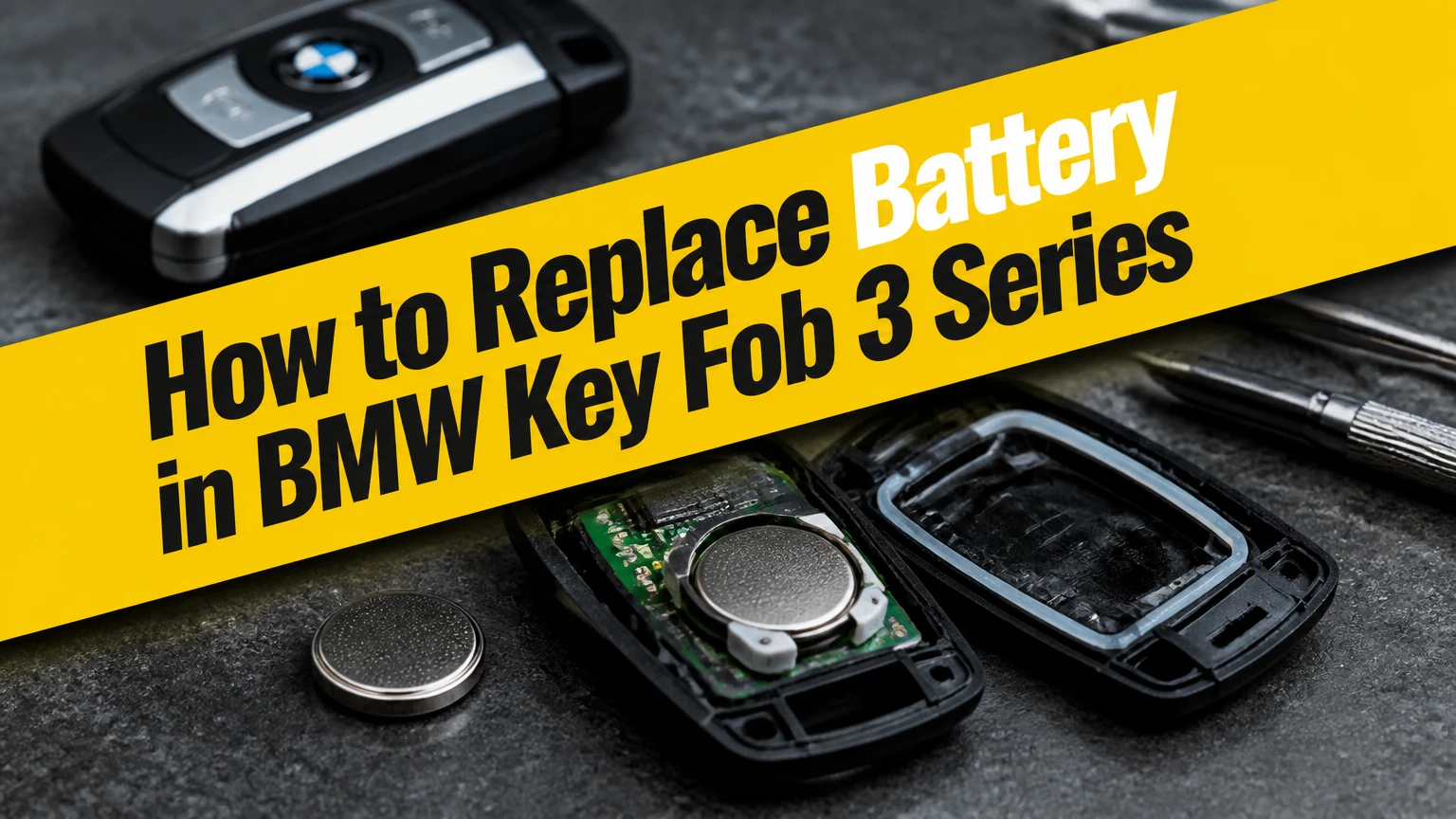
To replace the battery in a BMW 3 Series key fob, remove the mechanical key, open the battery cover, install the specified coin cell with the positive side facing the marked direction, and close the housing. Most replaceable batteries take 2-5 minutes to change, but the correct battery depends on the fob generation and Comfort Access equipment.
Key facts at a glance
Most BMW F30 3 Series key fobs use a replaceable CR2450 lithium coin cell.
Most BMW G20 3 Series key fobs use a replaceable CR2032 lithium coin cell.
E90-era fobs vary: Comfort Access commonly uses a CR2032, while standard fobs may contain a rechargeable VL2020.
Replacing a battery does not normally erase the key’s pairing or immobilizer authorization.
A depleted remote battery does not necessarily prevent emergency engine starting.
A typical DIY replacement costs $2-$8 and takes less than five minutes when the battery is accessible.
Before You Start
The most important preparation step is identifying the fob design, not guessing from the vehicle badge. BMW used different remote housings within overlapping model years, and replacement-key shells can also differ from the original factory key.
Time, tools, and cost
| Requirement | Typical value | Practical detail |
|---|---|---|
| Replacement time | 2-5 minutes | Add 5-10 minutes if contacts need cleaning |
| Battery cost | $2-$8 | Brand-name lithium cells usually cost more than generic multipacks |
| Tool requirement | 0-1 tool | Use the mechanical key or a plastic pry pick |
| Difficulty | Low | The main risk is cracking clips or bending contacts |
| Battery voltage | 3 volts nominal | CR2032 and CR2450 are both 3-volt lithium cells |
| Recommended spare | 1 additional cell | Store it in sealed packaging away from metal objects |
Have the new battery, a clean work surface, and a plastic pick available. A small flathead screwdriver can open some housings, but it can scratch the case or bridge electrical contacts if it slips.
Do not open the key over carpet, a drain, or a vehicle seat gap. The mechanical blade, rear cover, or a tiny retaining clip can fall out and become difficult to recover.
Which battery fits a BMW 3 Series key fob?
The battery that fits a BMW 3 Series key fob depends on the remote housing, production generation, and Comfort Access configuration. The table below is a useful starting point, but the marking on the old cell and the vehicle’s owner’s manual take priority over a year-only assumption.
| 3 Series family | Approximate production period | Common fob battery | Replaceable by owner? |
|---|---|---|---|
| E90, E91, E92, E93 Comfort Access | 2006-2011 | CR2032 | Usually yes |
| E90, E91, E92, E93 standard key | 2006-2011 | VL2020 rechargeable | Usually no, soldered |
| F30, F31, F34, F80 | 2012-2018 | CR2450 | Usually yes |
| G20, G21, G80 | 2019-present | CR2032 | Usually yes |
| Replacement or aftermarket shell | Any period | Varies by circuit board | Verify before purchase |
The F30 CR2450 and G20 CR2032 are not interchangeable. Both cells have a nominal 3-volt rating, but the CR2450 is physically thicker and may not fit a CR2032 holder.
Check the printed code before installation. A cell marked CR2032 is not equivalent to a rechargeable VL2020, even though the two batteries appear similar in size.
How to Replace Battery in BMW Key Fob 3 Series
The general BMW key-fob battery replacement process has five actions: remove the mechanical key, open the rear cover, remove the old cell, install the new cell in the correct orientation, and test every function. Do not force the housing, because retaining tabs are designed to release with controlled leverage rather than heavy pressure.
BMW’s G20 owner’s manual describes the first action as: “Press the button, arrow 1, and pull out the key.” The exact button location varies slightly by housing, but the mechanical blade normally unlocks the battery-cover access point.
Step 1: Remove the mechanical key
Press the small release button on the side or rear of the fob and pull the metal blade straight out. Put the blade aside where it cannot contact the battery or fall onto the floor.
For G20-style keys, the release is commonly on the narrow side edge. For many F30 keys, the release button is on the back. E90 keys may use a lower-corner release for the valet blade.
You will know it worked when: the metal blade slides out without twisting and the key cavity is visible.
Common mistake: pulling on the key ring or forcing the blade at an angle. Only the release button should be depressed during removal.
Step 2: Open the battery cover
Insert the tip of the mechanical key into the slot inside the empty key cavity. Apply light rotational pressure to lift the rear cover or battery hatch, then work around the edge if the cover has more than one clip.
A plastic pry pick is safer than a steel screwdriver. If a screwdriver is necessary, wrap its tip with a thin layer of tape and keep it away from the circuit board.
You will know it worked when: the rear panel separates along its designed seam without white stress marks or broken clips.
Common mistake: prying at the wrong seam. The visible decorative trim is not always the battery door, particularly on F-series remotes.
Step 3: Remove the old battery
Look at the installed battery before touching it. Record the battery code and photograph the positive and negative orientation, then lift the cell from its edge using a plastic pick or fingernail.
Avoid touching the circuit board, antenna components, and contact springs. Coin cells can discharge quickly if a metal tool connects the positive and negative terminals.
You will know it worked when: the old cell comes free without a bent retaining tab or displaced contact spring.
Common mistake: levering directly against a delicate contact. Lift from the battery edge and support the plastic holder instead.
Step 4: Install the new coin cell
Wipe the new battery with a clean, dry cloth before installation. Some retail cells have a surface coating or handling residue that can reduce contact quality, so use only a dry cloth unless the manufacturer specifically recommends another cleaning method.
Install the specified battery with the same orientation as the old cell. In many BMW fobs, the positive (+) side faces outward or upward, but the molded symbol inside your housing is the final authority.
You will know it worked when: the battery sits flat, the retaining spring contacts its edge, and the cell cannot rattle inside the holder.
Common mistake: pressing the cell down on the center of the circuit board. Seat one edge beneath the retaining lip, then press the opposite edge into place.
Step 5: Refit the cover and test the key
Align the cover’s tabs first, then press around the perimeter until every clip is flush. Reinsert the mechanical key and test lock, unlock, trunk release, and panic functions from several feet away.
Test the key before throwing away the old battery. If the buttons fail, reopen the housing while the orientation and contact positions are still easy to inspect.
You will know it worked when: the case closes evenly, the buttons have normal travel, and the vehicle responds consistently from the expected range.
Common mistake: testing only one button. A bent contact or partially closed cover can allow one function to work while another fails.
How Do E-Series, F-Series, and G-Series Fobs Differ?
BMW 3 Series key fobs differ mainly in battery access, cell chemistry, and Comfort Access hardware. F-series remotes typically have a large removable CR2450, while G-series remotes commonly use a CR2032; some E-series standard keys use a soldered rechargeable VL2020 instead of a user-replaceable cell.
E90, E91, E92, and E93 keys
An E-series Comfort Access key commonly has a small removable battery door. Remove the valet blade, open the rear door, and replace the CR2032 with its positive side facing the same direction as the original.
An E-series standard key may contain a rechargeable VL2020 soldered to the circuit board. That battery recharges when the key is inserted into the ignition slot or used in the vehicle, depending on the specific system.
A soldered VL2020 is not a normal coin-cell replacement job. Opening the case can damage the shell, circuit board, or immobilizer-related components, and soldering a substitute requires the correct tabbed cell and electronics technique.
F30, F31, F34, and F80 keys
F-series 3 Series remotes commonly use a CR2450. Remove the metal key, insert it into the rear-cover slot, and gently twist to release the battery panel.
The CR2450 is thicker than a CR2032. Do not substitute the thinner cell because it may not maintain pressure against the contacts, producing intermittent lock or unlock operation.
G20, G21, and G80 keys
G-series 3 Series remotes commonly use a CR2032 in a dedicated rear compartment. The side release removes the integrated key blade, and the blade then provides leverage at the internal access slot.
G-series cars may also support BMW Digital Key or smartphone-based access, but changing the physical key-fob battery does not replace phone authentication, vehicle pairing, or a Digital Key setup.
What Does Comfort Access Change?
Comfort Access uses proximity detection and passive-entry functions, so its key can consume energy faster than a basic button-only remote. A low-battery warning, reduced passive-entry range, or inconsistent touch locking can appear before the active lock and unlock buttons stop working.
| Symptom | Likely battery-related cause | First check | Next action |
|---|---|---|---|
| Buttons work only near vehicle | Low cell voltage | Confirm correct CR2032 or CR2450 | Install a fresh name-brand cell |
| Touch unlocking fails | Comfort Access range is reduced | Test active unlock buttons | Inspect battery contacts and door-handle area |
| Key battery warning appears | Vehicle detected low fob voltage | Replace cell and drive normally | Scan faults if warning persists |
| One key works, another does not | One fob cell is depleted | Compare both fobs | Replace the weak fob battery |
| Remote works intermittently | Loose contact or damaged spring | Inspect cell seating | Restore contact tension carefully |
| Passive start works but buttons fail | Remote transmitter power is low | Hold fob at backup location | Replace battery and test |
Comfort Access does not automatically mean the battery type is different. On E-series cars, however, Comfort Access is a useful clue because it often identifies a removable CR2032 design instead of the standard key’s rechargeable VL2020.
Does Replacing the Battery Require Programming?
Replacing a BMW 3 Series key-fob battery normally does not require programming or resynchronization. The battery powers the transmitter, while the vehicle retains the key’s existing authorization and rolling-code relationship.
If the key remains completely unresponsive after a correct battery installation, inspect the contacts before attempting a pairing procedure. A bent spring, wrong cell thickness, cracked solder joint, water damage, or failed transmitter is more likely than lost programming.
The familiar lock-unlock synchronization procedure used on some older BMW systems is not a universal cure for a dead remote. It cannot repair a broken contact or restore power to a damaged circuit board.
What If the BMW Key Battery Is Completely Dead?
A BMW 3 Series with Comfort Access or keyless ignition can often start when the remote battery is depleted by using the vehicle’s emergency recognition location. The exact backup location varies by generation, so consult the owner’s manual before relying on it.
Common procedures include holding the key against a marked area on the steering column or placing it in a designated key tray or emergency-detection pocket. Press the brake or clutch as required, then press the engine-start button while the key is in the backup position.
A dead remote battery may prevent remote locking, passive entry, or trunk release while leaving immobilizer recognition available. If the car displays “No key detected,” move the fob away from smartphones, other keys, metal cases, and wireless charging devices before trying the backup location.
Why Does the New Battery Still Not Work?
A new BMW key-fob battery that does not restore operation usually indicates incorrect orientation, poor terminal contact, the wrong battery type, or a damaged transmitter. Battery replacement does not solve a circuit-board failure, water intrusion, or a depleted soldered rechargeable cell.
Use this diagnostic sequence:
- Confirm the cell code. A CR2032, CR2450, and VL2020 are different components.
- Confirm polarity against the molded plus sign and the original installation.
- Check that the cell is flat and held firmly by the contact spring.
- Inspect for corrosion, dirt, bent terminals, or a cracked plastic holder.
- Test the second BMW key to separate vehicle faults from fob faults.
- Try the emergency-start position if the vehicle does not detect the key.
- Ask a qualified automotive locksmith or BMW technician to test the transmitter.
Do not scrape contacts aggressively. Plated terminals can lose their protective finish, and excessive bending can cause them to break from the circuit board.
Why is the remote range still short?
Short range after a battery change usually results from a weak or incorrectly seated cell, interference, or a damaged antenna rather than a programming problem. Test the fob in an open area, away from a phone, wireless charger, metal wallet, and other radio transmitters.
A healthy replacement cell should restore normal operation, but “normal range” varies with vehicle environment, regional radio-frequency specifications, building materials, and the condition of the fob antenna. A second key provides the most useful comparison.
What Are the Common Replacement Mistakes?
The most expensive mistake is treating every BMW 3 Series key as a disposable coin-cell design. E-series standard keys with soldered VL2020 batteries require electronics repair or key replacement, not a CR2032 forced into the housing.
Other frequent errors include:
- Installing a CR2032 in an F30 CR2450 holder: the thinner cell may not maintain contact.
- Using a steel tool across terminals: a short circuit can damage the board.
- Ignoring a bent contact spring: the new battery then appears defective.
- Closing the cover with a displaced gasket or clip: moisture can enter the housing.
- Buying an unmarked cell: low-quality cells can show poor voltage under load.
- Discarding the old battery before testing: the original orientation becomes harder to verify.
- Biting or licking a coin cell: lithium batteries and child-safe bitterant coatings should never be handled this way.
Keep removed lithium coin cells away from children and pets. Tape the terminals of used cells and recycle them through a battery collection point rather than placing them loose in household waste.
DIY Replacement or Professional Service?
DIY replacement is the sensible choice when the battery compartment is clearly removable and the fob has no physical damage. Professional service is preferable for a soldered VL2020, broken housing, water damage, failed contacts, or a key that remains dead with a verified fresh cell.
| Service route | Typical cost | Typical time | Best use case |
|---|---|---|---|
| DIY CR2032 replacement | $2-$6 | 2-5 minutes | G20 or E-series Comfort Access |
| DIY CR2450 replacement | $3-$8 | 2-5 minutes | F30, F31, F34, or F80 |
| Parts-store assistance | $5-$15 | 5-20 minutes | Removable battery and intact housing |
| BMW dealer battery service | $30-$60 | 15-45 minutes | Owner wants inspection and function test |
| Locksmith soldered-cell repair | $30-$100 | 30-90 minutes | E-series VL2020 replacement |
| Complete replacement key | $200-$600 or more | Hours to days | Lost, damaged, or non-repairable key |
Prices are typical consumer ranges, not fixed BMW pricing. Dealer charges vary by country, labor rate, warranty coverage, and whether the technician diagnoses an additional fault.
A dealer battery change is not automatically better for a simple removable cell. Its value is the diagnostic check, correct parts identification, and confirmation that the transmitter and Comfort Access functions operate normally.
When Should You Replace the Battery?
Replace a removable BMW 3 Series key-fob battery when remote range drops, passive entry becomes inconsistent, the vehicle displays a key-battery warning, or the fob stops responding. There is no universal replacement interval because usage, temperature, cell quality, and Comfort Access activity change battery life.
| Fob situation | Typical service life | Replace when |
|---|---|---|
| Button-only remote | 2-4 years | Range decreases or buttons require close proximity |
| Comfort Access remote | 1-2 years | Passive entry becomes intermittent |
| Frequently used primary key | 1-3 years | Warning or reduced response appears |
| Spare key stored unused | 3-5 years | Test annually and replace before travel |
| Rechargeable VL2020 key | Variable | Charge retention falls or remote remains weak |
These are practical ranges, not BMW-mandated intervals. Heat, cold, repeated proximity detection, and long periods beside the vehicle can shorten service life.
An expert rule of thumb is to replace the spare key before a long trip, not after the primary key fails. A spare with an aging battery may still unlock the door mechanically but provide no convenient remote access when needed.
Frequently Asked Questions
Can I use a CR2025 instead of a CR2032 in a BMW key?
A CR2025 may fit some CR2032 holders physically, but it is 0.7 millimeters thinner and generally has lower capacity. The thinner cell can lose contact when the fob is moved, so use the battery code specified by the housing or owner’s manual rather than treating coin cells as interchangeable.
How do I know whether my BMW has Comfort Access?
Comfort Access usually permits locking or unlocking by touching the exterior door-handle surface while the key remains in your pocket. Equipment varies by market and model year, so the vehicle’s original equipment list, owner’s manual, or VIN-based BMW build sheet provides a more reliable answer than the door-handle appearance alone.
Will a BMW key fob work after sitting without a battery?
A removable-battery BMW key fob normally retains its programming while unpowered. After installing the correct cell, the remote should operate without coding; if it does not, inspect polarity, contacts, housing damage, and transmitter condition before assuming the key needs synchronization.
How can I unlock my BMW if the key fob battery dies?
Pull the integrated mechanical blade from the fob and use it in the driver-door lock, which may be hidden beneath a handle cap. To start the vehicle, place the fob at the BMW emergency-recognition location specified for that generation, then follow the dashboard instructions.
Should I replace both BMW key batteries at once?
Replace both batteries together only when both keys show reduced range, are the same age, or the vehicle will be used for a long trip. Test each key independently first, because replacing a healthy battery adds cost without improving a transmitter that already performs normally.
Can a BMW dealer replace a rechargeable VL2020 battery?
A BMW dealer or qualified automotive locksmith can assess a soldered VL2020 key, but the available remedy may be cell replacement, key repair, or complete key ordering. Do not pry out the rechargeable cell as though it were a removable CR2032, because circuit-board and immobilizer damage can make the key unusable.
The Bottom Line
The safest way to replace a BMW 3 Series key-fob battery is to identify the fob design first, then match the printed battery code and polarity. Use a CR2450 for most F30-era removable remotes, a CR2032 for most G20-era remotes, and verify whether an E90-era standard key contains a soldered VL2020. A careful replacement takes 2-5 minutes, does not normally erase programming, and should restore remote range when the battery and contacts are healthy. Follow the correct generation-specific method when learning how to replace battery in bmw key fob 3 series.