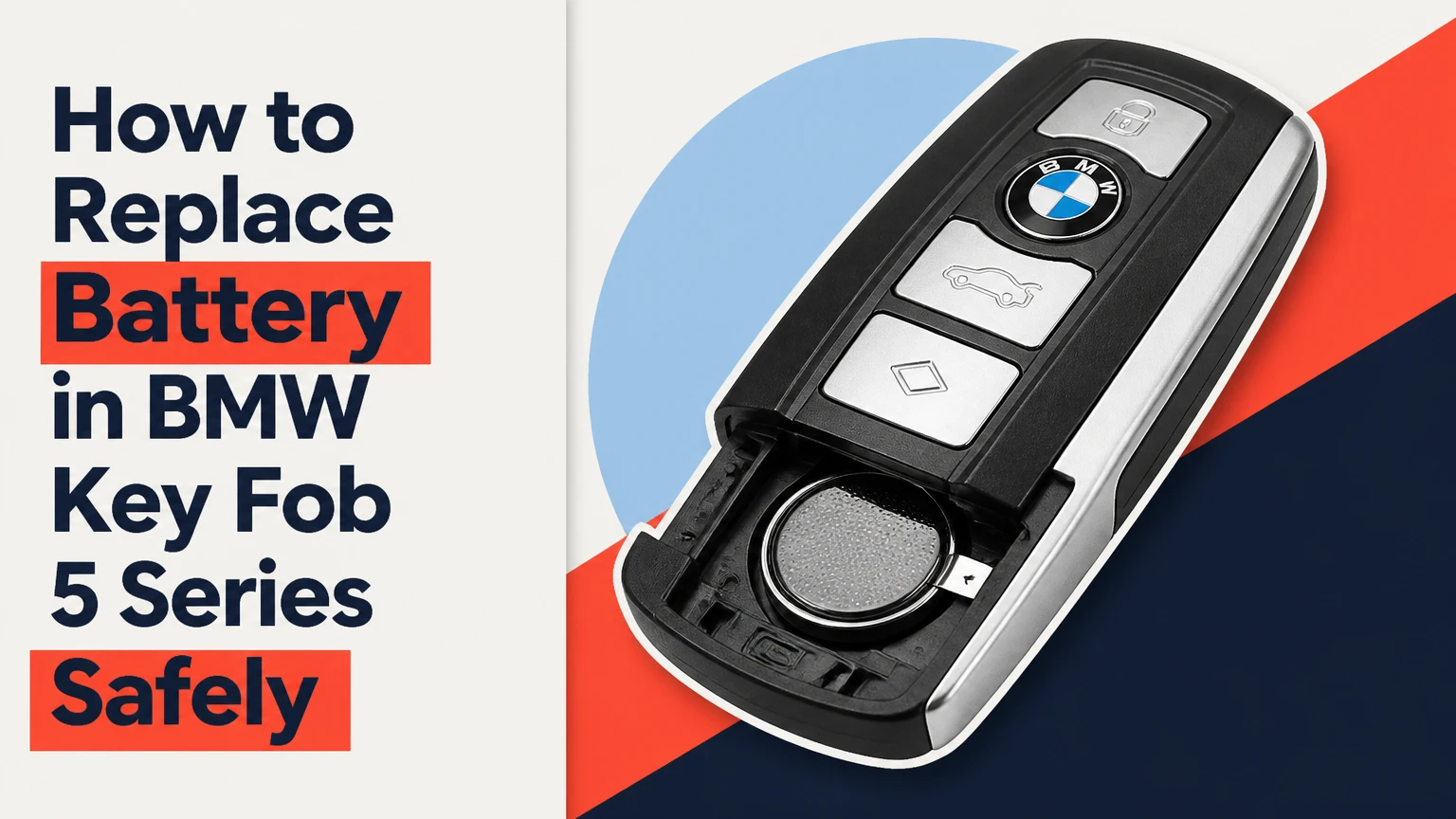
To replace the battery in a BMW 5 Series key fob, identify the key generation, remove the mechanical blade, open the correct access point, install the specified coin cell with matching polarity, and snap the housing closed. Most removable-battery BMW keys take 2-5 minutes and do not require reprogramming.
Key Facts at a Glance
A BMW 5 Series key with a removable battery normally keeps its programming after a battery change.
G30, G31, and many G60/G61 keys use a replaceable CR2032 coin cell.
Many F10, F11, and F07 trapezoid keys use a CR2450, but equipment and market differences require verification.
Older BMW Diamond keys may contain a soldered VL2020 rechargeable cell rather than a replaceable battery.
Comfort Access can shorten battery life because the key participates in passive-entry communication.
A replacement cell usually costs $3-$8, while professional service commonly costs $15-$50.
Before You Start: Identify the Key and Gather Tools
The BMW 5 Series key housing determines the battery, opening method, and whether the job is suitable for home repair. Do not choose a cell from the vehicle year alone, because BMW used multiple key designs within some generations and markets.
You need the key fob, a new battery matching the old cell or the fob’s internal marking, and the mechanical key blade. A plastic trim tool is safer than a steel screwdriver, although a small flat-blade screwdriver can work when its tip is protected with tape.
| Item | Typical specification | Why it matters |
|---|---|---|
| Replacement coin cell | CR2032 or CR2450 | Thickness and voltage must match the housing |
| Older rechargeable cell | VL2020, often soldered | Requires electronics repair rather than a simple swap |
| Opening tool | 1 plastic pry tool or taped 2-3 mm flat blade | Reduces scratches and housing damage |
| Work time | 2-5 minutes for removable cells | Includes opening and functional testing |
| Typical DIY cost | $3-$8 | Depends on brand and pack size |
Work on a clean table rather than inside the car. Keep the old battery away from children and pets, and do not bend the spring contacts while removing the cell. Lithium coin cells can cause severe injury if swallowed.
Which BMW 5 Series key do you have?
A G30/G31 key usually has a slim silver-edged design and a removable rear cover. A G60/G61 key commonly has a more modern blade-shaped body with a battery tray. F10, F11, and F07 keys often have a larger trapezoid profile. Older E39 and E60 keys may have a diamond-shaped, sealed housing.
The fastest verification method is physical inspection. Remove the emergency blade and read the battery marking if the cell is visible. If no marking is accessible, check the BMW owner’s manual or use the vehicle identification number with a BMW parts department before forcing the case open.
| Key family | Typical 5 Series applications | Common battery arrangement | Home replacement difficulty |
|---|---|---|---|
| G60/G61 blade key | 2024-present 5 Series and Touring | CR2032 tray | Low |
| G30/G31/F90 modern key | 2017-2023 5 Series, M5 | CR2032 removable cover | Low |
| F10/F11/F07 trapezoid key | 2011-2016 5 Series variants | Often CR2450 removable cell | Low to moderate |
| E60/E61 Comfort Access key | 2004-2010 equipped cars | Replaceable cell on some housings | Moderate |
| E39 or early E60 Diamond key | 1996-2006 designs | VL2020 rechargeable cell | High, soldering required |
This table is a starting point, not a substitute for the battery marking. BMW key hardware can differ by Comfort Access equipment, production date, replacement-key history, and regional specification.
How Does a BMW 5 Series Key Fob Work?
A BMW 5 Series key fob sends encrypted authorization data to the vehicle’s locking and starting systems, while the immobilizer independently verifies whether the key is permitted to start the engine. The coin cell powers the remote and passive-entry functions, but replacing that cell normally does not erase the key’s identity.
Standard remote keys transmit when you press lock, unlock, or trunk buttons. Comfort Access adds short-range passive communication, allowing the vehicle to detect the key near the door handle and authenticate it without a button press.
That extra communication can consume battery power more quickly. Battery life depends on use, temperature, signal interference, key age, and whether the key remains close to the vehicle for long periods.
Does replacing the battery reprogram the key?
A normal coin-cell replacement does not require BMW key programming. The key’s security data is stored in nonvolatile electronics, so removing power for several minutes does not normally delete the vehicle pairing.
Synchronizing button operation can help after unusual interruption, but synchronization is different from immobilizer programming. If the car still does not recognize the key after a correct battery installation, the problem may involve a damaged transmitter, weak contacts, vehicle-side receiver faults, or a second-hand key that was never authorized for that vehicle.
How to Replace Battery in BMW Key Fob 5 Series
The general process is: remove the emergency blade, expose the battery compartment, replace the cell with the same orientation, close the housing, and test every button. The access method changes by key design, so use the matching procedure below instead of prying randomly around the perimeter.
Step 1: Remove the mechanical key blade
Press the small release button on the side or rear of the BMW 5 Series key fob. Pull the metal emergency blade straight out of its storage channel.
The blade often becomes the opening tool for the same fob. Set it on a clean surface if your housing uses a separate notch or tray mechanism.
Success checkpoint: The blade comes out without bending, and a slot, seam, or tray edge becomes visible.
Common mistake: Pulling on the blade without pressing the release. That can damage the retaining mechanism.
Step 2: Inspect the exposed access point
Look inside the blade cavity and around the lower edge of the housing. A small molded slot usually indicates where the cover should be released.
Do not insert a tool into a button gap, speaker opening, or random seam. BMW cases use locating tabs, and prying in the wrong position can crack the cover or crush the circuit board.
Success checkpoint: You can identify a deliberate pry notch or the edge of a sliding battery tray.
Common mistake: Using a large screwdriver that twists against the plastic rather than lifting the cover.
Step 3: Open a G30, G31, or F90 removable-cover key
Insert the tip of the mechanical blade into the internal notch exposed after blade removal. Twist gently to release the rear cover, working only as far as needed to separate the retaining clips.
Lift the rear panel away without pulling sharply. The CR2032 battery should sit in a shallow compartment with a spring contact or retaining lip.
Success checkpoint: The cover separates cleanly and the battery marking is readable.
Common mistake: Treating the entire outer seam as a pry line. The intended release point is usually inside the emergency-key opening.
Step 4: Open a G60 or G61 slider-tray key
Locate the battery tray at the lower edge of the newer blade-style key. Use the mechanical blade to catch the tray’s edge or release feature, then pull the tray straight out according to the housing’s molded direction.
Do not lever the tray sideways. The tray guides are narrow, and lateral force can deform them or leave the battery loose.
Success checkpoint: The tray slides out as one piece and the polarity marking is visible.
Common mistake: Assuming every G-generation key has a snap-off rear cover. Some G60/G61 designs use a removable tray instead.
Step 5: Open an F10, F11, or F07 trapezoid key
Remove the emergency blade, then locate the small opening or groove inside the blade cavity. Insert the blade tip and twist carefully until the rear panel pops free.
Many trapezoid housings use a CR2450, which is physically larger than a CR2032. Install the same size that was fitted, even if another BMW key in the family uses a different cell.
Success checkpoint: The rear panel releases while its upper tabs remain intact.
Common mistake: Substituting a CR2032 for a CR2450 because both batteries are coin-shaped and rated near 3 volts. The diameter and thickness are different.
Step 6: Remove the old coin cell
Use a fingernail or a small insulated pry tool to lift the old cell from its retaining lip. Note the orientation before removal, including which side faces the cover.
Most replaceable BMW coin cells install with the positive symbol facing outward or upward. The molded polarity symbol inside the tray is the controlling instruction when it differs from a generic diagram.
Success checkpoint: The contact tabs remain raised enough to press firmly against the new cell.
Common mistake: Flattening a contact tab by wedging a metal tool underneath it. A fresh battery cannot power the fob if the terminal no longer touches it.
Step 7: Install the new battery
Fit a reputable CR2032 or CR2450 from a manufacturer such as Panasonic, Energizer, Duracell, or Varta when that size matches the original. Hold the cell by its edges, because fingerprints and oils are less likely to contaminate the contact surfaces.
Press one edge under the retaining lip, then lower the opposite edge until it seats flat. Never force a cell that rocks, bows, or requires the cover to push it into place.
Success checkpoint: The cell lies flat, the positive side matches the engraving, and the contact does not slide away.
Common mistake: Installing the battery upside down. Reverse polarity can prevent operation and may stress the circuit.
Step 8: Refit the cover and emergency blade
Align the cover’s upper tabs first, then press around the housing until every clip clicks into place. For a tray design, slide the tray in along its guides until it stops or clicks.
Reinsert the mechanical blade. The housing should close without a gap, and no button should remain depressed by a misaligned cover.
Success checkpoint: The case is flush on all sides and the blade locks into place.
Common mistake: Using adhesive on a removable cover. Glue makes future battery service harder and can contaminate the case seam.
Step 9: Test the BMW 5 Series key
Stand near the vehicle and press lock, unlock, and trunk buttons once each. Check passive locking or unlocking separately if the vehicle has Comfort Access, because button transmission and passive communication use related but distinct functions.
Test the spare key too. If the spare works while the serviced key does not, the fault is probably inside the serviced fob rather than in the vehicle.
Success checkpoint: The car responds consistently from a normal distance, and the key does not require repeated button presses.
Common mistake: Testing from inside a garage surrounded by metal shelving or immediately beside the vehicle, where range problems are difficult to diagnose.
What Battery Does a BMW 5 Series Key Use?
The correct BMW 5 Series key battery is determined by the fob housing and its existing cell, not by the 5 Series badge alone. CR2032 is common in newer G-generation keys, CR2450 is common in many F-generation trapezoid keys, and older sealed Diamond keys may use a rechargeable VL2020.
| Battery | Nominal voltage | Typical BMW key use | Replaceable by simple swap? |
|---|---|---|---|
| CR2032 | 3.0 V | G30, G31, many G60/G61 designs | Yes |
| CR2450 | 3.0 V | Many F10, F11, F07 trapezoid keys | Yes |
| VL2020 | 3.0 V rechargeable | Older sealed Diamond keys | No, usually soldered |
| CR2025 | 3.0 V | Some unrelated BMW key housings | Only if housing specifies it |
The CR2032 and CR2025 share a 20 mm diameter but differ in thickness. A CR2450 is approximately 24 mm wide, so it cannot be treated as a direct substitute for a 20 mm cell.
Can you use a rechargeable battery in a modern key?
Do not replace a modern disposable CR2032 or CR2450 with a VL2020 simply because both are lithium coin cells. Charging circuitry, terminal layout, chemistry, and the key’s intended operating design differ.
The reverse substitution is also unsafe for an older rechargeable Diamond key. A disposable CR2032 does not provide the same charging behavior and may damage the key or create an unreliable power supply.
What Is Different About Comfort Access Keys?
Comfort Access does not usually change the battery replacement steps, but it can change battery longevity and symptoms. Passive-entry keys communicate while carried near the vehicle, so a Comfort Access battery may last roughly 1-2 years in demanding use, compared with a typical 3-5 years for a standard remote.
These are practical ranges, not BMW service guarantees. Frequent short trips, prolonged proximity to the car, cold weather, and radio interference can shorten the interval.
Store a spare key at least several feet from the vehicle when possible. A key left on a hook immediately beside the garage wall or car may communicate more often than a key stored in an interior drawer.
What If the BMW Key Has No Battery Door?
An older BMW Diamond key with no battery door usually contains a rechargeable VL2020 cell soldered to the circuit board. The key charges through the ignition while the vehicle runs, so the repair requires opening a sonically welded case, desoldering the old cell, fitting a compatible tabbed replacement, and resealing the housing.
That repair is not equivalent to replacing a removable coin cell. A utility knife can slip into the circuit board, antenna, or hand, while excessive heat from a soldering iron can lift circuit-board pads.
A specialist automotive locksmith or BMW electronics technician is the better choice when the key is your only working key. Typical professional repair may cost less than a new BMW key, but pricing depends on the housing, cell, shipping, and whether the board has additional damage.
What about a BMW Display Key?
The BMW Display Key uses a rechargeable internal battery and a charging arrangement specific to the display remote. It is not serviced like a CR2032 key fob.
Charge the Display Key with its specified cable or charging pad. If the display battery no longer holds charge, professional repair is safer than opening the laminated housing, because the screen, battery, and casing can be damaged during disassembly.
DIY Replacement Versus Dealer or Locksmith Service
DIY replacement is the sensible option for a modern BMW 5 Series key with a clearly marked removable battery. Professional service becomes preferable when the housing is sealed, the key has water damage, the contact tabs are broken, or the vehicle cannot recognize a known-good key after testing.
| Service choice | Typical cost | Typical time | Best use case |
|---|---|---|---|
| DIY CR2032 replacement | $3-$8 | 2-5 minutes | G30, G31, many G60/G61 keys |
| DIY CR2450 replacement | $3-$8 | 3-7 minutes | F10, F11, F07 removable-cell keys |
| Independent locksmith repair | $20-$75 typical | Same day to several days | Soldered cell or damaged housing |
| BMW dealer battery service | $15-$50 typical | 15-60 minutes | Owner wants documented service |
| New programmed BMW key | Hundreds of dollars typical | Appointment required | Lost, damaged, or unauthorized key |
Dealer charges vary by region and dealer policy. A replacement key is a different service from a battery change and can require ownership verification, ordering, and vehicle-specific authorization.
Common Mistakes and How to Fix Them
The new battery does not work
Remove the cell and compare its size, voltage, and polarity with the original. Check that the positive and negative contacts touch clean metal and that the cover is fully clipped into position.
If the fob still fails, test another new battery from a reliable source. Coin cells can be old, counterfeit, or discharged after poor storage.
The low-key-battery warning remains
A warning may remain briefly after installation, depending on vehicle software and measurement timing. Lock and unlock the car, start it normally, and drive for 5-10 minutes before reassessing.
If the warning returns immediately, inspect the contacts and test the battery under load. A key that transmits intermittently may have a cracked solder joint or damaged circuit board rather than a battery problem.
The buttons work only at close range
Short range usually indicates low battery voltage, poor contact pressure, a damaged antenna, or radio interference. Try the spare key in the same location to separate a key fault from a vehicle receiver issue.
Do not repeatedly press the button from several feet away while diagnosing. Repeated commands can obscure whether the first transmission was weak or the car failed to receive it.
The case will not close
Stop pressing and remove the battery. A wrong-size cell, a battery installed under the wrong retaining lip, or a displaced contact can hold the cover open.
Never clamp the housing shut. The pressure can crack the circuit board or permanently bend the contact spring.
The BMW will not start after the battery change
A dead remote battery does not necessarily prevent starting because many BMW keys contain a passive transponder. Sit in the vehicle, hold the back or marked side of the key against the steering-column key symbol or designated emergency-detection area, and press the Start/Stop button while applying the brake.
The exact detection location varies by model year. This procedure authorizes the key through the vehicle’s passive reader; it does not reprogram or pair the key.
How Long Should a BMW Key Battery Last?
A standard BMW remote battery commonly lasts 3-5 years, while a Comfort Access key may need replacement after approximately 1-2 years under frequent passive-entry use. A battery that fails within weeks indicates an abnormal condition rather than ordinary age.
Possible causes include a stuck button, moisture inside the case, constant proximity to the vehicle, incorrect cell type, poor contact pressure, or a failing key circuit. A replacement cell cannot correct a transmitter that remains electronically active all the time.
Keep the key dry, avoid leaving it in direct heat, and replace batteries in both frequently used keys when their ages are similar. Mark the installation date on a maintenance record rather than relying on the dashboard warning alone.
When Should You Stop and Get Professional Help?
Stop the DIY procedure if the key has a sealed case, visible corrosion, liquid damage, torn buttons, broken retaining tabs, or a circuit board that lifts with the cover. Soldered rechargeable keys require temperature-controlled tools and a tabbed replacement cell, not a loose battery from a household pack.
Professional help is also appropriate when the new battery tests correctly but the key remains unresponsive, the vehicle recognizes one key but not another, or the physical blade no longer releases. Those symptoms can involve immobilizer authorization, antenna damage, receiver faults, or a previous replacement housing.
A BMW dealer can verify the key against the vehicle, while an experienced automotive locksmith may offer a lower-cost electronics repair for an older key. Ask whether the quoted service is a battery replacement, board repair, or complete key replacement.
FAQ
Does a BMW 5 Series key need to be reset after a battery change?
A removable-battery BMW 5 Series key normally does not need resetting or programming after the cell is replaced. If the buttons stop responding, confirm polarity, contact pressure, and housing alignment first. A true authorization problem is different from a flat remote battery and may require dealer or locksmith diagnosis.
Can I drive my BMW if the key-fob battery is dead?
Most BMW 5 Series models can start with a dead remote battery if the passive transponder remains functional. Place the key against the model-specific emergency detection area near the steering column or center console, press the brake, and use the Start/Stop button.
Why does my BMW say the key battery is low after replacement?
The warning can result from a poor-quality cell, incorrect battery size, reversed polarity, weak contact pressure, or a key that is consuming power continuously. Drive for 5-10 minutes, then inspect the battery seating. An immediate repeat warning points to a contact or circuit fault.
Can I replace a BMW Diamond key battery without soldering?
Usually not. Older Diamond keys commonly use a soldered rechargeable VL2020 cell and have a welded housing without a removable battery door. Opening the case and replacing the cell requires electronics skills, so an automotive locksmith is safer for most owners.
Should I replace both BMW key batteries at the same time?
Replace both batteries together when both keys were used regularly and are the same age. The second key may still work today but fail soon after because coin cells installed during the same vehicle period usually experience similar aging, storage, and temperature conditions.
Does Comfort Access drain the BMW key battery faster?
Yes, Comfort Access can shorten battery life because passive-entry communication occurs without a button press. A typical Comfort Access interval is about 1-2 years, although usage and storage conditions matter. Keeping the key several feet from the parked vehicle can reduce unnecessary communication.
The Bottom Line
To replace the battery in a BMW key fob 5 Series, match the cell to the physical key, remove the emergency blade, use the designed access notch or tray, install the battery according to the internal polarity marking, and test the remote before leaving the work area. Modern removable cells require no reprogramming and usually cost $3-$8.
CR2032 is common in G30, G31, and newer G-generation keys, while many F10, F11, and F07 keys use CR2450. Older sealed Diamond keys and BMW Display Keys require different service methods, so do not force open a housing that has no battery door.