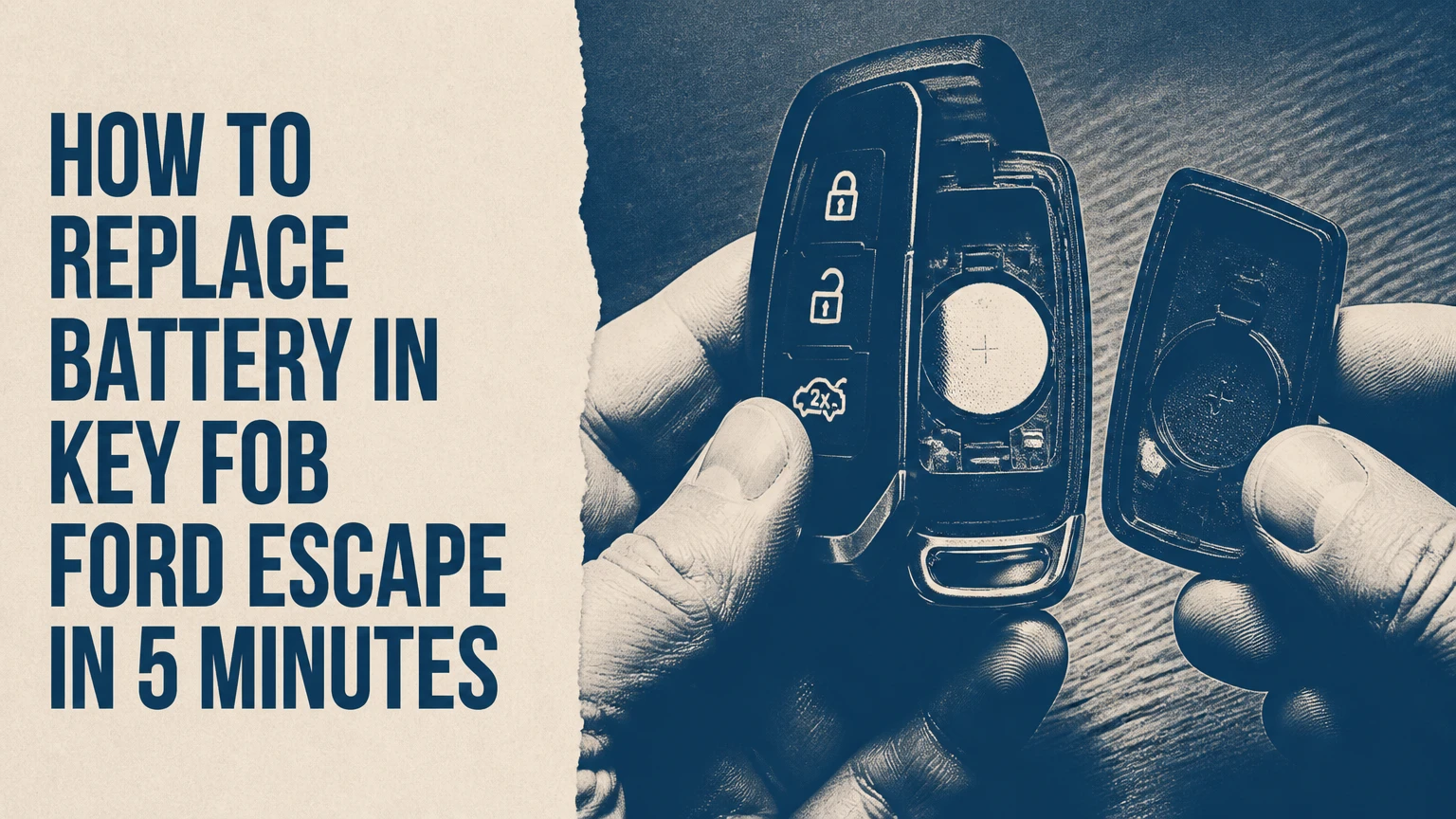
Replacing a Ford Escape key-fob battery usually takes 2-5 minutes and requires a small flathead screwdriver plus a new coin-cell battery. Most Escape remotes use a CR2032, while many 2020-2026 oval intelligent-access fobs use a CR2450. Confirm the number printed on the old battery or owner’s manual before opening the case.
Key Facts at a Glance
- A Ford Escape key fob normally keeps its programming after the battery is replaced.
- CR2032 and CR2450 batteries are both 3-volt lithium cells, but the CR2450 is thicker and is not interchangeable with a CR2032.
- Ford Escape flip keys and many angular smart keys use a CR2032 battery.
- Many 2020-2026 oval smart keys use a CR2450 battery, although equipment varies by market and trim.
- The positive side usually faces upward, toward the inside of the visible battery compartment.
- A replacement battery costs typically $2-$8 for a two-pack and takes 5-10 minutes for a first-time DIY repair.
Which Battery Does a Ford Escape Key Fob Need?
A Ford Escape key fob needs the battery number printed on the existing cell, the vehicle owner’s manual, or the replacement-key specification for that exact fob. Ford Escape remotes most commonly use CR2032 or CR2450 batteries, so model year alone is not a safe identification method.
| Fob design | Common Escape years | Typical battery | Vehicle starting system | Visual identifier |
|---|---|---|---|---|
| Oval intelligent-access remote | 2020-2026 | CR2450 | Push-button start | Rounded body, 4-5 buttons |
| Angular smart key | 2013-2019 | CR2032 | Push-button start | Shield-like angular shell |
| Flip key, integrated keyhead | 2013-2024 | CR2032 | Physical ignition | Folding metal blade |
| Standard remote | 2001-2012 | CR2032 | Separate ignition key | Separate 3-4 button transmitter |
The table shows typical configurations, not a universal Ford production rule. Ford used different transmitters across countries, trims, replacement-key part numbers, and option packages. The safest sequence is to read the old cell after opening the fob, compare the marking with the owner’s manual, and buy the same number.
Why do CR2032 and CR2450 batteries differ?
CR2032 and CR2450 batteries share a 3-volt nominal voltage but have different physical dimensions. The first two digits identify diameter in millimeters, while the last two digits identify thickness in tenths of a millimeter: CR2032 is approximately 20 mm by 3.2 mm, and CR2450 is approximately 24 mm by 5.0 mm.
| Battery | Nominal voltage | Approximate size | Typical capacity | Correct substitution |
|---|---|---|---|---|
| CR2032 | 3 V | 20 mm x 3.2 mm | 200-240 mAh | CR2032 holder only |
| CR2450 | 3 V | 24 mm x 5.0 mm | 500-620 mAh | CR2450 holder only |
| CR2025 | 3 V | 20 mm x 2.5 mm | 150-170 mAh | Not a recommended substitute |
| CR2016 | 3 V | 20 mm x 1.6 mm | 70-100 mAh | Not a recommended substitute |
A CR2025 may fit loosely where a CR2032 belongs, but the thinner cell can lose contact when the buttons are pressed or the case flexes. A CR2450 is too thick and too large for most CR2032 compartments; forcing it can bend the retaining spring or prevent the case from closing.
What Do You Need Before Starting?
Prepare the correct 3-volt lithium battery, a small flathead screwdriver, and a clean work surface before opening the Ford Escape remote. A quarter can open some older standard remotes, while precision tweezers help remove a tightly seated cell without scraping the circuit board.
| Requirement | Typical value | Purpose | Replacement or limitation |
|---|---|---|---|
| New battery | 1 x CR2032 or CR2450 | Powers the transmitter | Match the old cell exactly |
| Flathead screwdriver | 2-3 mm tip | Opens the housing | Use a plastic pry tool if available |
| Work time | 2-5 minutes | Normal replacement | Allow 5-10 minutes first time |
| DIY cost | $2-$8 | Two-pack retail range | Dealer or locksmith often $15-$25 |
| Optional tweezers | 1 pair, insulated tip preferred | Lifts old cell | Avoid shorting both terminals |
Use a Panasonic, Duracell, or Energizer lithium coin cell, or another reputable brand with intact packaging and a future expiration date. Do not use a rechargeable coin cell unless the fob specifically requires one, because rechargeable cells may have a different voltage and charging behavior.
Work over a table rather than a driveway. The emergency key, battery, or small rubber components can fall into dirt, and a dropped circuit board can suffer damage that a new battery cannot repair.
How to Replace a Ford Escape Key-Fob Battery
The replacement process has five actions: remove the emergency key if present, separate the housing at its designed notch, remove the old cell, install the new cell with matching polarity, and close the case. The factor that most determines success is choosing the correct battery thickness before prying the housing apart.
Step 1: Identify the fob and battery number
Inspect the remote before inserting a tool. Look for a rounded oval shell, an angular smart-key shell, a folding blade, or a separate transmitter with no integrated blade.
Check the battery number printed on the old cell if the marking is visible through the housing. If the fob has already stopped working, do not infer the number from the symptom, because weak range occurs with both CR2032 and CR2450 cells.
Success checkpoint: You can name the fob style and have a matching battery in hand.
Common mistake: Buying a CR2032 solely because it is the most common Ford key-fob battery.
Step 2: Remove the emergency key
Press or slide the release button or latch on the remote and pull the metal emergency key blade outward. On an oval or angular intelligent-access remote, the blade normally slides from a channel in the bottom or rear of the housing.
Place the blade beside the fob rather than using it immediately as a pry tool. The blade can open some cases, but a small flathead screwdriver gives more control and reduces the chance of scratching the plastic.
Success checkpoint: The key blade is fully removed and the opening or notch beneath it is visible.
Common mistake: Pulling the blade without releasing the latch, which can damage the retaining mechanism.
Step 3: Open the fob housing at the notch
Insert the screwdriver tip into the molded split or notch exposed by the removed key. Twist gently, using controlled pressure rather than levering against a button or the circuit board.
Open the housing a few millimeters first, then work around the perimeter if needed. Do not force a location that has no notch; Ford cases use clips and seams, and the correct opening point is normally marked by a cavity, indentation, or key-channel slot.
Success checkpoint: The back cover separates without cracked plastic or displaced buttons.
Common mistake: Inserting the screwdriver deeply, which can scratch the circuit board or tear the rubber button membrane.
Step 4: Remove the old battery
Note the old battery’s orientation before lifting it. Most Ford Escape fobs place the positive side, marked with a plus sign and text, facing upward, but the retaining contacts determine the final orientation for that specific housing.
Use the screwdriver edge or a fingernail at the battery’s relief notch. Lift one edge slowly, then slide the cell away from the spring contact. Avoid touching both battery surfaces with a metal tool at the same time, because that can create a short circuit.
Success checkpoint: The old cell is out, and the metal contacts remain flat, aligned, and unbroken.
Common mistake: Bending the contact spring upward so far that the replacement battery no longer sits firmly.
Step 5: Install the new battery and close the case
Place the matching battery into the holder with the same orientation as the old cell, normally the positive side upward. Seat the edge under the fixed retaining lip first, then press the opposite edge down until the spring contact holds it securely.
Align the housing halves and press around the perimeter until every clip clicks into place. Slide the emergency key back into its channel, then test lock, unlock, panic, and liftgate functions within a few feet of the vehicle.
Success checkpoint: The case closes flush, the key blade locks in place, and at least one remote function responds.
Common mistake: Leaving the battery’s protective film attached, which blocks electrical contact.
How Does Each Ford Escape Fob Open?
Ford Escape fob designs use different pry points, but all require the same sequence of controlled separation, polarity matching, and contact protection. The oval smart key opens through the emergency-key cavity, the angular smart key uses a side or key-channel slot, and the flip key opens inside its folded-blade recess.
Oval smart key, usually 2020-2026
Remove the emergency key from the bottom or side release. Insert a 2-3 mm flathead screwdriver into the slot exposed by the removed blade and twist until the rear cover separates.
Lift the old CR2450 from its edge, install the new CR2450 with the positive side facing up, and press the cover closed. The oval housing should close evenly; a raised corner indicates that the larger cell is not fully seated or the case clips are misaligned.
Ford’s newer push-button-start remotes can have a backup detection position inside the vehicle. The exact position varies, so consult the vehicle manual if the newly replaced remote locks the doors but the vehicle still reports that no key is detected.
Angular smart key, usually 2013-2019
Slide the rear release latch and remove the emergency key blade. Find the small opening in the blade cavity or along the side seam, then twist a small screwdriver carefully to separate the rear cover.
Install a CR2032 with the polarity matching the removed cell, commonly the plus side facing the operator. Keep the rubber button pad and internal circuit board in their original positions before snapping the housing closed.
An angular fob that has reduced range after battery replacement may have a cracked case, worn button membrane, or loose internal contact. The battery is not the only component that controls transmitter performance.
Flip key or integrated keyhead
Press the silver or blade-release button so the metal key flips outward. Inspect the recess where the blade rests when closed, because the recess commonly contains the intended pry notch.
Separate the battery cover, remove the old cell, and install a CR2032 with the positive side up unless the old battery shows another orientation. Close the cover firmly and fold the key blade back into the housing.
The flip-key design is used with a physical ignition, so a weak remote battery does not prevent the mechanical blade from turning the ignition lock. The remote locking functions may stop while the vehicle remains mechanically startable.
Standard separate remote
Older standard Ford Escape remotes usually separate at a perimeter seam or coin slot. A quarter may work on a purpose-built slot, but a thin flathead screwdriver is more precise when the cover is tight.
Open the shell, remove the CR2032, and match the polarity marking. Check that the rubber buttons remain seated in their molded positions before closing the two halves.
Does Replacing the Battery Reprogram a Ford Escape Key Fob?
Replacing a Ford Escape key-fob battery normally does not erase programming, because the transmitter stores its vehicle association in nonvolatile memory rather than in the disposable coin cell. A correctly installed battery should restore operation immediately, without a dealer programming session or a key-learning procedure.
If the remote remains unresponsive, first verify the battery number, polarity, protective film, and contact pressure. Test the spare key if available. If both remotes fail simultaneously, the vehicle may have a fuse, receiver, 12-volt battery, or electrical-system problem rather than two failed coin cells.
Some Ford vehicles can require synchronization after unusual power or button events, but synchronization is different from programming a replacement key. Do not pay for key programming until basic battery and vehicle-side checks are complete.
What If the New Battery Does Not Work?
A Ford Escape fob that remains inactive after a battery change usually has an orientation, contact, film, wrong-cell, or housing problem. Reopen the remote, compare the new battery with the removed battery, and inspect the holder before assuming the transmitter has failed.
| Symptom | Likely cause | Check | Corrective action |
|---|---|---|---|
| No buttons work | Battery upside down | Plus and minus markings | Reverse the cell |
| No response after installation | Protective film present | Battery surface and edge | Remove all packaging |
| Works only when squeezed | Loose contact | Spring and retaining lip | Reseat or professionally repair contact |
| Very short range | Weak cell or case damage | Fresh branded cell, cracks | Replace cell, then inspect shell |
| Case will not close | Wrong battery thickness | CR2032 versus CR2450 | Install the specified cell |
| Car will not detect key | Vehicle backup-slot issue | Manual location | Use the vehicle’s backup position |
| One button fails | Worn membrane or switch | Button feel and circuit pad | Replace shell or obtain repair |
Clean light oxidation with a cotton swab barely moistened with isopropyl alcohol, then allow the contact to dry completely. Do not flood the circuit board, scrape plated contacts aggressively, or spray household cleaner into the housing.
Cold weather can expose a marginal battery because lithium coin-cell performance falls as temperature drops. A fob that works normally indoors but fails outdoors in winter needs a fresh high-quality cell first, followed by contact and range testing at normal temperature.
How Do You Start a Ford Escape With a Dead Fob?
A Ford Escape with a dead key-fob battery can often start through its passive backup detection method. Push-button-start models generally require the dead remote to be placed in a designated backup slot or held at a specified location, while flip-key models use the physical blade in the ignition.
| Escape configuration | Emergency entry | Emergency start method | Key limitation |
|---|---|---|---|
| Push-button start, newer models | Mechanical emergency blade | Place fob in the owner-manual backup slot, then press Start | Slot location varies |
| Push-button start, earlier smart key | Mechanical emergency blade | Use the documented center-console or steering-column detection area | Trim-dependent |
| Flip key with physical ignition | Metal blade | Insert blade into ignition and turn normally | Remote buttons remain inactive |
| Separate older remote | Mechanical vehicle key | Insert the ignition key and start normally | Remote battery does not power ignition |
The backup slot may be inside the center console, a cupholder, or another compartment depending on the Escape generation and equipment. The owner’s manual is the authoritative source for that location; online descriptions that apply to one year can be wrong for another.
If the vehicle still will not start with the fob positioned correctly, check the vehicle’s 12-volt battery. A low vehicle battery can produce key-detection symptoms that resemble a dead remote.
How Much Do Time and Cost Vary?
A Ford Escape key-fob battery replacement typically costs $2-$8 as a DIY repair and takes 2-5 minutes once the correct cell is available. A locksmith or dealer commonly charges $15-$25 for a straightforward battery service, although prices vary by location and may include inspection or additional programming.
| Service option | Typical price | Typical time | Best use |
|---|---|---|---|
| DIY two-pack battery | $2-$8 | 2-5 minutes | Correct battery and intact case |
| Automotive-parts counter | $5-$15 | 5-15 minutes | Help identifying battery |
| Locksmith battery service | $10-$25 | 10-20 minutes | Damaged clips or uncertain opening |
| Dealer service | $15-$25 for battery service | 15-30 minutes | Warranty or vehicle-side diagnosis |
| New programmed key | $100-$400+ | 30-90 minutes | Lost, damaged, or unrecognized key |
Prices are typical consumer ranges, not a guaranteed quote. A new programmed key costs substantially more because the service includes a transmitter, mechanical blade, immobilizer programming, or labor rather than merely replacing a coin cell.
When Should You Stop and Seek Professional Repair?
Stop the DIY repair when the case is glued, the circuit board is cracked, the retaining contacts are detached, or the fob remains unrecognized after a verified battery and spare-key test. A locksmith is usually the most efficient first option for a damaged shell or failed button, while a Ford dealer is appropriate for immobilizer programming and vehicle receiver diagnosis.
A new battery cannot repair water intrusion, a broken antenna trace, a failed tactile switch, or a missing transponder. Repeatedly prying a sealed or damaged housing can turn a replaceable shell into a transmitter replacement.
Expert checks that prevent unnecessary key replacement
- Compare both fobs: If one remote works and the other does not, the vehicle receiver is probably functional.
- Test range before closing permanently: A button response from 1-2 feet does not prove normal range, so test from approximately 20-50 feet in an open area.
- Do not stack coin cells: Two 3-volt batteries can damage the transmitter and create unsafe pressure inside the housing.
- Inspect the old cell for swelling or leakage: Stop handling unusual leakage with bare fingers and dispose of the battery according to local household battery rules.
- Do not leave an intelligent key in the vehicle: Continuous proximity communication can contribute to battery drain and can create a security risk if the vehicle is accessible.
Frequently Asked Questions
Can I use a CR2025 instead of a CR2032 in a Ford Escape fob?
A CR2025 is not the preferred substitute for a CR2032 Ford Escape fob. Both cells are 3 volts and approximately 20 mm wide, but a CR2025 is 0.7 mm thinner, which can cause intermittent contact, reduced range, or failure when the housing flexes. Install the exact number specified by the old cell or manual.
How often should a Ford Escape key-fob battery be replaced?
A Ford Escape key-fob battery commonly lasts 2-4 years, depending on button use, temperature, storage distance from the vehicle, and the battery’s manufacturing age. Replace it when range declines, the vehicle displays a low-key-battery warning, or buttons require repeated presses. Keep one correctly sized spare at home.
Can a dead key-fob battery lock me out of my Escape?
A dead key-fob battery does not normally prevent mechanical entry because the remote contains an emergency key blade. Remove the blade from the fob, unlock the driver’s door manually, and use the vehicle’s documented backup-start position if push-button ignition does not detect the remote.
Why does my Ford Escape key fob work near the car but not from far away?
Short range usually indicates a weak or poor-quality coin cell, dirty contacts, a cracked housing, or radio-frequency interference. Install a fresh branded battery, verify contact pressure, and test outdoors away from large metal objects. If the spare fob has normal range, repair or replace the affected transmitter.
Does the Ford Escape key fob battery have to be programmed?
The coin-cell battery itself does not require programming. The Ford Escape key fob normally retains its transmitter and immobilizer data while the battery is removed. Programming becomes relevant when replacing the entire key, adding a new transmitter, or diagnosing a vehicle that cannot recognize either existing fob.
The Bottom Line
To replace the battery in a Ford Escape key fob, identify the housing style, confirm CR2032 or CR2450, open the case at its designed notch, match the old battery’s polarity, and test the buttons before leaving. The job normally takes 2-5 minutes and does not require reprogramming. If a verified battery fails, inspect contacts and test the spare key before paying for a new programmed remote.