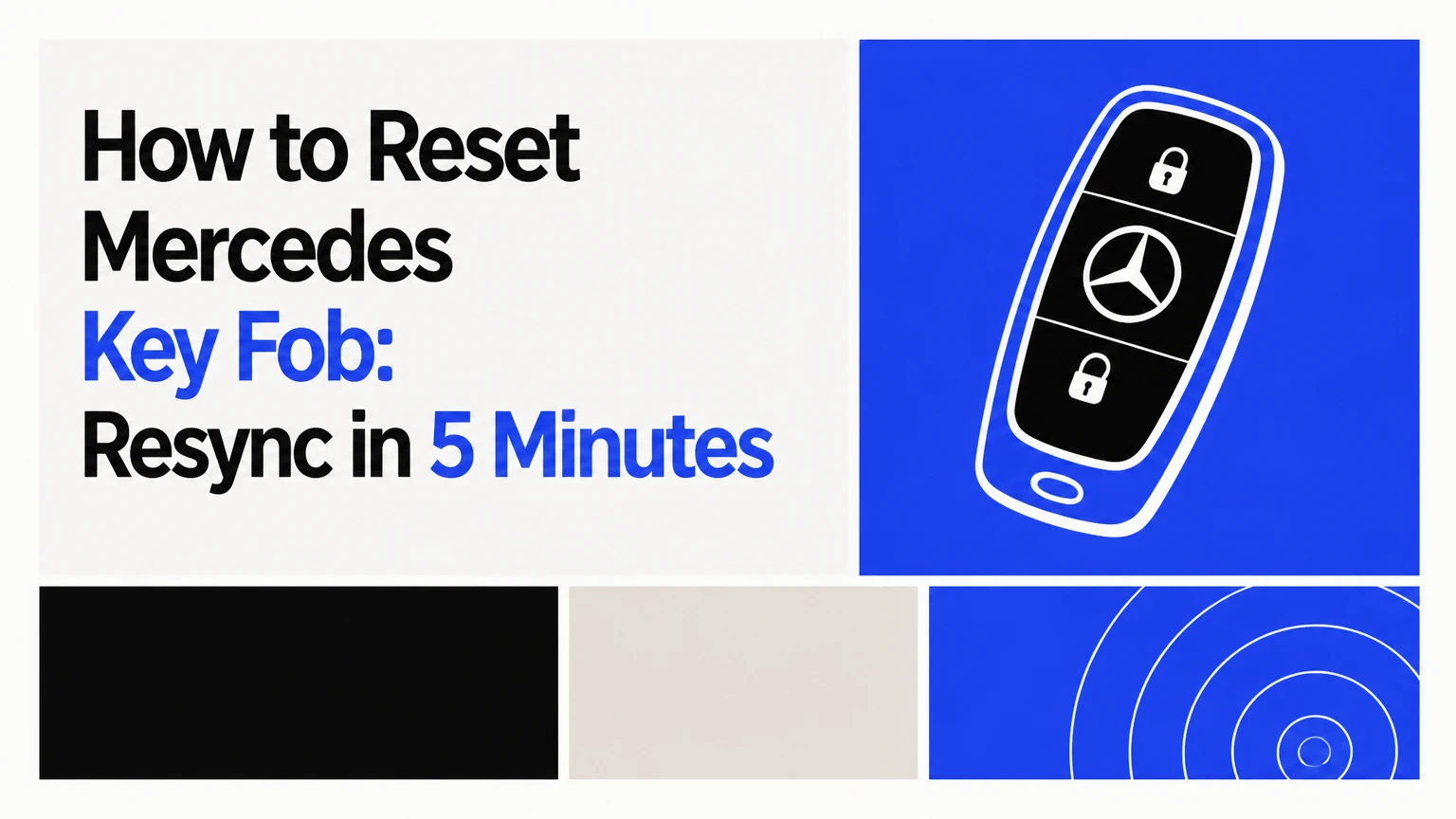
To reset a Mercedes key fob, first replace or verify its battery, then use the model-compatible SmartKey resynchronization sequence: hold the lock button, press unlock five times quickly, and test the vehicle. This home procedure restores remote synchronization on many older Mercedes models, but it does not program a new immobilizer key.
Key Facts at a Glance
Mercedes key fob resynchronization and new-key programming are different procedures.
The common older SmartKey sequence takes about 1-2 minutes and requires a working key battery.
A Mercedes remote can lock doors while an immobilizer or EIS/EZS fault still prevents starting.
CR2025 and CR2032 batteries appear in Mercedes keys, but the correct size depends on the exact fob.
A replacement Mercedes key usually requires VIN verification and specialist diagnostic authorization.
A flat vehicle battery can imitate a failed key fob because the car cannot receive or execute commands.
What Does Resetting a Mercedes Key Fob Actually Do?
Resetting a Mercedes key fob usually means resynchronizing the remote transmitter with the vehicle, not erasing and rewriting the key’s security identity. The procedure can correct intermittent lock, unlock, or trunk commands after a weak battery, extended inactivity, or repeated button presses outside the vehicle’s reception range.
Mercedes-Benz SmartKey systems contain several separate functions. The remote transmitter sends radio-frequency commands for normal locking and unlocking. Some generations also use infrared communication for short-range functions or data exchange, while a transponder authorizes starting through the vehicle’s immobilizer system.
The remote battery powers button transmission, but the immobilizer authorization path is not identical to the lock-button circuit. That distinction explains a common symptom: the doors respond, yet the engine does not start. In that case, repeating the remote resync sequence may accomplish nothing.
Mercedes-Benz owner manuals describe key operation and emergency-start procedures by model and production year, rather than offering one universal reset process. Treat the sequence below as a common older SmartKey method, not a guaranteed procedure for every W203, W211, W204, W212, W213, W206, or EQ model.
Reset Versus Program: What Is the Difference?
Resynchronization reconnects an existing, authorized key’s remote commands. Programming adds or authorizes a replacement key through Mercedes-specific security systems such as the electronic ignition switch, often called EIS or EZS depending on market and model.
A used key from another Mercedes is therefore not automatically reusable. The outer housing may fit, but the transponder, circuit board, frequency, firmware, and authorization status must all match the vehicle. Mercedes security architecture intentionally limits casual duplication.
How to Reset Mercedes Key Fob at Home
The common Mercedes SmartKey resynchronization method is completed in six actions: insert the key, switch the ignition on without starting, remove the key, hold lock, press unlock five times, and test the remote. The method is most suitable when the key still has a functioning battery and the vehicle previously recognized it.
Before You Start
| Requirement | Typical value | Why it matters |
|---|---|---|
| Home time | 5-10 minutes | Includes battery check and testing |
| Resync difficulty | Low | No scan tool is needed for the common sequence |
| Key requirement | Existing authorized key | A blank replacement cannot be created this way |
| Ignition position | Position 2, engine off | Supplies the required vehicle state on applicable models |
| Battery type | CR2025 or CR2032 | Confirm the marking inside the fob |
| Documentation | Owner’s manual or VIN | Needed when the model procedure differs |
Use the vehicle’s exact owner’s manual if the car has push-button start, Keyless-Go, an electronic ignition switch, or a newer MBUX-based system. Keep the physical key blade available because remote synchronization will not solve a locked-out vehicle with a dead fob battery.
Step 1: Insert the Existing Key
Insert the SmartKey into the electronic ignition switch. Do not use a newly purchased blank key for this procedure because the vehicle may not recognize its immobilizer data.
If the car uses KEYLESS-GO and has no conventional ignition slot, consult the vehicle manual before attempting the older sequence. Newer systems may use a different initialization or emergency-start method.
You will know this step is correct when: the key sits fully in the ignition switch without force.
Common mistake: pushing a damaged or incorrectly shaped key into the ignition. Stop if the key does not seat normally.
Step 2: Turn the Ignition to Position 2
Turn the key to position 2, sometimes labeled the second detent, without starting the engine. The instrument cluster should illuminate, while the starter remains inactive.
Position 2 is not the same as accessory position 1. The vehicle must enter the appropriate ignition state for the remote receiver on models that support this resynchronization process.
You will know this step is correct when: dashboard warning lamps and accessory systems activate.
Common mistake: starting the engine. If the engine starts, switch it off and restart the sequence from the beginning.
Step 3: Remove the Key and Hold Lock
Remove the key from the ignition switch. Immediately press and hold the lock button on the SmartKey.
Keep the lock button depressed during the next action. Timing matters more than force, and pressing the button repeatedly instead of holding it can interrupt the sequence.
You will know this step is correct when: the lock button remains continuously depressed while the fob is outside the ignition.
Common mistake: releasing lock before completing the unlock presses.
Step 4: Press Unlock Five Times
Press the unlock button five times in quick succession while continuing to hold the lock button. Use deliberate presses rather than holding unlock down.
The commonly published sequence is intended to resynchronize a previously authorized remote, not to enroll an unrecognized key. If the fob’s red indicator does not flash during the presses, replace or verify the battery before repeating the process.
You will know this step is correct when: five distinct unlock presses are completed without releasing lock.
Common mistake: pressing unlock slowly or counting fewer than five presses.
Step 5: Release Lock and Test the Remote
Release the lock button, insert the key again if necessary, and test lock, unlock, trunk, and panic functions from a short distance. Begin close to the vehicle because range testing from across a parking lot can introduce radio interference and a false failure.
Test every button separately. A working lock button does not prove that the trunk actuator, panic circuit, or Keyless-Go proximity function works.
You will know it worked when: the vehicle responds consistently to at least lock and unlock commands.
Common mistake: testing while standing beside wireless chargers, large radio transmitters, or another vehicle with a similar remote.
When Does the Home Sequence Not Apply?
The home sequence is not a substitute for key programming, immobilizer repair, or a model-specific diagnostic procedure. It may fail when the fob is blank, the internal circuit board is damaged, the vehicle battery is discharged, the receiver has a fault, or the car uses a newer system that does not support this exact sequence.
Mercedes-Benz model families overlap in production years and equipment. A 2015 C-Class with one key system may not follow the same procedure as a 2015 S-Class with another. The VIN, owner’s manual, fob part number, and vehicle equipment are more reliable than the key’s appearance.
Which Mercedes Key Battery Does the Fob Use?
Mercedes key fobs commonly use CR2025 or CR2032 coin cells, but the correct battery is determined by the marking inside the key, the owner’s manual, or the original battery specification. CR2032 cells are thicker than CR2025 cells, so substituting one can stress contacts or prevent the cover from closing.
| Fob or situation | Common battery possibility | Verification method | Typical symptom |
|---|---|---|---|
| Older black SmartKey | CR2025 | Read the removed cell | Weak red LED or short remote range |
| Chrome-trim SmartKey | CR2025 or CR2032 | Check cell marking and manual | Intermittent lock response |
| Later glossy SmartKey | CR2025 or CR2032 | Match original thickness | Keyless range loss |
| Replacement shell or board | Varies by board | Read circuit-board specification | Incorrect fit or no LED |
Slide out the mechanical key, use its tip or a plastic tool to open the battery compartment, and avoid bending the thin contact tabs. Install the cell with the polarity shown by the holder, then test the red LED before attempting resynchronization.
Mercedes-Benz guidance commonly warns owners to keep batteries away from children because coin cells create a serious ingestion hazard. Dispose of the old cell through a battery-recycling point rather than leaving it loose in household waste.
What If the Red LED Does Not Flash?
A red LED that does not flash usually indicates a depleted battery, reversed polarity, poor contact, or a damaged circuit board. Replace the cell with the exact specified type, inspect the contacts under good lighting, and test again before blaming the vehicle receiver.
Do not scrape contacts aggressively. A bent contact can lose pressure after the battery cover is closed, creating an intermittent fault that appears to be a synchronization problem.
Why Does the Mercedes Key Unlock the Doors but Not Start the Car?
A Mercedes key that unlocks the doors but will not start the engine has a starting-authorization problem, a key-recognition problem, or a vehicle electrical fault rather than a simple remote-sync problem. Remote locking and immobilizer authorization use related but distinct functions.
| Symptom | Most likely area | Safe first check | Escalation |
|---|---|---|---|
| No LED, no remote response | Key battery or board | Replace correct coin cell | Key repair or replacement |
| LED flashes, no door response | Receiver, interference, sync | Try spare key nearby | Scan vehicle receiver |
| Doors unlock, engine will not crank | EIS/EZS, transponder, vehicle battery | Check battery voltage and messages | Mercedes diagnostic specialist |
| Key turns or inserts, cluster stays dark | EIS/EZS or supply circuit | Try authorized spare key | Dealer or specialist locksmith |
| Keyless-Go fails, blade works | Proximity antenna or fob battery | Use emergency-start location | System diagnosis |
A key fob can transmit a valid lock command while its immobilizer transponder, antenna path, or vehicle authorization system remains faulty. Cleaning the infrared window may help on applicable models, but it will not repair a failed EIS/EZS module or an unrecognized transponder.
Check the vehicle battery before ordering a key. Low voltage can prevent the electronic ignition switch and central locking controller from operating normally, especially after the car has been parked for several weeks.
How Do Mercedes Key Types Affect Resetting?
Mercedes key generation affects battery access, remote frequency, emergency-start behavior, and programming restrictions. The key’s shape provides a useful clue, but part numbers and vehicle compatibility determine whether a reset or replacement procedure applies.
| Common key style | Approximate era | Typical Mercedes examples | Important limitation |
|---|---|---|---|
| Black plastic SmartKey | Early 2000s | W203 C-Class, W211 E-Class | Older procedure may apply |
| Chrome-trim SmartKey | 2006-2015 | W204 C-Class, W212 E-Class | Battery and frequency still vary |
| Glossy slim SmartKey | 2016-2020 | W213 E-Class, W222 S-Class | Keyless-Go equipment changes behavior |
| Rounded modern key | 2021-present | W206 C-Class, W223 S-Class | Dealer or specialist workflow is common |
Mercedes-Benz model codes such as W203 or W211 identify the chassis family, not every key configuration. Production market, facelift year, option package, and replacement-key part number can change the correct method.
An aftermarket shell can be useful when the original circuit board works and only the housing or buttons are damaged. A shell cannot repair a dead board, replace missing authorization data, or convert an incompatible frequency.
Can a New Mercedes Key Fob Be Programmed at Home?
A new Mercedes key fob generally cannot be fully programmed at home with the lock-button resync sequence. New-key authorization normally requires ownership verification and Mercedes-compatible security equipment operated by an authorized dealer or a qualified automotive locksmith.
The dealer or locksmith may require the vehicle identification number, registration, government-issued identification, and proof of ownership. Requirements vary by country and provider, but security documentation is a legitimate safeguard against unauthorized key creation.
A replacement process may include ordering a VIN-linked OEM key, verifying the vehicle, connecting a diagnostic system, and pairing or authorizing the key according to the applicable Mercedes security generation. Some newer systems have restrictions that prevent independent programming, while others can be supported by specialist locksmith equipment.
Do not buy a used key solely because its buttons or shell look identical. A used fob may remain cryptographically linked to another vehicle, and an online listing may omit frequency, region, part number, or immobilizer status.
Dealer, Locksmith, or Online Shell: Which Option Is Best?
A Mercedes dealer is the safest choice for a new or all-keys-lost situation, while a reputable automotive locksmith is often faster and less expensive for a supported model. An online shell is appropriate only when the original electronics still work and the owner is replacing physical housing components.
| Option | Typical US cost | Typical time | Best use case |
|---|---|---|---|
| Coin-cell replacement | $5-$15 | 5-10 minutes | Weak LED or short remote range |
| Diagnostic inspection | $80-$180 | 30-90 minutes | Key and vehicle symptoms conflict |
| Mobile specialist locksmith | $150-$450 | 1-4 hours | Supported replacement or on-site repair |
| Mercedes dealer key | $350-$800+ | 2-5 business days | New OEM key or restricted system |
| Online shell | $10-$50 | 30-90 minutes | Damaged housing with working board |
These are typical US consumer ranges, not guaranteed quotes. Luxury-model keys, emergency service, towing, taxes, regional labor rates, and all-keys-lost procedures can raise the total substantially.
A locksmith cannot legitimately bypass Mercedes immobilizer security through a simple remote reset. Ask whether the provider supports your exact chassis, key generation, market frequency, and all-keys-lost condition before paying a mobile-service fee.
What Should You Do If All Mercedes Keys Are Lost?
When all Mercedes keys are lost, contact a dealer or qualified automotive locksmith before purchasing an online fob. The provider will normally need the VIN, proof of ownership, a matching identification document, and access to the vehicle for verification or programming.
Do not assume the vehicle must always be towed. A mobile locksmith may be able to create or authorize a supported replacement at the vehicle’s location, while a dealer may require the car at the service facility depending on model and security system.
If the vehicle is locked, the mechanical blade may provide entry, but forcing a door or manipulating the ignition can damage seals, wiring, or the lock cylinder. Roadside assistance can provide non-destructive entry, but roadside technicians generally do not perform Mercedes immobilizer programming.
Common Mercedes Key Fob Failures and Fixes
Mercedes key fob failures usually fall into four groups: depleted power, lost remote synchronization, physical electronics damage, or a vehicle-side communication fault. Diagnose the least expensive reversible cause first, then escalate when symptoms implicate immobilizer or receiver hardware.
- The LED is dark. Install the specified CR2025 or CR2032, check polarity, and inspect contact pressure.
- The LED flashes but locks do not respond. Try the resync sequence, test close to the vehicle, and check for radio interference.
- Only one button works. Inspect the rubber keypad and circuit-board switch; a shell replacement may solve physical wear.
- The key became unreliable after water exposure. Remove the battery, allow the board to dry fully, and avoid heat guns that can damage components.
- The spare key works normally. The primary fob is the stronger suspect; compare batteries before ordering a replacement.
- Neither key works. Check vehicle-battery voltage, central-locking fuses, receiver faults, and diagnostic messages.
A practitioner rule is to test the spare key before repeating any programming attempt. If both keys fail in the same way, the vehicle is more likely to be the problem.
Another useful rule is to separate range from recognition. A remote that works only when held against the vehicle suggests battery power, contacts, or antenna performance; a key that operates locks normally but cannot authorize starting points elsewhere.
How Much Does Mercedes Key Fob Repair Cost?
Mercedes key fob repair costs about $5-$15 for a battery, $10-$50 for a replacement shell, $80-$180 for diagnosis, $150-$450 for supported locksmith service, and $350-$800 or more for many dealer replacement keys. Exact pricing depends on model, security generation, location, and whether all keys are missing.
| Repair or service | Typical price | Owner action | Main cost risk |
|---|---|---|---|
| Battery replacement | $5-$15 | DIY or retail counter | Wrong cell or damaged contacts |
| Shell transfer | $10-$50 | Move original board | Broken board during transfer |
| Key-board repair | $75-$250 | Specialist inspection | Water or switch damage |
| Locksmith replacement | $150-$450 | Provide VIN and ownership proof | Unsupported security system |
| Dealer replacement | $350-$800+ | Order and verify OEM key | Towing and waiting time |
A low advertised price may cover only an empty shell, not an authorized electronic key. Confirm whether the quote includes the blade, battery, transponder, remote board, cutting, programming, taxes, and emergency call-out charges.
When Should You Stop DIY Troubleshooting?
Stop DIY work when the key will not insert normally, the circuit board has corrosion, the vehicle shows an immobilizer warning, both authorized keys fail, or the replacement fob is unverified. Further probing can damage delicate contacts and does not bypass Mercedes security authorization.
DIY work is reasonable for a battery change, careful shell transfer, and the applicable resynchronization sequence. It is not appropriate for forcing an EIS/EZS module, modifying transponder data, bypassing ownership controls, or repeatedly cycling a failing vehicle battery.
Mercedes-Benz dealer service is the clearest path for newer restricted systems or warranty-sensitive repairs. A specialist locksmith can be the better practical option when the provider can identify the exact key system and document the programming method.
FAQ
Does Disconnecting the Mercedes Car Battery Reset the Key Fob?
Disconnecting the vehicle battery does not normally reset or program a Mercedes key fob. The action may erase some vehicle settings and can create additional low-voltage symptoms, while the fob’s authorization data remains unchanged. Use the correct resynchronization procedure or obtain a diagnostic assessment instead.
Can I Reset a Mercedes Key Fob Without the Original Key?
You cannot use the common resynchronization sequence without an existing authorized key because the procedure restores communication for a key the vehicle already recognizes. If every key is lost, a dealer or qualified locksmith must verify ownership and supply or authorize a replacement.
Why Does My Mercedes Key Fob Work Only Near the Car?
A Mercedes key fob that works only near the car usually has a weak battery, poor battery contact, damaged antenna circuitry, or radio interference. Replace the specified cell first, then test in an open area. If range remains severely reduced, have the fob and vehicle receiver diagnosed separately.
Will a Used Mercedes Key Fob Work on Another Car?
A used Mercedes key fob may not work on another vehicle even when the housing and buttons match. The transponder and security data can remain linked to the original car, and frequency or firmware may differ. Reusing only the physical shell is safer than buying an unverified used electronic key.
Does Keyless-Go Need a Separate Reset?
Keyless-Go may require a separate diagnosis or model-specific procedure because proximity antennas, passive authorization, and button-based remote functions are distinct systems. A successful lock-button resynchronization does not prove that passive entry or push-button starting has been restored.
The Bottom Line
To reset a Mercedes key fob, verify the correct battery, perform the common lock-and-five-unlock resynchronization sequence when the vehicle and key support it, and test the result close to the car. The procedure does not create a new key or repair immobilizer faults. If the Mercedes key still fails, compare the spare key, check vehicle-battery health, and use a dealer or qualified locksmith for programming and security diagnosis.