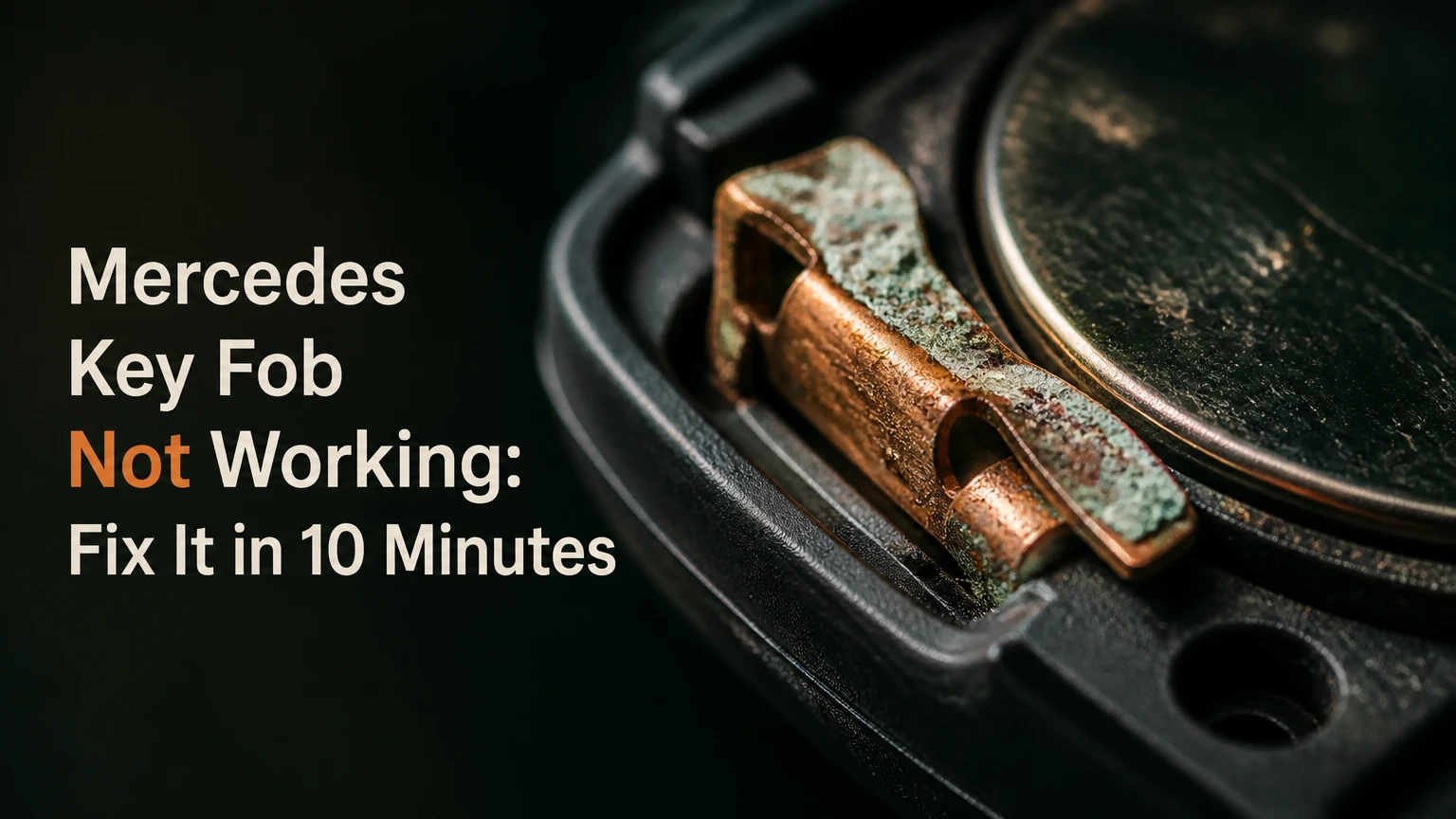
A Mercedes key fob that is not working usually has a depleted coin-cell battery, damaged contacts, a failed button or circuit board, or a vehicle-side receiver problem. Replace and test the correct battery first, then separate remote-locking failure from Keyless Go and engine-start failure, because each function uses different components and emergency procedures.
Key Facts at a Glance
A Mercedes key fob battery type varies by key design and vehicle generation; CR2025 and CR2032 cells are common, but some older keys use two cells.
A flashing red LED suggests that the fob has power, but the LED does not prove that the radio transmitter, infrared output, buttons, or circuit board works.
A Mercedes can often be unlocked mechanically and started with an emergency transponder-reading procedure when the fob battery is dead.
If two known-good keys fail in the same way, investigate the Mercedes vehicle battery, fuses, antennas, and receiver before buying another fob.
A used Mercedes SmartKey is generally not a simple replacement because key authorization is tied to the vehicle’s security system.
Never bridge a blown fuse with a larger fuse; the original rating protects wiring and control modules from excessive current.
What should you check first?
The fastest diagnosis takes about five minutes: test the fob LED, try the spare key, operate the mechanical key, and check whether the car recognizes the key at the start button. A single dead remote with a working spare points toward the fob; two failed remotes point toward the Mercedes vehicle, interference, or a shared power problem.
Use the symptom matrix
| Symptom | Most likely area | First test | Typical next action |
|---|---|---|---|
| No LED and no remote response | Coin cell, battery contacts, circuit board | Press Lock beside a camera and inspect LED | Install the specified new battery |
| LED flashes, doors remain locked | Button, infrared path, receiver, fuse | Try Unlock from 1-2 meters away | Test spare key and vehicle-side circuits |
| Remote buttons work, touch entry fails | Keyless Go setting, passive antenna, fob proximity circuit | Press a fob button, then try the handle | Check Keyless Go settings and antennas |
| Doors unlock, engine says key not detected | Interior antenna, fob transponder, 12-volt battery | Hold the fob against the Start/Stop button | Use emergency recognition procedure |
| Both keys fail after a flat vehicle battery | Vehicle power or control-module issue | Measure vehicle battery voltage | Charge or test the 12-volt battery |
| One button works intermittently | Worn microswitch or cracked solder joint | Compare each button’s response | Repair the board or replace the key |
A red light is a useful first clue, not a complete diagnosis. Some Mercedes key designs use an LED for infrared or general button feedback, while the car may use separate infrared and radio-frequency paths for different functions.
Try the spare key before opening anything
The spare key is the strongest low-cost control test. If the spare unlocks and starts the car normally, the original fob has a localized fault. If neither key works, replacing both batteries may waste time because Mercedes keys rarely fail simultaneously without a shared cause.
Move the car away from strong radio interference when testing. A phone, wireless charging pad, security gate, or other transmitter can sometimes disrupt remote operation temporarily, although persistent failure usually indicates a hardware, power, or vehicle-side problem.
How do you replace a Mercedes key fob battery?
Replace the battery with the exact cell specified for the key, usually a CR2025 or CR2032, in about 5-10 minutes. Remove the emergency key, open the correct release mechanism without prying against the circuit board, install the cell with the marked positive side oriented as before, and test every function immediately.
Identify the key before buying a battery
| Key design | Common period | Typical battery arrangement | Identification clue |
|---|---|---|---|
| Older black SmartKey | Approximately 1997-2005 | Often 2 x CR2025 | Black case, separate sliding battery tray |
| Chrome-sided SmartKey | Approximately 2006-2016 | Often 1 x CR2025 | Chrome edge, removable metal emergency key |
| Teardrop or newer square key | Approximately 2017 onward | Often 1 x CR2032 | Larger glossy case, rear release cover |
| Older flip or switchblade key | Model-dependent, often pre-2003 | Usually 1 coin cell | Folding metal blade and older button layout |
These year ranges are approximate because Mercedes sold overlapping key designs across markets and model lines. Read the old cell before disposal, compare the owner’s manual, or use the VIN with a Mercedes parts department when the key design is ambiguous.
Open a chrome-sided SmartKey
- Slide the release tab and pull out the metal emergency key.
- Insert the metal key into the designated opening near the end of the fob.
- Use controlled pressure to release the rear cover, rather than twisting the blade against the plastic.
- Remove the old coin cell and note its orientation.
- Install the new cell without touching both faces with wet or oily fingers.
- Refit the cover until each retaining tab clicks into place.
You will know the battery installation worked when the LED responds and the doors lock or unlock from close range. A common mistake is installing the correct battery upside down, which produces the same symptoms as a dead cell.
Open an older black SmartKey
Older black Mercedes keys commonly use a sliding tray that releases after the emergency key is removed. Push the internal gray release tab in the direction shown by the molded guide, then slide the tray out far enough to replace both cells if the design contains two.
Do not force the tray. Brittle retaining tabs can break after years of heat exposure, and a damaged tray may lose electrical pressure against the battery contacts. Replace both cells together with the same brand and type when the key uses two batteries.
Open a newer teardrop or square key
Newer Mercedes fobs commonly release through a rear cover button or a small molded latch. Press the release, slide or lift the cover as the case design permits, and avoid inserting a screwdriver beside the buttons because the circuit board and rubber button membrane sit close to the shell.
Coin cells have different thicknesses. A CR2032 is 3.2 millimeters thick, while a CR2025 is 2.5 millimeters thick, so substituting one for the other can cause poor contact even when the diameter is identical.
Check the result systematically
| Check after replacement | Normal result | Failure implication | Correct response |
|---|---|---|---|
| LED after button press | Immediate flash on supported design | No power or contact | Recheck polarity and spring contacts |
| Lock button | Doors lock within normal range | Button or transmitter issue | Test other buttons and spare key |
| Unlock button | Doors unlock consistently | Receiver or switch issue | Test close range and vehicle fuses |
| Trunk or panic button | Function responds when equipped | Worn individual switch | Consider board repair |
| Keyless Go handle | Vehicle detects touch key | Passive-entry issue | Check setting, antenna, and fob |
| Start authorization | Engine starts with brake applied | Transponder or vehicle fault | Use emergency recognition and scan vehicle |
Why does the key work but the car does not?
A Mercedes key fob can have a flashing LED and still fail to operate the vehicle because the LED only confirms limited electrical activity. The remaining possibilities include a failed transmitter, damaged infrared window, broken button switch, lost synchronization on an older system, radio interference, a blown central-locking fuse, a failed antenna module, or a weak vehicle battery.
Separate fob functions before testing
Remote locking, infrared communication, Keyless Go, and immobilizer authorization are related but not identical. A key can unlock the doors while its passive-entry function fails, or it can unlock the doors while the car refuses to recognize the electronic key for starting.
The smartphone camera test has a narrow use. Point the end of the fob toward the camera, press a remote button, and look for a purple or white infrared flash. The test can reveal infrared output on compatible phones, but it cannot reliably confirm radio-frequency transmission or immobilizer authorization. Some cameras filter infrared, so a failed visual test is not conclusive.
Inspect the Mercedes vehicle side
If a known-good key fails at close range, check the vehicle’s 12-volt battery condition before dismantling trim. A low system voltage can create several unrelated warnings and prevent comfort-access modules from responding, particularly after the car has sat unused or experienced a jump-start.
Then consult the fuse chart for the exact model and year. Fuse locations vary, but circuits may be labeled central locking, antenna amplifier, Keyless Go, interior antenna, or access authorization. The Mercedes owner’s manual and fuse-card diagram are more reliable than a generic online fuse list.
A fuse is evidence, not the diagnosis. If a replacement fuse blows immediately, stop replacing it and find the short or failed module. A larger fuse can overheat wiring and increase repair damage.
Can Keyless Go stop working while the buttons still work?
Yes. Mercedes Keyless Go can fail independently of the remote buttons because passive entry uses vehicle antennas, proximity detection, door-handle sensors, and a fob circuit designed for low-power communication. Pressing a fob button may temporarily wake or change the fob’s state, but repeated failure requires testing the handle, spare key, vehicle battery, and relevant settings.
Some Mercedes systems disable passive access after a deliberate double press of the Lock button to reduce battery consumption or prevent passive unlocking. Press a normal button once, wait briefly, and test the handle again. The exact behavior depends on vehicle generation and market configuration.
If both keys lose touch entry but remote buttons continue working, suspect the vehicle’s passive-entry system rather than two simultaneous fob failures. A diagnostic scan may identify an interior or exterior antenna fault that a visual fuse inspection will miss.
How do you start a Mercedes with a dead key fob?
A Mercedes with a dead fob battery can often start because the immobilizer transponder may be read without coin-cell power. Vehicles with a SmartKey slot generally require the fob to be inserted into that slot, while vehicles with a Start/Stop button commonly require the fob to touch or closely contact the button while the brake pedal is pressed.
Emergency-start procedure
- Remove the metal emergency key from the fob.
- Unlock the driver’s door through the concealed mechanical lock cylinder.
- Enter the vehicle and expect the alarm to sound on some configurations.
- If the dashboard has a SmartKey slot, remove the Start/Stop button if the design allows and insert the fob into the slot.
- If there is no slot, hold the fob directly against the marked Start/Stop button.
- Press the brake pedal and press the Start/Stop button.
- Remove the fob only after the vehicle has started or the display identifies the next required action.
You will know the emergency-read procedure worked when the instrument cluster recognizes the key and the engine cranks or starts normally. The method will not overcome a missing, unrecognized, or internally damaged transponder, a dead vehicle battery, a steering-lock fault, or a security-system failure.
The mechanical key opens the door but does not replace electronic authorization. Keep the fob against the specified reader area, and do not assume the location is identical across a C-Class, E-Class, GLC, GLE, or Sprinter.
Does a Mercedes key need resynchronization?
Most later Mercedes SmartKeys do not require routine resynchronization after a coin-cell replacement. Older infrared flip keys and early remote systems may lose synchronization, particularly after repeated button presses outside the vehicle, but the correct sequence depends on the model and regional system.
A commonly cited older procedure is to point the key toward the vehicle, press Lock and Unlock together for roughly 5-10 seconds, release both, then press Unlock once. Use that procedure only when the owner’s manual or a qualified Mercedes technician confirms compatibility.
Do not repeatedly perform an older reset sequence on a modern DAS3 or DAS4 vehicle and assume programming has occurred. Synchronization restores communication on certain older remotes; it does not program a replacement key, repair a failed antenna, or authorize a used SmartKey to another vehicle.
What do the failure symptoms mean?
The failure pattern usually identifies the defective layer more accurately than the LED alone. Remote range, individual button behavior, Keyless Go operation, and start authorization should be recorded separately before a repair decision.
| Observed pattern | Probable cause | Confidence from symptom alone | Best next test |
|---|---|---|---|
| No LED, no buttons, no start recognition | Battery, contacts, board, transponder damage | Medium | New cell, contact inspection, spare key |
| LED works, no lock or unlock | Transmitter, button switch, receiver, fuse | Low | Camera test, close-range test, spare key |
| Lock works, Unlock fails | Worn Unlock switch, infrared path, receiver command | Medium | Press switch feel, test camera, board inspection |
| Remote works, Keyless Go fails | Passive-entry setting, antenna, proximity circuit | High | Try second key and each door handle |
| Doors work, Start/Stop says key missing | Interior antenna, transponder, vehicle battery | Medium | Emergency start and battery test |
| Works only beside the car | Weak battery, poor contacts, transmitter degradation | High | Replace cell and inspect terminals |
| Failure after washing or immersion | Liquid corrosion or residue | High | Stop repeated testing and inspect board |
| Both keys fail simultaneously | Vehicle battery, receiver, fuse, interference | High | Charge battery and scan vehicle modules |
An intermittent fob deserves faster attention than a completely dead one. Intermittent operation often precedes a cracked solder joint, worn microswitch, contaminated contact, or battery terminal that has lost spring tension.
Should you repair or replace the key?
Repair is sensible when the shell, buttons, or battery contacts are damaged but the authorized electronics remain serviceable. Replacement is usually safer when the circuit board has extensive corrosion, the transponder is damaged, the key is lost, or the fob repeatedly fails after a verified battery and vehicle-side diagnosis.
Water damage is rarely fixed by drying alone. Remove the battery only if safe, avoid applying heat, and have a specialist inspect corrosion under the switches and integrated circuits. A replacement shell cannot repair a failed board.
A used online key is not automatically useless, but it is rarely a plug-and-play solution. Mercedes authorization systems and key generations impose different restrictions, and many previously assigned keys cannot be paired to another vehicle through ordinary programming. Ask the supplier whether the key is new, vehicle-specific, virgin, refurbished, or merely a shell before paying.
Which replacement option makes sense?
A Mercedes dealer offers the lowest compatibility uncertainty, while a properly equipped automotive locksmith often offers lower cost and faster mobile service. The correct choice depends on whether the original key is present, whether the car starts, local security rules, and whether the locksmith supports the exact Mercedes security generation.
| Replacement route | Typical US cost | Typical time | Usually required |
|---|---|---|---|
| Mercedes-Benz dealer, one new key | $400-$800 or more | 3-10 business days | Government ID, registration or title, VIN |
| Qualified European automotive locksmith | $200-$450 | Same day, often 1-3 hours | ID, ownership proof, vehicle access |
| Key shell and battery repair | $30-$150 | 30-120 minutes | Existing working electronics |
| Lost-all-keys mobile service | $350-$1,000 or more | Same day to several days | Ownership proof, security-compatible equipment |
These are typical US market ranges, not fixed Mercedes prices. Model, year, Keyless Go equipment, programming policy, travel distance, emergency timing, and whether all keys are lost can move the total substantially.
Ask a locksmith whether the technician handles Mercedes DAS3 or DAS4 systems, can cut or supply the emergency blade, and will provide a written total before beginning. Automotive locksmith organizations such as the Associated Locksmiths of America advise consumers to verify licensing requirements, identification, and ownership before authorizing vehicle-entry work.
A dealer is usually the better choice when the vehicle has advanced security faults, no keys remain, or factory documentation is necessary. A specialist locksmith is often the better choice for a failed spare, mobile service, or a replacement that must be supplied and programmed at the vehicle.
What mistakes cause repeat failure?
The most common repeat failure is installing the wrong coin cell or damaging the battery contacts while opening the shell. Mercedes owners also mistake a working LED for proof of a working transmitter, replace a fuse without investigating why it failed, or buy a used key without confirming authorization compatibility.
Avoid these errors:
- Do not guess the battery type. CR2025 and CR2032 share a 20-millimeter diameter but differ in thickness.
- Do not pry beside the buttons. The rubber membrane and microswitches can shift or tear.
- Do not touch both battery faces repeatedly. Skin residue can accelerate contamination and reduce reliable contact.
- Do not assume camera output proves radio output. The camera sees infrared, not every Mercedes communication channel.
- Do not install a higher-rated fuse. The rating protects the harness and module.
- Do not buy a used SmartKey from a marketplace without written compatibility terms. The shell may be genuine while the electronics remain assigned to another vehicle.
One practitioner rule is especially useful: diagnose with two independent tests before buying a key. For example, confirm that the spare fails and that the vehicle battery is healthy, or confirm that the original fob fails at the car while the same key’s emergency transponder procedure also fails.
How much time and money should the diagnosis take?
A battery-only repair typically costs $3-$15 for a quality coin cell and takes 5-10 minutes. A professional diagnostic visit commonly takes 30-90 minutes, while receiver, antenna, or control-module repairs can range from roughly $150 to more than $1,000 depending on access, parts, and coding.
| Repair scenario | Typical parts cost | Typical labor or service time | Likely total |
|---|---|---|---|
| Single coin-cell replacement | $3-$15 | 5-10 minutes | $3-$30 |
| Shell or button repair | $15-$80 | 30-90 minutes | $50-$150 |
| Fob board repair | $75-$250 | 1-3 hours | $100-$350 |
| Antenna or receiver diagnosis | $50-$300 | 1-3 hours | $150-$600 |
| New programmed SmartKey | $250-$700 parts and coding | 1-3 hours, plus ordering | $400-$1,000 or more |
Prices vary by country and model. A dealer quote should identify the key, coding, emergency blade, labor, and taxes separately; a locksmith quote should identify travel, programming, and any all-keys-lost surcharge.
When should you stop DIY troubleshooting?
Stop DIY work when the shell will not open with normal release pressure, the board shows corrosion, the vehicle repeatedly blows the same fuse, the car reports an electronic steering-lock or authorization fault, or the only key has been disassembled and still cannot start the vehicle. Continuing can turn a battery replacement into a damaged-shell or immobilizer problem.
Contact Mercedes-Benz roadside assistance, a dealer, or a qualified automotive locksmith when the vehicle is immobilized in an unsafe location. Bring registration or title and government identification, because legitimate key providers must verify ownership before cutting or authorizing a security key.
Frequently Asked Questions
Will a dead Mercedes key battery prevent the car from starting?
A dead coin-cell battery does not always prevent starting because many Mercedes vehicles can read the key’s passive transponder through an emergency antenna. Use the model-specific SmartKey slot or hold the fob against the Start/Stop button while pressing the brake. A dead vehicle battery or damaged transponder still prevents starting.
Why does my Mercedes key lock the car but not unlock it?
A Mercedes key that locks but does not unlock may have a worn Unlock microswitch, damaged infrared output, a receiver problem, or a vehicle setting fault. Test the button at close range, try the spare, inspect the LED and battery, and check whether the interior door switch operates normally.
Can cold weather make a Mercedes key fob stop working?
Cold weather can reduce coin-cell output and expose weak battery contacts, especially when a marginal battery is already near depletion. Warm the fob naturally, test it close to the vehicle, and install the correct fresh cell. Do not heat the fob with a hair dryer or place it on a heater.
Can I program a Mercedes key myself?
Owners can usually replace a battery and perform limited older-remote synchronization themselves, but a new Mercedes SmartKey generally requires vehicle-specific authorization and specialized diagnostic equipment. DIY programming instructions sold online may apply to a different security generation and can leave the vehicle without a usable key.
How do I know whether the Mercedes car or the fob is faulty?
Use the spare key, test the fob at close range, and check the vehicle’s 12-volt battery. One failed key indicates a fob fault; two failed keys indicate a shared vehicle-side or interference problem. A professional scan is needed when both remotes work intermittently or the dashboard reports key authorization faults.
The Bottom Line
A Mercedes key fob not working is most often resolved by installing the correct CR2025 or CR2032 battery, correcting its polarity, or restoring contact pressure. If a new battery changes nothing, use the spare key and symptom pattern to distinguish the fob from the Mercedes receiver, Keyless Go antennas, vehicle battery, fuse, or immobilizer. Use the mechanical key and emergency start procedure when stranded, then choose a dealer or qualified Mercedes automotive locksmith only after confirming the exact key generation and programming requirements.