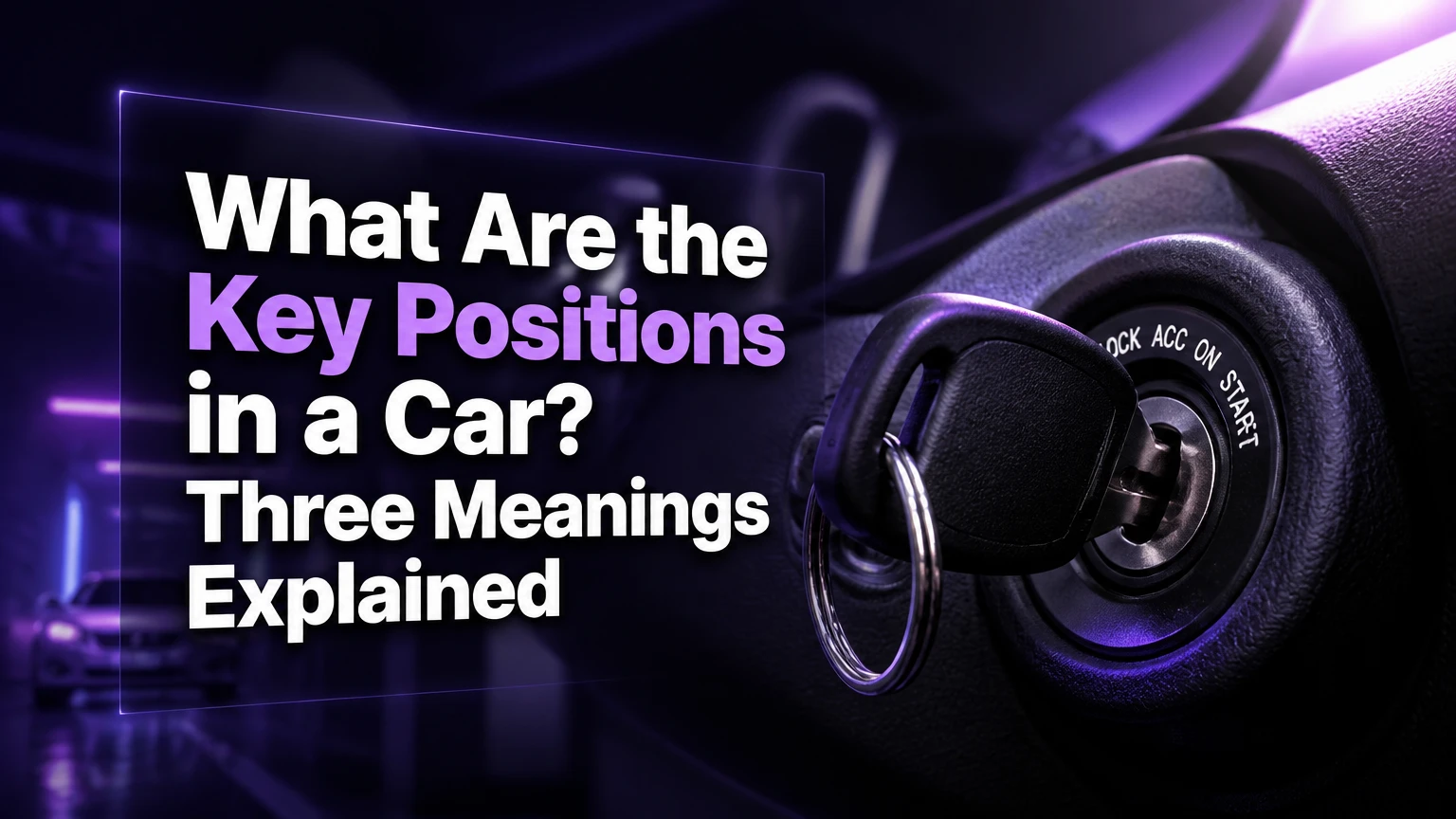
The key positions in a car usually mean the ignition switch states: LOCK/OFF, ACC, ON/RUN, and START. In everyday automotive language, the phrase can also refer to driver seating positions or wheel-alignment angles, so the correct answer depends on whether the question concerns starting, controlling, or maintaining the vehicle.
Key Facts at a Glance
- LOCK/OFF removes ignition power and usually permits physical key removal, while steering-column locking depends on the vehicle design.
- ACC powers selected accessories without running the engine; the radio, blower, windows, or outlets may vary by model.
- ON/RUN powers the vehicle control modules and warning lamps but does not necessarily operate every system continuously.
- START energizes the starter circuit only while the key or button is held, then returns to RUN after the engine starts.
- A safe driver position keeps the chest at least 10 inches from the steering-wheel airbag cover and preserves full pedal control.
- Wheel alignment describes toe, camber, caster, and thrust angle, with correct values set by the vehicle manufacturer rather than universal numbers.
What Are the Key Positions in a Car?
The four traditional ignition positions are LOCK or OFF, ACC, ON or RUN, and START. They are electrical states controlled by a mechanical ignition switch or an electronic body-control system, and each state supplies a different combination of power to accessories, control modules, ignition components, and the starter motor.
A physical key normally moves through detents in sequence. LOCK/OFF is the parked state, ACC supplies limited accessory power, ON/RUN wakes the vehicle for driving, and START closes the starter-control circuit. The spring-loaded START position is temporary, because releasing the key allows it to return to RUN.
The exact behavior is vehicle-specific. Some cars allow the heater fan in ACC, some shut it off; some use a separate steering-lock mechanism; and many modern vehicles label the first button press as ACCESSORY rather than ACC. The owner’s manual is the final authority for the symbols and functions on a particular car.
| Position | Typical electrical function | Engine state | Typical use |
|---|---|---|---|
| LOCK/OFF | Ignition modules off; limited memory power remains | Not running | Park, remove key, lock vehicle |
| ACC | Radio, outlets, selected windows, display power | Not running | Brief accessory use |
| ON/RUN | Instrument cluster, ECU, airbag module, fuel and emissions controls | Running or ready | Driving and pre-start checks |
| START | Starter relay and solenoid energized | Cranking | Starting for several seconds |
What Does ACC Power?
ACC, or accessory, powers selected low-load systems while leaving the engine and normal ignition sequence inactive. Common ACC loads include the audio system, infotainment screen, 12-volt socket, interior electronics, and sometimes power windows or the climate blower.
ACC is not a universal equipment list. A vehicle may disable the blower, heated seats, rear defroster, or windows in order to preserve battery charge, while another model may permit them. The distinction matters because an accessory can operate without the engine alternator replenishing the battery.
A typical modern passenger-car accessory load may range from roughly 3-15 amperes, depending on the screen, audio amplifier, lighting, and charging devices connected. A healthy 12-volt battery can lose enough starting capacity after prolonged ACC use, especially in cold weather, but a precise 30-60-minute limit is not valid for every battery or vehicle.
What Happens in ON or RUN?
ON/RUN activates the vehicle’s normal control and monitoring network without necessarily turning the engine. The instrument cluster illuminates warning lamps, the engine-control module wakes, the transmission controller communicates, and systems such as the airbags and anti-lock brakes perform checks.
Many fuel-injected vehicles briefly run the fuel pump when the system enters RUN, but the pump may cycle again only when the control module sees the conditions required for starting. Diesel vehicles may also use a glow-plug or “wait to start” indicator. A driver should wait for required warning-light checks to complete rather than repeatedly cranking immediately.
ON/RUN is also the position that drains a battery fastest when the engine is stopped. Displays, control modules, ignition coils, injectors, and cooling fans can draw substantially more power than a radio alone, although the actual current varies widely by vehicle and operating state.
Why Is START Spring-Loaded?
START is spring-loaded because the starter motor should operate only during cranking. Turning a key to START or pressing the button sends control power to a relay or starter solenoid, which connects high battery current to the starter motor.
The starter may draw approximately 150-350 amperes during difficult cranking, with smaller engines and warm conditions generally requiring less. Once the engine starts, the key returns to RUN, and the starter disengages through the ignition switch, relay logic, or an electronic starter-control module.
Holding START after the engine has caught can damage the starter drive or create unnecessary mechanical stress. Many modern vehicles prevent repeated cranking while the engine is already running, but drivers should not rely on that safeguard.
How Do You Use Ignition Positions?
Use the ignition sequence in four stages: enter the vehicle with the key or recognized fob, select ACC only when accessories are needed, select ON/RUN for the pre-start check, and select START while holding the brake or clutch as required. A normal start takes seconds, but the correct interlock and warning-light behavior matters more than speed.
- Insert the key or bring the fob inside. Keep the fob away from metal containers and other electronic devices if detection is unreliable.
- Turn to ACC only for brief accessory use. Avoid leaving the vehicle in ACC while listening to audio for long periods.
- Turn to ON/RUN. Confirm that the instrument cluster wakes and that the security, oil-pressure, and charging lamps behave normally.
- Apply the brake in an automatic vehicle. A manual-transmission car generally requires the clutch pedal depressed, sometimes with the gear selector in Neutral.
- Turn to START and release when the engine runs. Do not hold the starter continuously for long periods; many manufacturers recommend short attempts with cooling intervals.
- Verify the result. The oil-pressure and battery warning lamps should normally go out after the engine starts, while a persistent warning requires diagnosis.
A successful start produces a running engine, a normal charging-voltage rise, and no abnormal starter noise. If the engine cranks slowly, stop repeated attempts and check battery voltage, terminal connections, and fuel or immobilizer indicators.
How Do Keyless Start Positions Work?
Push-button systems reproduce OFF, ACC, RUN, and START electronically, but the button sequence varies by manufacturer. A brief press without the brake commonly selects ACC, a second press selects ON/RUN, and pressing the button with the brake or clutch depressed commands starting.
The vehicle uses a key-fob radio signal, an immobilizer transponder, brake or clutch switches, and control-module logic. The engine will usually not start unless the system confirms an authorized fob and the correct pedal or transmission condition.
| Action on a typical push-button system | Result | Important condition |
|---|---|---|
| Press button with no pedal | ACC | Accessories only |
| Press button twice with no pedal | ON/RUN | Cluster and modules active |
| Press button with brake depressed | Start request | Automatic transmission usually in Park or Neutral |
| Hold button during a running engine | Emergency shutdown on some models | Follow the owner’s manual |
| Press button after parking | OFF | Selector usually must be in Park |
A dead fob battery does not always prevent starting. Many vehicles provide a marked backup location, such as a slot in the center console, a pocket near the steering column, or direct contact between the fob and the start button. The location differs by model.
Can You Start a Car in Neutral?
Many automatic cars can start in Neutral because the neutral-safety switch permits starter operation in Park and Neutral. The feature helps when a vehicle must be moved, but it does not bypass a defective immobilizer, failed starter, or discharged battery.
To test the interlock safely, keep the brake applied, confirm the area is clear, and select Neutral before attempting a start. If the engine starts in Neutral but not Park, the range sensor, shift linkage, or transmission-position adjustment may need inspection.
Never use Neutral starting as a substitute for diagnosing a vehicle that unexpectedly starts in gear. A car that cranks outside the permitted selector positions has a serious safety fault.
How Should You Set the Driver’s Seat?
Set the driver’s seat so the driver can fully depress every pedal, maintain a slight knee bend, keep the shoulders against the backrest, and hold the steering wheel without reaching. The seat must also preserve airbag clearance and keep the lap belt low across the pelvis.
Start with the seat distance. Depress the brake pedal fully and move the seat until the knee remains slightly bent, commonly around 20-30 degrees from full extension. A knee angle near 120 degrees is a useful ergonomic reference, not a mandatory specification for every body type or vehicle.
Raise the seat to obtain a clear view without sacrificing head clearance. Set the backrest near an upright driving posture, often about 100-110 degrees from the seat cushion, then adjust the steering column so the hands rest around the 9 and 3 o’clock positions with relaxed shoulders.
NHTSA’s driver-position guidance uses a minimum chest-to-airbag distance of 10 inches from the steering-wheel hub. That distance is a safety threshold, not permission to sit so far back that the driver cannot press the pedals or see the road.
- Move the seat forward or backward for pedal control.
- Adjust seat height for visibility and at least several inches of headroom.
- Recline the backrest enough to support the shoulders without creating a reclined posture.
- Set the steering wheel for a slight elbow bend and unobstructed instrument visibility.
- Raise the head restraint so its center supports the back of the head, not the neck.
- Adjust mirrors only after the seating position is fixed.
The best checkpoint is practical: the driver can steer, brake, and operate the clutch without stretching, while the seat belt remains correctly positioned. A position that feels comfortable while parked may still be unsafe if it causes the lap belt to cross the abdomen or the driver to reach for the wheel.
Which Seat Adjustments Matter Most?
Seat distance and steering-wheel reach affect control and airbag spacing more than cosmetic seat features. Lumbar support, height, recline, thigh extension, and memory settings then refine comfort, but an electrically adjustable seat cannot compensate for an incorrect basic position.
| Seat feature | Typical adjustment | Main benefit | Common limitation |
|---|---|---|---|
| Manual fore-aft track | 150-250 mm travel | Fast, low-cost positioning | Coarser adjustment |
| Manual seat height | 30-60 mm range | Changes sightline and thigh angle | Often unavailable on passenger seats |
| Power lumbar | 2-4-way bladder or motor | Supports lower-back contour | Excess pressure can cause discomfort |
| Thigh extension | 30-80 mm extension | Supports longer legs | May interfere with pedal posture |
| Memory seat | 2-3 stored profiles | Repeats driver settings | Depends on motors and vehicle electronics |
Power seats usually add weight and repair complexity, while manual seats remain usable if electrical systems fail. Memory seating has its greatest value in shared vehicles, where repeated readjustment can otherwise leave the steering wheel, mirrors, and seat in mismatched positions.
A seat should not be chosen by adjustment count alone. Twenty-way adjustment does not guarantee a usable thigh angle, head restraint position, or steering-wheel range for a particular driver.
What Do Wheel Alignment Positions Mean?
Wheel-alignment positions are the geometric angles that determine how each wheel points and tilts relative to the road, suspension, and vehicle centerline. The main measurements are toe, camber, caster, and thrust angle, and the correct values come from the manufacturer’s specification for that exact model and suspension.
- Toe describes whether the tires point inward or outward when viewed from above. Toe-in points the fronts of the tires closer together; toe-out points them farther apart.
- Camber describes the inward or outward tilt of the wheel when viewed from the front. Negative camber places the top inward, while positive camber places it outward.
- Caster describes the forward or rearward tilt of the steering axis when viewed from the side. Positive caster generally supports straight-line stability and steering return.
- Thrust angle describes the direction in which the rear axle pushes the vehicle relative to the geometric centerline.
Alignment values are measured in degrees or millimeters, depending on the machine and specification. A generic camber range such as -0.5 to -1.5 degrees cannot replace the factory data, because tire size, ride height, suspension design, and load assumptions alter the correct setting.
| Alignment angle | Viewing direction | Typical effect of excessive error | Common wear or handling symptom |
|---|---|---|---|
| Toe | Above the vehicle | Tire scrub across the tread | Feathered tread and steering wander |
| Camber | In front of the wheel | Uneven load on inner or outer shoulder | Shoulder wear |
| Caster | Beside the vehicle | Steering effort or return changes | Pull or unequal steering feel |
| Thrust angle | Behind the vehicle | Rear axle points off center | Crooked steering wheel |
How Is a Four-Wheel Alignment Performed?
A four-wheel alignment begins with a suspension and tire inspection, continues with electronic measurement, and ends with adjustments in the order specified by the vehicle manufacturer. A competent shop does not adjust alignment angles until it confirms that worn components, incorrect tire pressures, or damaged wheels are not causing the readings.
- Inspect the vehicle. Check tire pressure, tread, wheel runout, ride height, ball joints, tie rods, control-arm bushings, and wheel bearings.
- Mount targets or sensors. The alignment machine attaches measurement heads to all four wheels.
- Compensate and measure. The technician rolls or lifts the vehicle according to the machine procedure, then records toe, camber, caster, and thrust angle.
- Set the rear axle first when adjustable. Rear toe and camber establish the thrust direction on many vehicles.
- Adjust the front suspension. Caster and camber may use bolts, shims, slotted mounts, or dedicated adjustment kits; tie rods set front toe.
- Center the steering wheel. The wheel must remain centered while toe is adjusted, rather than being straightened afterward.
- Road-test and print results. The final sheet should show before-and-after values against the model’s specified range.
Some cars have limited factory adjustment. If a measurement remains outside specification, the cause may be a bent knuckle, subframe, control arm, spring, or collision-damaged body structure rather than a missing adjustment.
How Much Do These Services Cost?
Typical United States pricing is about $80-$150 for a standard four-wheel alignment, $150-$400 for a conventional ignition-cylinder replacement, and $300-$800 for some electronic key-fob or module replacements. Actual charges vary by region, vehicle security system, parts availability, taxes, and whether damaged hardware must also be repaired.
| Service or component | Typical cost range | Typical time | Main price variable |
|---|---|---|---|
| Four-wheel alignment | $80-$150 | 45-90 minutes | Vehicle adjustment design |
| Ignition lock cylinder | $150-$400 | 1-3 hours | Key coding and labor access |
| Smart key or fob | $100-$400 | 15-90 minutes | Dealer programming and model |
| Immobilizer or body module | $300-$800+ | 1-4 hours | Diagnosis, coding, and part cost |
| Power-seat motor repair | $200-$700 | 1-4 hours | Motor, track, and trim access |
Alignment should be priced after inspection if the vehicle has worn steering or suspension components. Paying for an alignment before replacing a loose tie rod often produces a temporary printout rather than a durable repair.
When Does a Car Need Alignment?
A car needs alignment after a substantial pothole or curb impact, suspension repair, collision damage, persistent pulling on a reasonably level road, or abnormal tire wear. Annual or 12,000-mile service can be a reasonable inspection habit, but no universal interval applies to every vehicle or road environment.
Tire pressure must be checked before diagnosing a pull. A low tire, mismatched tire, conicity defect, crowned road, or brake drag can mimic alignment trouble. A vehicle that drifts slightly right on a crowned public road may not have a mechanical alignment fault.
| Symptom | First check | Likely alignment or mechanical cause |
|---|---|---|
| Feathered tread | Run hand across tread and verify toe | Excessive toe or loose linkage |
| Inner shoulder wear | Measure camber and inspect suspension | Excessive negative camber |
| Steering wheel off-center | Check thrust angle and front toe | Rear toe error or incorrect adjustment |
| Vehicle pulls left or right | Tire pressure, brake drag, road slope | Caster or camber difference |
| Car wanders at speed | Tire condition and suspension play | Toe error, worn bushings, or low caster |
What Can Go Wrong With These Positions?
Ignition, seating, and alignment faults produce different warning signs, so diagnosis should begin by identifying which “position” the driver means. A key that will not turn is an ignition or steering-lock issue; a cramped posture is a seating adjustment issue; and feathered tread points toward toe or related suspension geometry.
Ignition faults
A key that will not rotate may be held by steering-column load, a damaged lock cylinder, a wrong key, or a transmission interlock. Gently move the steering wheel left and right while applying light key-turning pressure. Do not force the key, because a broken key can turn a simple obstruction into a lock-cylinder repair.
Dashboard lights with silence during START can result from a weak battery, starter relay, neutral-safety switch, clutch switch, immobilizer problem, or starter motor. Test battery voltage and terminal connections before striking a starter motor, because tapping is an unreliable temporary measure and can damage components.
Seat-position faults
Slouching changes belt geometry and can place the lap belt across soft abdominal tissue. Sitting too close to the steering wheel reduces the recommended airbag clearance, while sitting too far away can prevent full pedal control.
A power seat that stops moving may have a blown fuse, failed motor, damaged switch, obstructed track, or wiring fault under the seat. Disconnecting seat wiring without following the service procedure can trigger an airbag warning, so restraint-system connectors require special care.
Alignment faults
A damaged suspension component cannot be corrected by turning an alignment adjuster. If toe or camber changes after a short drive, the vehicle may have a loose joint, bent part, shifted subframe, or failing bushing.
Performance alignment settings also have trade-offs. Mild negative camber can improve cornering grip on a track, but excessive negative camber can reduce straight-line braking contact and accelerate inner-edge tire wear on a daily-driven car. Factory specifications are the safer default for normal road use.
How Do the Three Meanings Differ?
Ignition positions control electrical power, seating positions control the driver’s relationship to the controls and restraints, and alignment positions control tire contact with the road. They share the word “position,” but they are separate automotive systems with different measurements, symptoms, and repair methods.
| Meaning of position | Main components | Measured or selected by | Typical failure result |
|---|---|---|---|
| Ignition state | Key switch, start button, relay, immobilizer | Key rotation or button sequence | No accessory power or no crank |
| Driver seating position | Seat tracks, recliner, steering column, mirrors | Driver adjustment | Poor control or unsafe belt geometry |
| Wheel alignment angle | Tie rods, control arms, knuckles, rear links | Alignment rack and manufacturer data | Pulling, wander, or tire wear |
| Gear-selector position | Park, Reverse, Neutral, Drive | Shift lever or electronic selector | No start, unexpected movement, or limp mode |
The phrase “key positions” does not normally describe gear-selector positions. Park, Reverse, Neutral, and Drive are transmission ranges, while LOCK, ACC, RUN, and START are ignition states. Confusing the two can lead to an incorrect diagnosis when a vehicle refuses to start.
FAQ
Is ACC the same as ON in a car?
ACC and ON are different ignition states. ACC supplies selected accessories while the engine remains off, whereas ON/RUN activates the vehicle’s primary control modules, warning systems, and starting circuits. Some vehicles allow the blower or windows in ACC, so the owner’s manual determines the exact equipment available.
Why will my car key not turn from LOCK?
The most common simple cause is steering-lock tension against the locking pin. Apply gentle turning pressure to the key while moving the steering wheel slightly left and right. If that fails, inspect the key, shifter position, lock cylinder, and immobilizer system, and avoid forcing the key into the cylinder.
How far should I sit from the steering wheel?
Keep the chest at least 10 inches from the steering-wheel hub while retaining full control of the pedals and wheel. The exact seat track position depends on body size and vehicle design, but reaching the pedals by slouching or stretching is unsafe even when the airbag distance appears adequate.
Can bad alignment damage tires quickly?
Incorrect toe can damage tire tread relatively quickly because the tire scrubs sideways while rolling. Camber errors usually create inner- or outer-shoulder wear, while caster differences more often affect pull and steering return. Correct tire pressure and suspension condition should be verified before alignment diagnosis.
Do all cars have adjustable caster and camber?
No. Many vehicles provide front toe adjustment but have limited or no factory adjustment for caster or camber. Persistent readings outside specification can indicate worn, bent, or displaced suspension parts, although aftermarket correction hardware exists for some lifted, lowered, or collision-repaired vehicles.
Should I use ACC while waiting in a parked car?
Use ACC briefly rather than for extended waiting, because the alternator is not charging the battery when the engine is off. A phone charger and radio may use modest current, but displays, climate fans, heated accessories, and battery age can reduce starting capacity much faster.
The Bottom Line
The key positions in a car most often mean LOCK/OFF, ACC, ON/RUN, and START, but the phrase can also describe driver seating geometry or wheel-alignment angles. Use the ignition states in sequence, position the driver at least 10 inches from the steering-wheel hub with full pedal control, and diagnose alignment from manufacturer specifications rather than generic angle numbers.