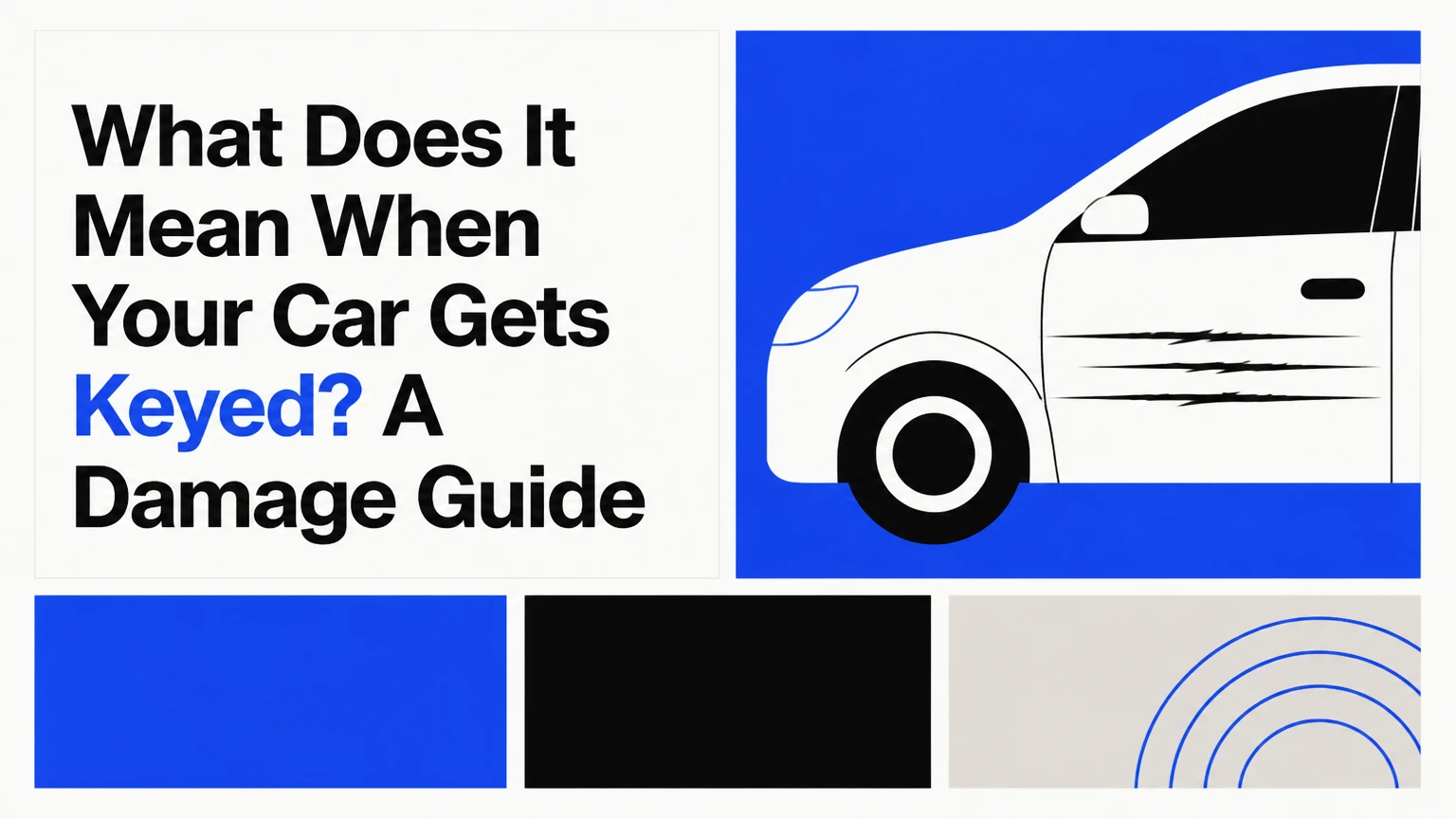
When your car gets keyed, someone has intentionally scratched its painted surface with a sharp object, commonly a house key, car key, knife, or metal tool. Car keying is deliberate property damage, usually treated as vandalism or criminal mischief, and the repair depends on whether the groove reaches the clear coat, color coat, primer, or underlying metal or plastic.
Key Facts at a Glance
A keyed-car scratch is usually a deliberate, continuous groove made by a sharp object.
A fingernail that does not catch often indicates clear-coat damage, but the test cannot reliably identify every paint layer.
Polishing can reduce scratches confined to the clear coat, while exposed primer or metal normally requires paint repair.
Comprehensive or equivalent non-collision coverage may cover vandalism, subject to the policy, deductible, and local insurance law.
The first response is to photograph the vehicle, preserve possible evidence, check cameras, and avoid washing or polishing the area.
A bodyshop estimate depends on scratch depth, panel count, paint type, blending, vehicle value, and local labor rates.
What Does It Mean When Your Car Gets Keyed?
A keyed car has been deliberately scratched rather than damaged by ordinary road debris or an accidental parking contact. The act may be random, retaliatory, related to a parking dispute, or connected to a personal conflict, but a visible scratch alone cannot establish who caused it or why.
Keying commonly produces a long, narrow line across a door, quarter panel, hood, trunk, or several adjoining panels. A house key is a familiar tool, but the object may also be a ring, screwdriver, knife, stone, or another hard edge. The legal classification varies by jurisdiction and by the repair value. Confused.com, RAC, Progressive, and several bodyshop guidance pages generally describe vandalism as a comprehensive-coverage issue rather than collision damage, although policy wording controls the result.
The mark is not always proof of keying. A shopping-cart impact, bicycle handlebar, branch, belt buckle, or parking-lot scrape can create similar damage. Transfer from another vehicle, especially colored plastic or rubber, may sit on top of intact paint and can sometimes be removed without repainting.
Why do people key cars?
People key cars for several possible reasons, including anger over parking, perceived property damage, disputes between neighbors, jealousy, political or personal hostility, and opportunistic vandalism. Motive should not be inferred from the scratch pattern alone, because the same linear damage can result from unrelated contact.
Do not confront a suspected person based only on timing or proximity. Preserve video, witness details, and messages, then let police, a property manager, or an insurer assess the evidence.
How Does Keying Damage Car Paint?
Keying damage occurs when a hard edge concentrates force along a narrow line and cuts into the paint system. The sharp object may remove material, push paint aside, or fracture the surrounding clear coat, so one apparent line can contain several depths and widths.
Modern factory paint normally has four functional layers:
| Layer | Typical approximate thickness | Main function | What damage may reveal |
|---|---|---|---|
| Clear coat | 1.5-2.0 mil | UV and chemical protection | Dull white line or gloss loss |
| Base coat | 0.5-1.0 mil | Vehicle color and pigment | Gray, white, black, or contrasting color |
| Primer | 0.5-1.0 mil | Adhesion and corrosion protection | Uniform gray or beige layer |
| Panel substrate | Variable, often 0.7-2.0 mm steel | Structural or exterior panel support | Bright metal, aluminum, or dark plastic |
Paint thickness varies by manufacturer, repaint history, panel location, and measuring method. A paint-depth gauge measures the combined coating thickness, not the depth of one specific scratch, and a gauge cannot diagnose a groove by itself.
What does a keyed scratch look like?
A keyed scratch often appears as a continuous, narrow line with sharp edges, irregular pressure marks, and a consistent direction. A clear-coat scuff may look gray or white under direct light and may seem less visible when wet, while exposed primer or metal retains a strong color contrast after the panel is dampened.
Look for these clues:
- Length and continuity: Keying often crosses a large section of one panel or continues across multiple panels.
- Edge shape: A sharp groove has defined edges; broad abrasion has feathered edges.
- Material transfer: A scrape may leave paint or plastic from another object beside the damaged area.
- Panel transitions: A line that changes height across doors may indicate deliberate movement around the vehicle.
- Impact evidence: Dents, broken trim, or concentrated chips point toward contact rather than a simple dragged key.
Only an inspection under strong, angled light can separate many borderline cases.
How Deep Is the Damage?
Scratch depth is best estimated from appearance, touch, and inspection under controlled light, but a fingernail test is only a screening method. If a fingernail glides across a clean, dry scratch, the mark may be confined to the clear coat; if the nail catches, the groove may have entered the color or primer layers.
| Damage category | Likely layers affected | Common visual sign | Usual repair direction |
|---|---|---|---|
| Surface marring | Clear coat texture only | Gloss loss, faint gray haze | Polish or machine compound |
| Clear-coat groove | Clear coat | White line, less visible when wet | Compound, polish, or spot refinishing |
| Color-coat cut | Clear coat and base coat | Primer-colored or contrasting line | Touch-up, spot repair, or panel refinishing |
| Substrate exposure | Clear coat, base coat, primer, and metal or plastic | Silver metal or dark plastic | Seal promptly, then professional paint repair |
Do not press hard with a fingernail. Dirt can scratch the surface during testing, and a deep-looking line may be a deposit sitting on top of the coating. Clean a small surrounding area with automotive shampoo and water, dry it with a clean microfiber towel, and avoid aggressive rubbing.
Can a keyed scratch be polished out?
A polisher can remove or reduce a keyed scratch only when enough intact clear coat remains around and below the mark. Polishing cannot replace missing pigment, primer, or metal, so a groove that catches a nail or reveals a different layer usually needs paint rather than more abrasive compound.
A practical test is to inspect the mark after washing and applying a small amount of water-based detail spray. Temporary visual disappearance suggests optical filling or wetting, not proof that the damage has healed. A scratch that becomes invisible only under wax will return when the product wears away.
Professional detailers may use a dual-action polisher, measured compound, and controlled passes. Repeated hand sanding can remove more clear coat than the scratch warrants, especially on a factory finish that may have only a limited remaining coating thickness.
What Should You Do First If Your Car Gets Keyed?
The correct first response is evidence preservation, not repair. Photograph the complete vehicle, record the location and time, preserve video, obtain a repair estimate, and report the incident before polishing, washing aggressively, or applying touch-up paint.
Step 1: Photograph the vehicle and scratch
Take wide photographs showing the car’s position, nearby signs, parking lines, and surrounding property. Follow with close images from several angles, using a ruler or coin for scale, and photograph the vehicle identification number separately if an insurer requests it.
Record:
- The date, approximate discovery time, and exact location.
- The affected panels and whether the scratch crosses a gap.
- Existing damage that was present before the incident.
- Broken trim, dents, debris, or transferred material.
- Weather, lighting, and whether the vehicle was wet.
Keep the original files. Editing or compressing images can remove metadata and make later comparisons harder.
Step 2: Check cameras and witnesses
Ask nearby businesses, apartment managers, homeowners, and parking operators whether cameras cover the vehicle. A parked dashcam with motion detection or impact recording may contain useful footage, but many systems overwrite files quickly.
Request preservation rather than demanding a copy. Some operators will release recordings only to law enforcement because privacy rules, retention periods, or local regulations restrict direct sharing.
Step 3: Make a police or property report
Report intentional vehicle damage to the appropriate local authority, especially when several panels are affected, a threat preceded the incident, or video identifies a suspect. A report creates a time-stamped record, but insurers do not universally require one, so verify the requirement in the policy.
Do not describe an unproven motive as fact. State what you observed, when you observed it, and what evidence exists.
Step 4: Notify the insurer before authorizing repairs
Ask whether vandalism is covered, which deductible applies, whether a police report is required, and whether the insurer needs photographs or an inspection. Coverage names differ by country, but in the United States vandalism commonly falls under comprehensive coverage, not collision coverage.
How Much Does It Cost to Repair a Keyed Car?
Typical professional repair costs range from about $100-$300 for light polishing, $250-$800 for localized paint repair, and $500-$1,500 or more for a complete panel refinish in markets using United States dollar pricing. A multi-panel repair, pearl paint, matte finish, or blending can push the total beyond $2,000.
The figures below are practitioner ranges, not universal published prices. The supplied AI Overview lists BDT 1,500-4,000 for a DIY compound kit, BDT 15,000-35,000 for professional buffing, BDT 25,000-55,000 for touch-up work, and BDT 45,000-120,000 per panel for a respray. Those BDT figures may be reasonable in some Bangladesh markets, but they should not be transferred to another country without a local quote.
| Repair route | Typical price range | Typical time | Suitable damage |
|---|---|---|---|
| DIY compound and polish | $20-$80 or BDT 1,500-4,000 | 1-3 hours | Clear-coat haze or shallow marring |
| Professional detail correction | $100-$300 or BDT 15,000-35,000 | 3-6 hours | Surface and some shallow clear-coat marks |
| Mobile spot repair | $250-$800 or BDT 25,000-55,000 | 4 hours-2 days | Localized color-layer damage |
| Bodyshop panel refinish | $500-$1,500 or BDT 45,000-120,000 | 2-5 business days | Deep, wide, or substrate-exposing scratches |
| Multi-panel repair and blending | $1,000-$3,000+ | 3-10 business days | Long scratches crossing adjacent panels |
Paint code, tri-coat or pearl pigment, matte clear coat, previous repainting, corrosion, and the need to remove trim can change the estimate substantially. A quote should identify each panel, preparation work, paint operations, blending, clear coat, curing, and tax.
Should you claim insurance for a keyed car?
Claim insurance when the covered repair estimate clearly exceeds the deductible and the policy conditions are satisfied. Paying privately may make more financial sense when the repair is only slightly above the deductible, although claim history rules and premium effects vary by insurer and jurisdiction.
Use this simple comparison:
| Repair estimate | Deductible | Immediate claim payment before limits | Typical decision |
|---|---|---|---|
| $350 | $500 | $0 | Pay privately |
| $900 | $500 | $400 | Compare claim history and premium impact |
| $1,800 | $500 | $1,300 | Claim often merits consideration |
| $3,000 | $1,000 | $2,000 | Obtain inspection and claim promptly |
The arithmetic does not decide the claim alone. A policy may exclude certain circumstances, impose reporting deadlines, or use a different deductible for glass, vandalism, or named risks.
Which Repair Method Fits the Damage?
Professional panel refinishing provides the most consistent result for deep or multi-panel keying, while polishing is the least expensive option for clear-coat-only damage. Mobile paint repair can reduce cost and downtime, but the color match and edge blending may be more visible under angled light.
| Option | Typical finish | Cost level | Best use | Main limitation |
|---|---|---|---|---|
| DIY polish | Invisible to good on shallow marks | Low | Clear-coat marring | Cannot replace missing paint |
| Touch-up pen | Functional, visible at close range | Low to medium | Tiny chips and narrow cuts | Poor choice for long door-length grooves |
| Mobile spot repair | Good at normal viewing distance | Medium | One localized panel area | May not correct dents or broad damage |
| Bodyshop respray | Closest to factory appearance | High | Deep or multiple-panel damage | Requires curing time and color blending |
| Replacement panel | New or professionally painted panel | Highest | Severe damage or unavailable paint match | More expensive and may affect fit or history |
A bodyshop may refinish an entire door rather than fill a long line with paint. That approach controls gloss and texture across the panel, while adjacent-panel blending helps manage metallic or pearl color differences.
When is DIY repair a bad idea?
DIY repair is a poor choice when bare metal is exposed, the scratch crosses a body line, the car has matte or tri-coat paint, the panel was previously repainted, or the vehicle is leased and must pass a strict return inspection. Sanding through the remaining clear coat can turn a repairable mark into a larger refinishing job.
Touch-up paint can provide temporary corrosion protection on exposed steel if applied to a clean, dry surface with the correct color code. It will rarely make a long keyed line invisible, and an incorrect paint pen can make professional color matching more difficult.
What Mistakes Make Keying Damage Worse?
The most damaging mistakes are aggressive polishing, household abrasives, delayed sealing of exposed steel, and covering the evidence before documenting it. Repair attempts should match the layer affected, because stronger abrasion cannot restore paint that has been removed.
- Using toothpaste: Household toothpaste varies in abrasive content and can haze automotive clear coat. Automotive compounds are formulated for paint systems and controlled machine use.
- Waxing a deep groove: Wax can leave pale residue in the cut and does not repair missing pigment or corrosion protection.
- Wet-sanding without a thickness plan: Sandpaper can flatten the surrounding clear coat and create a visible halo.
- Scrubbing transferred material: Hard rubbing may convert a removable deposit into permanent marring.
- Ignoring exposed steel: Rust timing depends on humidity, salt, coating condition, and metal type. Corrosion may begin quickly in wet, salty conditions, but “rust within days” is not a universal deadline.
- Repairing before photographing: A cleaned or filled scratch may weaken the evidence needed for an insurance or police report.
A temporary clear touch-up or corrosion-inhibiting product can reduce exposure while waiting for an appointment, but follow the product label and disclose the application to the repairer.
How Can You Prevent a Car From Being Keyed?
Parking choices, camera coverage, and sacrificial paint protection reduce risk but cannot guarantee prevention. The most useful combination is a visible, well-lit parking position, a properly configured parking-mode dashcam, and protection on high-value panels.
A hardwired dashcam with a G-sensor can save impact events, while motion detection may record people approaching the vehicle. Camera performance depends on field of view, low-light quality, storage capacity, battery protection, and local privacy law. A dashcam cannot identify a person outside its frame or recover footage that was overwritten.
Paint protection film, commonly called PPF, adds a sacrificial urethane layer over selected panels. Self-healing PPF can reduce light surface marks, but a forceful key strike may cut through the film and damage the paint beneath. Film replacement is still necessary when the protective layer is penetrated.
Use these practical measures:
- Park inside a monitored garage when available.
- Choose visible, illuminated spaces without blocking a driveway or occupying two bays.
- Avoid recurring disputes over access, parking lines, or loading zones.
- Enable parking recording and verify that the camera saves clips after vibration.
- Inspect the vehicle before leaving a location where a dispute occurred.
- Keep threatening messages and photographs in a secure backup.
What If You Have a Lease, Older Car, or Luxury Vehicle?
The best repair decision changes with vehicle value, lease obligations, paint complexity, and the cost of an imperfect color match. A low-value older car may need only corrosion protection, while a leased or luxury vehicle usually benefits from documented professional work.
| Vehicle situation | Sensible first choice | Avoid | Reason |
|---|---|---|---|
| Older, low-value car | Seal exposed metal and compare repair to vehicle value | Expensive full-panel work without valuation | Cosmetic repair may exceed market benefit |
| Leased vehicle | Certified bodyshop estimate and insurer notification | Unrecorded DIY sanding or mismatched paint | Lease inspections may charge for visible damage |
| Luxury vehicle | Manufacturer-approved or high-quality collision center | Cheap broad touch-up on pearl or matte paint | Color, texture, and resale standards are demanding |
| Daily driver with one shallow mark | Detailer inspection and measured polishing | Repainting a clear-coat-only scratch | Paint removal is unnecessary |
| Multi-panel vandalism | Police report, insurer inspection, bodyshop estimate | Repairing one panel before documenting all damage | Blending and claim scope may change |
Ask the repairer whether the panel will be blended, how the paint code will be verified, whether the finish is gloss or matte, and whether corrosion treatment is included. Keep invoices and photographs for future resale or lease-return records.
The Bottom Line
When your car gets keyed, the event means deliberate scratching of the vehicle’s paint, but the exact repair depends on the damage depth and the policy that covers the vehicle. Photograph the scene first, preserve cameras and witness information, report the incident when appropriate, and obtain a written estimate before choosing polish, touch-up paint, mobile repair, or a bodyshop respray.
A scratch confined to clear coat may respond to professional correction. A groove exposing primer, steel, aluminum, or plastic needs paint-system repair, and exposed steel should be sealed promptly in wet or salty conditions. Insurance is worth considering when the covered estimate exceeds the deductible by a meaningful amount.
FAQ
Is keying a car considered vandalism?
Keying a car is generally treated as intentional property damage, vandalism, criminal mischief, or a similar offense, depending on local law and repair value. The legal outcome depends on evidence, intent, jurisdiction, and the cost of damage. A police report documents the event but does not automatically prove who caused it.
Can I wash a car after someone keys it?
You can gently rinse and wash around a keyed area after documenting the damage, but avoid abrasive rubbing, polishing, wax, and touch-up paint until photographs and an inspection are complete. If the scratch exposes steel, keep the area dry and ask a repairer about temporary corrosion protection.
How long does a keyed-car repair take?
A shallow polish may take 1-3 hours, localized touch-up usually takes several hours to two days, and a full panel refinish commonly takes 2-5 business days. Multi-panel work may take 3-10 business days because preparation, paint blending, curing, trim removal, and quality checks add time.
Will a car wash remove a keyed scratch?
A car wash can remove dirt or transferred material, but it cannot remove a groove that has cut into clear coat or color paint. If the mark disappears after gentle cleaning, the damage may be surface contamination. If the line remains and catches a nail, professional paint correction or refinishing may be necessary.
Does PPF stop someone from keying a car?
Paint protection film can absorb light surface damage and may prevent the underlying paint from being cut. PPF does not guarantee protection against a forceful or repeated strike, and a deeply cut film normally requires replacement. Coverage is strongest when film protects the specific panel that receives the damage.
What evidence is useful when there is no camera?
Useful evidence includes time-stamped photographs, parking receipts, messages, witness names, access records, nearby camera locations, and a written timeline of when the vehicle was last undamaged. Absence of video does not make a report impossible, but suspicion without corroboration is not proof of responsibility.