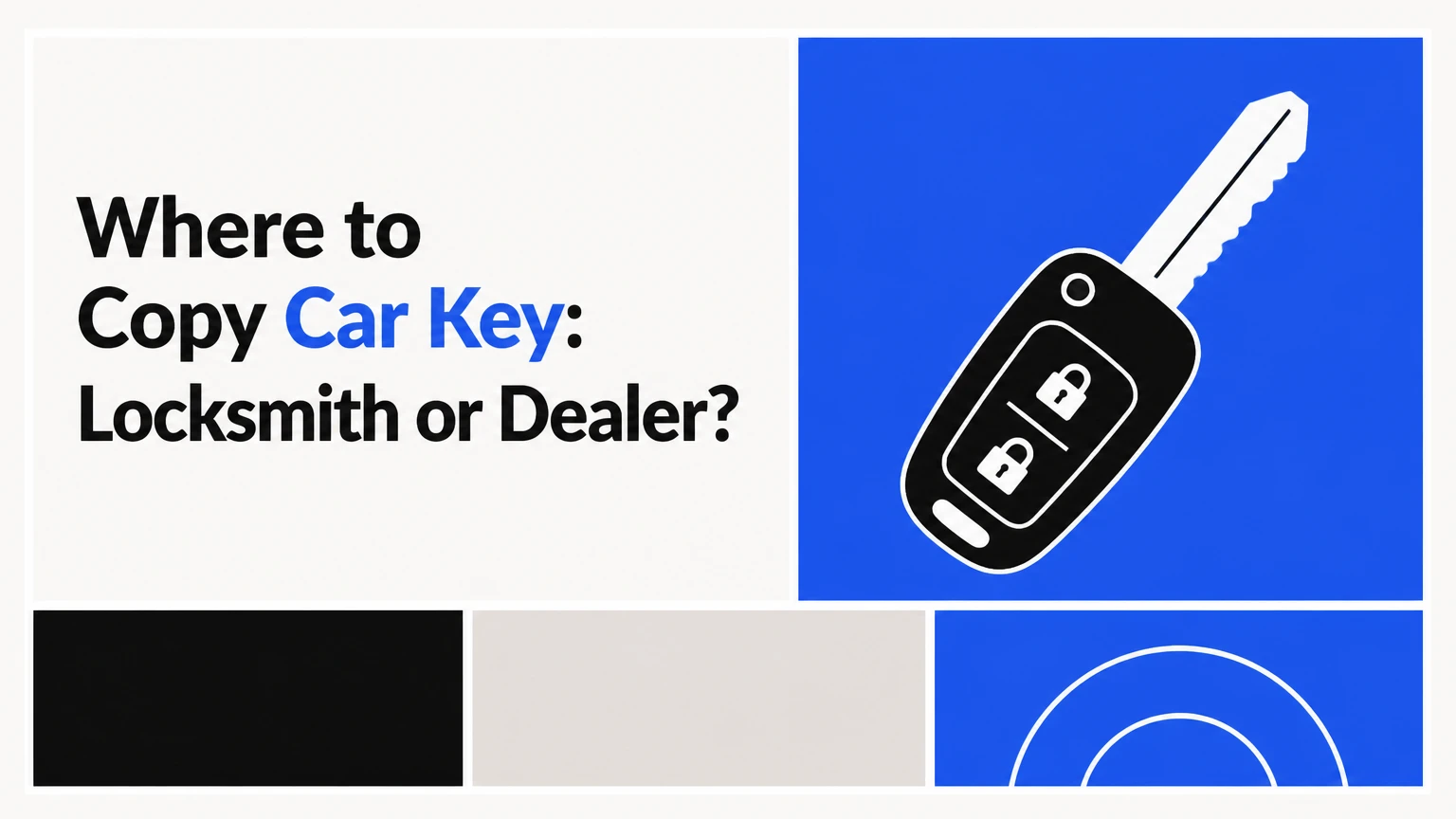
The best place to copy a car key is usually a reputable automotive locksmith, especially for transponder keys, remote fobs, and mobile service. A dealership is the safest choice for restricted or unusually new systems, while hardware stores and kiosks generally suit older vehicles that need only a mechanical blade. The key type determines the price, equipment, and programming requirement.
Key Facts at a Glance
A traditional metal car key typically costs $5-$15 and takes 2-5 minutes to duplicate.
A transponder-key duplicate commonly costs $70-$150 and requires chip programming.
A smart key or proximity fob commonly costs $200-$600 or more, depending on the vehicle.
A locksmith can often cut and program a replacement at the vehicle, avoiding a dealership tow.
A copied blade may unlock the doors but fail to start the engine if its immobilizer chip is not programmed.
A working original key makes duplication cheaper and simpler than replacing a key after all keys are lost.
Where Can You Copy a Car Key?
You can copy a car key at an automotive locksmith, vehicle dealership, selected hardware stores, or an automated key kiosk. Automotive locksmiths provide the broadest balance of programming capability, mobile convenience, and price, but dealerships remain necessary for some manufacturer-controlled systems and warranty-sensitive vehicles.
The phrase “copy a car key” covers several different services. A shop might duplicate a metal blade, clone a transponder, cut a high-security key, pair remote buttons, or add a proximity fob to the vehicle’s authorized-key list. Those tasks require different blanks and tools.
A useful first test is to inspect the key. A plain metal blade usually needs cutting only. A plastic key head, visible buttons, a thick sidewinder blade, or a push-button ignition indicates that electronic programming may also be required.
Which provider fits your key?
| Provider | Typical service | Typical price | Typical time | Best fit |
|---|---|---|---|---|
| Automotive locksmith | Cutting, transponder programming, remote and smart-key service | $70-$400 | 15-60 minutes | Most modern vehicles |
| Dealership parts or service department | OEM key ordering and vehicle programming | $150-$600+ | Same day to several days | Restricted or new models |
| Hardware store | Mechanical cutting and selected common vehicle keys | $5-$120 | 5-30 minutes | Older or supported vehicles |
| Automated kiosk | Basic duplication and some ordered automotive keys | $10-$250 | Minutes to several days | Simple keys or supported models |
| Online retailer | Blank or complete replacement fob shipment | $20-$300 | Shipping time plus programming | Price-sensitive owners with verification |
Prices are typical United States consumer ranges, not guaranteed quotes. Labor rates, vehicle security systems, local regulations, OEM parts, and whether a working key is available can change the final bill substantially.
How Does Car-Key Duplication Work?
Car-key duplication has two separate parts: mechanical replication and electronic authorization. The blade must match the lock cylinder, while a transponder or proximity device must communicate with the immobilizer system in a format the vehicle accepts.
A traditional key uses only the blade profile. Newer vehicles use an immobilizer, an anti-theft system that checks a coded transponder near the ignition or start system. The engine control module, immobilizer control unit, or related body-control module can prevent normal starting when the code is absent or unauthorized.
A remote fob adds another function. Its lock and unlock buttons use radio communication, but the remote battery and the engine-start transponder may be separate circuits. Consequently, a key can start the vehicle while its buttons remain unpaired, or its buttons can work while the blade or immobilizer does not.
What happens at a professional key service?
- Ownership verification: The technician may request a driver’s license, registration, insurance document, or title. Requirements vary by provider and jurisdiction.
- Vehicle identification: The technician confirms the year, make, model, trim, ignition type, VIN, and sometimes the existing key’s part number.
- Blank selection: The correct blade profile, transponder type, remote frequency, and manufacturer-compatible shell are matched to the vehicle.
- Cutting: A standard duplicator, code-cutting machine, laser cutter, or CNC machine creates the blade pattern.
- Programming: The new transponder or proximity fob is enrolled through approved diagnostic equipment, a manufacturer system, or a supported onboard procedure.
- Testing: The technician checks door locks, trunk release, ignition operation, engine start, remote buttons, and warning lights.
The strongest practical rule is to test every function before leaving. A key that turns in the ignition has not necessarily completed the job.
What Type of Car Key Do You Have?
The vehicle’s key type predicts where to go, what equipment is required, and how much the duplicate will cost. Age alone is not enough because some older vehicles use transponders, while some newer vehicles still include a mechanical emergency blade.
| Key type | Identification clues | Equipment required | Typical duplicate price | Typical time |
|---|---|---|---|---|
| Traditional metal key | Plain blade, no buttons or chip head | Mechanical key cutter | $5-$15 | 2-5 minutes |
| Transponder key | Plastic head, conventional ignition | Cutter plus immobilizer programmer | $70-$150 | 15-30 minutes |
| Laser or sidewinder key | Thick blade with central groove | High-security cutter or CNC machine | $120-$250 | 20-45 minutes |
| Remote-head key | Blade attached to buttons | Cutter plus remote and chip programming | $150-$350 | 30-60 minutes |
| Smart or proximity fob | Push-button start, no normal ignition slot | Diagnostic programmer and compatible fob | $200-$600+ | 30-60 minutes |
| Valet or emergency blade | Limited blade or backup insert | Key cutter, sometimes no electronics | $15-$80 | 5-20 minutes |
The owner’s manual, original key label, VIN lookup, and a photograph of the key can help a provider identify the correct format. A VIN identifies the vehicle, but it does not automatically guarantee that every online key listing with the same year and model will work.
Does a transponder key need programming?
A transponder key needs programming when the vehicle’s immobilizer must recognize its chip. Cutting the blade alone may allow the key to enter and turn the lock, but the engine can remain disabled when the chip is missing, incompatible, or unregistered.
Some vehicles support onboard self-programming when two already-authorized keys are present. Many do not. The procedure also differs by manufacturer, model year, market, and security configuration, so a generic internet sequence should not be treated as universal.
Key cloning is another option. A specialist may copy an authorized chip’s identity to a compatible blank, but some newer systems use cryptographic protections or rolling credentials that prevent simple cloning. Programming a new key into the vehicle is often more reliable than copying an old chip.
What Does It Cost to Copy a Car Key?
Copying a car key typically costs $5-$15 for a metal key, $70-$150 for a transponder key, $150-$350 for a remote-head key, and $200-$600 or more for a smart fob. A dealership, emergency callout, missing original, premium brand, or required OEM part can raise the total.
The quoted price should identify whether it includes the blank, cutting, programming, service call, tax, battery, and testing. A low advertised price may cover only a blade or a basic diagnostic visit.
| Cost factor | Common effect on price | Example consequence |
|---|---|---|
| Working key available | Reduces labor and recovery work | Duplicate may take 15-30 minutes |
| All keys lost | Adds $100-$500 or more in typical labor | Vehicle identification and security reset may be needed |
| Mobile locksmith visit | Adds $50-$150 in typical travel or callout fees | Service occurs at home or roadside |
| OEM smart fob | Adds $100-$350 over some aftermarket options | Dealer-grade part and warranty |
| Laser-cut blade | Adds $40-$120 over a basic cut | Requires specialized equipment |
| After-hours service | Adds $50-$200 in typical emergency fees | Nights, weekends, and holidays cost more |
| Dealership programming | Adds towing and labor exposure | Vehicle may need to reach the service department |
Insurance or roadside-assistance coverage may reimburse some lost-key or lockout costs, but policies differ. Check the policy’s key-replacement limit, deductible, proof requirements, and whether programming is included before authorizing work.
Is a Locksmith Better Than a Dealership?
An automotive locksmith is usually the better value for a duplicate key because the locksmith can often cut and program the key at the vehicle for less than a dealership. A dealership is preferable when the manufacturer requires online authorization, the vehicle uses a restricted system, an OEM warranty matters, or local locksmiths lack the necessary equipment.
The claim that independent locksmiths cannot program luxury or newer vehicles is too broad. Capability depends on the exact model, immobilizer generation, credentials, software access, and local rules. Some vehicles require manufacturer-linked access, while others can be serviced by a properly equipped automotive locksmith.
| Decision criterion | Automotive locksmith | Dealership | Hardware store or kiosk |
|---|---|---|---|
| Traditional metal key | $5-$20, often immediate | $20-$60, appointment may apply | $5-$15, usually immediate |
| Transponder programming | Often available, $70-$150 | Usually available, $150-$300 | Limited by model and location |
| Smart-fob replacement | $200-$600+ typical | $300-$800+ typical | Often order-only or unavailable |
| Mobile service | Common, 20-60 minute arrival | Rare, tow may be required | Not applicable |
| OEM part availability | OEM or aftermarket options | OEM by default | Selected blanks only |
| All-keys-lost service | Often available on supported vehicles | Available, commonly requires vehicle access | Usually unavailable |
| Main limitation | Equipment and model coverage vary | Higher cost and slower scheduling | Little or no electronic expertise |
When should you use a hardware store or kiosk?
Use a hardware store or kiosk when the key is a plain metal blade or the specific location confirms support for your vehicle’s transponder. Do not assume that a store able to cut a key can also pair its chip, remote buttons, or smart-fob functions.
Ask the store to inspect the exact key type before cutting. A machine can produce a physically accurate blade that still lacks the correct immobilizer electronics. Automated kiosks may also provide an ordered product that arrives unprogrammed, leaving the owner responsible for a compatible programming appointment.
When is a dealership the right choice?
Choose a dealership when an authorized OEM part, manufacturer security access, or model-specific programming is required. Dealerships also provide the clearest route when no working key remains and the vehicle uses a system that local locksmiths cannot access.
The trade-off is cost and logistics. The service department may require an appointment, proof of ownership, an ID, and a towable vehicle, while a mobile locksmith may complete supported work in a driveway.
What Should You Bring Before Booking?
Bring the vehicle, one working key if available, a government-issued ID, vehicle registration or title, and the VIN. A provider cannot reliably quote or program a key from the model name alone because trim, market, ignition system, and security module can change the required part.
Before calling, record the vehicle year, make, model, trim, ignition style, number of existing keys, and exact symptoms. Photograph the front and back of the key, including its buttons and markings, without publishing the VIN or key code publicly.
What should you ask for in the quote?
Request an itemized quote that states:
- Key blank or fob brand and part number
- Mechanical cutting charge
- Transponder or immobilizer programming charge
- Remote-button pairing charge
- Mobile service or emergency fee
- Battery and replacement shell costs
- Warranty period and return policy
- Whether old or missing keys will be erased
A reputable provider should explain what the quoted service does not include. “Key replacement” may mean a physical product only, whereas “cut and program” should address both major functions.
Can You Copy a Car Key Without the Original?
You can often obtain a car key without the original, but the service becomes key replacement or all-keys-lost programming rather than ordinary duplication. A locksmith or dealership may use the VIN, vehicle lock decoding, manufacturer key codes, and diagnostic programming to create and authorize the replacement.
All-keys-lost service usually costs more because the technician must verify ownership, identify the vehicle, obtain a suitable key, and program it without an authorized reference key. The vehicle may need to be present, and some models require a tow to a dealership or specialist.
Do not order a key from a VIN alone. A VIN can identify the vehicle but may not identify the correct blade, remote frequency, regional configuration, or immobilizer version. A provider should confirm compatibility before cutting or programming.
Can You Buy a Car Key Online?
You can buy some replacement keys online, but online purchase and vehicle programming are separate steps. Online keys can reduce the parts cost, yet an incorrect frequency, incompatible chip, locked fob, poor-quality blade, or unsupported part number can eliminate the saving.
Use the exact OEM part number when possible. Confirm whether the product is new, refurbished, aftermarket, unlocked, virgin, or previously paired to another vehicle, because some systems cannot accept a used fob without specialist procedures.
| Online-key check | Acceptable confirmation | Risk if ignored |
|---|---|---|
| Vehicle identity | Year, model, trim, VIN-supported fitment | Wrong electronics |
| Frequency | Region-specific frequency confirmed | Remote buttons fail |
| Transponder | Chip type named by part number | Engine will not start |
| Fob status | New or programmable status stated | Used fob may remain locked |
| Blade profile | Correct keyway and cuttable blank | Door or ignition will not turn |
| Return policy | Programming failure covered in writing | Unusable part cannot be returned |
The safest arrangement is to ask the locksmith or dealership whether it will program a customer-supplied key before purchasing it. Some providers refuse unknown aftermarket parts because they cannot guarantee compatibility or warranty the result.
Why Does a Copied Key Unlock the Door but Not Start the Car?
A copied key can unlock the door but fail to start the car because the blade and remote functions are separate from the immobilizer transponder. The door lock may respond to the mechanical cut, while the engine computer rejects an unprogrammed or incompatible chip.
A flashing security light, padlock symbol, or “key not detected” message supports an electronic authorization problem. A key that turns but produces no crank may instead indicate a mechanical, ignition-switch, battery, or starter fault, so the dashboard behavior matters.
How do you troubleshoot a new key?
| Symptom | Likely cause | Correct next action |
|---|---|---|
| Key will not enter or turn | Wrong cut, burr, or worn lock cylinder | Stop forcing it and request inspection |
| Key turns, engine does not start | Chip absent or unprogrammed | Return for immobilizer programming |
| Buttons fail, engine starts | Remote pairing or fob battery issue | Test battery and pair remote |
| Fob works intermittently | Weak battery or damaged case | Install the specified battery |
| “No key detected” appears | Dead fob battery or wrong proximity fob | Use emergency-start location and reprogram |
| Duplicate works poorly | Original key was heavily worn | Request code cutting or a new lock code |
Never shave a modern key casually to correct a poor fit. Removing material can make the blade unusable and cannot repair an incorrect keyway or transponder.
What Common Car-Key Copying Mistakes Should You Avoid?
The most expensive mistakes are copying a worn key, buying an unverified fob, waiting until the last key disappears, and accepting a quote that excludes programming. Each mistake creates a predictable failure that a pre-service inspection can prevent.
- Copying a heavily worn original: The duplicate reproduces the wear, not the factory specification. Ask whether the technician can cut by key code.
- Ordering by year and model only: Similar vehicles can use different trims, frequencies, and immobilizers. Verify the part number.
- Assuming a metal cut is a complete key: A blade does not replace a transponder or proximity credential.
- Leaving without a full test: Check locks, trunk, panic button, remote start if equipped, engine start, and warning lights.
- Deleting keys unnecessarily: Ask whether the new key will be added or whether the vehicle’s authorized-key list will be reset.
- Using an unknown emergency provider: Confirm the business name, arrival fee, total price, and ownership requirements before dispatch.
One practitioner rule is worth remembering: duplicate a working key before it becomes the only key. All-keys-lost service is commonly slower and more expensive because the technician loses the easiest reference and may need a security reset.
How Do You Find a Reliable Car-Key Provider Near You?
Search for “automotive locksmith,” “transponder key programming,” or “smart key replacement” plus your city, then verify coverage for the exact vehicle before requesting an appointment. A general locksmith directory listing does not prove that the operator owns automotive diagnostic equipment.
Check the business license where licensing applies, physical address, recent reviews, insurance information, and stated service area. Ask for an itemized written estimate and whether the technician will provide a receipt showing the part and programming work.
A local provider should answer four questions clearly:
- Can you cut and program a key for my exact year, make, model, and trim?
- Is the quoted price complete, including travel, cutting, programming, and tax?
- Will you test the key and remote before payment?
- What proof of ownership must I show?
Avoid providers that promise every make at one unusually low price, refuse to identify the key brand, or request sensitive vehicle information through an unsecured public channel.
Which Option Is Best for Your Situation?
The best place to copy a car key depends on the key technology and whether a working key remains. A mobile automotive locksmith is the default choice for most modern daily drivers, a hardware store suits a simple metal key, and a dealership handles restricted or manufacturer-controlled systems.
Older vehicle with a plain metal key
Choose a hardware store, home center, locksmith, or kiosk that confirms the blade profile. Expect approximately $5-$15 and a few minutes. Test the duplicate in the door and ignition before leaving.
Modern sedan or SUV with one working transponder key
Choose a reputable automotive locksmith that confirms programming coverage. Typical service costs $70-$150 and takes 15-30 minutes, often without towing.
Push-button vehicle with a smart fob
Call a locksmith or dealership that specifically advertises proximity-fob programming. Expect $200-$600 or more, and confirm whether the emergency blade, battery, remote buttons, and engine authorization are all included.
Vehicle with no working key
Start with a specialist automotive locksmith and compare the complete quote with the dealership’s price, including towing. Some models can be recovered roadside, while others require manufacturer-linked access.
New luxury vehicle
Ask both providers whether they can legally and technically access the exact immobilizer system. Use the dealership when the locksmith cannot confirm online authorization, OEM compatibility, or a written programming warranty.
Frequently Asked Questions
Can AutoZone copy a car key?
AutoZone and similar automotive retailers may sell key blanks, batteries, or selected replacement products, but store-level cutting and programming availability varies by location and vehicle. Call the specific store with the year, make, model, and key type before relying on it for a complete duplicate.
Can I program a transponder key myself?
Some vehicles allow onboard programming when two authorized keys are already available. Many vehicles require diagnostic equipment or manufacturer access, and an incorrect procedure can leave the new key unusable. Confirm the exact owner’s-manual procedure or use a qualified automotive locksmith.
How many spare car keys should I keep?
Two working keys are a sensible minimum for vehicles with immobilizers because many self-programming procedures require two authorized keys, and losing one still leaves a reference for duplication. Store the spare separately from the primary key, not inside the same key pouch.
Does a new car key need a new battery?
A mechanical key does not need a battery. A remote-head key or smart fob usually needs a correctly specified coin-cell battery for buttons and proximity detection, but the immobilizer chip may operate independently on some designs.
Will a copied car key damage the ignition?
A correctly cut, deburred key should not damage the ignition. A poorly cut blade, thick burr, incorrect profile, or key forced into a worn cylinder can cause sticking and accelerate lock wear, so stop using a duplicate that feels rough.
Does roadside assistance pay for a replacement key?
Some roadside plans cover lockout service, while separate insurance or manufacturer programs may cover key replacement or programming. Check the benefit limit, deductible, exclusions for lost keys, and requirement to use an approved provider before authorizing a replacement.
The Bottom Line
For most drivers asking where to copy a car key, the best first call is a reputable mobile automotive locksmith that confirms the exact vehicle and key type. Use a hardware store or kiosk for a plain metal key, compare a locksmith with a dealership for electronic keys, and choose the dealership when manufacturer authorization or a restricted smart-key system makes independent programming unavailable. A complete duplicate includes the correct cut, electronic programming when required, and a full test of every function.