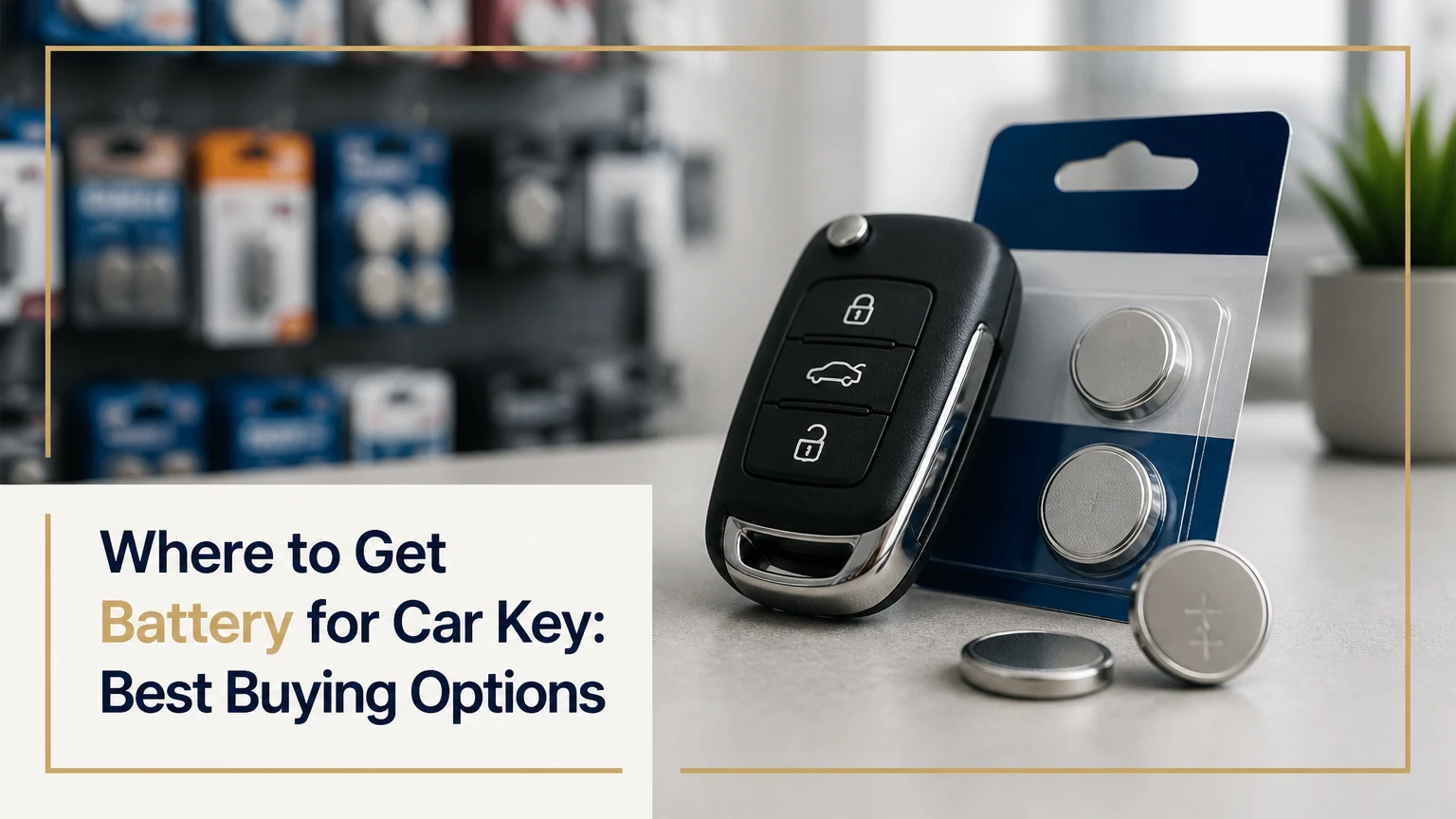
The best place to get a battery for a car key is usually an auto parts store, supermarket, pharmacy, hardware store, or reputable online retailer. Expect to pay about $2-$15 locally or less per cell in a quality multipack online; confirm the exact code printed on the old battery or specified in the owner’s manual before buying.
Key Facts at a Glance
Most vehicle remotes use a 3-volt lithium coin cell, commonly CR2032, CR2025, CR2016, CR2450, or CR1620.
An auto parts store is the fastest assisted option because staff may identify and install the correct battery.
A supermarket or pharmacy usually offers the lowest immediate effort for common CR2032 and CR2025 cells.
A reputable online seller often has the lowest unit price, but delivery and counterfeit risks make it unsuitable for an urgent repair.
Replacing the cell normally does not erase the key’s programming because the security code is stored in nonvolatile memory.
A key fob that remains dead after a correct battery replacement may have damaged contacts, a failed circuit board, or a separate vehicle problem.
Where to Get Battery for Car Key Today
For a same-day purchase, choose an auto parts store if you want help, or a supermarket, pharmacy, hardware store, or electronics retailer if you already know the battery code. Locksmiths and dealerships are better for damaged, sealed, or malfunctioning fobs, but their labor charges can exceed the price of the battery by a wide margin.
Store inventory varies by country and branch, so check the retailer’s website or call before driving across town. Common cells such as CR2032 and CR2025 are widely stocked; less common sizes, including CR1616, CR1620, CR1632, and CR2450, are more reliable finds at battery specialists or online retailers.
Local buying options compared
| Buying location | Typical battery price | Typical wait | Installation help |
|---|---|---|---|
| Supermarket or pharmacy | $2-$8 per pack | 5-15 minutes | Usually none |
| Hardware or electronics store | $3-$10 per pack | 5-20 minutes | Occasional |
| Auto parts store | $4-$15 per cell or pack | 5-20 minutes | Often available |
| Battery specialist | $5-$20 per cell or pack | 10-30 minutes | Usually available |
| Automotive locksmith | $10-$30 installed | 15-60 minutes | Yes |
| Dealership service department | $25-$100 typical battery service | 30-120 minutes | Yes, with vehicle support |
| Online marketplace | $1-$5 per cell in multipacks | 1-7 days | None |
The prices above are typical retail ranges, not universal quotations. Taxes, country, brand, packaging, and local labor rates change the final amount. A dealership quote of $150-$450 usually involves diagnosis, key programming, replacement-key work, or a bundled service visit rather than the coin cell alone.
Which Store Is Best for Your Situation?
The best retailer depends on urgency, confidence, battery rarity, and whether the fob needs physical help. An auto parts store gives the strongest balance of speed and assistance, online retail gives the lowest unit price, and a locksmith is the most practical choice when the case or electronics are damaged.
| Situation | Best option | Typical total cost | Why |
|---|---|---|---|
| Remote stopped working today | Auto parts store | $4-$15 | Immediate stock and possible installation |
| You know the code and want spares | Reputable online retailer | $5-$15 for 4-10 cells | Lowest price per battery |
| You cannot open the fob | Locksmith or battery specialist | $10-$40 | Tools and handling reduce case damage |
| Luxury smart key shows a warning | Dealer or specialist | $10-$50 | Model-specific procedure available |
| Key works intermittently | Auto parts store first | $4-$20 | Battery and contact inspection |
| Fob is cracked or water-damaged | Automotive locksmith | $30-$150+ | Battery replacement alone may not solve failure |
| Store is closed and the car is immobilized | Owner’s manual and emergency key | $0 initially | Mechanical entry and backup start method |
A drugstore or supermarket is a sensible choice when the old cell clearly reads CR2032 or CR2025 and the fob is easy to open. It is a poor choice when the battery code is unreadable, the key is a sealed rechargeable unit, or the vehicle uses a model-specific emergency procedure.
What Battery Does a Car Key Use?
A car key fob battery is usually a small lithium coin cell that powers the remote transmitter, buttons, indicator LED, and, in some designs, proximity detection circuitry. The correct replacement must match the original code, physical thickness, diameter, voltage, and terminal arrangement.
The IEC naming system makes common codes readable. In CR2032, “C” identifies lithium-manganese dioxide chemistry, “R” identifies a round cell, “20” indicates approximately 20 millimeters in diameter, and “32” indicates approximately 3.2 millimeters thick. The code identifies size and chemistry, not a vehicle brand.
| Battery code | Nominal voltage | Diameter | Thickness | Typical use pattern |
|---|---|---|---|---|
| CR2016 | 3.0 V | 20 mm | 1.6 mm | Thin older remotes and compact fobs |
| CR2025 | 3.0 V | 20 mm | 2.5 mm | Many European and Japanese fobs |
| CR2032 | 3.0 V | 20 mm | 3.2 mm | One of the most common key-fob cells |
| CR1632 | 3.0 V | 16 mm | 3.2 mm | Compact smart keys and remotes |
| CR1620 | 3.0 V | 16 mm | 2.0 mm | Smaller older remotes |
| CR2450 | 3.0 V | 24 mm | 5.0 mm | Larger proximity and smart-key designs |
Battery codes are more reliable than vehicle-brand lists. The same manufacturer can use different cells across production years, trim levels, markets, and key designs, so a Honda, Ford, Toyota, BMW, or Nissan badge does not identify the battery by itself.
Can you use a CR2025 instead of a CR2032?
A CR2025 should not replace a CR2032 unless the vehicle manufacturer specifically permits it. Both cells are about 20 millimeters wide and produce 3 volts, but a CR2025 is 0.7 millimeters thinner, which can create a loose or intermittent connection in a holder designed for a CR2032.
The reverse substitution can be physically worse. A CR2032 in a CR2025 holder may press too hard against the cover, deform the contact, prevent the case from closing, or damage the circuit board. Do not stack two thinner cells to imitate a thicker one, because the combined voltage becomes approximately 6 volts and can destroy the fob electronics.
How Do You Identify the Correct Key-Fob Battery?
Read the code printed on the old battery, then compare it with the owner’s manual or the vehicle manufacturer’s parts information. If the marking is hidden by corrosion or the cell is missing, photograph the battery holder and provide the vehicle’s exact year, model, trim, and key type to a parts specialist.
Use this order of evidence:
- Owner’s manual: Check the key, remote, or battery-replacement section.
- Old battery marking: Read the code on the flat face, such as CR2032.
- Fob part number: Look inside the housing or on its rear shell.
- Parts-counter lookup: Give the complete vehicle details, not only the brand.
- Physical comparison: Confirm diameter and thickness only after the code is known.
Do not identify a cell by appearance alone. CR2016, CR2025, and CR2032 share a 20-millimeter diameter and look nearly identical from above. A digital caliper can measure the cell, but the printed code remains the safer reference because some holders have unusual retaining clips or polarity layouts.
How Do You Replace a Car Key Battery?
Most replaceable key-fob batteries can be changed in three to five minutes with the emergency key blade, a plastic pry tool, or a small flat-head screwdriver. The factor that determines success is correct identification and polarity, not mechanical skill.
Before you start
| Requirement | Typical specification |
|---|---|
| Time | 3-5 minutes |
| Difficulty | Easy, with moderate care around clips |
| Replacement cell | One matching 3-volt lithium coin battery |
| Tools | Plastic pry tool or small flat-head screwdriver |
| Reference | Old battery, owner’s manual, or fob part number |
| Work area | Clean, dry table with adequate light |
Step 1: Remove the emergency key
Slide the release catch and pull out the metal emergency blade if the fob has one. The blade may expose a slot designed for opening the case, and removing it prevents accidental bending while you separate the housing.
You will know this step worked when the blade is completely clear of the plastic shell. Do not force a blade that uses a separate pin or screw; consult the model-specific manual instead.
Step 2: Open the fob housing
Find the molded seam or small notch around the case. Insert a plastic pry tool or the emergency key tip into the notch and twist gently until the retaining clips release.
Work around the perimeter rather than bending one corner sharply. Excessive force can break the clips, separate a rubber button membrane, or dislodge a transponder component that the car needs for immobilizer recognition.
Step 3: Record battery orientation
Photograph the old cell before removing it and identify the side marked with a plus sign. Many fobs place the positive side upward, but the contact layout is not universal.
You will know the orientation is recorded when the replacement can be placed in the identical direction without guessing. A reversed cell normally prevents operation, but it does not usually erase programming.
Step 4: Remove and install the cell
Release the old battery with a fingernail or plastic tool, then slide the replacement under the retaining clip without bending the spring. Hold the new cell by its edge; clean fingerprints from the faces with a dry, lint-free cloth if necessary.
Check that any manufacturer packaging film has been removed. A transparent insulating sticker or coating between the battery and contact can make a brand-new cell appear dead.
Step 5: Close and test the fob
Align the housing, press the halves together until every clip clicks, reinstall the emergency blade, and test lock, unlock, trunk, panic, and remote-start functions where fitted. Test from several distances because a weak signal may indicate a contact issue rather than a button problem.
You will know the replacement worked when the vehicle responds consistently and the fob case closes flush. If the car starts but the remote buttons fail, inspect the battery contacts and remote circuit separately.
What Should You Check When the New Battery Does Not Work?
A new key-fob battery that fails immediately usually reflects wrong polarity, incorrect size, insulating film, poor contact pressure, or a damaged remote rather than a need for programming. Diagnose those physical causes before paying for a new key or electronic reprogramming.
Use this sequence:
- Confirm the code: Compare the installed cell with the old code and manual.
- Confirm polarity: Match the plus and minus orientation shown before removal.
- Remove film: Inspect both faces for a clear sticker or residue.
- Inspect contacts: Look for flattened springs, dirt, oxidation, or white corrosion.
- Check seating: The cell must sit flat under the retaining clip.
- Test a second known-good cell: New batteries can be depleted or defective.
- Inspect buttons: A collapsed rubber membrane may prevent a switch from closing.
- Check damage: Water intrusion, cracked solder joints, and a broken case can disable the transmitter.
Use a cotton swab lightly dampened with isopropyl alcohol on dirty contacts, then let the area dry fully. Do not flood the circuit board, scrape plating aggressively, or bend a contact repeatedly because metal fatigue can make the connection fail permanently.
A remote with reduced range before total failure often points to a weak cell. A remote that stopped after being dropped or submerged may need circuit repair even when its voltage measures correctly.
Does Changing the Battery Require Programming?
Replacing a key-fob battery normally does not require programming because the vehicle’s security pairing is stored in memory that does not depend on continuous battery power. Some older or model-specific systems may require a resynchronization sequence, so the owner’s manual takes precedence over generic instructions.
Battery replacement and key programming are different services. Programming adds or authorizes a key in the immobilizer system; resynchronization restores communication between an existing remote and the vehicle after a power interruption.
Possible symptoms of lost synchronization include a working physical key with unresponsive remote buttons immediately after replacement. The procedure may involve turning the ignition, opening the driver’s door, inserting the emergency key, or pressing a remote button in a timed sequence, and the exact steps vary substantially by manufacturer.
Do not assume a dealership is the only solution. An automotive locksmith with the correct diagnostic equipment may resynchronize or program a key for less, while some vehicles allow owner-performed resynchronization.
How Much Should a Car Key Battery Replacement Cost?
A do-it-yourself replacement typically costs $2-$15, an assisted retail replacement commonly costs $5-$30, and a locksmith or dealership visit can range from $10 to several hundred dollars when diagnosis, programming, or a replacement fob is involved. The battery itself is rarely the expensive part.
| Service type | Typical parts cost | Typical labor or service cost | Typical total |
|---|---|---|---|
| DIY single cell | $2-$8 | $0 | $2-$8 |
| DIY multipack | $5-$20 | $0 | $0.50-$5 per cell |
| Auto parts installation | $4-$15 | $0-$10 | $4-$25 |
| Battery specialist | $5-$20 | $5-$20 | $10-$40 |
| Automotive locksmith | $3-$15 | $10-$50 | $13-$65 |
| Dealership battery-only visit | $5-$20 | $20-$80 | $25-$100 |
| New programmed key | $50-$300+ | $50-$200+ | $100-$500+ |
These are typical consumer ranges, not guaranteed prices. Ask whether a quoted dealership amount covers only a coin cell, because a $150-$450 estimate generally signals a replacement key, diagnostic appointment, programming, or a bundled service charge.
Are Online Key-Fob Batteries Safe to Buy?
Online batteries are safe to buy when the seller identifies the manufacturer, expiration or production information, packaging condition, and return policy. Multipacks reduce unit cost, but unverified marketplace listings increase the chance of counterfeit, old, heat-damaged, or incorrectly labeled cells.
Prefer established battery brands such as Panasonic, Energizer, Duracell, Maxell, or a reputable automotive supplier. Check that the package is sealed, the code is exact, and the seller stores lithium cells away from excessive heat and moisture.
The cheapest listing is not always the lowest-cost choice. A weak cell that lasts two months creates another case-opening job and can strand a proximity-key owner, while a fresh branded cell typically provides a longer service interval.
The U.S. Consumer Product Safety Commission treats coin and button cells as ingestion hazards, especially for children. Store spare batteries in their original child-resistant packaging, keep them away from loose household objects, and tape the terminals before disposal.
Can You Start a Car With a Dead Key-Fob Battery?
Most vehicles with push-button ignition include a backup method for a dead remote, but the location varies by manufacturer. Hold the fob directly against the start button, place it in a marked backup slot, or use the emergency key to unlock the door, following the owner’s manual.
A dead coin cell does not necessarily disable the immobilizer transponder. Many smart keys contain a passive transponder that the vehicle can read at close range even when the remote transmitter cannot send lock or unlock commands.
Common backup arrangements include:
- Touching the fob to the start button while pressing the brake.
- Placing the fob in a center-console, cup-holder, or glovebox slot.
- Holding the fob beside the steering-column receiver.
- Unlocking the driver’s door with the hidden mechanical blade.
Do not leave the emergency blade inside the vehicle after testing it. The blade opens the door mechanically, but it does not replace a working remote for every vehicle function.
What Are the Important Edge Cases?
Certain key designs do not accept a standard replaceable coin cell. Some luxury vehicles use rechargeable batteries, soldered cells, sealed housings, or a complete smart-key module that requires specialist service.
Check the design before prying:
- Rechargeable fob: A vehicle may recharge the key inductively or through a dedicated cradle. Installing a CR2032 can damage the system.
- Sealed housing: Ultrasonic-welded cases may require a locksmith and replacement shell.
- Soldered battery: Removing the cell requires electronics tools and polarity control.
- Water-damaged fob: A fresh battery cannot repair corrosion beneath the circuit board.
- Leased vehicle: Warranty or maintenance coverage may include key-fob service.
- Multiple fobs: Replace cells in every regularly used remote if they are the same age, but verify each code independently.
A vehicle warning such as “key battery low” usually concerns the remote cell, not the 12-volt car battery. If the dashboard reports a key-not-detected condition after a correct replacement, test the backup start location and inspect the fob for electronic damage.
How Should You Dispose of the Old Battery?
Recycle a used lithium coin cell through a battery-recycling point, household hazardous-waste program, or retailer collection box where available. Do not place loose lithium coin cells in household trash because they can short against metal and create a fire risk.
Cover both sides of the old cell with nonconductive tape, keep it separate from keys and coins, and follow local recycling instructions. Never burn, crush, puncture, recharge, or dismantle a CR-series disposable battery.
Frequently Asked Questions
How long does a car key battery last?
A car key battery commonly lasts two to four years, although frequent button use, passive-entry proximity detection, extreme temperatures, and a fob stored close to the vehicle can shorten that period. Replace the cell when range drops, buttons require repeated presses, or the dashboard displays a low-key-battery warning.
Can a car key battery drain while the fob is not used?
A key fob can slowly consume power while idle because its receiver or proximity circuitry may remain in a low-power monitoring state. Storing the fob beside the vehicle can increase communication activity on some systems, so keep spare and everyday keys several meters away when practical.
Should I replace both key-fob batteries at once?
Replace both batteries together only when both fobs use the same cell and were purchased or installed at the same time. Each remote has its own battery, contacts, and usage history, so check the code individually rather than assuming two visually identical fobs use identical cells.
Can I use a rechargeable CR2032 in a car key?
Do not substitute a rechargeable coin cell for a disposable CR2032 unless the fob manufacturer explicitly supports it. Rechargeable cells can have different voltage, chemistry, capacity, charging behavior, and safety requirements, while most key fobs are designed for a standard 3-volt lithium primary cell.
Why does my car key work only near the vehicle?
Short operating range usually indicates a weak battery, dirty or loose contacts, radio interference, a damaged antenna, or a failing fob circuit. Install the exact fresh cell first, then test the remote outdoors away from large metal objects; persistent short range requires locksmith or dealer diagnosis.
Where can I get battery for car key if every store is closed?
If every store is closed, use the emergency key and the vehicle’s documented backup-start position to operate the car temporarily, then buy the exact cell from an auto parts store, battery specialist, or reputable online seller. Avoid forcing an incorrectly sized battery into the fob.
The Bottom Line
For most drivers, an auto parts store is the best answer to where to get battery for car key because it combines same-day availability, code lookup, and possible installation for roughly $4-$15. Choose a supermarket or pharmacy when you already know the exact CR code, buy a branded multipack online for planned replacements, and use a locksmith when the fob is damaged, sealed, or still fails after a correct battery change.