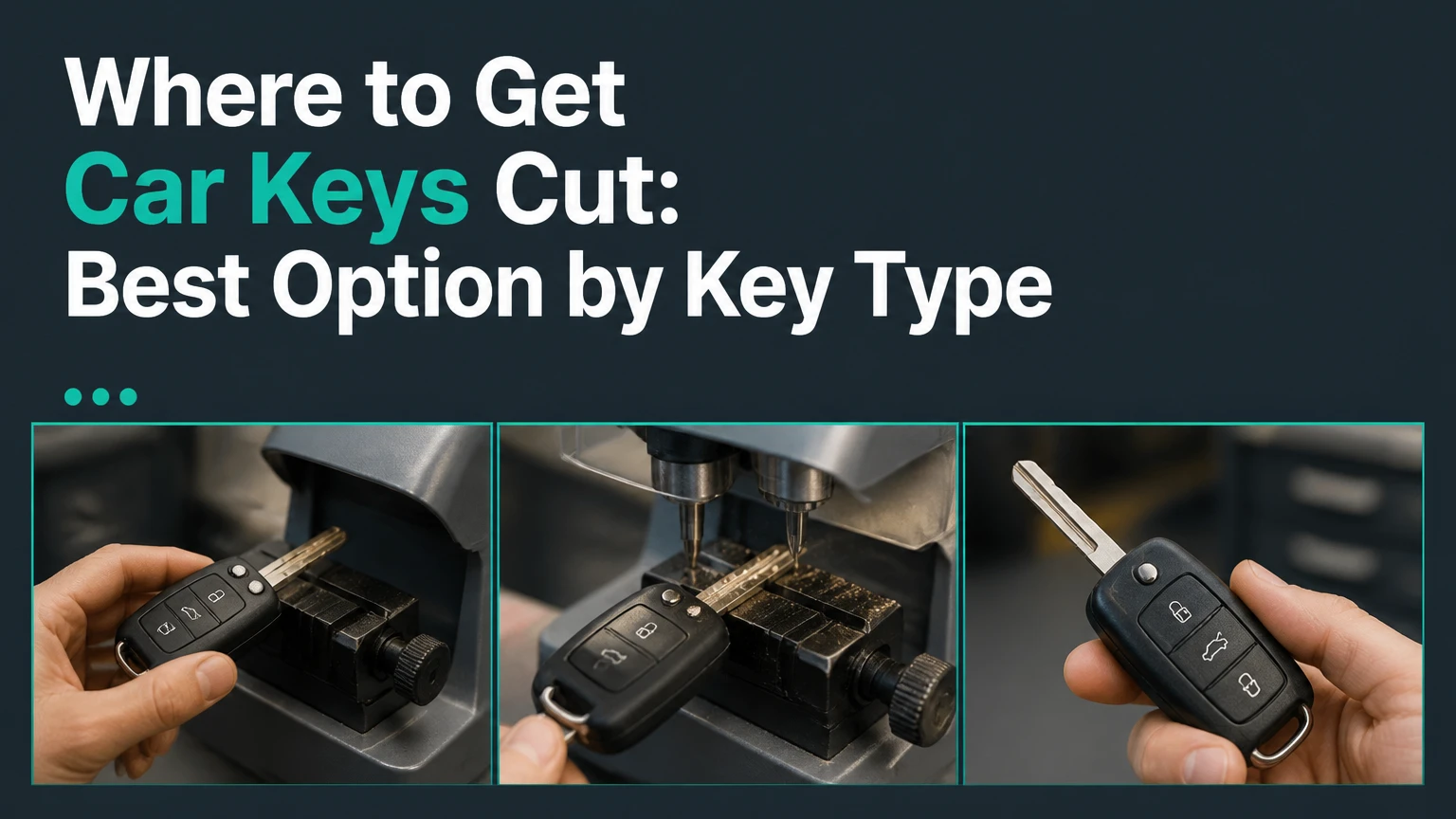
An automotive locksmith is usually the best place to get car keys cut because a qualified technician can cut mechanical blades, program transponder chips, replace remote fobs, and travel to a disabled vehicle. Use a hardware store only for a basic metal spare, and choose a dealership when your vehicle requires brand-specific software or a security system an independent locksmith cannot access.
Key Facts at a Glance
- A mechanically correct car key may still need transponder programming before the engine will start.
- Automotive locksmiths commonly provide mobile cutting and programming in approximately 20-60 minutes.
- A dealership is usually the highest-cost option, while a hardware store is suitable mainly for older, non-electronic keys.
- Copying a heavily worn key can produce a duplicate that turns poorly or damages the ignition cylinder.
- Typical North American prices range from about $5-$15 for a basic metal duplicate to $250-$600 or more for a modern smart key.
- A reputable provider normally requests photo identification, vehicle registration, and proof that you may possess the vehicle.
Where to Get Car Keys Cut
The best provider is determined by the vehicle’s key technology and your situation, not by the lowest advertised cutting price. A basic edge-cut key needs a blank and a mechanical duplicator, while a proximity fob needs a compatible electronic unit, diagnostic equipment, and immobilizer authorization.
An automotive locksmith offers the broadest practical service for most drivers. A dealer offers factory access, but usually at a higher price and with less flexibility if the vehicle is stranded. Hardware stores and automated kiosks work for a narrow category: simple metal keys without a transponder or remote function.
Provider comparison
| Provider | Suitable key types | Typical North American price | Typical time | Mobile service |
|---|---|---|---|---|
| Automotive locksmith | Edge-cut, sidewinder, transponder, remote, many smart keys | $75-$350 | 20-60 minutes | Often available |
| Car dealership | Brand-specific mechanical, transponder, smart, proximity | $150-$600+ | 1 hour to 3 days | Rarely available |
| Hardware store | Basic edge-cut metal blanks | $5-$15 | 5-15 minutes | No |
| Key kiosk | Selected basic metal blanks | $5-$25 | 5-10 minutes | No |
| Online parts plus local programmer | Compatible blank, shell, selected fobs | $20-$250 before labor | 1-7 days | Depends on programmer |
Prices vary by country, vehicle, key frequency, part availability, and emergency timing. The Bangladeshi taka ranges sometimes shown in general search summaries are not universal prices. A local quote should replace any international estimate.
Which Provider Should You Choose?
Choose a mobile automotive locksmith for most replacement keys, a hardware store for a simple older-car duplicate, and a dealership for restricted or unusually complex systems. The decision changes when all keys are lost, the vehicle is under warranty, the key is a smart proximity fob, or the vehicle uses proprietary security access.
Choose a locksmith when speed and flexibility matter
A qualified automotive locksmith can often cut and program a key at the vehicle’s location, which avoids towing when the car is locked or immobilized. Many technicians use laser or sidewinder cutters, transponder tools, and manufacturer-specific diagnostic software.
Ask whether the quoted price includes the blade, electronic key or fob, cutting, programming, travel, emergency labor, taxes, and a working test. “Key cutting” alone may exclude the programming that allows the engine to run.
A locksmith is not automatically competent for every make. Confirm that the technician supports your exact year, model, key system, and all-keys-lost procedure.
Choose a dealership when factory access is the priority
A dealership can order a key matched to the vehicle identification number and use manufacturer software for immobilizer registration. This route is sensible for newer luxury vehicles, some electric vehicles, vehicles with restricted key systems, and cases involving a stolen key that must be deleted from the vehicle’s memory.
Dealer service may require a title, registration, government identification, and sometimes a tow. Parts ordering can extend the process from the same day to several business days, particularly when the fob is backordered.
The dealership is not always technically superior for a routine duplicate. A reputable locksmith may provide the same functional result at a lower price, especially for common Toyota, Honda, Ford, Chevrolet, Nissan, Hyundai, and Kia applications.
Choose a hardware store or kiosk for a plain metal spare
A hardware store or self-service kiosk is appropriate when the key has no buttons, no visible transponder housing, and no immobilizer function. The option is fast and inexpensive, but staff may not identify a high-security profile or diagnose an ignition cylinder that is already worn.
Do not assume a plastic-headed key is electronic. Some vehicles use a plastic head for grip only, while others hide a transponder chip inside it. The vehicle owner’s manual, key markings, or a locksmith can confirm the difference.
How Car Key Cutting and Programming Work
Car key cutting reproduces the blade pattern that matches the vehicle’s lock cylinder; key programming separately pairs an electronic transponder or remote with the vehicle. A duplicate can therefore fit the door and still fail to start the engine when the immobilizer does not recognize its chip.
Duplication from a working key
A technician identifies the blank profile, aligns the original and blank, and cuts the new blade with an edge duplicator or code-capable machine. The technician then deburrs the blade and checks operation in the door, trunk, and ignition where applicable.
A working original is the preferred reference, but its condition matters. A key that has lost metal from years of use can transfer inaccurate dimensions to the duplicate, especially when the lock cylinder has also worn.
The best practice is to duplicate a lightly used key, not the key that has become difficult to insert or turn.
Code cutting without an original
Code cutting uses a key code from a manufacturer record, lock cylinder, service database, or other authorized source. A code cutter produces the intended factory pattern instead of reproducing wear on an old blade.
A VIN is not always the same as a key code, and a VIN alone may not provide enough information for every vehicle. Providers may need the exact trim, lock type, production date, immobilizer system, and proof of ownership before obtaining or using a code.
Code cutting cannot solve every electronic problem. The blade still requires a compatible transponder or fob, and the vehicle may require programming after the cut.
Electronic programming
Programming registers a transponder chip, remote, or smart key with the vehicle’s body or engine-control system. The procedure may use an OBD-II diagnostic port, a manufacturer server, a security PIN, an existing-key sequence, or a combination of these methods.
Remote locking and engine authorization are separate functions on many vehicles. A fob may lock the doors but fail to start the engine, or start the vehicle while its buttons remain unprogrammed.
What Type of Car Key Do You Have?
The visible key shape does not always reveal the complete system. Identify the blade, buttons, transponder housing, emergency blade, and ignition method before requesting a price.
| Key type | Physical identifying feature | Electronic function | Typical replacement price | Common service |
|---|---|---|---|---|
| Edge-cut metal key | Straight cuts along one or both edges | None on basic versions | $5-$15 | Mechanical duplication |
| Transponder key | Plastic head with hidden chip | Immobilizer authorization | $75-$180 | Cut and chip programming |
| Sidewinder key | Center groove milled into a thick blade | May include a chip or remote | $100-$250 | High-security cutting |
| Remote-head key | Blade attached to button housing | Remote locking plus immobilizer | $100-$250 | Cutting, battery check, programming |
| Smart or proximity fob | Push-button ignition, no normal ignition slot | Wireless authorization | $180-$600+ | Fob registration and emergency blade |
| Key card | Flat card-shaped electronic transmitter | Keyless entry and starting | $150-$500 | Vehicle-specific programming |
A sidewinder key is often called a laser-cut key, although modern machines generally mill the groove with computerized equipment rather than using a conventional laser. The important distinction is the high-security blade profile, not the marketing name.
A smart fob may contain a small emergency blade. That blade can unlock the door when the fob battery is dead, but it normally cannot replace the electronic starting function.
How Much Does Car Key Cutting Cost?
Typical North American car-key prices run from $5-$15 for a basic duplicate, $75-$180 for a transponder key, $100-$250 for a sidewinder or remote-head key, and $180-$600 or more for a smart fob. Emergency labor, towing, imported vehicles, and scarce parts can raise the final invoice.
| Service situation | Parts estimate | Labor and programming | Typical total | Typical completion |
|---|---|---|---|---|
| Plain metal spare | $2-$8 | $3-$10 | $5-$15 | 5-15 minutes |
| Transponder duplicate | $25-$90 | $50-$120 | $75-$180 | 20-45 minutes |
| Sidewinder duplicate | $40-$130 | $60-$120 | $100-$250 | 30-60 minutes |
| Remote-head replacement | $50-$150 | $50-$120 | $100-$250 | 30-60 minutes |
| Smart fob replacement | $100-$400 | $80-$200 | $180-$600+ | 30 minutes to 3 days |
| All keys lost, mobile visit | $50-$400 | $100-$300 | $150-$700+ | 30-120 minutes |
These are typical planning ranges, not a universal price list. A genuine manufacturer fob costs more than many aftermarket units, and some vehicles require online security authorization that adds time or a service charge.
A low quote can also omit the programming fee. Request a written out-the-door price before authorizing work.
What Should You Bring to the Locksmith or Dealer?
Bring the vehicle, the working key if available, government identification, registration or title, and the vehicle identification number. A provider may refuse service without ownership evidence because car-key work can provide access to a vehicle.
Give the technician the exact make, model, year, trim, ignition type, and whether the key starts the vehicle. A photograph of the existing key helps identify the blade, but it does not prove chip compatibility.
For a stranded vehicle, ask whether the technician needs access to the driver’s seat, ignition, diagnostic port, or engine compartment. Remove personal items before work begins, and keep the old key or broken fob until the new one passes every test.
How Do You Find a Reliable Local Provider?
Search for “automotive locksmith,” “car key programming,” or “mobile car key replacement” together with your city, then screen providers by capability rather than review count alone. Confirm the exact vehicle application, total price, arrival window, ownership documents, warranty, and payment method before dispatch.
Use this five-minute screening process:
- Call two or three providers and give the exact year, make, and model.
- State whether you have one working key, a damaged key, or no keys.
- Ask whether the service includes cutting and immobilizer programming.
- Request separate prices for aftermarket and original-equipment parts.
- Confirm travel, night, weekend, tax, and emergency charges.
- Ask what warranty covers a defective fob, failed programming, or poor cutting.
- Verify the company name, technician identity, business address, and receipt process.
A provider who gives a firm price without asking the vehicle year or key situation may be quoting a basic blade only. A provider who refuses to explain ownership verification or warranty terms deserves caution.
Common Failure Modes and Their Fixes
The new key turns the lock but will not start the engine
The blade is probably cut correctly, but the transponder is absent, incompatible, or unprogrammed. Have an automotive locksmith scan the immobilizer system and verify the chip frequency, vehicle protocol, and programming status.
A remote button test does not prove starting authorization. The remote transmitter and immobilizer chip can be separate components.
The new key sticks in the ignition
A sticking key usually indicates an inaccurate cut, an incorrect blank, a worn original, or a worn ignition cylinder. Stop forcing the key because a broken blade can turn a simple duplication into an extraction and lock-repair job.
Ask for a code-cut key when the original is worn. If both old and new keys behave badly, have the ignition cylinder inspected.
The remote works, but the car says “key not detected”
A weak coin-cell battery, incorrect fob frequency, damaged antenna, or incomplete registration can cause the warning. Replace the battery with the specified type, then have the provider confirm compatibility and perform the manufacturer’s emergency-start procedure.
Do not buy a fob based only on matching button layout. Frequency, immobilizer generation, FCC or regional designation, and software compatibility can differ.
The aftermarket key will not program
The part may contain the wrong transponder, an encrypted chip that cannot be reused, or a remote board intended for another market. Some providers also decline customer-supplied parts because failed programming and poor blade metal create warranty disputes.
Ask before purchasing whether the locksmith will cut and program a supplied blank. Compare the complete cost with a provider-supplied part.
All keys are lost
Call a mobile automotive locksmith first when the vehicle is accessible and the model is supported. The technician can verify ownership, create a blade from a code or lock, program a new key, and sometimes erase missing keys from the vehicle’s memory.
Use a dealership when the locksmith cannot access the required security system, when the vehicle is under a service contract, or when the manufacturer requires a replacement module. Towing may be necessary, so compare the total cost rather than the key price alone.
A key breaks inside the fob shell
Keep every piece of the broken fob. A locksmith may transfer a usable transponder board or chip into a replacement shell, reducing the cost when the electronics still function.
A shell replacement does not repair a failed circuit board. Test the buttons, immobilizer response, and emergency blade before discarding the original housing.
Should You Buy a Car Key Online?
Buying online can reduce the parts price, but compatibility and warranty risk move to the buyer. An online blank is reasonable when the exact part number, blade profile, frequency, transponder type, and return policy have been verified, and a local provider agrees to service it.
Online listings often use photographs that hide differences between model years. A visually identical fob may have a different circuit board, regional frequency, or locked programming state.
Never insert an uncut aftermarket blade into the ignition to test it. Hard or poorly finished metal can damage delicate wafers. Let the locksmith inspect the blank before cutting.
When Is Owner Programming Possible?
Some vehicles allow an owner to add a spare key by following a manufacturer-defined sequence, but the method varies by year and usually requires two already-programmed keys. Other vehicles require diagnostic equipment, a security code, or online authorization.
Owner programming is most useful for a documented spare-key procedure, not for an all-keys-lost emergency. The owner’s manual is the authoritative source for the sequence, and a failed attempt may leave the remote unpaired without solving the immobilizer problem.
Remote-button synchronization and transponder programming are different procedures. Completing one does not guarantee completion of the other.
How Can You Reduce the Total Cost?
Make a spare while one reliable key still works, compare a locksmith’s complete quote with the dealer’s complete quote, and avoid replacing an entire fob when a shell, battery, or isolated blade is the only failed component. Preventive duplication is usually faster than an all-keys-lost recovery.
Use these cost-control choices:
- Ask for a duplicate rather than a full replacement when the original starts the car.
- Request code cutting if the original is visibly worn.
- Compare original-equipment and reputable aftermarket fobs.
- Ask whether a damaged shell can be replaced without changing the electronics.
- Avoid emergency nighttime service when the vehicle remains secure and drivable.
- Confirm whether programming a second key costs less during the same visit.
Security may justify dealer service after theft. If a key was stolen, ask whether the provider can delete it from the vehicle’s authorized-key list.
Frequently Asked Questions
Can any locksmith cut a key for every car?
No. Automotive locksmith equipment and software vary widely, and some technicians specialize in domestic vehicles, European brands, motorcycles, or older mechanical systems. Ask about the exact year, model, key type, and all-keys-lost capability before booking. A general locksmith may cut a door key but lack the tools to program the immobilizer.
Can a dealership cut a key from the VIN?
Often, but the VIN may identify the vehicle without providing every detail needed for a working key. The dealer may verify ownership, retrieve the correct key code or part number, order the key, cut it, and program it. Production date, trim, region, and security system can affect the required part.
How long does it take to get a car key cut?
A plain metal duplicate usually takes 5-15 minutes. A transponder or sidewinder key commonly takes 20-60 minutes when the correct part is available, while a smart-fob replacement may take 30 minutes to several days if the dealer must order the part. Mobile travel time is additional.
Can a hardware store copy a transponder car key?
Some hardware stores can cut selected transponder blanks, but many cannot program the chip for the vehicle. The store’s cutting service may produce a blade that opens the doors while leaving the engine immobilizer inactive. Confirm both mechanical cutting and vehicle programming before paying.
What happens if my only car key is worn?
Do not use the worn key as the pattern if it sticks, turns roughly, or shows rounded cuts. An automotive locksmith can inspect the lock, identify the key code where available, and cut a fresh blade to specification. The provider should also check whether the ignition cylinder itself has worn.
Is a smart key the same as a key fob?
A smart key is a type of key fob that communicates with the vehicle when it is nearby, often enabling push-button starting. A conventional remote fob may only lock and unlock doors and may require a separate physical key or ignition transponder. The terms are often used loosely in retail listings.
The Bottom Line
For most drivers, a qualified mobile automotive locksmith is the best place to get car keys cut because the technician can handle mechanical cutting, transponder programming, and on-site service in one visit. Use a hardware store for a basic metal spare, compare total costs with the dealer, and choose the dealership when proprietary security access or a stolen key makes factory service the safer option.