Car keys are expensive because a modern key is an electronic security credential, not merely a cut piece of metal. A replacement may require a compatible transponder or smart-fob circuit, mechanical cutting, vehicle-specific programming, security authorization, and technician time, so typical prices range from about $10 for a basic duplicate to $700 or more for some proximity systems.
Key Facts at a Glance
- A mechanical key can often cost $10-$50, while a proximity smart key commonly costs $250-$700 or more.
- A transponder chip authorizes the vehicle immobilizer, but a remote-control signal usually performs locking functions separately.
- Cutting a blade does not necessarily make the vehicle start; immobilizer programming may still be required.
- A locksmith is often less expensive than a dealer, but model coverage depends on software, credentials, equipment, and vehicle security access.
- A dead fob battery usually affects buttons or proximity detection, while the passive immobilizer chip may continue working.
- A spare made while one working key remains usually costs less and creates fewer recovery problems than replacing an only key.
Why Are Car Keys So Expensive?
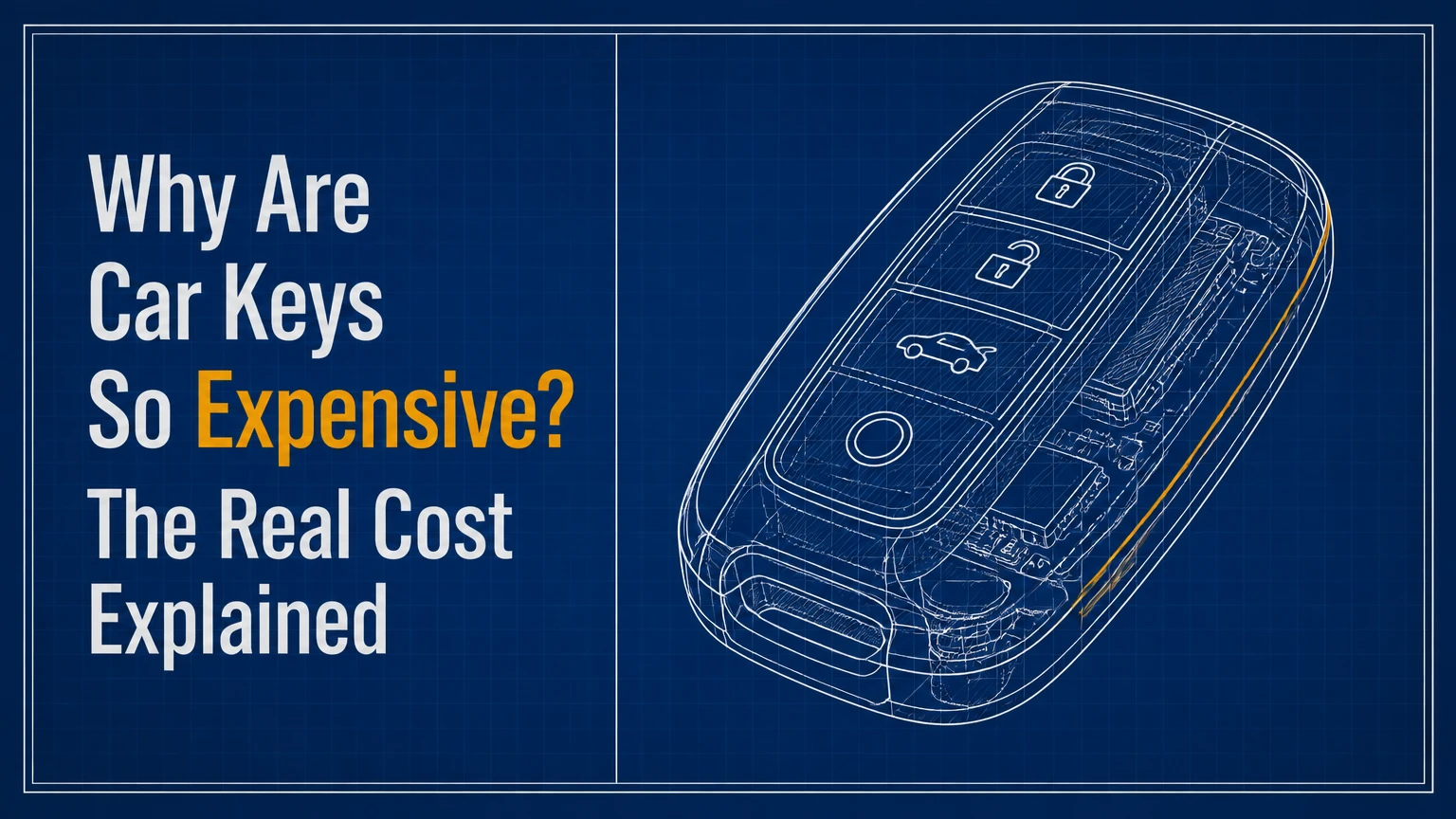
The main reason car keys are expensive is that manufacturers use them to control access to the vehicle’s anti-theft system. A modern fob can contain a mechanical emergency blade, printed circuit board, immobilizer transponder, radio transmitter, proximity antenna, battery, switches, and encryption-related memory in one small housing.
The price reflects several separate operations. The provider must identify the correct key frequency and part number, cut the blade if one exists, establish security access to the vehicle, pair the key with the body or immobilizer system, and test starting, locking, trunk release, and proximity functions.
A replacement also carries a security risk. Programming equipment and credentials are controlled more tightly than ordinary key-cutting machines because unauthorized key creation could help someone steal a vehicle. The owner therefore pays for specialized tools, technician training, software subscriptions, and liability as well as plastic and electronics.
The most expensive scenario is losing every programmed key. A spare-key job can use the existing authorization system efficiently, while an all-keys-lost job may require vehicle-specific security procedures, identity verification, emergency access, towing, or a dealer appointment.
What Is a Modern Car Key?
A modern car key is a physical and electronic device with several functions that can operate independently. The metal blade opens a lock or turns an ignition on older designs, the transponder authorizes starting, and the radio or proximity system controls convenience features such as locking and unlocking.
The distinction matters when diagnosing cost. A damaged button does not automatically mean the immobilizer chip has failed, and a vehicle that cranks but does not start is not necessarily suffering from a weak remote battery.
The Main Components
| Component | Function | Typical failure or cost effect |
|---|---|---|
| Mechanical blade | Opens door or turns ignition cylinder | Cutting commonly adds $10-$60 |
| Immobilizer transponder | Authorizes engine starting | Programming commonly adds $50-$200 |
| Radio transmitter | Sends lock, unlock, panic, or trunk commands | Incorrect frequency can make a fob unusable |
| Proximity antenna and circuit | Enables passive entry and push-button start | Smart-fob replacement commonly reaches $250-$700 |
| Coin-cell battery | Powers active remote and proximity functions | CR2032 or CR2025 replacement often costs $2-$10 |
| Housing and buttons | Protects electronics and provides controls | Shell repair may avoid full electronic replacement |
A transponder can be passive, meaning the vehicle’s antenna supplies the energy needed for its short-range response. The remote transmitter is different because it normally needs the fob battery to send a longer-range command.
How Does a Transponder Key Prevent Starting?
A transponder key prevents starting by requiring the vehicle immobilizer to recognize an authorized electronic identifier before enabling the engine-control sequence. The exact architecture differs by manufacturer, but the vehicle generally reads the transponder through an antenna near the ignition switch or through a start-system antenna network.
When the key is inserted or the start button is used, the immobilizer system checks whether the electronic credential belongs to the vehicle. If authorization succeeds, the engine control module, body control module, or immobilizer module permits starting. If authorization fails, the starter may remain disabled or the engine may start briefly and stop, depending on the design.
The AI Overview’s four-step handshake is a useful simplification, but it is not universal. Some systems use rolling or challenge-response authentication, some divide authorization between several modules, and many smart keys communicate through low-frequency and radio-frequency channels. A cut blade alone cannot reproduce that electronic permission.
A programming session may add a new key, erase missing keys, or synchronize modules. It does not always erase every old key automatically, so owners should ask whether a lost fob remains authorized.
Which Key Types Cost the Most?
Proximity smart keys generally cost the most because they combine immobilizer authorization, passive entry, push-button starting, multiple antennas, and a more complex circuit board. Basic mechanical duplicates cost the least because they require neither electronics nor vehicle programming.
| Key type | Typical replacement price in the USA | Typical service time | Programming usually required? |
|---|---|---|---|
| Mechanical blade | $10-$50 | 10-20 minutes | No |
| Transponder key | $70-$250 | 20-45 minutes | Yes |
| Remote or flip key | $150-$350 | 30-60 minutes | Usually |
| Laser or high-security blade key | $100-$300 | 30-60 minutes | Sometimes |
| Proximity smart fob | $250-$700+ | 1-2 hours | Yes |
| Luxury European smart key | $400-$1,000+ | 1-4 hours | Often, with restricted access |
These are typical consumer ranges, not universal prices. A key for a high-volume compact car may cost much less than a key for a new luxury SUV, even when both use push-button starting.
“Laser-cut” also describes the blade profile, not necessarily the electronic system. A high-security blade may require precise equipment, but its total price depends more heavily on whether the key contains a transponder or smart-fob module.
What Are You Paying For When a Key Is Replaced?
A car-key invoice usually combines parts, cutting, programming, security access, diagnostics, labor, and sometimes travel or towing. The visible fob is only one line in the total cost.
| Cost element | Typical range | When it applies |
|---|---|---|
| Replacement shell | $15-$60 | Broken housing with working electronics |
| Aftermarket electronic fob | $30-$180 | Compatible part accepted by the vehicle |
| OEM electronic fob | $100-$500+ | Dealer-supplied or brand-specific part |
| Blade cutting | $10-$60 | Key has a mechanical emergency or ignition blade |
| Programming labor | $50-$200 | Transponder, remote, or proximity pairing |
| Mobile service call | $50-$150 | Locksmith travels to the vehicle |
| Emergency or after-hours fee | $50-$200 | Night, holiday, or roadside response |
| Towing | $75-$250+ | Vehicle must reach a dealer or equipped shop |
The programming fee is not simply payment for pressing a button. The technician may need a diagnostic interface, current manufacturer software, a security PIN or online authorization, battery support, and a procedure that varies by model year.
What Happens During Replacement?
A normal replacement involves four stages: identification, cutting, programming, and testing. A working spare usually takes about 20-60 minutes, while an all-keys-lost job can take one to several hours.
1. Identify the Vehicle and Key
The provider confirms the make, model, year, VIN, ignition style, key frequency, blade profile, and existing key status. The VIN helps identify the correct configuration, but it does not always reveal every equipment variation, so the original part number or a vehicle scan may still be necessary.
2. Cut the Mechanical Blade
A locksmith duplicates an existing blade when possible or decodes the lock when every key is missing. A new blade may open the door but fail to turn the ignition if the cut pattern, thickness, or profile is wrong.
3. Program the Electronic Credential
The technician connects an approved diagnostic tool or uses a model-specific procedure to add the key to the immobilizer, body-control, or smart-key system. Some vehicles require internet credentials, a security PIN, two existing keys, or a stable external power supply.
4. Test Every Function
The final check should cover engine starting, lock and unlock buttons, trunk release, panic alarm, passive entry, push-button starting, emergency blade operation, and dashboard warnings. A key that starts the car but cannot unlock it remotely is only partially programmed.
A common practitioner rule is to ask for a function test before paying. Customers often discover a wrong frequency or incomplete programming after leaving the shop, when returning the vehicle becomes inconvenient.
Is a Locksmith Cheaper Than a Dealer?
An automotive locksmith is often cheaper for common models and mobile jobs, while a dealer is more dependable when the vehicle requires proprietary credentials or a restricted replacement process. The correct choice depends on model coverage, whether a working key remains, warranty expectations, and the vehicle’s location.
| Decision factor | Automotive locksmith | Dealership |
|---|---|---|
| Typical total price | $100-$500 | $200-$1,000+ |
| Mobile service | Often available | Rarely available |
| Common-model coverage | Strong for many older vehicles | Strong across the brand |
| New or restricted model access | May be limited | Usually available |
| Mechanical cutting | Often completed on site | Usually completed at service department |
| Vehicle transport | Often unnecessary | May require towing |
| OEM part certainty | Varies by quoted part | Usually high |
| Warranty and records | Provider-specific | Brand service record |
A locksmith may provide a faster and less expensive service without sacrificing function, but only if the technician has current equipment for that exact vehicle. A dealer is not automatically better at every key job, although dealer access becomes more valuable when the vehicle uses locked security gateways, online authorization, or a unique smart-key system.
When Should You Use a Locksmith?
Use a qualified automotive locksmith when the vehicle is accessible, the model is supported, and you want mobile cutting or programming. Ask for the total price, part origin, programming guarantee, proof-of-ownership requirements, and whether lost keys can be removed from the authorization list.
When Is a Dealer the Safer Choice?
Use a dealer when the vehicle is new, high-value, under warranty, or unsupported by local locksmith equipment. Dealer service is also sensible when the immobilizer has been replaced, several modules are mismatched, or the manufacturer requires online security authorization.
Can an Online Key or DIY Programming Lower the Cost?
An online key can lower the parts cost, but it creates compatibility and programming risks that can erase the saving. DIY programming works only on vehicles that explicitly support an owner procedure, and many modern models still require professional diagnostic access.
Before buying an online fob, verify the exact FCC or regional frequency, part number, button layout, blade profile, immobilizer type, and whether the chip is new and programmable. A fob that looks identical may contain a locked, previously assigned, or region-incompatible circuit.
The lowest-risk budget strategy is often a reputable replacement shell when the original electronics still work. The next option is a verified compatible blank supplied to a locksmith. The riskiest option is an unbranded “universal” fob advertised without vehicle-specific compatibility.
Do not repeatedly attempt random programming sequences. Some vehicles limit failed attempts, require a timed security delay, or leave the owner with a drained battery and no working key.
What If the Only Key Is Lost?
Losing the only key changes the job from duplication to vehicle entry, key creation, and security recovery. Typical all-keys-lost costs range from $200-$1,000 or more, depending on the vehicle, location, towing requirement, and whether the provider can perform mobile programming.
The technician must first gain lawful access without damaging the vehicle. Next, the provider identifies the lock or vehicle data, cuts a key, obtains security authorization, programs the new credential, and tests the immobilizer and remote systems.
A replacement does not always erase the lost key. Ask whether the missing key can be deleted from the vehicle’s authorized-key list and whether all remaining keys must be present during the procedure. The answer varies by manufacturer and immobilizer generation.
Proof of ownership is normal. A legitimate provider may request government identification, registration, title, insurance records, or a dealer-issued authorization, especially for newer or luxury vehicles.
Can a Broken or Dead Fob Be Repaired?
A broken fob can often be repaired if the circuit board, transponder, and switches still function. Replacing the shell, buttons, or coin-cell battery may cost $2-$60, compared with hundreds for a complete smart fob.
| Symptom | Likely cause | First action | Likely remedy |
|---|---|---|---|
| Buttons do nothing | Dead CR2032 or CR2025 battery | Replace battery and inspect contacts | Battery or contact repair |
| Car starts, housing cracked | Damaged shell | Preserve the circuit board | Shell replacement |
| Remote works intermittently | Worn switches or cracked solder joint | Test at close range | Board repair or fob replacement |
| Remote works, car will not start | Transponder or immobilizer issue | Try the spare key | Diagnostic scan |
| No proximity entry after water exposure | Moisture damage or weak battery | Stop repeated testing | Drying, board repair, or replacement |
| Key turns, engine will not authorize | Wrong or unprogrammed chip | Check immobilizer warning | Programming or compatible key |
The commonly repeated claim that more than 80% of key failures are dead batteries is not a reliable universal statistic. Battery replacement is a sensible first test, but immobilizer faults, damaged switches, water intrusion, vehicle-battery problems, and antenna failures also cause similar symptoms.
Avoid disconnecting the vehicle battery as a routine “hard reset.” Modern vehicles can lose learned settings, trigger fault codes, or create additional electrical problems, and battery disconnection does not repair a mismatched key or failed immobilizer antenna.
Why Does a New Key Still Fail?
A new key can fail because the part is incompatible, the wrong frequency was supplied, the transponder was not programmed, or the vehicle has a separate fault. Programming cannot compensate for an incorrect circuit board or a damaged receiver.
Check the following in order:
- Confirm whether the key starts the engine, operates the buttons, or does neither.
- Install the specified coin-cell battery with the correct polarity.
- Test the vehicle’s main battery, especially if interior lights are dim.
- Compare the replacement part number and frequency with the vehicle specification.
- Try a known working key to separate vehicle faults from fob faults.
- Request a diagnostic scan if the immobilizer warning remains illuminated.
Radio interference can temporarily affect remote commands, but it rarely explains a persistent no-start condition. A phone, laptop, or radar detector should not be treated as the primary diagnosis until battery, compatibility, and immobilizer status are checked.
How Can You Reduce the Replacement Price?
The most effective way to reduce cost is to create a spare while one programmed key still works. A working key lets a locksmith verify the vehicle, test the replacement, and avoid the more complex access and recovery work associated with an all-keys-lost event.
Use these cost-control steps:
- Compare a complete quote from at least one qualified locksmith and the dealer.
- Ask whether the quoted part is OEM, aftermarket, refurbished, or shell-only.
- Preserve a damaged fob until its circuit board has been tested.
- Confirm cutting, programming, mobile travel, taxes, and emergency fees in writing.
- Avoid buying a fob before confirming frequency and part compatibility.
- Request deletion of a lost key if the vehicle supports that procedure.
- Keep two working keys in separate, secure locations.
Insurance or roadside-assistance policies sometimes cover lost or damaged keys, but limits, exclusions, deductibles, and replacement-source rules differ. Check the policy before authorizing an expensive emergency service.
Do Luxury and Newer Cars Cost More?
Luxury and newer cars often cost more because their keys use restricted parts, encrypted communication, online authorization, or multiple control modules. The price difference is not caused by the logo alone, although brand-specific parts and dealer labor can add substantially.
European vehicles from BMW, Mercedes-Benz, Audi, and Porsche may require controlled ordering, vehicle-specific initialization, or security credentials that many independent providers cannot access. A locksmith who handles common domestic models may therefore refer the job to a dealer.
The same rule applies to newer mainstream vehicles with security gateways. A third-party provider may cut the blade and supply the fob but lack the credential needed to complete programming. Ask about capability before arranging mobile service.
Digital phone keys can reduce dependence on a physical fob on compatible vehicles, but they are not a universal replacement. Compatibility may depend on the vehicle trim, smartphone operating system, account ownership, battery state, and manufacturer application.
Which Replacement Option Fits Your Situation?
Choose the provider and part type according to the failure, not according to the lowest advertised starting price. A shell repair is appropriate for cosmetic damage, while a dealer may be necessary for a restricted all-keys-lost case.
| Owner situation | Best first option | Typical cost | Main limitation |
|---|---|---|---|
| Working key, need a spare | Automotive locksmith | $70-$300 | Model coverage varies |
| Cracked shell, functions work | Replacement shell | $15-$60 | Board must transfer successfully |
| Dead remote buttons | Battery and contact inspection | $2-$60 | Does not fix immobilizer faults |
| Lost one of two keys | Locksmith or dealer comparison | $100-$500 | Confirm whether lost key remains active |
| Lost only key | Mobile locksmith with model coverage | $200-$1,000+ | May require dealer or towing |
| New luxury vehicle | Dealer quote first | $400-$1,000+ | Higher labor and part cost |
| Used car with uncertain key history | Diagnostic and key audit | $100-$400 | Existing keys may need deletion |
An honest limitation matters: an aftermarket key is not automatically poor, and an OEM key is not automatically worth its premium. Compatibility, programming support, return policy, and final testing matter more than the label alone.
FAQ
Do All Cars Need Programming After Key Replacement?
No. A purely mechanical key does not need electronic programming, while most transponder, remote, and proximity keys do. Some older vehicles support onboard procedures for adding a spare, but many newer vehicles require a diagnostic tool, security code, or online manufacturer authorization.
How Long Does Car-Key Replacement Take?
A basic mechanical duplicate often takes 10-20 minutes. A programmed transponder or remote key commonly takes 20-60 minutes, while a smart key or all-keys-lost job may take one to four hours, excluding towing, security delays, parts ordering, or dealer scheduling.
Is an OEM Key Always Better Than an Aftermarket Key?
No. OEM keys usually provide the strongest part-number certainty and manufacturer support, but a verified aftermarket key can work correctly at a lower price. The buyer should confirm frequency, chip type, programming status, return terms, and compatibility with the exact vehicle before purchase.
Can a Locksmith Make a Key Without the Original?
Often, yes. A qualified automotive locksmith may decode the lock, use vehicle data, or access the immobilizer system after verifying ownership. The job becomes more difficult when every key is missing, the vehicle uses restricted security access, or the locksmith lacks equipment for that model.
Should a Lost Key Be Removed From the Vehicle?
Yes, when the manufacturer’s system supports deletion or reauthorization. Removing a lost key from the authorized list reduces the risk that someone who finds it can unlock or start the vehicle. Ask the technician exactly which keys remain active after programming.
Are Smart Keys More Vulnerable to Theft?
Smart keys can increase convenience-related theft risk when criminals relay or amplify proximity signals, although the risk depends on vehicle design and security controls. Store the fob away from exterior doors, use the manufacturer’s sleep or disable function when available, and verify that the vehicle locks successfully.
The Bottom Line
Why are car keys so expensive? Because a modern car key combines physical access with an electronic authorization credential, and replacement often requires compatible hardware, precision cutting, security programming, diagnostics, and testing. The lowest-cost path is usually a verified spare made while one working key remains, while an all-keys-lost or restricted luxury-vehicle job may justify dealer service.