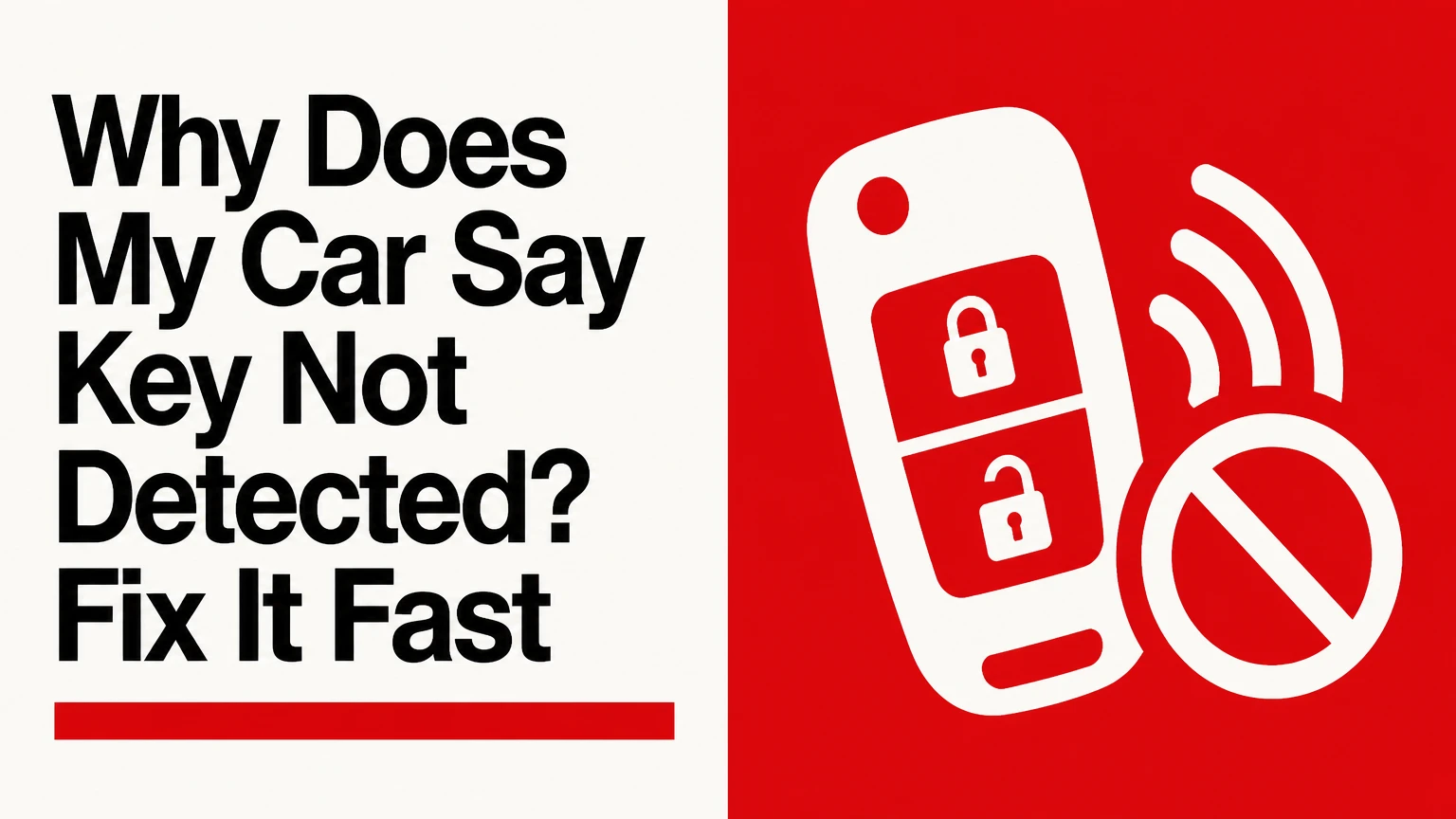
The “Key Not Detected” message means the vehicle’s keyless-entry or immobilizer system cannot authenticate an authorized key fob or phone key. The usual causes are a weak fob battery, radio interference, a low vehicle battery, an incorrectly placed key, or a fault in the car’s antennas, receiver, or immobilizer module.
Key facts
A dead fob battery may stop remote buttons while the fob’s passive transponder still starts the vehicle through the backup location.
Holding the fob against the start button often activates the emergency detection path, but the exact location is vehicle-specific.
If both programmed keys fail at the same time, suspect the vehicle battery, receiver, antenna system, or immobilizer before buying another fob.
A new coin-cell battery usually does not require key programming, while a replacement fob normally does.
A jump-start can restore detection temporarily, but a battery that repeatedly falls below about 12.2 volts at rest needs testing.
Phone-as-a-key systems depend on Bluetooth Low Energy, Ultra-Wideband, software permissions, and phone power, so they need a separate backup plan.
What Does “Key Not Detected” Mean?
“Key Not Detected” means the car has not completed the authentication exchange required to unlock or authorize ignition. The message does not automatically mean the key is lost, unprogrammed, or permanently damaged.
A push-button vehicle normally searches for an authorized fob through several low-frequency antennas placed in the cabin, doors, trunk area, and sometimes the rear bumper. The fob responds over a higher-frequency radio channel, and the vehicle’s body control or immobilizer system checks the encrypted credential before enabling the starter or fuel and ignition systems.
Detection and authorization are separate events. A vehicle may recognize the fob for door entry but reject it for starting, or it may start while showing a later low-battery warning. That difference helps identify whether the problem is the fob battery, a cabin antenna, a door antenna, or the immobilizer.
A conventional metal key with an embedded transponder works differently. The ignition reader energizes the chip, so the key does not depend on a replaceable remote-control battery for immobilizer authorization.
How Does a Smart Key System Work?
A smart key system uses short-range radio communication to locate and authenticate the fob. The vehicle sends a low-frequency request, commonly around 125 kHz, and the fob returns an encrypted radio response, often in regional bands such as 315 MHz or 433 MHz.
The sequence is generally:
- A door handle, start-button request, or periodic vehicle search activates an antenna.
- The antenna sends a low-frequency wake-up signal.
- The fob wakes and transmits its identification response.
- The vehicle compares the response with stored security credentials.
- The immobilizer permits entry or engine operation when the credential is valid.
Manufacturers vary the antenna layout, frequencies, encryption, and emergency-start procedure. The 125 kHz and 315 or 433 MHz figures describe common system families, not a universal specification for every car sold worldwide.
The fob battery powers the buttons and radio response in many systems, but some fobs also contain a passive transponder. That passive chip can remain usable when the coin cell is exhausted, which explains why holding a “dead” fob at a specified backup point may start the car.
What Is the Difference Between Detection and Programming?
Detection is the vehicle receiving a response from a key it already recognizes. Programming is the security process that adds a replacement key’s identity to the vehicle.
Replacing a CR2032 or CR2025 battery normally preserves the fob’s stored credential. A new or used replacement fob may require cutting, pairing, immobilizer registration, or specialized diagnostic access. Button synchronization and immobilizer programming are also different procedures, and one does not always replace the other.
Why Does My Car Say Key Not Detected?
The most likely cause is a weak fob battery, but the correct diagnosis depends on whether the doors respond, whether the spare key works, and whether the vehicle’s electrical system is healthy. Troubleshooting those three observations prevents unnecessary fob purchases.
| Symptom | Most likely area | First test | Typical next action |
|---|---|---|---|
| One fob fails, spare works | Fob battery or fob damage | Hold failed fob at start button | Replace battery or repair fob |
| Both fobs fail suddenly | Vehicle battery or receiver | Test headlights and battery voltage | Charge, jump-start, or test battery |
| Buttons fail, emergency start works | Coin cell or remote circuit | Replace CR2032 or CR2025 | Recheck lock and unlock range |
| Unlock works, start fails | Cabin antenna or immobilizer path | Use backup slot | Scan vehicle if issue remains |
| Works away from charger, fails nearby | Radio interference | Remove electronics | Replace or relocate accessory |
| Warning appears while driving | Intermittent detection or system fault | Check manual warning procedure | Arrange diagnostic inspection |
Can a Dead Key Fob Battery Cause the Warning?
Yes. A weak coin cell can reduce the fob’s radio output until the vehicle cannot receive a reliable response, especially when the fob is in a bag, behind a phone, or several feet from the cabin antenna.
Press the fob buttons from close range. If the locks respond slowly, only work beside the car, or stop responding entirely, replace the battery with the exact type printed inside the fob or listed in the owner’s manual. Match the polarity, keep the circuit board dry, and avoid bending the battery contacts.
A new battery should produce immediate improvement in remote operation. If the warning remains but the emergency-start position works, the fob’s passive transponder is probably functional and the remote circuit, battery contact, or fob case may be at fault.
Can a Weak Car Battery Cause Key Not Detected?
Yes. A low 12-volt vehicle battery can prevent the passive-entry antennas, body control module, or immobilizer receiver from operating correctly. Dim headlights, flickering dashboard lamps, slow power windows, repeated warning messages, and clicking during attempted starting support this diagnosis.
As a practical voltage guide, approximately 12.6 volts indicates a fully charged conventional lead-acid battery at rest, about 12.2 volts indicates a substantially discharged battery, and below 12.0 volts indicates severe discharge. Voltage alone cannot prove battery health because a failing battery may show acceptable voltage until a load is applied.
Charge or jump-start the vehicle according to the manufacturer’s instructions. If the warning disappears after external power is connected, test the battery and charging system rather than treating the fob as the only fault.
Can My Phone or Another Device Block the Key?
Yes, nearby electronics can interfere with a marginal key signal, although ordinary smartphones do not normally block a healthy fob at normal distances. Wireless charging pads, radar detectors, two-way radios, aftermarket alarms, poorly designed USB adapters, and metal-lined wallets create more plausible interference conditions.
Remove the fob from:
- A smartphone case or wireless charging compartment
- A laptop bag containing several electronic devices
- A metal coin pouch or RFID-blocking sleeve
- A radar detector or two-way radio
- A large ring of keys and metal objects
Then try the fob by itself. An interference diagnosis is stronger when the key works consistently after the suspected accessory is unplugged or moved.
How Do I Start a Car When the Key Is Not Detected?
Start the car by placing the fob at the manufacturer’s emergency detection point, usually against the start button or inside a marked backup pocket. The procedure typically takes less than one minute, but the location and required button action differ by vehicle.
Step 1: Remove Interference
Take the fob out of a bag and separate it from phones, coins, chargers, and other keys. Sit in the driver’s seat with every authorized fob outside the vehicle if possible, because another damaged or misplaced fob can complicate diagnosis.
Success checkpoint: The warning changes or the vehicle starts when the isolated fob is used.
Common mistake: Leaving the fob inside a metal case or placing it on a wireless charging pad.
Step 2: Hold the Fob Against the Start Button
Press the brake pedal, then touch the fob directly to the start button while pressing the button. Some vehicles require the fob logo, key-ring end, or a particular side to face the button.
Success checkpoint: The instrument cluster wakes normally and the engine starts.
Common mistake: Pressing the button repeatedly without holding the fob at the specified position.
Step 3: Use the Backup Pocket
Search the owner’s manual for “passive starting,” “emergency key detection,” or “key battery discharged.” Common locations include the center-console tray, cupholder, glove box, door pocket, underside of the console, and a slot near the steering column.
Success checkpoint: The car starts even though normal remote detection remains unavailable.
Common mistake: Assuming every model uses the cupholder or start button as its emergency location.
Step 4: Test the Spare Key
Use the spare fob alone. A working spare points toward the original fob, while failure with both programmed keys points toward the vehicle or a shared environmental cause.
Success checkpoint: One key works consistently across several starts.
Common mistake: Testing both fobs while they remain together in the same bag, which does not isolate the fault.
Step 5: Restore Power or Get a Diagnostic Scan
If the headlights are dim or the dashboard resets, charge or jump-start the vehicle before replacing parts. If both keys fail with a healthy battery, the vehicle needs a diagnostic scan for antenna, receiver, body-control, or immobilizer faults.
Success checkpoint: The warning disappears after a confirmed battery repair or a documented fault repair.
Common mistake: Buying an unverified replacement fob before checking the car’s 12-volt supply.
Where Is the Key Fob Backup Slot?
The backup slot is usually inside the cabin, but its position depends on the vehicle’s make, model, and year. The owner’s manual is the authoritative source because manufacturers place the passive reader in different consoles and specify different fob orientations.
| Common backup location | Vehicles that may use this design | How to identify it | Typical emergency action |
|---|---|---|---|
| Center-console tray | Ford, Chevrolet, Nissan models | Molded key or wireless symbol | Place fob in tray, press brake, start |
| Cupholder | Toyota, Lexus, Hyundai models | Recess or printed key icon | Set fob in holder, press start |
| Glove box | Some European and luxury vehicles | Marked pocket or flat reader | Insert fob, activate ignition |
| Against start button | Honda, Mazda, Subaru models | Button or manual instruction | Touch fob to button, press brake |
| Steering-column slot | Older push-start vehicles | Narrow labeled receiver | Insert or align fob, start vehicle |
| Key card reader area | Tesla and some digital-key systems | Console or door-pillar reader | Place card or approved key at reader |
The emergency reader may rely on a passive transponder, a short-range antenna, or a direct inductive coupling arrangement. It does not prove that the fob’s remote battery or radio transmitter is healthy.
What If the Spare Key Also Says Key Not Detected?
If the spare key also fails, check the vehicle battery and interference before assuming both fobs failed. Two independent fob batteries can be weak, but simultaneous failure is more consistent with a low-voltage condition, a failed receiver, a disconnected antenna, or an immobilizer communication problem.
Use this decision sequence:
- Remove chargers, radar equipment, and aftermarket electronics.
- Check whether interior lights, headlights, and locks operate normally.
- Measure the 12-volt battery after the car has rested, if a meter is available.
- Try the emergency detection location with each key separately.
- Attempt a start only according to the owner’s manual.
- Scan for body-control, passive-entry, antenna, or immobilizer codes.
A vehicle that starts through the backup slot but not through normal detection likely has a remote-signal, antenna, or fob-side issue. A vehicle that will not start through the backup method either may have a deeper immobilizer, brake-switch, selector-position, or vehicle-power fault.
How Do Transponder Keys, Smart Fobs, and Phone Keys Compare?
Transponder keys use a physical blade and embedded immobilizer chip, smart fobs use passive-entry radio authentication, and phone keys use an authorized mobile device. Smart fobs provide the broadest emergency usability, while phone keys provide convenience but add software and battery dependencies.
| Key system | Main communication | Replaceable battery | Emergency limitation | Typical replacement cost |
|---|---|---|---|---|
| Metal transponder key | Ignition reader and passive chip | No for immobilizer | Blade must fit ignition | $50-$180 |
| Smart key fob | LF wake-up and UHF response | Yes, commonly CR2032 or CR2025 | Backup slot required | $150-$600 |
| Key card | RFID, NFC, or model-specific radio | Often no | Card must reach reader | $20-$150 |
| Phone-as-a-key | Bluetooth LE or UWB | Phone battery required | App, permissions, and phone power | $0-$100 |
| Dealer-issued replacement | Manufacturer programming system | Depends on key type | Vehicle access and proof required | $300-$800 or more |
Prices are typical U.S. ranges, not fixed quotes. Luxury vehicles, proximity sensors, integrated remote starters, geographic labor rates, and all-keys-lost situations can increase the total.
Is Phone-as-a-Key More Reliable Than a Fob?
Phone-as-a-key is not universally more reliable than a physical fob because it depends on the phone’s battery, Bluetooth or UWB hardware, app status, operating-system permissions, and account authorization. A phone key is convenient for sharing and can support hands-free access, but a discharged phone can leave the driver without a usable credential.
Digital Key systems from manufacturers such as BMW, Tesla, Ford, Hyundai, and Genesis use different combinations of Bluetooth Low Energy, NFC, and Ultra-Wideband. Carry the emergency key card or physical key specified by the manufacturer, and test it before relying on phone-only access.
How Much Does a Key Not Detected Repair Cost?
A coin-cell battery costs about $5-$15 and takes roughly five minutes to replace. Typical U.S. mobile locksmith work costs about $100-$300 for diagnosis, cutting, or programming, while a dealer replacement commonly costs $300-$800 or more, depending on the vehicle.
| Repair path | Typical U.S. cost | Typical time | Usually needed when |
|---|---|---|---|
| Fob battery replacement | $5-$15 | 5-10 minutes | Buttons are weak or dead |
| Fob inspection or case repair | $20-$100 | 15-60 minutes | Broken contacts or housing |
| Mobile locksmith programming | $100-$300 | 30-90 minutes | Replacement fob needs registration |
| Dealer key replacement | $300-$800+ | 1-4 hours | OEM key, security verification, or complex programming |
| Vehicle battery service | $150-$350 | 30-90 minutes | Low voltage causes multiple warnings |
| Antenna or receiver diagnosis | $100-$250 diagnostic fee | 1-3 hours | Both keys fail with healthy power |
| Antenna or module repair | $200-$1,000+ | Same day to several days | Wiring, module, or water damage is confirmed |
The lowest-cost path is diagnosis before replacement. A locksmith can often verify key output and program a compatible key, but some newer systems require dealer credentials, online authorization, or manufacturer-specific equipment.
Can Water Damage or a De-Synchronized Key Cause the Warning?
Water damage can cause a permanent or intermittent detection failure, while rolling-code desynchronization is possible but less common than a depleted battery or damaged switch. Neither condition should be “fixed” by repeatedly pressing buttons or buying an unrelated replacement fob.
Open the fob only if the design permits it. Remove the battery, inspect for moisture or green-white corrosion, and allow the housing to dry fully; light surface contamination may be cleaned with high-purity isopropyl alcohol and a soft brush, but damaged circuit traces require professional repair or replacement.
Rolling codes do not usually desynchronize merely because buttons were pressed many times. Many systems tolerate missed button presses, and the exact resynchronization process varies by manufacturer. Follow the owner’s manual, and do not assume that turning a physical key will reprogram every modern smart fob.
A replacement fob must match the vehicle’s market, frequency, chip type, and software compatibility. Cheap online listings often omit those details, while a reputable locksmith or dealer can verify compatibility from the vehicle identification number and existing key data.
What Should You Avoid While Troubleshooting?
Avoid forcing the fob case, guessing the battery orientation, repeatedly jump-starting a damaged battery, or attempting undocumented programming sequences. Incorrect procedures can lock out the vehicle, damage trim, erase learned keys, or create a second fault that obscures the original problem.
Use these practitioner rules:
- Keep the working spare away from the primary key during diagnosis.
- Photograph the old battery orientation before removal.
- Do not test a key inside a metal-lined wallet.
- Do not leave a fob beside the vehicle overnight if passive entry repeatedly wakes it.
- Do not purchase a used fob until a locksmith confirms that it can be reset and programmed.
- Keep the mechanical emergency blade and spare battery with the vehicle’s paperwork, not inside the locked car.
A Faraday pouch can reduce passive-key relay exposure when keys are stored near exterior walls, but test the pouch regularly because damaged or poorly made shielding can produce false confidence. The pouch is a security accessory, not a repair for a weak fob.
When Should You Call a Locksmith, Dealer, or Roadside Service?
Call roadside service first when the vehicle battery is flat, the car is blocking traffic, or safe access to the backup procedure is impossible. Call a mobile automotive locksmith when one fob is defective or a replacement needs cutting and programming.
Use a dealer when the vehicle requires proprietary online programming, all keys are lost, a warranty claim applies, or a digital-key account cannot be restored through the manufacturer’s application. Choose a repair shop with manufacturer-level scan capability when both keys fail despite a confirmed healthy battery.
Stop troubleshooting and seek professional help if the warning appears while driving, steering or braking warnings appear simultaneously, the immobilizer light flashes continuously, the fob has been submerged, or the vehicle enters an alarm or security lockout state. Do not disconnect modules or repeatedly remove battery terminals without model-specific instructions.
Frequently Asked Questions
Will a new key fob battery erase the programming?
No, replacing the coin cell normally does not erase the fob’s stored security credential. The battery powers the remote circuit, while key registration is stored in the fob and vehicle security systems. Correct polarity and firm battery contacts matter; a replacement fob itself usually requires programming.
Can I drive if the car says key not detected?
Sometimes, but the answer depends on whether the engine has already started and what the owner’s manual says. A moving vehicle may continue operating after intermittent detection, yet it might not restart after shutdown. Treat a persistent warning as a repair issue and carry the working key inside the cabin.
Why does my car unlock but not start?
Unlocking may use the door antenna and remote radio path, while starting uses a separate interior antenna and immobilizer authorization process. A weak fob battery, failed cabin antenna, brake-switch problem, or immobilizer communication fault can therefore allow entry but block engine operation.
Can a locksmith program any replacement key fob?
No. A locksmith can program many compatible fobs, but compatibility depends on the vehicle’s year, market, frequency, transponder type, security platform, and available programming equipment. Provide the vehicle identification number and ask whether the quoted price includes the key, cutting, programming, and a working-key requirement.
How long will a CR2032 key battery last?
A CR2032 commonly lasts about one to three years in ordinary use, although frequent button presses, passive-entry proximity, temperature, and battery quality change the interval. Replace it sooner when range decreases, buttons respond inconsistently, or the dashboard displays a low-key-battery message.
What if the key is locked inside the vehicle?
Use the manufacturer’s app, a second key, the mechanical emergency blade, roadside service, or an automotive locksmith. Do not pry the door or insert improvised tools around weather seals, because modern vehicles contain curtain airbags, wiring, and sensitive door-frame components.
The Bottom Line
The answer to “why does my car say key not detected” is usually a failed wireless or passive authentication attempt, most often caused by a weak fob battery, interference, or low vehicle voltage. Isolate the fob, use the backup slot or start-button detection point, test the spare, and check the 12-volt battery before paying for programming or module replacement.