A car key usually will not turn because the steering-wheel lock is under tension, the transmission interlock is not fully released, or the key and ignition lock cylinder are worn or contaminated. A dead remote-fob battery normally does not stop a conventional metal key from rotating, although it can prevent some vehicles from recognizing the transponder or starting.
Key Facts at a Glance
- A steering-wheel lock under load is the fastest and most common no-cost check.
- A spare key that turns normally points strongly toward a worn or damaged primary key.
- Automatic cars must usually be in Park or Neutral before the ignition system can rotate or release.
- Dry graphite or a manufacturer-approved lock lubricant is safer for many cylinders than repeated applications of oily spray.
- A key that has required wiggling for days or weeks may indicate progressive wafer or cylinder wear.
- Typical United States repair costs range from $10-$45 for a basic mechanical key to $250-$600 for some ignition housing repairs.
Why Is My Car Key Not Turning?
A car key does not turn when the lock cylinder cannot align the key cuts, the steering-lock bolt is loaded, or a safety interlock blocks ignition movement. The mechanical key, ignition lock cylinder, steering column, transmission position system, and immobilizer can interact, but they do not all fail in the same way.
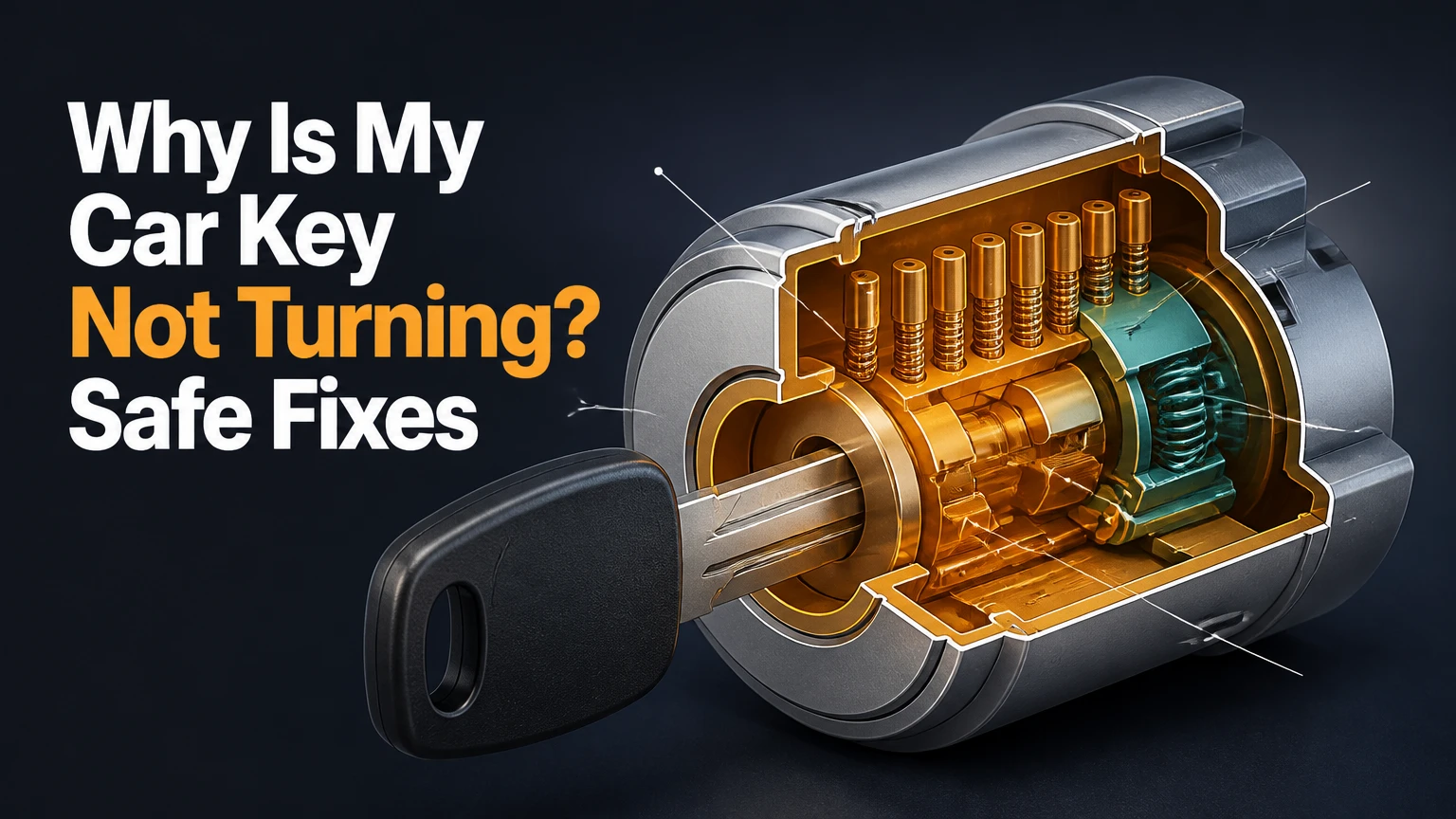
Most conventional ignition cylinders use pins or wafers. The correctly cut blade lifts those internal pieces to a common shear line, allowing the plug to rotate. Rotation then releases the steering-column lock and moves the ignition switch through positions such as accessory, run, and start.
The important diagnostic distinction is gradual versus sudden failure. A key that became sticky over several weeks suggests blade wear, wafer wear, corrosion, or debris. A key that stopped turning immediately after parking against a curb more often indicates steering-lock pressure.
How does the steering lock prevent rotation?
The steering lock prevents rotation by extending a hardened bolt into the steering-column or steering-wheel mechanism when the vehicle is parked. If the front tires press against a curb, rest on an incline, or point sharply against resistance, the bolt can carry enough load to keep the ignition plug from moving.
Insert the key fully. Apply only light turning pressure in the normal direction while moving the steering wheel left and right. One direction usually has a small amount of movement; hold the wheel toward that side while turning the key gently.
Do not use pliers. Excess torque can twist or snap the blade inside the cylinder.
Can a dead key-fob battery stop the key from turning?
A dead key-fob battery usually cannot stop a conventional metal key from turning because the blade and cylinder operate mechanically. The battery powers remote locking and, on some designs, passive-entry functions; the immobilizer transponder may receive energy from the vehicle’s antenna without a replaceable fob battery.
Some vehicles have electronic steering locks or unusual key authorization systems. For those models, a low vehicle battery, failed electronic steering lock, or unrecognized transponder can prevent the normal start sequence. The key may still rotate, or the vehicle may display a security warning.
A no-start condition after normal key rotation is therefore a different diagnosis from a key that physically cannot rotate.
What Should You Try First?
Use the following sequence, which takes about 2-10 minutes and costs nothing unless lubrication or a replacement key is needed. The steering-wheel release and spare-key tests provide the most useful early information, while forcing the blade provides the greatest avoidable risk.
Step 1: Release steering-wheel pressure
Put the vehicle in Park, or Neutral with the parking brake applied for a manual transmission. Insert the key fully, then pull the steering wheel firmly toward the left and right limits while applying gentle turning pressure to the key.
Success checkpoint: the key moves into the accessory or run position and the steering wheel unlocks.
Common mistake: turning the key hard while holding the wheel stationary, which increases the load on the lock bolt.
If the vehicle is pressed against a curb, moving the vehicle slightly may be necessary. Do not place yourself in front of a vehicle or release the parking brake on a slope merely to relieve pressure.
Step 2: Confirm the transmission position
Automatic vehicles use a shift interlock or park-position switch to prevent key removal or ignition operation under unsafe conditions. Push the selector firmly into Park, move it through the positions, return it to Park, and try the key again.
A manual vehicle generally does not use the same Park switch. Confirm Neutral, apply the parking brake, and press the clutch if the vehicle’s starting procedure requires it.
Success checkpoint: the key turns after the selector clicks completely into the required position.
Common mistake: assuming the lever display says Park when the linkage or position switch has not fully registered it.
A failed brake-light switch, shifter-position sensor, or shift cable can produce related interlock symptoms. A vehicle that will not show Park correctly deserves professional inspection.
Step 3: Test a spare key
Try the spare key without adding a ring of heavy accessories. A spare that turns smoothly identifies the original blade as the primary suspect, although a cylinder can also be worn enough to accept one key better than another.
A hardware-store copy made from a worn key may reproduce the same error. A locksmith can cut a replacement from the vehicle’s key code or decode an unworn factory key, then program a transponder when required.
Success checkpoint: the spare enters fully and rotates through the same positions without wiggling.
Common mistake: repeatedly bending a key straight and continuing to use it.
Step 4: Inspect the keyway and use suitable lubricant
Remove visible dirt from the blade with a clean, lint-free cloth. If the cylinder is dry or sticky, use a small amount of dry lock lubricant or a product approved in the vehicle service information.
Electrical contact cleaner is not automatically a lock lubricant. It can damage finishes, plastics, or seals on some assemblies, and its spray force can push debris deeper. Standard WD-40 is a water-displacing product, not the best long-term lubricant for every ignition cylinder; repeated wet applications can retain dust and metal particles.
Insert and remove the key several times, then try a gentle rotation. Stop if the blade becomes harder to insert or withdraw.
Success checkpoint: the key inserts to full depth and turns without force.
Common mistake: flooding the keyway with oil.
Step 5: Stop before the blade breaks
Do not hammer the key, twist it with pliers, or use a large tool for leverage. A very light tap on the key head is sometimes used by locksmiths for a sticking cylinder, but it is not a universal home repair and can worsen a cracked blade, damaged wafer, or electronic ignition housing.
If the key remains immovable after the steering, shifter, spare-key, and careful lubrication checks, arrange a mobile automotive locksmith or tow service. The next step requires diagnosis rather than more force.
Which Part Is Actually Failing?
The failing component can often be narrowed down by the key’s physical behavior. A blade problem changes when a different key is used, while a steering-lock problem changes when wheel pressure is relieved; a cylinder problem usually affects every correctly cut key.
| Observed symptom | Most likely cause | Useful confirming test | Typical response |
|---|---|---|---|
| Key turns after wheel movement | Loaded steering lock | Hold wheel toward side with play | Release pressure, no parts needed |
| Spare key works smoothly | Worn primary blade | Compare insertion depth and rotation | Cut by key code, program chip if needed |
| Every key sticks or stops halfway | Worn or dirty cylinder | Test two known-good keys | Locksmith inspection or cylinder replacement |
| Key will not turn only in Park | Shift interlock or cable | Try Neutral with parking brake applied | Switch, cable, or linkage diagnosis |
| Key turns, security light remains on | Immobilizer recognition fault | Observe warning lamp and messages | Key programming or electrical diagnosis |
| Key turns but starter is silent | Electrical switch, relay, battery, or interlock | Check dashboard power and battery voltage | Start-circuit diagnosis, not cylinder repair |
What does a worn key feel like?
A worn key often feels loose, requires repeated repositioning, or works in the door but not the ignition. Rounded valleys and shortened shoulders prevent the blade from lifting each wafer to the intended shear line, especially when the cylinder has also accumulated wear.
Compare the suspect key with a factory spare. Look for rounded edges, bent metal, deep scratches, or a shoulder that no longer matches. Do not file the blade or copy it repeatedly. Locksmith key-code cutting produces a more accurate replacement than duplicating a worn profile.
What does a failing ignition cylinder feel like?
A failing ignition cylinder may bind at the same point with every key, refuse to return to the lock position, or feel gritty during insertion and rotation. A key that turns only when lifted, pushed down, or twisted sideways indicates internal wear or misalignment.
Heavy keychains accelerate loading while the vehicle moves. The effect is not always immediate, because the blade and brass wafers wear together over time. If the cylinder intermittently works, replacing the key alone may provide only temporary relief.
Is the immobilizer responsible for a physically stuck key?
An immobilizer usually controls authorization to start, not the physical alignment of a conventional blade. A security system can prevent the engine from running after the key turns, but it normally does not create a hard mechanical stop in a standard pin-and-wafer cylinder.
Electronic steering locks and integrated ignition modules are exceptions. Model-specific service information matters, particularly on vehicles from BMW, Mercedes-Benz, Audi, Volkswagen, and other manufacturers that use electronic column authorization.
How Much Does the Repair Cost?
Typical United States costs range from $10-$45 for a basic mechanical replacement key and approximately $150-$350 for many cylinder repairs, while electronic steering-lock or ignition-housing work can exceed $600. The vehicle year, key type, programming requirement, labor access, location, and towing charge determine the final invoice.
| Repair or service | Typical parts or service cost | Typical time | Main price variable |
|---|---|---|---|
| Basic metal duplicate key | $10-$25 | 10-20 minutes | Key blank and cutting method |
| Transponder key cut and programmed | $50-$180 | 30-90 minutes | Vehicle security system |
| Remote fob replacement | $75-$350 | 20-60 minutes | OEM versus aftermarket fob |
| Ignition lock cylinder replacement | $150-$350 | 1-2 hours | Rekeying and trim removal |
| Ignition switch or housing repair | $250-$600 | 2-4 hours | Access and electronic integration |
| Mobile locksmith callout | $80-$250 | 30-90 minutes | Time, distance, emergency hours |
| Vehicle tow | $75-$200 locally | 30-90 minutes | Distance and region |
These are typical planning ranges, not a quote. Dealerships commonly charge more for OEM parts and security programming, while a qualified mobile locksmith may cut, decode, rekey, and program keys at the vehicle.
A replacement cylinder may require the new lock to be keyed to the existing door key, or the vehicle may need multiple keys and modules synchronized. Ask whether the estimate includes extraction, rekeying, programming, labor, and VAT or sales tax where applicable.
Should You Use a Locksmith or Dealership?
A mobile automotive locksmith is usually the practical first choice for a stranded owner with a conventional key, while a dealership is preferable when the vehicle uses a manufacturer-specific electronic steering lock, active warranty coverage, or restricted key programming. DIY checks are appropriate only when no force or disassembly is involved.
| Service option | Typical cost | On-site capability | Best fit | Main limitation |
|---|---|---|---|---|
| Owner troubleshooting | $0-$20 | Steering and key checks | Sudden lock tension | Cannot diagnose deep failures |
| Mobile automotive locksmith | $80-$500 | Cutting, extraction, rekeying, programming | Roadside cylinder and key faults | Equipment varies by vehicle |
| Independent repair shop | $150-$600 | Cylinder and ignition repairs | Mechanical component replacement | Usually needs vehicle access |
| Dealership | $250-$1,000+ | OEM diagnosis and programming | Newer security systems | Often requires towing |
| Roadside assistance | Membership or $75-$200 | Basic unlocking and towing | Immediate safety and transport | May not repair the ignition |
Choose a locksmith who specifically advertises automotive key programming and ignition-cylinder work, not only residential lock service. Provide the make, model, year, VIN availability, key type, and exact symptom before authorizing work.
For modern vehicles, ask whether the technician can diagnose electronic steering-lock modules and whether replacement parts require online manufacturer authorization. A cheap mechanical intervention is not a saving if it damages a security module.
What Changes by Vehicle Situation?
The immediate procedure changes with the vehicle’s transmission, weather, key design, and parking position. The underlying diagnosis still depends on separating mechanical resistance from authorization or electrical faults.
Cold weather
Freezing moisture can restrict a cylinder, while thickened contamination makes wafers move slowly. Warm the key in your hand, use a vehicle-safe lock de-icer, and avoid an open flame or boiling water near paint, seals, and electronics.
If the key turns after warming but binds again, the cylinder needs cleaning or replacement. Temporary thawing does not remove the underlying moisture or wear.
Automatic transmission
Park confirmation is the primary extra check. If the key works in Neutral but not Park, do not treat the result as an ignition-cylinder failure; inspect the shift cable, park switch, or interlock circuit.
Keep the parking brake applied before testing Neutral. The vehicle can move if the transmission is not fully secured.
Manual transmission
Manual vehicles usually do not have a Park position, so steering-lock tension, key wear, and cylinder condition move higher on the list. Confirm Neutral and apply the parking brake before attempting any test.
Some models require the clutch pedal for starting, but that requirement does not usually explain a key that cannot rotate.
Push-button start
A push-button vehicle may have a hidden mechanical emergency key for the door, but that key may not operate an ignition cylinder because the car uses an electronic start authorization system. Hold the fob against the manufacturer-specified backup location and check the owner’s manual for a low-fob-battery start procedure.
A weak 12-volt vehicle battery can disable electronic steering locks and key recognition. Check battery voltage and warning messages before replacing the fob.
Key stuck in the ignition
A key stuck in the ignition usually means the cylinder has not returned fully to the lock position, the vehicle is not registering Park, or the steering-lock and shift-interlock systems remain loaded. Confirm Park, gently move the steering wheel, and turn the key only toward the normal lock position.
Do not yank the key upward or use a screwdriver. If the key head flexes, stop immediately because extraction can cost more than a controlled locksmith visit.
What Are the Most Common Mistakes?
The most expensive mistakes apply force before identifying the source of resistance. A bent key, broken wafer, stripped housing, or damaged electronic module can turn a one-minute steering-lock release into a repair requiring extraction, parts, programming, and towing.
- Using pliers: Pliers multiply torque at the weakest part of the blade. Keep the key aligned and use finger pressure only.
- Copying a worn key: A duplicate machine reproduces the existing wear. Use the original key code or an unworn reference key.
- Flooding the cylinder: Oily residue catches lint and metal dust. Use a small amount of compatible dry lubricant instead.
- Ignoring a heavy keychain: Weight creates repeated leverage against the blade and cylinder during driving. Use a light ring.
- Striking electronic housings: Plastic covers and steering-lock modules can crack or shift internally. Modern assemblies need model-specific procedures.
- Replacing the battery first: A remote battery affects buttons and some authorization functions, but it rarely fixes a metal key that physically will not rotate.
A practical locksmith rule is to treat repeated wiggling as a warning, not a technique. If normal rotation requires manipulation, the key and cylinder are already losing their designed clearance.
How Can You Prevent a Repeat Failure?
Prevent recurrence by replacing worn keys early, keeping the keychain light, and addressing intermittent resistance before the cylinder stops. A code-cut key is preferable to a copy of a visibly worn blade, especially when the vehicle has one original key left.
Keep the blade clean and dry. Do not insert a damaged key, foreign object, or improvised shim into the keyway. Follow the vehicle manufacturer’s lubrication specification because some cylinders use coated wafers or materials that react poorly to general-purpose sprays.
Record the make, model, year, key type, and whether the vehicle has a transponder or electronic steering lock. That information lets a locksmith bring compatible blanks and programming equipment instead of performing a second visit.
When Should You Stop Troubleshooting?
Stop home troubleshooting when the key bends, the blade cracks, the cylinder remains locked with two known-good keys, the security warning persists, or the vehicle has an electronic steering-lock system. Those signs indicate a component or authorization fault that force cannot solve safely.
Call roadside assistance or a mobile automotive locksmith if the vehicle is blocking traffic, parked on a slope, or unsafe to work around. Tow the vehicle to a qualified repair facility when the cylinder, ignition housing, body-control module, or electronic steering lock requires diagnosis.
What information should you give the technician?
Provide the exact vehicle make, model, year, engine or trim when known, transmission type, key style, and whether the key turns in the door. Report whether failure developed gradually, whether the steering wheel is locked, whether the spare key works, and whether a security message appears.
Also state whether the key is stuck inside, whether the dashboard powers up, and whether the vehicle was recently exposed to water, freezing temperatures, a collision, or a discharged 12-volt battery. These details separate key cutting from cylinder, interlock, and electronic diagnosis.
FAQ
Why does my key turn halfway but not all the way?
A key that turns halfway and stops may be misaligned inside a worn cylinder, obstructed by a damaged wafer, or held by steering-lock pressure. Try the spare key and release wheel tension first. If both keys stop at the same position, stop turning and arrange a cylinder inspection.
Can I start my car without the original key?
A vehicle cannot normally be started legally and reliably without an authorized key or programmed replacement. A locksmith or dealership can verify ownership, cut a key, and program the transponder when the vehicle supports that service. Mechanical duplication alone may unlock the door but still fail to authorize engine operation.
Why does the key turn but the engine does not start?
A turning key and a no-start condition point away from a mechanically seized lock. Possible causes include a weak battery, starter circuit fault, fuel or ignition problem, park or clutch switch, or immobilizer authorization error. Check dashboard power and warning lamps, then diagnose the starting system separately.
Why will the key not come out after I turn the car off?
A key may remain trapped because the transmission is not fully recognized as Park, the ignition has not reached the lock position, or the cylinder and interlock are worn. Push the selector firmly into Park and turn the key gently toward lock. Do not force removal if the blade binds.
Is graphite always the best ignition lubricant?
Graphite is not universally correct for every ignition cylinder. Some manufacturers specify a particular dry or synthetic lock lubricant, and excess graphite can contaminate nearby components. Check the owner’s manual or service information, apply a minimal amount, and stop if lubrication does not restore smooth movement.
Can a locksmith remove a broken key from the ignition?
An automotive locksmith can often extract a broken key with specialized tools while preserving the cylinder, but success depends on blade position, cylinder damage, and whether fragments obstruct the wafers. Do not push the fragment deeper or glue another object to it. Replacement and reprogramming may still be necessary.
The Bottom Line
A car key will not turn most often because steering-wheel pressure, incomplete Park or Neutral registration, a worn key, or a binding ignition cylinder prevents normal mechanical alignment. Start with the steering-wheel release, transmission-position check, and spare-key test, then use only compatible lubricant and gentle pressure.
The exact answer to “why is my car key not turning” depends on whether the failure changes with wheel movement, a different key, temperature, or gear position. If every key remains stuck, the key bends, or a security warning appears, stop forcing the ignition and use an automotive locksmith or qualified dealership.