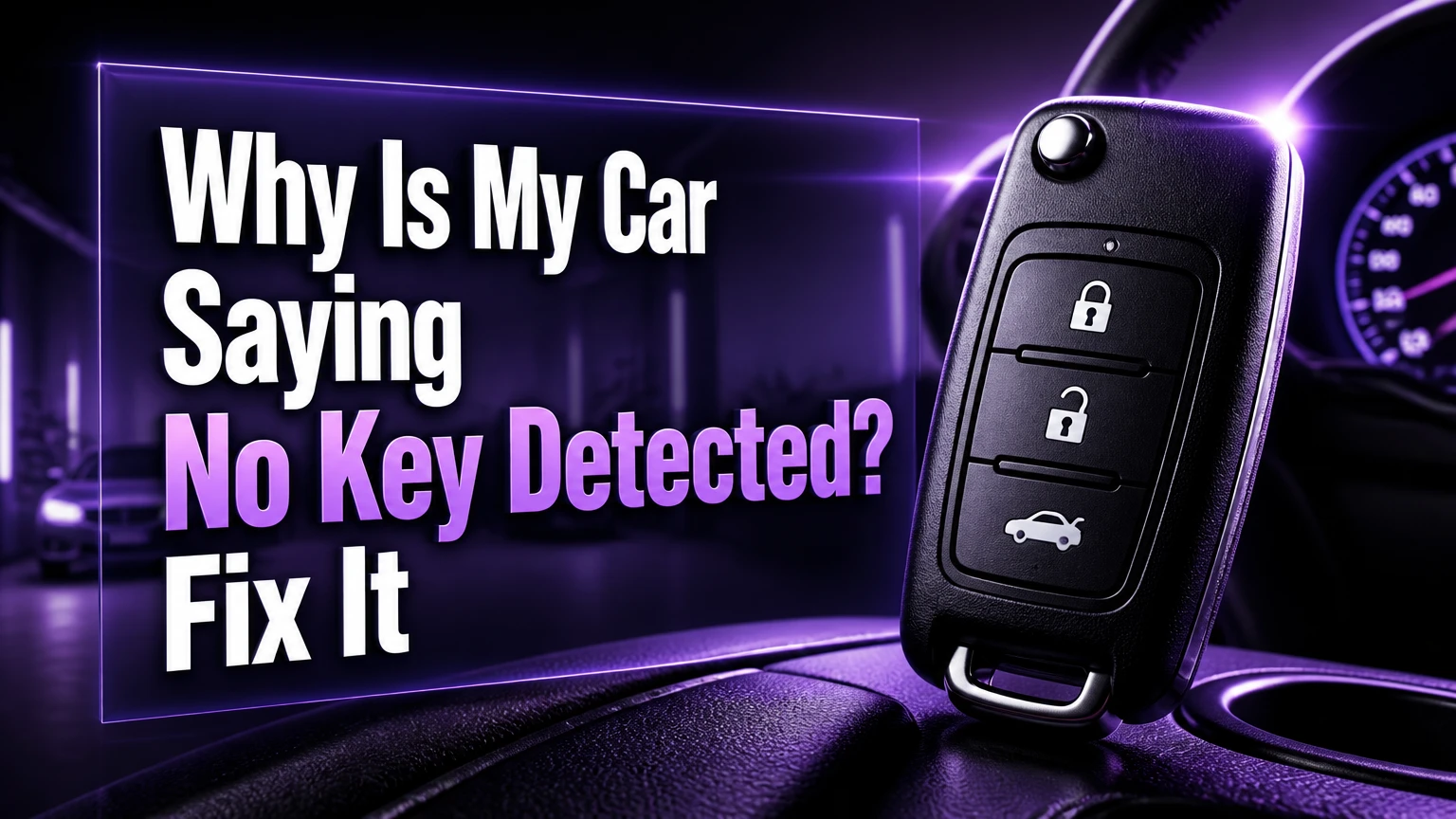
A car displays “No Key Detected” when its immobilizer or passive-entry system cannot authenticate an approved key fob. The most common causes are a weak fob battery, signal interference, an incorrectly positioned fob, a discharged 12-volt vehicle battery, or a damaged or unprogrammed key.
Key facts at a glance
A dead fob battery does not always prevent emergency starting because many fobs contain a passive transponder.
The exact backup-reader location differs by make, model, and year; common locations include the start button, center console, cup holder, or steering-column area.
A key-fob button can work while passive detection fails because remote buttons and proximity detection use different circuits and signal conditions.
A second programmed fob is the fastest practical test for separating a key problem from a vehicle problem.
Disconnecting the vehicle battery is not a universal fix and can erase settings or create additional warning lights.
A replacement smart key usually needs vehicle-specific programming, even when the shell and battery physically fit.
What Does the Warning Mean?
The “No Key Detected” message means the vehicle’s body control module, immobilizer control unit, or smart-key module did not receive a valid response from an authorized key. The warning identifies an authentication failure, not one specific broken component.
A passive keyless-entry and start system normally detects the fob near the vehicle, challenges it with a low-frequency signal, and checks its encrypted response. When the response is absent, too weak, blocked, invalid, or outside the permitted range, the car refuses proximity unlocking or push-button starting.
The wording varies by manufacturer. Nissan may display “No Key Detected,” Toyota may show “Key not detected,” Ford may report “No Key Detected,” and Hyundai may show a smart-key warning or an immobilizer symbol. The underlying diagnosis remains similar, but the emergency reader position and reset procedure are model-specific.
How Does the Keyless System Work?
A smart-key system uses short-range radio communication, antennas, a control module, and an immobilizer authorization code. The car first wakes the fob, the fob sends a coded response, and the vehicle allows starting only after the response passes its security checks.
A typical passive system uses low-frequency antennas around 125 kHz to locate or wake the fob, while the fob commonly transmits in an ultra-high-frequency band such as 315 MHz or 433 MHz. Frequencies vary by market and manufacturer, so those values describe common designs rather than a universal specification.
The process usually follows these stages:
- You touch the door handle or press the start button.
- The vehicle antenna sends a low-frequency challenge.
- The fob wakes and transmits its encrypted identification response.
- The smart-key or body control module verifies the response.
- The immobilizer authorizes engine operation.
The key fob does not need cellular service for ordinary passive starting. Phone-as-a-key systems are different because they may depend on Bluetooth Low Energy, an active app, device permissions, or an NFC card.
Why can the buttons work when proximity detection fails?
A key fob button can unlock the doors while passive entry fails because the two functions use different operating conditions. Button operation proves that some fob electronics and the coin cell have power, but it does not prove that the proximity antenna, passive response circuit, vehicle antenna, or immobilizer communication is working.
Why Is My Car Saying No Key Detected?
The most likely cause is a weak or incorrectly installed fob battery, followed by signal obstruction, a failing fob, a weak 12-volt vehicle battery, or a fault in an antenna or smart-key control module. The fastest diagnosis starts with the backup-start position and a second programmed fob.
Is the key fob battery the problem?
A depleted coin cell is the first check because passive detection often becomes unreliable before the fob buttons stop working. Typical smart fobs use CR2032 or CR2025 batteries, but the correct size and polarity must come from the old battery, fob marking, or owner’s manual.
| Observation | Likely meaning | Immediate test |
|---|---|---|
| LED is dim or absent | Weak coin cell or damaged button circuit | Install the specified battery |
| Buttons work at 1-3 metres | Remote transmitter still has power | Try the backup reader |
| Warning appeared after a low-battery message | Fob battery is the leading suspect | Replace the cell |
| New battery changes nothing | Fob, antenna, programming, or car battery fault | Test a second fob |
Replace the battery on a clean, dry surface. Do not bend the contacts, touch the cell excessively, or force the case closed. The positive side commonly faces upward, but some fobs use a different orientation.
A battery replacement usually takes 5-10 minutes and costs about $3-$15 for a quality coin cell. A fob LED is only a rough clue, because an LED can illuminate even when the radio transmission is too weak or the fob has internal damage.
Could interference be blocking the fob?
Metal objects and nearby radio-frequency sources can reduce the effective detection range. Move the fob away from a phone, laptop, wireless charging pad, large key ring, coins, foil-lined wallet, magnetic clasp, or another vehicle key before testing again.
Interference is more plausible when the warning appears in one location and disappears after the vehicle moves. A parking garage, security gate, aftermarket alarm, radar detector, or poorly installed accessory can also create a local problem, although a persistent warning in multiple places points more strongly toward the fob or vehicle.
Do not place the fob inside a metal container while testing. Keep it in an open hand, separate from electronic devices, and within 15-30 centimetres of the backup reader.
How Can You Start With a Dead Key Fob?
You can often start a push-button vehicle with a dead key-fob battery by placing the fob against the start button or in the manufacturer’s designated emergency reader. The passive transponder may still receive enough energy at close range for the immobilizer to authenticate it.
Use this sequence:
- Sit in the driver’s seat with the brake or clutch pedal depressed.
- Remove the fob from a bag, metal case, or crowded key ring.
- Hold the fob directly against the start button, logo side or marked end facing the button.
- Press the start button while keeping the fob in contact.
- If that fails, try the backup slot shown in the owner’s manual.
- Remove the fob only after the engine starts.
| Common reader location | Vehicles that may use the layout | Verification method |
|---|---|---|
| Against start button | Various Nissan, Ford, and Hyundai models | Hold fob to button |
| Center console | Several Toyota and Lexus models | Place fob in marked pocket |
| Cup holder | Selected Chevrolet and GMC models | Use labeled transmitter pocket |
| Steering-column area | Selected Mazda and European models | Touch fob to marked area |
The exact location cannot be inferred reliably from the vehicle brand alone. Manufacturers change the reader position between model years, trim levels, and markets. If the emergency method works, replace the fob battery before assuming the car needs programming.
Could the Vehicle Battery or Electronics Be at Fault?
A weak 12-volt battery can cause “No Key Detected,” especially when the dashboard is dim, the starter clicks, multiple warning lights appear, or the vehicle’s locks behave erratically. A healthy resting battery commonly measures about 12.6 volts, while approximately 12.2 volts indicates a significantly discharged battery.
| Vehicle symptom | Typical electrical clue | Best next action |
|---|---|---|
| Interior lights are very dim | 11.8-12.1 V resting | Charge and test 12-volt battery |
| Dash resets repeatedly | Voltage drops below 10 V during crank | Load-test battery and connections |
| Fob works, car remains silent | 12.4-12.7 V resting | Scan smart-key and antenna systems |
| Warning follows battery replacement | Lost initialization or low system voltage | Follow model-specific relearn procedure |
These voltage values are practical diagnostic ranges, not a substitute for a load test. A battery can show acceptable voltage while failing under starter load. Corroded battery terminals, a loose ground cable, or a failed DC-DC converter on a hybrid can produce similar symptoms.
A battery reset should not be the first response. Disconnecting the negative terminal for 10 minutes may reset some modules, but it can also erase radio settings, trigger window or steering-angle relearns, and leave a vehicle immobilized if the underlying fault remains.
What Does Testing a Second Fob Tell You?
A second programmed fob provides the most useful isolation test. If the second fob starts and unlocks the vehicle normally, the original fob is probably depleted, damaged, desynchronized, or no longer programmed; if both fobs fail, inspect the vehicle battery, antennas, module, and wiring.
Use both keys under the same conditions:
- Test them away from phones and metal objects.
- Try passive unlocking at the same door.
- Use the emergency reader for starting.
- Note whether the dashboard recognizes either key.
- Test in a second location if interference is suspected.
Water damage is a frequent hidden cause. A fob that went through a washing machine, fell into snow, or developed corrosion may work intermittently before failing completely. Opening the case can reveal residue, bent contacts, cracked solder joints, or a loose battery holder.
A key that repeatedly loses detection after a battery change may have a damaged transmitter or a programming problem. Replacing the shell alone does not repair the circuit board.
Does a Replacement Fob Need Programming?
Most replacement smart fobs require vehicle-specific programming, and a physically compatible shell or coin cell does not guarantee compatibility. The fob must match the vehicle’s frequency, immobilizer generation, part number, encryption system, and programming procedure.
Some older vehicles allow limited owner programming when one or more working keys are present. Many newer vehicles require a diagnostic scan tool, security credentials, or an online manufacturer service. Tesla Phone Key, Hyundai Digital Key, BMW Digital Key, and NFC smart cards also have separate enrollment rules.
| Replacement option | Typical cost | Typical time | Main limitation |
|---|---|---|---|
| Coin-cell battery | $3-$15 | 5-10 minutes | Does not fix damaged electronics |
| Aftermarket programmed fob | $80-$250 | 30-90 minutes | Compatibility and security-tool limits |
| OEM fob with locksmith programming | $150-$400 | 30-90 minutes | Some new models require dealer access |
| Dealer-supplied OEM fob | $300-$800+ | 1-3 hours or order delay | Highest price and possible towing |
Typical prices vary by country, model, proximity features, and whether all keys are lost. Keep every existing key available because some systems erase previously registered keys during a complete replacement procedure.
Why Does the Warning Come and Go?
Intermittent detection usually indicates marginal battery voltage, a loose fob contact, environmental interference, water damage, or a failing vehicle antenna. An intermittent message is diagnostic evidence, not a harmless dashboard glitch.
Record when the failure occurs. A warning only after the fob sits in a handbag suggests shielding or pressure on the fob; a warning after rain suggests moisture; a warning only at home suggests interference; and a warning after cold starts suggests low fob or vehicle-battery voltage.
Practitioner rule: if replacing the coin cell changes the range but does not eliminate the warning, stop repeatedly buying batteries. Test the spare key and have the vehicle scanned for smart-key antenna or communication codes.
What Should You Do if the Car Is Stranded?
Start with the emergency reader, then replace or isolate the fob battery, and call roadside assistance or a mobile automotive locksmith if both keys remain unrecognized. Do not repeatedly press the start button with a weak vehicle battery because repeated attempts can discharge it further.
Use this parking-lot sequence:
- Move the fob away from your phone and wallet.
- Unlock the door with the hidden mechanical key if passive entry fails.
- Hold the fob to the start button or use the documented backup slot.
- Try the spare programmed key.
- Check whether the dashboard, interior lights, and horn have normal power.
- Request a 12-volt jump-start or diagnostic service if the car is electrically weak.
- Ask a locksmith to test the key before ordering a replacement.
The hidden mechanical key normally opens the door but does not bypass the immobilizer. A jump-start helps only when the vehicle battery is the cause; it cannot repair a missing key authorization.
Which Repair Provider Should You Choose?
A mobile automotive locksmith is usually the fastest lower-cost option for a failed fob, lost key, or on-site programming, while a dealership is the safer choice for module faults, new security systems, warranty work, and models requiring proprietary access.
| Repair need | Mobile locksmith | Dealership | Typical decision |
|---|---|---|---|
| Coin-cell replacement | $5-$30 | $20-$60 | DIY or locksmith |
| One replacement smart key | $150-$400 | $300-$800+ | Locksmith when compatible |
| All keys lost | $200-$600 | $400-$1,000+ | Compare security capability |
| Antenna or module diagnosis | $100-$250 | $150-$350 | Dealer for proprietary faults |
| Warranty software update | Usually unavailable | Manufacturer-covered | Dealership |
Ask the locksmith whether the quoted price includes the fob, cutting the emergency blade, programming, travel, and an erase-and-relearn procedure. Ask the dealer whether the part is in stock and whether the vehicle must be towed.
An honest limitation matters here: aftermarket fobs are not automatically inferior, but compatibility databases and programming access are uneven. A locksmith may be excellent for a common Ford or Toyota while lacking the secure gateway access required by a new luxury vehicle.
What Are the Main Key-System Alternatives?
Standard smart fobs, phone-as-a-key systems, and NFC smart cards all authenticate the user differently. A physical smart fob is the most independent option, while digital systems add convenience but create phone-battery, software, enrollment, and account dependencies.
| System | Communication | Backup requirement | Typical failure |
|---|---|---|---|
| Smart fob | LF wake-up plus UHF response | Mechanical blade or reader slot | Coin-cell failure |
| Phone-as-a-key | Bluetooth Low Energy | Physical key or NFC card | Phone battery or app issue |
| NFC smart card | Near-field communication | Separate fob or card | Short range or damaged card |
| Remote-start app | Cellular data and vehicle modem | Physical key for driving | Account or network outage |
A phone-as-a-key application may continue working without cellular service after enrollment, depending on the manufacturer, but Bluetooth permissions, phone power-saving settings, operating-system updates, and account status can still interrupt access. Carrying the physical backup card or key remains sensible.
How Much Does a No-Key Repair Cost?
A no-key repair costs about $3-$15 for a battery, $100-$250 for diagnosis, $150-$400 for many locksmith replacement jobs, and $300-$800 or more through a dealership. Module, antenna, wiring, luxury-brand, and all-keys-lost cases can exceed those typical ranges.
The cost depends on the failed layer:
- Battery: lowest-cost repair, usually completed in 5-10 minutes.
- Damaged fob: replacement and programming, commonly 30-90 minutes.
- Vehicle 12-volt battery: often $120-$300 installed, depending on battery type.
- Antenna or wiring: commonly $150-$500 after diagnosis.
- Smart-key or body control module: often $500-$1,500 including configuration.
Do not approve a $500 fob replacement before testing a new coin cell, the emergency reader, and a second key. The reverse mistake also occurs: replacing batteries repeatedly when the vehicle has a failed interior antenna.
Common Mistakes and Better Fixes
Several popular responses waste money or create new faults. The most important mistake is treating every “No Key Detected” message as a programming failure.
- Buying the wrong coin cell: Match the printed number, not the shape alone. CR2032 and CR2025 have the same diameter but different thicknesses.
- Installing the battery upside down: Follow the polarity marking inside the fob; do not assume the positive side always faces the cover.
- Using a metal key case during diagnosis: Remove the case because it can reduce passive detection range.
- Disconnecting the car battery first: Test voltage and the spare key before resetting modules.
- Ordering an unverified online fob: Confirm the exact part number, market frequency, and programming support.
- Assuming a mechanical key starts the engine: The blade opens the lock, while the immobilizer still needs an authorized transponder.
- Ignoring a low-key-battery warning: Replace the cell before the emergency method becomes your only starting option.
A manufacturer owner’s manual should control the final procedure. The National Highway Traffic Safety Administration describes immobilizers as anti-theft systems designed to prevent a vehicle from starting without the correct key, which is why ordinary jump-starting cannot override a failed authorization.
FAQ
Can I drive after the car says no key detected?
Yes, if the engine has already started and the warning is intermittent, but carry the recognized key inside the vehicle and avoid switching the engine off in an unsafe location. The vehicle may continue running, yet it may not restart after shutdown. Replace the fob battery and diagnose repeated warnings promptly.
Will a new car battery fix the key warning?
A new 12-volt battery fixes the warning only when low vehicle voltage caused the body control or smart-key module to malfunction. A new car battery will not repair a dead fob cell, damaged transmitter, failed antenna, or missing programming. Voltage testing and a second-fob comparison should come first.
Can I unlock the car if the smart key is dead?
Yes, most smart fobs contain a removable mechanical key blade for the driver-door cylinder. The cylinder may be hidden under a handle cap. Unlocking the door manually can trigger the alarm on some models, so use the emergency-start procedure immediately afterward.
Does a dead key fob battery stop the immobilizer?
A dead coin cell does not always stop immobilizer recognition because many systems include a passive transponder that the emergency reader can energize at close range. The design differs by vehicle, and severe water or circuit-board damage can disable both active and passive functions.
Why does my spare key work but the main key does not?
A working spare key usually indicates that the vehicle antennas, immobilizer module, and starting system are operating. The main key likely has a depleted cell, internal damage, incorrect programming, or a transmitter fault. Replace its battery, inspect for moisture, and seek fob testing if the failure remains.
When should I call a dealer instead of a locksmith?
Call a dealer for warranty repairs, body-control-module faults, secure-gateway restrictions, new luxury vehicles, or a replacement procedure that requires manufacturer credentials. Choose a qualified mobile locksmith for many common fob batteries, lost keys, and on-site programming jobs after confirming model compatibility.
The Bottom Line
“Why is my car saying no key detected?” usually has a manageable answer: the car cannot authenticate the fob because of a weak battery, interference, incorrect placement, low vehicle voltage, damage, or a programming fault. Hold the fob against the start button or use the documented backup slot, replace the correct coin cell, test the spare key, and check the 12-volt battery before buying an expensive replacement.
If both programmed keys fail in multiple locations, the vehicle needs professional smart-key diagnosis rather than more battery changes. A mobile locksmith commonly handles fob replacement, while a dealership is better equipped for proprietary modules, software, and warranty work.