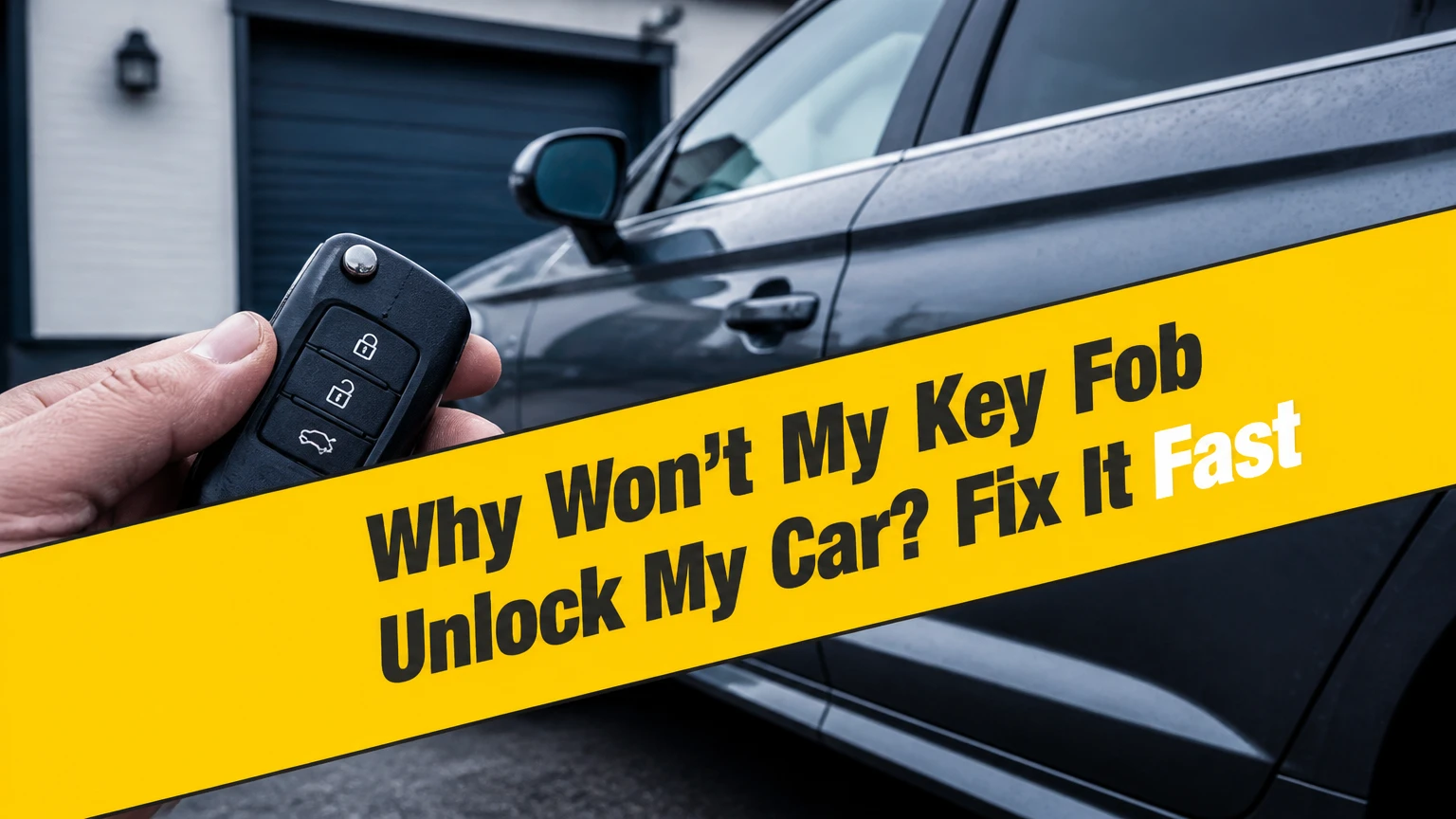
A key fob usually will not unlock a car because its coin-cell battery is weak, its buttons or circuit board are damaged, the vehicle battery is discharged, or the remote has lost synchronization. Test the spare fob first, then replace the primary battery and check whether the car responds to any remote or manual lock command.
Key Facts at a Glance
- A CR2032 or CR2025 battery is common, but the correct cell depends on the vehicle and fob design.
- A spare fob separates a remote problem from a vehicle receiver, fuse, BCM, or actuator problem.
- A car that starts normally but ignores remote buttons usually has a fob, receiver, programming, or lock-control fault.
- A fob battery can prevent remote unlocking without preventing the engine from starting.
- A mechanical emergency key can open many vehicles even when the fob battery is dead.
- Replacement fobs typically cost $20-$80 for basic remotes and $200-$600 or more for proximity systems.
Why Won’t My Key Fob Unlock My Car?
The most likely cause is a depleted fob battery, especially when the operating range became shorter before the remote stopped responding. Other common causes include a stuck or worn button, water damage, radio interference, a dead vehicle battery, failed door-lock hardware, or lost pairing between the fob and vehicle.
A useful diagnostic rule is to compare symptoms rather than repeatedly press the button. If the spare works, focus on the original fob. If neither fob works but the interior lights and manual locks operate, inspect the vehicle receiver, fuse, BCM, or programming. If the manual key also cannot unlock the door, the problem may involve a seized lock cylinder or a separate mechanical issue.
Which symptom do you have?
| Symptom | Most likely area | First test | Typical remedy |
|---|---|---|---|
| Range shortened over days | Fob battery | Test from 1-2 metres | Install specified coin cell |
| No response from one fob | Remote hardware or battery | Try spare fob | Battery, button repair, or replacement |
| Neither fob works | Vehicle power, receiver, fuse, or programming | Check dome light and spare | Charge battery or diagnose vehicle |
| Car starts but remote fails | Remote-entry circuit | Use manual lock switch | Battery, resync, receiver, or BCM diagnosis |
| One door remains locked | Door actuator, latch, or wiring | Operate interior lock | Repair actuator, latch, or harness |
| Unlock works, lock does not | Worn lock button or lock circuit | Press lock while watching lamps | Repair button or vehicle lock circuit |
| Works only in one location | RF interference | Move 30-50 metres away | Remove interference source or relocate |
How Does a Car Key Fob Work?
A car key fob sends a coded radio-frequency message to the vehicle’s remote keyless entry receiver. The body control module validates that message, then commands the door-lock actuators, hazard lamps, alarm, or trunk release.
Many North American systems use approximately 315 MHz, while many European systems use approximately 433.92 MHz, although exact frequencies vary by market, model, and regulatory approval. Modern remotes generally use changing or rolling authentication codes rather than one permanent unlock signal. Repeatedly pressing a button normally does not permanently erase the fob, but some vehicles can lose synchronization after unusual battery or button events.
A proximity smart key adds low-frequency vehicle antennas, interior detection, and passive-entry sensors. That architecture creates more possible failure points than a basic clicker, including antenna modules, door-handle sensors, and key-presence logic. A weak fob battery can therefore produce different symptoms in passive entry, remote buttons, and push-button starting.
Is a dead fob battery the same as a dead car battery?
No. A dead fob battery affects the remote transmitter, while a discharged vehicle battery prevents the car from powering its receiver and lock actuators. Interior lights, dashboard illumination, horn operation, and engine cranking help distinguish the two, although a severely discharged vehicle battery can make every electrical test inconclusive.
How Can You Tell Whether the Fob or Car Is at Fault?
Use the spare fob, the interior lock switch, and the mechanical key in that order. These tests take about five minutes and identify whether the fault follows the remote or remains with the vehicle.
- Try the spare fob from close range. Hold it within 1 metre of the driver’s door. A working spare points toward the primary fob.
- Check vehicle power. Turn on the dome light and hazard lamps. Dim lights, clicking relays, or no electrical response indicate a possible vehicle-battery problem.
- Use the interior lock switch. If the switch locks every door, the actuators and much of the lock wiring are probably functional.
- Try the mechanical key. Remove the hidden blade if the fob has one, and use the driver-door cylinder.
- Move away from interference. Test in an open area at least 30-50 metres from the original parking spot.
- Watch the vehicle response. Flashing lamps without movement can indicate a lock actuator or latch fault rather than a radio problem.
You will know the fault is probably fob-side when a fresh battery restores range or the spare remote works immediately. You will know the fault is probably vehicle-side when both correctly paired remotes fail in multiple locations.
How Do You Replace a Key Fob Battery?
Replace the coin cell with the exact battery number specified by the owner’s manual or the marking on the old cell. A typical replacement takes 5-10 minutes and requires a coin or plastic pry tool, a clean work surface, and the correct battery.
- Record the old battery orientation. Photograph the inside before removing anything.
- Open the housing carefully. Use the designed slot rather than forcing the seam near the circuit board.
- Read the battery marking. CR2032 and CR2025 are different thicknesses, so do not substitute solely because both cells fit.
- Remove the cell without bending contacts. Lift the retaining clip gently and avoid levering against delicate solder joints.
- Install the new battery with correct polarity. The positive side commonly faces upward, but the housing marking controls.
- Close the case completely. A loose shell can misalign the button membrane or allow water entry.
- Test beside the vehicle. Press unlock once, then test lock and trunk functions.
The repair worked when the car responds consistently from the former normal distance. If a new battery produces no response, inspect the battery contacts, test another fresh cell from a reputable brand, and check whether the vehicle requires resynchronization.
What mistakes make a new battery fail?
A new coin cell may fail when the polarity is reversed, the wrong thickness is installed, the retaining prong is bent, or the battery surface is contaminated. Clean visible oxidation with a small amount of isopropyl alcohol on a swab, allow the board to dry fully, and never flood the circuit board with liquid.
Can a Key Fob Lose Its Programming?
A key fob can lose synchronization with the remote-entry receiver, but a battery change does not automatically cause that failure in every vehicle. Remote synchronization, immobilizer registration, and proximity-key programming are separate functions, so the correct remedy depends on the vehicle’s design.
Some older vehicles provide an owner-programmable sequence involving ignition cycles, door-lock actions, or a programming button. Other vehicles require a scan tool, an existing working key, a security PIN, or dealer authorization. An internet procedure for one Ford, Nissan, Toyota, Volkswagen, or Chrysler model may be unsafe or irrelevant to another model year.
Check the owner’s manual under “remote control,” “keyless entry,” or “transmitter programming.” If the engine starts but lock buttons fail after a battery replacement, try the documented resynchronization process before buying a new fob. If the immobilizer warning appears or the vehicle says “no key detected,” seek model-specific programming help instead.
Why Does the Car Start but the Remote Does Not Unlock It?
A car can start while its remote unlocking fails because the immobilizer transponder and remote keyless-entry transmitter are separate circuits. The passive transponder may receive power from the vehicle’s antenna without using the fob’s coin cell, while the lock buttons depend on the transmitter battery and receiver.
Check the fob battery first. Then inspect whether every remote function fails or only unlock. A failed unlock button can result from a worn rubber membrane, contaminated contact, or cracked solder joint, while a working lock button proves that at least some transmitter circuitry remains active.
Push-button vehicles often include a backup start position near the start button, steering column, center console, or a marked pocket. The owner’s manual identifies the exact location. Starting the car does not prove that the passive-entry antennas or remote-lock receiver are healthy.
Why Does Only One Door Stay Locked?
One door that remains locked points toward a local actuator, latch, wiring, or mechanical problem rather than a dead key fob. If the other doors respond to the same unlock command, the receiver and central unlock request are probably working.
Test the affected door with the interior switch and the physical lock knob. Listen for a click or motor sound. A silent door suggests an actuator, fuse feed, connector, or wiring fault; a clicking door that remains locked suggests a seized latch or mechanically disconnected actuator.
| Observation at affected door | Likely fault | Safe next action | Typical repair range |
|---|---|---|---|
| No sound, no movement | Actuator power or motor | Check interior switch result | $150-$450 |
| Motor clicks, lock stays shut | Seized latch or linkage | Avoid forcing handle | $200-$600 |
| Lock knob moves manually | Remote command or actuator linkage | Compare all doors | $100-$350 |
| Door works intermittently | Harness or connector | Inspect hinge wiring | $150-$500 |
| Key cylinder turns but latch does not | Mechanical linkage | Locksmith or trim diagnosis | $150-$400 |
Can Radio Interference Stop a Key Fob?
Radio interference can block or reduce a remote’s effective range, particularly near high-power transmitters, security gates, wireless equipment, or certain parking facilities. Interference normally affects a location or range pattern, not only one fob in every environment.
Move the vehicle and fob into an open area, remove the fob from a metal-lined bag, and separate it from large electronic devices. Test the remote at several distances. If it works normally elsewhere, the fob may be healthy and the parking location is the variable.
Do not confuse interference with a weak battery. A range that declines gradually over days is more consistent with a depleted coin cell, while sudden failure in one car park suggests environmental interference. If the vehicle is equipped with passive entry, touching the door handle may also fail in an interference zone.
How Do You Unlock a Car When the Fob Battery Is Dead?
Most modern fobs contain a hidden mechanical key for emergency door entry, and many push-button vehicles provide a backup location for starting when the fob battery is depleted. The exact release tab, lock-cylinder cover, and backup detection position vary by make and model.
Look for a small release slider on the fob housing. Pull out the metal blade, then locate the driver-door key cylinder, which may sit behind a removable handle cap. Insert the blade carefully and turn it without excessive force. A frozen or seized cylinder requires lubricant and professional assistance, not brute force.
Once inside, hold the fob against the marked start-button area or place it in the vehicle’s backup key pocket. Do not assume the emergency procedure is universal. The owner’s manual, roadside-assistance provider, or manufacturer support line can provide the model-specific sequence without damaging trim or weather seals.
How Much Does a Replacement Key Fob Cost?
A replacement key fob typically costs $20-$80 for a basic remote, $80-$200 for an integrated flip key, $50-$150 for a transponder key, and $200-$600 or more for a proximity smart key. Cutting, programming, emergency travel, taxes, and vehicle security access can add to those figures.
| Fob type | Typical part cost | Programming or cutting time | Common total cost |
|---|---|---|---|
| Basic RKE remote | $20-$80 | 15-30 minutes | $40-$150 |
| Integrated flip key | $80-$200 | 30-60 minutes | $120-$300 |
| Transponder chip key | $50-$150 | 20-45 minutes | $100-$250 |
| Proximity smart key | $200-$600+ | 1-2 hours | $250-$800+ |
| Luxury encrypted smart key | $350-$900+ | 1-3 hours | $450-$1,200+ |
These are typical consumer-market ranges, not guaranteed prices. A European luxury vehicle, all-keys-lost situation, immobilizer security wait, or mobile service call can exceed the table. Ask whether the quote includes the fob, blade cutting, programming, diagnostic fee, and emergency callout.
Which Replacement Option Should You Choose?
A mobile automotive locksmith is usually the best value for a stranded driver, while a dealership is the safest choice for a high-security leased or luxury vehicle. Online aftermarket hardware costs least, but compatibility and programming risks shift to the buyer.
| Provider | Typical price position | Typical appointment time | Best fit | Main limitation |
|---|---|---|---|---|
| Automotive dealership | Highest, $200-$1,200+ | 1-3 hours | Luxury or encrypted systems | Often requires vehicle visit |
| Mobile locksmith | Midrange, $120-$700 | 30-120 minutes | Stranded or working drivers | Provider quality varies |
| Online aftermarket | Lowest part price, $15-$250 | 1-7 days delivery | Older DIY-compatible cars | Wrong part may be unusable |
| Automotive parts retailer | Low to midrange, $30-$300 | Same day to 48 hours | Battery or simple remote | Programming may be unavailable |
Match the replacement by part number, FCC ID where applicable, frequency, button layout, blade profile, transponder type, and vehicle year or trim. Identical-looking shells can contain incompatible chips. A used proximity fob may remain locked to its original vehicle and cannot always be reset.
Can you program a replacement fob yourself?
You can often program a basic remote on older vehicles when the owner’s manual provides an onboard sequence. Integrated keys may still require blade cutting, while transponder and proximity systems commonly need a compatible scan tool, security credentials, or an already authorized key.
DIY programming is a poor choice when all keys are lost, the car is immobilized, the vehicle uses encrypted authentication, or the replacement seller cannot verify compatibility. The cheapest blank is not the cheapest outcome if a locksmith later must diagnose an incorrect frequency or unusable chip.
What Vehicle-Side Faults Can Prevent Unlocking?
Vehicle-side faults include a discharged 12-volt battery, blown fuse, failed receiver antenna, BCM communication fault, damaged wiring, and door-lock actuator failure. These faults become more likely when both fobs fail, the manual interior switch behaves abnormally, or multiple electrical features stopped working together.
Check the owner’s manual for the remote-locking, BCM, or body-control fuse locations. Do not replace a fuse with a higher amperage rating. A replacement fuse that fails immediately indicates a short or component fault requiring electrical diagnosis.
A mechanic can scan the BCM for communication codes, verify receiver power and ground, observe whether the vehicle detects the fob signal, and command individual actuators. Diagnostic labor commonly takes 0.5-1.5 hours before parts are installed. A remote replacement cannot repair a failed receiver or corroded door harness.
What Are the Most Common Repair Mistakes?
The most expensive mistakes come from replacing the wrong component, assuming every battery change needs programming, or buying a fob by appearance alone. A disciplined test sequence prevents unnecessary parts purchases.
- Buying by shell shape: Match the FCC ID or manufacturer part number, not only the button arrangement.
- Using the wrong coin cell: CR2025 and CR2032 share a diameter but differ in thickness and capacity.
- Bending the battery contact: A flattened spring can stop electrical contact even with a new battery.
- Programming before testing: Confirm battery polarity and vehicle power before attempting a pairing sequence.
- Ignoring the manual key: Emergency entry may be available even when remote buttons are dead.
- Forcing a seized door cylinder: Excessive torque can break the blade or damage the lock.
- Cleaning with excessive liquid: Alcohol should be applied sparingly, and the circuit must dry completely.
- Assuming a dead fob cannot start the car: Many proximity systems have a backup detection location.
An experienced locksmith rule is simple: diagnose the signal path before ordering parts. The path is fob battery, button and transmitter, air interface, vehicle receiver, BCM command, wiring, actuator, and latch.
How Can You Prevent Another Remote Lockout?
Replace a coin cell when range noticeably declines, keep a tested spare fob accessible, and learn the mechanical-key and backup-start procedures before an emergency. Store the spare away from moisture, extreme heat, and heavy objects that can press buttons continuously.
| Prevention action | Recommended interval or threshold | Reason | Practical check |
|---|---|---|---|
| Test spare fob | Every 3-6 months | Confirms backup readiness | Unlock from 5-10 metres |
| Replace weak battery | At first range reduction | Prevents complete transmitter loss | Compare normal operating distance |
| Inspect housing seal | Every battery change | Prevents water intrusion | Check cracked case and gasket |
| Record part number | Before buying replacement | Avoids incompatible hardware | Photograph FCC ID and label |
| Learn emergency entry | Once per vehicle | Reduces lockout damage | Practice release blade procedure |
| Check vehicle battery | At service intervals | Prevents receiver shutdown | Measure about 12.6 V at rest |
Keep the second fob outside the locked vehicle but secure from theft. A battery stored in a glovebox may be useless if the vehicle battery is also discharged, so roadside assistance remains sensible for unsafe locations or damaged locks.
The Bottom Line
Why won’t my key fob unlock my car? Start with the simplest separation test: use the spare fob, check vehicle power, and move away from possible interference. Replace the correct coin cell, inspect the buttons and contacts, then follow the model-specific synchronization procedure. If both remotes fail, investigate the receiver, BCM, fuse, wiring, or actuators rather than buying another fob.
A basic remote may be a $20 battery problem, while a proximity system can require a $250-$800 replacement and programming visit. Use a mobile locksmith for convenient midrange service, choose the dealership for encrypted or leased vehicles, and verify the exact part number before ordering online.
Frequently Asked Questions
Will a dead key fob battery make my car unable to start?
A dead key fob battery usually does not disable the immobilizer transponder, so many vehicles still start through a backup detection position. Place the fob against the specified start-button area or inside the emergency key pocket. Traditional ignition keys may continue working normally because the transponder receives energy from the vehicle antenna.
Why does my key fob work only when I am close to the car?
A short operating range usually indicates a weakening coin-cell battery, damaged antenna, poor battery contact, or a cracked housing. Replace the specified battery first and test in an open area. If range remains below the vehicle’s former distance, compare the spare fob and inspect the primary remote for water or physical damage.
Does changing a car remote battery erase its programming?
Changing the battery does not universally erase programming, although some vehicles can require resynchronization after power is interrupted or buttons are pressed during the change. Follow the exact owner’s-manual procedure. Immobilizer registration is different from remote synchronization and may require a locksmith or manufacturer diagnostic tool.
Can cold weather stop a key fob from unlocking a car?
Cold weather reduces coin-cell performance and can expose a marginal battery, but it rarely destroys a healthy remote by itself. Warm the fob naturally, install the correct fresh cell, and test again. Ice inside the door latch can also mimic a remote failure when the vehicle receives the unlock command but the latch cannot move.
Should I repair or replace a damaged key fob?
Repair a damaged key fob when the housing, rubber pad, battery contact, or isolated solder joint is the only failed component and the circuit board remains dry. Replace it when the board has corrosion, the transmitter is cracked, the immobilizer chip is missing, or compatible repair labor approaches the cost of a programmed replacement.
Can a locksmith make a key fob without the original?
A qualified automotive locksmith can often create and program a replacement without the original, but requirements vary by vehicle. The locksmith may need proof of ownership, the vehicle identification number, a security code, and access to the vehicle. All-keys-lost service generally costs more and can take longer than duplicating a working fob.