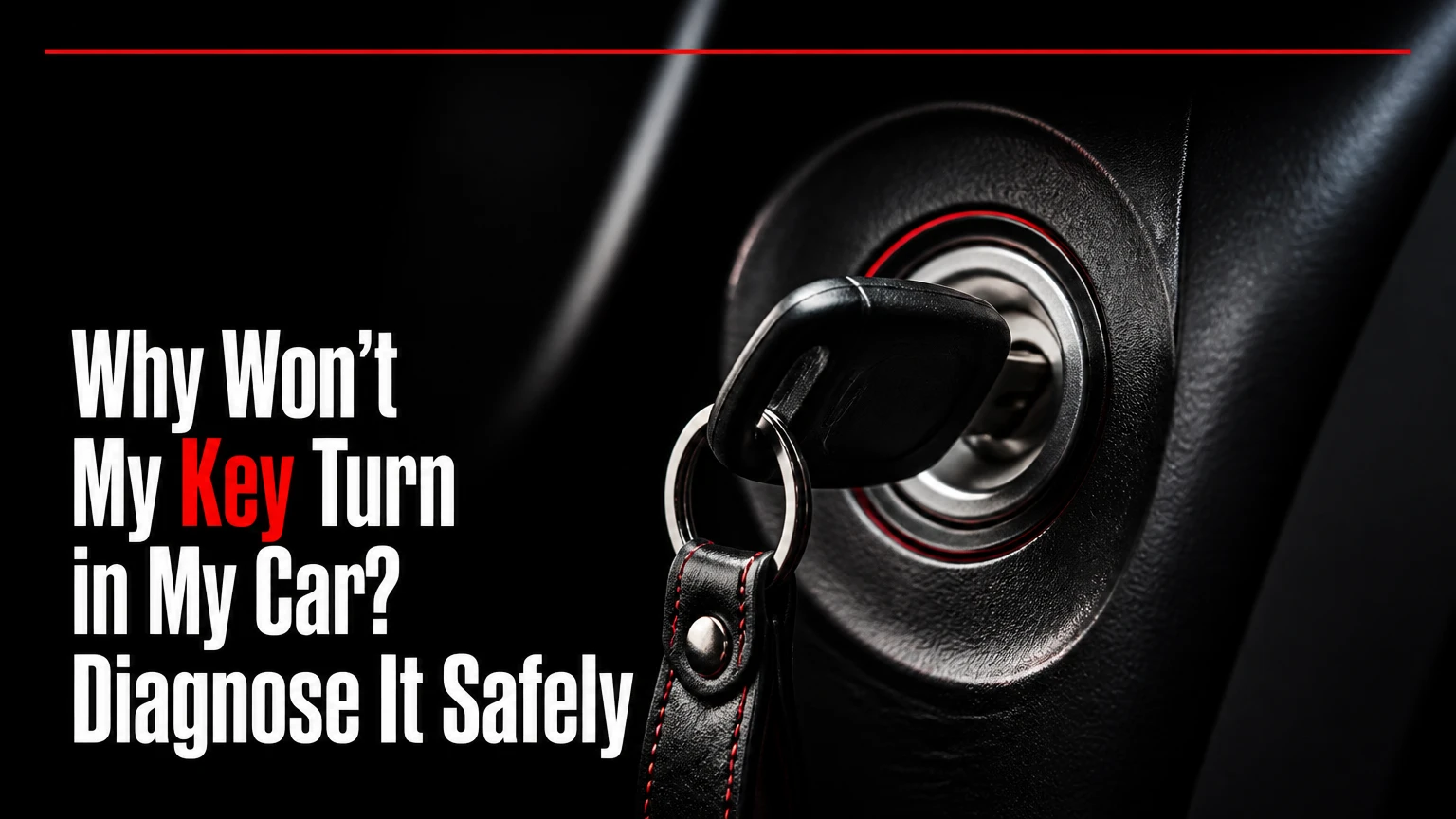
A car key usually will not turn because the steering-wheel lock is loaded, the transmission interlock is not recognizing Park, the key is worn or damaged, or the ignition lock cylinder is failing. A dead battery can affect electronic release systems, but it normally does not stop a conventional mechanical key from rotating inside a healthy cylinder.
Key Facts at a Glance
- Turn the steering wheel left and right while applying light turning pressure to the key.
- Automatic vehicles commonly require the shifter to register Park before the key can rotate or release.
- A spare factory-cut key is one of the fastest ways to separate key wear from cylinder failure.
- A transponder immobilizer usually prevents the engine from starting; it does not usually lock a conventional key against rotation.
- Do not twist harder when the key binds, because a broken key inside the cylinder costs more to extract.
- Typical repair costs range from $0 for an interlock adjustment to $400-$800 or more for dealer cylinder replacement.
Why Won’t My Key Turn in My Car?
The ignition lock cylinder is the first component to diagnose when a physical key enters the steering column but refuses to rotate. The cylinder contains wafers or pins that must align with the key cuts, while a separate steering-lock mechanism can prevent rotation when the wheel is loaded against a curb.
The key turns the cylinder, and the cylinder operates the electrical ignition switch or an electronic authorization system behind it. On many vehicles, a shift-lock or key-release interlock also links the ignition position to the transmission selector. These systems vary by make, model, year, and ignition design.
A key that inserts smoothly but will not rotate points toward steering-lock pressure, a shift interlock, worn key cuts, or an internal cylinder fault. A key that catches, stops halfway, or will not insert fully points more strongly toward debris, a bent key, a damaged wafer, or the wrong key.
What Should You Check First?
Check the steering wheel, gear selector, key condition, and dashboard power before spraying anything into the ignition. The first four checks take about two to five minutes and require no tools.
Check the Steering Wheel Lock
Hold the key with gentle turning pressure toward the normal start direction. At the same time, move the steering wheel firmly left and right. One direction usually has a small amount of movement; work that direction while easing the key through the lock.
Do not yank the wheel or wrench the key. The steering lock may be carrying the weight of a front tire pressed against a curb, especially when the vehicle was parked with the wheels turned sharply. You will know the check worked when the key moves from Lock to Accessory without unusual resistance.
Confirm Park or Neutral
Press the brake and push the automatic shifter firmly into Park. Then move it to Neutral and try the key again while holding the brake, but only if the vehicle can remain safely stationary.
A misadjusted shift cable, worn Park-position sensor, failed brake-light switch, or low system voltage can prevent the interlock from confirming the correct selector position. Manual-transmission vehicles generally do not use the same Park interlock, although some models include separate ignition or clutch safety controls.
Try the Spare Key
Use the spare key without adding force. If the spare turns normally, the original key is worn, bent, contaminated, or incorrectly duplicated.
Compare both keys on a flat surface. Look for rounded cuts, shiny contact areas, a visible bow, cracked plastic, or a blade that differs in profile. A key copied from a worn key can reproduce the original error, so a dealer or automotive locksmith should cut a replacement from the vehicle code or a verified original.
Check the Keyway and Dashboard
Remove the key and inspect the slot with a flashlight. Do not insert a paper clip, knife, screwdriver, or compressed-air nozzle into the cylinder because those objects can bend wafers or drive debris farther inside.
Check whether the instrument cluster, interior lights, and accessories operate. Dashboard power helps diagnose battery and electronic-release problems, but it does not prove that the ignition cylinder is mechanically healthy.
How Does the Ignition Lock Cylinder Work?
A mechanical ignition lock cylinder rotates only when the key’s cut pattern aligns its internal wafers or pin pairs at the cylinder’s shear line. Once aligned, the cylinder can rotate and command the ignition switch, accessory circuit, starter circuit, or an electronic authorization module.
Traditional cylinders use spring-loaded metal wafers or pins. Years of insertion gradually polish and round the key cuts, while a heavy key ring can add downward force to the blade and cylinder during driving. The cylinder may then work intermittently, especially when the key is held at a slightly different angle.
A transponder chip adds a separate security layer. An antenna near the ignition reads the chip code, and the immobilizer authorizes fuel, spark, or continued engine operation. A failed transponder can produce a crank-no-start or start-and-stall condition, but it generally does not explain a key that physically cannot move from the Lock position.
Which Fault Matches the Symptoms?
The symptom pattern often identifies the failing system before parts are removed. Compare the key’s insertion behavior, steering-wheel movement, dashboard response, and whether a spare key changes the result.
| Symptom | Most likely area | Immediate check | Typical next action |
|---|---|---|---|
| Key inserts fully, wheel is rigid, key will not move | Steering lock | Move wheel while turning key lightly | Release wheel load |
| Key turns with spare but not original | Key blade | Compare both keys | Cut a code-based replacement |
| Key catches halfway into slot | Debris, bent key, damaged wafer | Inspect with flashlight | Locksmith inspection |
| Key turns to Accessory but not Start | Interlock, ignition switch, immobilizer | Check Park, Neutral, warning lamps | Electrical diagnosis |
| Key rotates but engine will not run | Battery, starter, immobilizer, fuel system | Check lights and security lamp | Starting-system diagnosis |
| Key remains stuck after engine is off | Park interlock or cylinder | Re-seat Park and hold brake | Service interlock or cylinder |
| No dash power and electronic release is locked | Battery or release solenoid | Test voltage and manual override | Charge battery or follow manual |
Can a Dead Battery Stop the Key From Turning?
A dead battery can stop an electronic ignition release or prevent a smart-key system from recognizing the vehicle, but battery failure is not the usual cause of a conventional metal key binding in a mechanical cylinder. The distinction depends on whether the car has a blade-operated ignition, a rotary electronic switch, or push-button start.
Some vehicles use battery power for a solenoid that releases the key, selector, or steering lock. A fully discharged battery can therefore leave the key trapped or prevent an electronic knob from operating. The owner’s manual may specify an emergency release slot, backup fob position, or mechanical key procedure.
Measure battery voltage only if you have a suitable meter and can work safely. Roughly 12.6 volts at rest indicates a fully charged 12-volt battery, while readings near 12.0 volts indicate substantial discharge; vehicle-specific testing and temperature affect interpretation. Do not jump-start a vehicle in traffic or bypass an interlock with improvised wiring.
What If the Key Is Worn or the Wrong Key?
A worn key is the leading explanation when the problem developed gradually, improves when the blade is lifted slightly, or disappears with a newer spare. A wrong key often inserts only partly, fails to enter smoothly, or belongs to the door, glove box, or another vehicle.
Use a factory-code replacement when possible. Dealer key cutting may use the vehicle identification number and proof of ownership, while an automotive locksmith may decode the cylinder or cut a key from manufacturer data. An inexpensive hardware-store duplicate can work for an older, accurate key, but it is a poor choice when the original is already worn.
Do not file the key teeth or bend the blade back and forth. Small changes alter the cut geometry, and a weakened blade can snap inside the cylinder. A replacement blade does not automatically solve an immobilizer issue; the transponder may need programming according to the vehicle manufacturer’s procedure.
| Key option | Typical US cost | Typical time | Best use | Main limitation |
|---|---|---|---|---|
| Existing spare key | $0 | 1 minute | Immediate diagnosis | May also be worn |
| Hardware-store duplicate | $5-$25 | 10-30 minutes | Older vehicles with accurate keys | Poor fit or missing chip |
| VIN-cut mechanical key | $50-$150 | 1-2 hours | Eliminating blade wear | Does not repair cylinder |
| Transponder key | $80-$250 | 30 minutes-2 hours | Chipped ignition systems | Programming may be required |
| Smart-key fob | $150-$500 | 30 minutes-2 hours | Keyless-start vehicles | Vehicle-specific pairing |
Should You Lubricate the Ignition Cylinder?
Use lubricant only when the vehicle manufacturer or a qualified locksmith recommends a compatible product for that cylinder. A small amount of dry lock lubricant may help a mildly sticky wafer, but lubricant cannot repair a broken spring, distorted housing, worn key, or failed electronic interlock.
Avoid flooding the keyway with oil, penetrating fluid, silicone, or household spray. Product advice differs by cylinder design, and some manufacturers specify dry PTFE or another dedicated lock product rather than graphite. Graphite can also create problems in some modern cylinders if excessive powder contaminates nearby electrical components.
If lubrication is appropriate, apply the smallest amount stated on the product label, insert the correct key several times, and remove it to inspect for debris. Stop immediately if resistance increases, the key becomes difficult to remove, or metal fragments appear. A locksmith should service a cylinder that needs repeated lubrication.
When Is the Ignition Cylinder Failing?
An ignition lock cylinder is probably failing when the key works only at certain angles, the spare key behaves identically, the keyway feels gritty, or the problem returns after temporary release. Intermittent operation is a warning, not a reason to keep using the cylinder until it locks completely.
A damaged cylinder can leave the vehicle immobilized in a parking lot and can create a broken-key extraction problem. Cylinder wear may also affect the Lock, Accessory, Run, and Start detents, making the key feel loose or allowing accessories to cut out unexpectedly.
A locksmith may clean, repair, rekey, or replace the cylinder depending on the vehicle. Replacement can preserve the existing key pattern on some designs, while other vehicles require a new cylinder, matching keys, and immobilizer programming. The correct part cannot be chosen from the symptom alone.
What Does a Locksmith Do?
An automotive locksmith verifies ownership, tests the key and cylinder, checks the interlock, and identifies whether the security system needs programming. Depending on the vehicle, the locksmith may decode the cylinder, remove a broken blade, rekey a replacement, or install and program a new ignition assembly.
Mobile service is useful when the car cannot be driven. Ask for a written estimate that separates the service call, key cutting, cylinder parts, programming, and extraction charges. A locksmith who quotes a replacement before testing the key, steering lock, and selector may be skipping basic diagnosis.
What Are the Typical Repair Costs?
Typical US costs range from no charge for releasing steering pressure to $400-$800 or more for dealer replacement of the cylinder, keys, and related programming. Regional labor rates, vehicle security systems, parts availability, towing, and after-hours service can change the final bill substantially.
A new key is usually cheaper than cylinder replacement. A mobile locksmith often costs less than a dealer because the vehicle may not need towing, but dealer service can be preferable when the vehicle requires proprietary programming, a recalled part, or a complex electronic steering lock.
RepairPal publishes vehicle-specific repair estimates, while NHTSA’s recall database can identify safety campaigns that may affect ignition or steering components. Neither source replaces a physical diagnosis, because the same symptom can come from a key, selector, cylinder, battery, or ignition switch.
| Repair path | Typical price | Typical duration | Driving outcome | When it makes sense |
|---|---|---|---|---|
| Steering-lock release | $0 | 1-5 minutes | Immediate | Wheel pressure caused binding |
| Spare or code-cut key | $0-$150 | 10 minutes-2 hours | Usually immediate | Original key is worn |
| Locksmith extraction | $75-$200 | 30-90 minutes | Often same visit | Blade broke or jammed |
| Mobile cylinder repair | $150-$350 | 45-120 minutes | Usually same day | Mechanical cylinder is worn |
| Dealer cylinder replacement | $400-$800+ | 1-2 days | After parts/programming | Electronic or OEM-specific system |
| Tow to a repair facility | $75-$200 | 30-120 minutes | Moves vehicle only | Car cannot be safely serviced roadside |
Which Fix Is Safest for Each Situation?
The safest repair depends on whether the key is merely bound or the lock has a mechanical failure. A driver parked against a curb should try the steering-wheel release first, while a driver with an intermittent gritty cylinder should avoid repeated cycling and arrange professional service.
| Situation | Safe first choice | Avoid | Escalate when |
|---|---|---|---|
| Wheel locked after curb parking | Relieve wheel pressure gently | Forcing the key | Key remains fixed after two attempts |
| Original key is visibly worn | Use verified spare | Filing or bending blade | Spare also fails |
| Automatic shifter feels loose | Hold brake, reseat Park, try Neutral | Moving vehicle on an incline | Selector does not show Park |
| Key broke in cylinder | Leave fragments in place | Pliers or screwdrivers | Call an automotive locksmith |
| Smart key has no response | Use manual fob location from manual | Random battery bypasses | Emergency procedure fails |
| Cylinder works intermittently | Stop relying on it | Large keychain and repeated force | Arrange repair before next trip |
What Mistakes Make the Problem Worse?
The most expensive mistake is applying increasing torque to a key that has already stopped. Ignition blades are thin, and breaking one inside the cylinder can require extraction, disassembly, a replacement key, or complete cylinder removal.
Remove heavy accessories from the key ring after the immediate problem is resolved. A heavy keychain does not normally cause a sudden lockout by itself, but years of vibration and leverage can accelerate wear in the blade and cylinder.
Do not assume WD-40 is universally forbidden or universally suitable. WD-40 products differ, and vehicle manufacturers specify different lubricants; the reliable rule is to avoid unapproved liquid flooding and follow the service information for the specific cylinder.
Do not bypass the neutral-safety switch, steering lock, or immobilizer with wires. Those systems protect against unintended movement and unauthorized starting, and improvised bypasses can create injury, fire, airbag, or theft risks.
How Do Cold Weather and Debris Change the Diagnosis?
Cold weather can thicken contamination, freeze moisture, or expose a marginal battery, but temperature alone does not prove the cylinder needs replacement. A key that works after warming the cabin or drying the keyway may have moisture or contamination, while a recurring problem at normal temperature indicates wear.
Use the vehicle manufacturer’s approved de-icer for a frozen lock, not hot water. Hot water can refreeze inside the cylinder, damage trim, or create a second lockout after the vehicle cools. Keep the spare key dry and never heat a transponder key with an open flame.
Dust, pocket lint, and metal shavings can restrict key insertion. A flashlight inspection is safer than probing the slot, and repeated contamination means the cylinder needs cleaning or replacement rather than more spray.
What If the Key Turns but the Car Still Will Not Start?
A key that turns normally but does not start the engine indicates a different diagnostic path. Check battery voltage, starter response, security-lamp behavior, fuel delivery, and the ignition switch rather than treating the problem as a stuck-cylinder fault.
A single click may indicate a weak battery, poor terminal connection, starter relay, or starter motor. Normal cranking with a security warning can indicate an unrecognized transponder. Starting and immediately stalling can also result from immobilizer authorization, although fuel and engine-management faults can produce similar symptoms.
Record exactly what happens: no movement, no dash power, one click, slow cranking, normal cranking, or start-and-stall. That description lets a locksmith or technician choose the correct test instead of replacing a lock unnecessarily.
When Should You Stop Troubleshooting?
Stop DIY attempts when the key bends, metal flakes appear, the key is stuck, the cylinder rotates without normal detents, or the steering column shows damage. These symptoms indicate a risk of worsening the failure or disabling the vehicle in a more difficult position.
Call roadside assistance or an automotive locksmith when the car is in a travel lane, on a steep incline, in extreme weather, or blocking emergency access. If the vehicle is under warranty or affected by a recall, contact the manufacturer or authorized dealer before paying for parts.
Keep the key in the neutral position while applying only light pressure during basic checks. Two careful attempts are reasonable; repeated jiggling is not a repair strategy.
Frequently Asked Questions
Can I turn the key without pressing the brake?
A conventional keyed vehicle may allow key rotation without the brake pedal, but many automatic vehicles require the brake for selector and key-release functions. Press the brake firmly, confirm Park, and do not move the shifter unless the vehicle is safely secured.
Why does my key turn in the door but not the ignition?
Door and ignition locks can wear differently because they use separate cylinders. A key that opens the door but will not rotate the ignition may be worn, incorrectly cut, or incompatible with a failing ignition cylinder. Test a verified spare before ordering parts.
Can a bad alternator stop my key from turning?
A bad alternator usually causes a discharged battery and a no-start condition, not mechanical key binding. If the vehicle uses an electronic steering or ignition release, low voltage can prevent release indirectly. Test the battery and charging system after confirming the key physically moves.
Is a key fob battery responsible for a metal key not turning?
A dead fob battery usually affects remote locking or smart-key recognition, not a mechanical blade’s ability to rotate a conventional cylinder. Many smart-key vehicles provide a backup fob location or emergency blade procedure in the owner’s manual.
Should I replace the key or the ignition cylinder?
Replace the key first when the blade is worn and a spare has not been tested. Replace or repair the cylinder when both accurate keys bind, insertion is gritty, the fault is intermittent, or the cylinder has damaged internal wafers.
How long does an ignition lock repair take?
A simple steering-lock release can take one to five minutes, a mobile locksmith repair commonly takes 45-120 minutes, and dealer replacement may take one to two days when parts or programming are required. Towing adds time but does not diagnose the fault.
The Bottom Line
The answer to “why wont my key turn in my car” is usually a loaded steering lock, an unrecognized Park position, a worn key, or a failing ignition lock cylinder. Try the steering-wheel release, confirm Park or Neutral, test the spare key, and inspect the keyway without forcing or flooding it. If both correct keys fail, stop turning and call an automotive locksmith or qualified technician before the blade breaks.